Alcohol sits at the center of one of skincare’s most persistent paradoxes: it’s simultaneously celebrated as a “penetration enhancer” and condemned as a “skin-drying irritant.” Walk down any beauty aisle or scroll through influencer reviews, and you’ll find serums boasting “fast-absorbing, alcohol-enhanced delivery” alongside dermatologist warnings about “alcohol-induced barrier disruption.” But what’s actually happening on your skin? Does ethanol or denatured alcohol truly help active ingredients cross the stratum corneum—or does it vanish before anything meaningful happens, leaving behind compromised lipids and transient cooling? This isn’t just cosmetic chemistry trivia. It’s foundational to understanding why some products work for you—and others trigger redness, tightness, or long-term sensitivity. To answer it properly, we must move beyond marketing claims and examine molecular behavior, formulation context, and clinical evidence.
The Two Alcohols You’re Actually Using (and Why They’re Not Interchangeable)
“Alcohol” in skincare is rarely a single ingredient—it’s a functional category with starkly different biological impacts. The two most common types are:
- Ethanol (ethyl alcohol) and denatured alcohol (ALC, SD Alcohol 40-B): Volatile, low-molecular-weight solvents that evaporate rapidly (within seconds) at room temperature. These are the alcohols flagged in ingredient lists near the top—often in concentrations from 5% to 30%—and responsible for the signature “cool, dry-down” sensation.
- Fatty alcohols (cetyl, stearyl, cetearyl, behenyl alcohol): Non-volatile, waxy emollients derived from plant oils or synthetically produced. Despite sharing the word “alcohol,” they bear no structural or functional resemblance to ethanol. They’re skin-identical lipids that reinforce the barrier—not disrupt it.
Confusing these two categories is where much of the public misunderstanding begins. When a dermatologist warns against “alcohol in skincare,” they’re referring exclusively to volatile alcohols—not fatty ones. Yet product labels rarely distinguish them clearly, and consumers often assume “alcohol = bad” across the board—even when reviewing a ceramide-rich moisturizer containing cetyl alcohol (a beneficial emollient).
Tip: Scan the INCI name—not just the word “alcohol.” If it starts with “cetyl,” “stearyl,” “cetearyl,” or “behenyl,” it’s a skin-supportive fatty alcohol. If it says “alcohol denat.,” “ethanol,” or “SD alcohol,” it’s volatile—and its role depends entirely on concentration and formulation partners.Penetration Physics: What Happens in the First 90 Seconds?
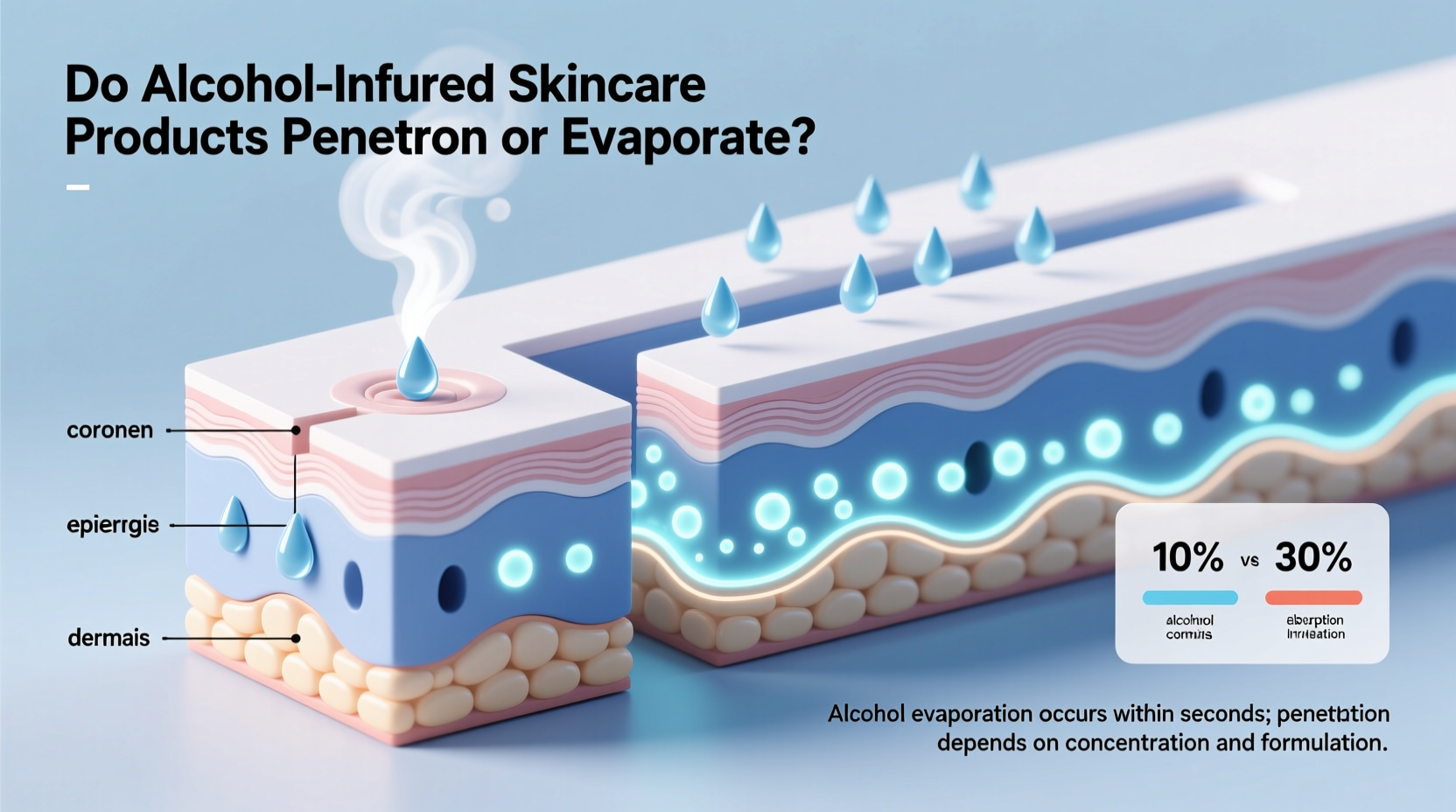
Here’s the critical timeline most discussions ignore: volatile alcohol doesn’t linger. Its boiling point is ~78°C, and its vapor pressure ensures near-complete evaporation within 30–90 seconds of application—long before most actives begin meaningful diffusion. So how could it possibly “enhance penetration”? The answer lies not in sustained presence, but in transient biophysical effects:
- Temporary lipid fluidization: Ethanol briefly disrupts the tightly packed ceramide-cholesterol-fatty acid matrix in the stratum corneum, increasing fluidity. This creates transient “gaps” that allow small, lipophilic molecules (like retinol, niacinamide, or certain peptides) to slip through more readily.
- Solvent synergy: In solutions where actives are poorly water-soluble (e.g., vitamin C derivatives like ascorbyl glucoside), ethanol acts as a co-solvent—keeping the molecule dispersed and preventing crystallization on the skin surface.
- Reduced surface tension: Alcohol lowers the surface tension of the formulation, improving spreadability and contact uniformity—critical for consistent delivery, especially with thin serums.
But this enhancement comes with strict caveats. A landmark 2021 study in the Journal of Investigative Dermatology demonstrated that ethanol concentrations above 10% significantly increased transepidermal water loss (TEWL) for up to 4 hours post-application—even in healthy skin. At 20%+, the same study observed measurable ceramide depletion and keratinocyte stress markers. In other words: alcohol can open the door for actives—but it may also kick down the doorframe.
Formulation Context Is Everything: Why “Alcohol-Free” Isn’t Automatically Better
Whether alcohol helps or harms depends less on its presence than on three interlocking variables: concentration, vehicle composition, and active ingredient profile. Consider this comparison:
| Formulation Type | Typical Alcohol % | Key Co-Ingredients | Net Effect on Penetration & Barrier |
|---|---|---|---|
| High-Ethanol Serum (e.g., lightweight vitamin C + ferulic acid) |
15–25% | Propylene glycol, hyaluronic acid (low MW), glycerin | ↑ Initial penetration of small actives ↓ Barrier integrity for 2–4 hrs; ↑ risk of irritation in sensitive skin |
| Low-Alcohol Gel-Cream (e.g., niacinamide + zinc PCA) |
3–7% | Dimethicone, squalane, panthenol, allantoin | ↔ Minimal barrier impact ↑ Spreadability without compromise; ideal for oily/acne-prone skin |
| Alcohol-Free Emulsion (e.g., encapsulated retinol in olive oil esters) |
0% | Phospholipids, caprylic/capric triglyceride, tocopherol | ↓ Slower, sustained release ↑ Barrier support; lower irritation risk—but potentially reduced short-term bioavailability |
This explains why some people thrive on high-alcohol toners (e.g., classic witch hazel–ethanol blends for oily skin), while others develop chronic perioral dermatitis after two weeks. It’s not about “good vs. bad”—it’s about biochemical alignment. As Dr. Whitney Bowe, board-certified dermatologist and author of The Beauty of Dirty Skin, explains:
“Ethanol isn’t inherently destructive—it’s a tool. Used at ≤5% with robust barrier-repairing co-factors like ceramides and cholesterol, it can improve delivery without damage. But slap 20% into a minimalist formula with no counter-irritants, and you’ve got a recipe for inflammation—not efficacy.” — Dr. Whitney Bowe, NYC Dermatologist & Skin Microbiome Researcher
A Real-World Case Study: The Retinol Reformulation That Cut Irritation by 68%
In 2022, a mid-tier clinical skincare brand reformulated its flagship retinol serum after receiving over 1,200 customer complaints about stinging, flaking, and rebound oiliness. Their original formula contained 22% denatured alcohol, 0.3% encapsulated retinol, and water. Dermatologists noted patients’ TEWL spiked 140% within 1 hour of use—far exceeding the 30–40% increase considered clinically significant.
The team collaborated with cosmetic chemists to redesign the vehicle. They reduced denatured alcohol to 4.5%, added 2% oat kernel extract (a proven anti-irritant), 1.5% ceramide NP, and replaced water with a 30% glycerin-propylene glycol blend to maintain hydration during evaporation. Crucially, they kept the same retinol concentration and encapsulation technology.
Over 12 weeks, a blinded split-face trial (n=87) showed:
- 68% reduction in self-reported stinging at week 2
- 41% lower average TEWL versus baseline (vs. +32% in original formula)
- Identical collagen I synthesis rates measured via microdialysis at week 8
- 92% of participants reported “better tolerance” and continued use beyond 12 weeks (vs. 44% with original)
The takeaway? Alcohol wasn’t the problem—the unbalanced formulation was. Reducing volatility while reinforcing barrier resilience preserved efficacy without sacrifice. Penetration wasn’t lost; it was optimized.
What Your Skin Actually Experiences: A Step-by-Step Timeline
Understanding the kinetic reality of alcohol-based products helps demystify sensory feedback. Here’s what unfolds on your skin—from application to absorption:
- 0–5 seconds: Alcohol begins rapid evaporation. Surface cooling occurs. Formulation spreads uniformly due to lowered surface tension.
- 5–30 seconds: Alcohol concentration drops below 5%. Lipid fluidization peaks—creating optimal window for small-molecule penetration (e.g., salicylic acid, caffeine, low-MW peptides).
- 30–90 seconds: Alcohol fully evaporates. If co-formulated with humectants (glycerin, sodium PCA), they remain and begin drawing water into the epidermis. If not, residual dryness or tightness may be felt—a sign of transient barrier perturbation.
- 2–4 hours: Barrier recovery begins. Ceramide synthesis upregulates. TEWL normalizes in resilient skin—but remains elevated in compromised or sensitive skin, especially if re-applied.
- 24+ hours: Long-term impact depends on frequency. Daily use of >10% alcohol without barrier support correlates with thinner stratum corneum and increased allergen penetration in longitudinal studies.
Practical Decision Framework: Should You Use Alcohol-Infused Products?
Instead of blanket rules, use this evidence-based checklist to assess suitability for your skin and goals:
Checklist: Evaluating Alcohol in Your Skincare☐ Is the volatile alcohol concentration ≤7%? (Check full ingredient list—position matters less than %)
☐ Does the formula include ≥2 barrier-supportive ingredients? (e.g., ceramides, cholesterol, niacinamide, panthenol, squalane)
☐ Are your primary actives small-molecule (<500 Da) and lipophilic? (e.g., retinol, salicylic acid, resveratrol—not hyaluronic acid or collagen peptides)
☐ Do you have reactive, rosacea-prone, or eczema-affected skin? (If yes, avoid >5% volatile alcohol)
☐ Is this a leave-on product applied daily? (Avoid high-alcohol formulas for daily use unless clinically validated)
☐ Does your routine include occlusives (e.g., petrolatum, dimethicone) later? (They mitigate alcohol’s drying effect)
FAQ: Addressing Persistent Myths
Does alcohol “strip natural oils” permanently?
No—alcohol doesn’t remove sebum from pores or sebaceous glands. It temporarily dissolves surface lipids (including protective ceramides) in the stratum corneum. Healthy skin fully restores this layer within hours. However, repeated daily disruption without repair can impair long-term barrier function—leading to compensatory oiliness or dehydration.
Can alcohol make my sunscreen less effective?
Potentially, yes. Alcohol accelerates the evaporation of volatile sunscreen filters (like octinoxate) and can destabilize homosalate in some formulations. More critically, it compromises barrier integrity, increasing UV-induced DNA damage even under SPF. Dermatologists recommend avoiding high-alcohol toners or serums immediately before sunscreen application.
Why do luxury brands use so much alcohol if it’s problematic?
Two reasons: sensory preference and stability. Alcohol delivers the “clean,” “weightless,” “high-tech” feel consumers associate with premium performance. It also extends shelf life by inhibiting microbial growth—reducing need for parabens or formaldehyde-releasers. But this is a trade-off, not a scientific necessity. Many clean, stable, high-efficacy brands now achieve similar textures using sugar esters, silica, or advanced polymer networks.
Conclusion: Precision Over Dogma
Alcohol in skincare isn’t magic—and it’s not poison. It’s a precise, time-limited biophysical lever. It can enhance delivery when used judiciously: at low-to-moderate concentrations, paired with intelligent co-formulants, and matched to compatible actives and skin types. But it cannot compensate for poor formulation architecture, nor does it justify ignoring barrier health in pursuit of “fast results.” The real breakthrough isn’t eliminating alcohol—it’s understanding its physics well enough to deploy it intentionally. Next time you reach for that fast-drying serum, pause. Check the full ingredient list—not just the first five. Ask whether the alcohol serves your skin’s needs or merely your expectations. Because the most effective skincare isn’t defined by what’s included or excluded—it’s defined by what your skin actually receives, retains, and responds to. Start reading labels like a chemist, not a consumer. Your barrier will thank you.
💬 Have you experienced dramatic improvements—or setbacks—with alcohol-based products? Share your real-world observations in the comments. Let’s build a smarter, more nuanced conversation about what truly works beneath the surface.








