In the realm of modern anime, few series have resonated with audiences as profoundly as *Attack on Titan* and *Vinland Saga*. Both are celebrated for their complex narratives, philosophical undertones, and unflinching portrayal of violence. Yet beneath their epic battles and sweeping historical canvases lies a deeper thread—trauma. The way each series handles psychological suffering, generational pain, and the long-term effects of violence sets them apart not just in storytelling quality, but in emotional authenticity. When comparing *Attack on Titan* and *Vinland Saga*, the question arises: which anime explores trauma more deeply?
The answer isn't straightforward. While both shows depict trauma as an inevitable consequence of war and vengeance, they approach it through different lenses—one rooted in systemic cycles and collective guilt, the other in personal redemption and internal reckoning. Understanding their distinct methods reveals how trauma is not only portrayed but processed within their characters and worlds.
The Nature of Trauma in Storytelling
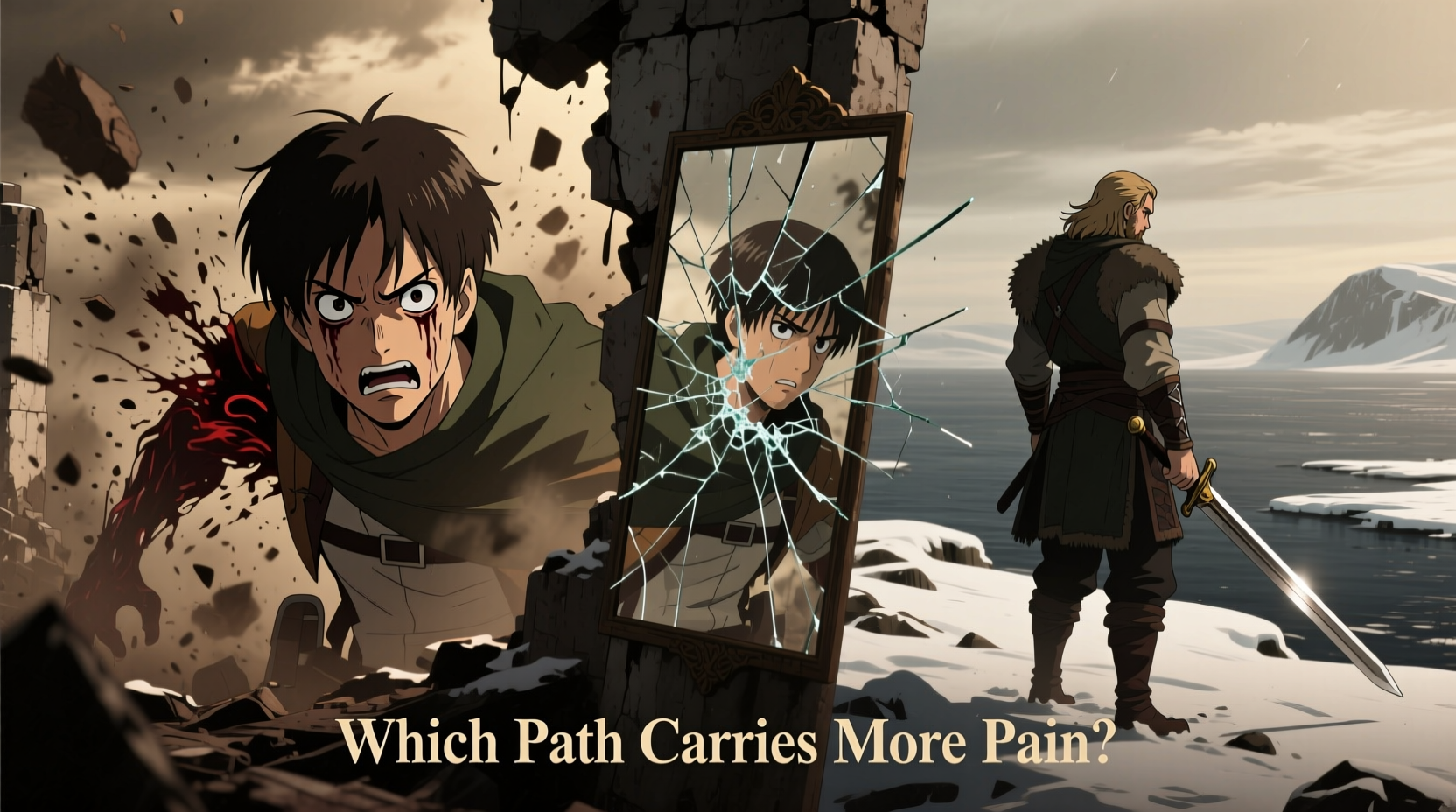
Trauma in fiction is more than just a character experiencing loss or witnessing violence. True exploration involves showing how that experience alters perception, distorts relationships, and reshapes identity over time. In both *Attack on Titan* and *Vinland Saga*, trauma is not a single event but a continuous condition shaped by environment, ideology, and inherited suffering.
In *Attack on Titan*, trauma begins at the individual level—Eren Yeager’s helplessness as he watches his mother eaten by a Titan—but quickly expands into a societal framework. The entire population of Paradis lives under the constant threat of annihilation, creating a culture of fear, militarization, and dehumanization. This collective trauma manifests in institutionalized behaviors: blind obedience to authority, propaganda-driven nationalism, and the normalization of child soldiers.
Conversely, *Vinland Saga* centers on Thorfinn, a young warrior consumed by hatred after his father’s murder. His journey starts as one of revenge, but evolves into a meditation on the cost of violence. Unlike Eren, whose trauma fuels ideological extremism, Thorfinn’s pain becomes a prison from which he must consciously escape. The show doesn’t just depict trauma—it dissects its lingering grip on the psyche, even when the source of pain is gone.
“Trauma isn’t overcome by victory. It’s confronted in stillness.” — Dr. Lena Matsuo, Clinical Psychologist & Anime Narrative Researcher
Narrative Structure and Psychological Progression
The structure of each series plays a crucial role in how trauma is conveyed. *Attack on Titan* unfolds like a political thriller layered with mythological horror. Its pacing is relentless, mirroring the urgency of survival. Flashbacks and revelations about the world’s history are doled out sparingly, often destabilizing characters’ understanding of reality. This reflects how trauma disrupts coherence—characters frequently act on incomplete information, much like real people grappling with fragmented memories or distorted beliefs.
Eren’s descent into genocidal resolve isn’t sudden; it’s framed as the culmination of lifelong exposure to oppression, betrayal, and loss. The audience witnesses his transformation not as a villainous turn, but as a tragic inevitability shaped by a world that offers no healing. There is no therapy, no reconciliation—only escalation. This absence of recovery mechanisms underscores the show’s bleak message: trauma, when left unchecked and weaponized by ideology, consumes everything.
*Vinland Saga*, especially in its second season, takes a radically different structural approach. After the climax of Thorfinn’s revenge arc, the narrative slows to a near-halt. He spends years as a slave, stripped of agency, name, and purpose. This deliberate pacing forces viewers to sit with his numbness, depression, and dissociation—states rarely given space in action-oriented anime. The silence between scenes, the monotony of labor, and the quiet interactions with fellow slaves become the language of healing.
Tip: Pay attention to moments of silence in both series—they often carry more emotional weight than dialogue.Character Arcs: Eren vs. Thorfinn
At the heart of this comparison are two protagonists shaped by profound trauma: Eren Yeager and Thorfinn Karlsefni.
Eren begins as a symbol of resistance—a boy determined to eradicate Titans and reclaim freedom. But as the truth about the world unfolds, his trauma morphs into nihilism and fatalism. His final plan—the Rumbling—is not born of malice, but of despair. He sees no future where peace is possible, only endless cycles of hatred. In this sense, Eren embodies the idea that trauma can erode empathy, turning victims into perpetrators. His arc is less about personal growth and more about exposing the impossibility of escape within a broken system.
Thorfinn, on the other hand, undergoes a transformation defined by rejection. He rejects violence, revenge, and even identity. After achieving his vengeance, he finds no satisfaction—only emptiness. His enslavement becomes a form of penance, and his eventual awakening is gradual, marked by small acts of compassion. Where Eren’s story ends in destruction, Thorfinn’s points toward renewal. His trauma isn’t erased; it’s integrated. He learns to live with guilt without being ruled by it.
| Aspect | Attack on Titan (Eren) | Vinland Saga (Thorfinn) |
|---|---|---|
| Origin of Trauma | Mother’s death, loss of homeland | Father’s murder, betrayal by mentor |
| Primary Response | Rage, vengeance, ideological extremism | Obsession with revenge, self-destruction |
| Turning Point | Learning the truth about Eldians and Marley | Killing Askeladd, realizing emptiness |
| Resolution | Sacrifice through mass destruction | Redemption through humility and labor |
| Healing Depicted? | No—trauma perpetuates cycle | Yes—slow, non-linear recovery shown |
Thematic Depth: Cycles of Violence and Generational Pain
Both series grapple with the idea that trauma is inherited. In *Attack on Titan*, this is literal—characters carry the memories of past hosts through Founding Titan power. But even without supernatural elements, the show illustrates how hatred is passed down. Reiner Braun, for instance, is both victim and victimizer. He invades Paradis to protect Marley, believing Eldians are monsters, while simultaneously breaking under the guilt of his actions. His breakdown in the Reiss cave is one of the most harrowing depictions of psychological collapse in anime.
Likewise, Gabi Braun represents the next generation indoctrinated into hate. Her arc highlights how children are molded by national narratives, repeating traumas they didn’t personally experience. The series offers little hope for breaking this cycle—Eren’s final act ensures more suffering, suggesting that liberation through violence only breeds further trauma.
*Vinland Saga* also confronts intergenerational harm, particularly through Canute and Thors. Canute inherits a kingdom built on conquest and slavery, yet seeks to create a peaceful utopia. His failure is tragic, but his vision lingers. Thors, meanwhile, is remembered not for his strength in battle, but for his pacifism. His legacy directly influences Thorfinn’s later choices.
The key difference lies in agency. While *Attack on Titan* portrays individuals as pawns in a deterministic world, *Vinland Saga* insists that change is possible—even if rare. Thorfinn chooses peace despite every reason to reject it. His farm community, though fragile, stands as a testament to the possibility of healing.
Mini Case Study: The Breakdown of Reiner Braun
Reiner’s psychological unraveling is a masterclass in depicting repressed trauma. For years, he maintains a dual identity: warrior of Marley and infiltrator in Paradis. He suppresses his guilt, convincing himself his actions are justified. But during the Battle of Shiganshina, when he’s cornered and beaten by Eren, his mind fractures. He regresses into “the Warrior,” then into “the Armored Titan,” and finally into Marcel, his childhood friend whom he failed to protect.
This moment isn’t just dramatic—it’s clinically accurate. Dissociative identity states, flashbacks, and somatic memory recall mirror real PTSD symptoms. The show doesn’t sensationalize his breakdown; it presents it as the inevitable result of prolonged emotional suppression. Yet, even after confessing, Reiner is not forgiven. He remains trapped, serving as a reminder that some wounds never fully heal.
A Comparative Verdict: Which Explores Trauma More Deeply?
If depth is measured by emotional realism and the depiction of recovery, *Vinland Saga* emerges as the more profound exploration of trauma. It doesn’t just show the damage—its second season is dedicated to the slow, painful process of rebuilding a self after violence. Thorfinn’s journey from killer to farmer, from rage to stillness, is one of the most honest portrayals of post-traumatic growth in any medium.
*Attack on Titan*, while equally powerful, focuses more on trauma as a structural force—an inescapable engine driving history. It excels in showing how systems perpetuate suffering, how ideologies exploit pain, and how liberation can become another form of oppression. But it offers no model for healing. Its world is too broken, its cycles too entrenched.
Thus, *Vinland Saga* delves deeper into the **internal** experience of trauma, while *Attack on Titan* examines its **external** consequences. One asks, “How do we stop hurting each other?” The other asks, “Can we ever stop at all?”
Checklist: Signs of Realistic Trauma Portrayal in Media
- Characters exhibit delayed reactions to traumatic events
- Behavior changes persist beyond initial shock
- Survivors struggle with guilt, shame, or identity loss
- Healing is non-linear and not guaranteed
- Support systems (or lack thereof) impact recovery
- Trauma affects decision-making long after the event
- Victims sometimes become aggressors
FAQ
Is Eren a victim or a villain?
Eren is both. His actions in the final season are horrific, but the series frames them as the outcome of lifelong trauma, manipulation, and isolation. He is not excused, but understood—a tragic figure who could not imagine a world beyond vengeance.
Does Thorfinn forgive himself?
Not fully—and the show doesn’t suggest he should. Instead, Thorfinn learns to live with his past. His forgiveness is active: working the land, protecting others, and rejecting violence. It’s a daily choice, not a one-time resolution.
Which anime has more realistic mental health portrayal?
*Vinland Saga* edges ahead due to its focus on depression, dissociation, and recovery. *Attack on Titan* captures acute trauma and PTSD accurately, but offers fewer insights into long-term coping or treatment.
Conclusion: Confronting the Weight of Suffering
Both *Attack on Titan* and *Vinland Saga* stand as monumental achievements in anime storytelling, each offering a devastating look at how trauma shapes individuals and societies. *Attack on Titan* dares to ask whether humanity is capable of breaking free from its violent nature, ultimately answering with ambiguity and sorrow. *Vinland Saga* dares to hope—that even those steeped in blood can choose peace, one small step at a time.
In terms of depth, *Vinland Saga* provides a more intimate, sustained examination of trauma’s aftermath. It doesn’t offer easy answers, but it does offer something rare in war stories: the quiet courage of letting go. That makes it not only the more emotionally nuanced series but also the one that challenges viewers to reflect on their own relationship with pain, anger, and forgiveness.
🚀 What did these series teach you about trauma and healing? Share your thoughts in the comments—let’s keep the conversation going.








