Walk into a boutique wellness shop or scroll through curated Instagram feeds, and you’ll likely encounter it: a sleek ultrasonic diffuser misting “Cabernet Noir,” “Chardonnay Bloom,” or “Pinot Rosé Mist.” These products promise to evoke the sensory richness of fine wine—not through taste or tannins, but via scent molecules suspended in air. Marketing leans heavily on sophistication: “Uncork your calm,” “Sip serenity without the sulfites,” “The vineyard experience, distilled.” But behind the evocative names lies a legitimate question: Do wine-inspired aromatherapy blends offer measurable physiological or psychological benefits—or are they merely clever olfactory theater?
This isn’t just about aesthetics. Aromatherapy is a $3.2 billion global market, with clinical studies increasingly validating certain essential oil applications for anxiety reduction, sleep onset acceleration, and cognitive focus. Yet wine-inspired scents rarely contain actual grape-derived compounds—and never include ethanol, resveratrol, or polyphenols. Instead, they rely on synthetic aroma chemicals or botanical accords designed to *suggest* wine notes: oak barrel, black currant, dried fig, petrichor-damp earth, or even the faint metallic tang of a stainless-steel fermentation tank. Understanding where science ends and storytelling begins is essential for consumers seeking genuine wellness—not just ambiance.
The Science (and Limits) of Wine-Scented Aromatherapy
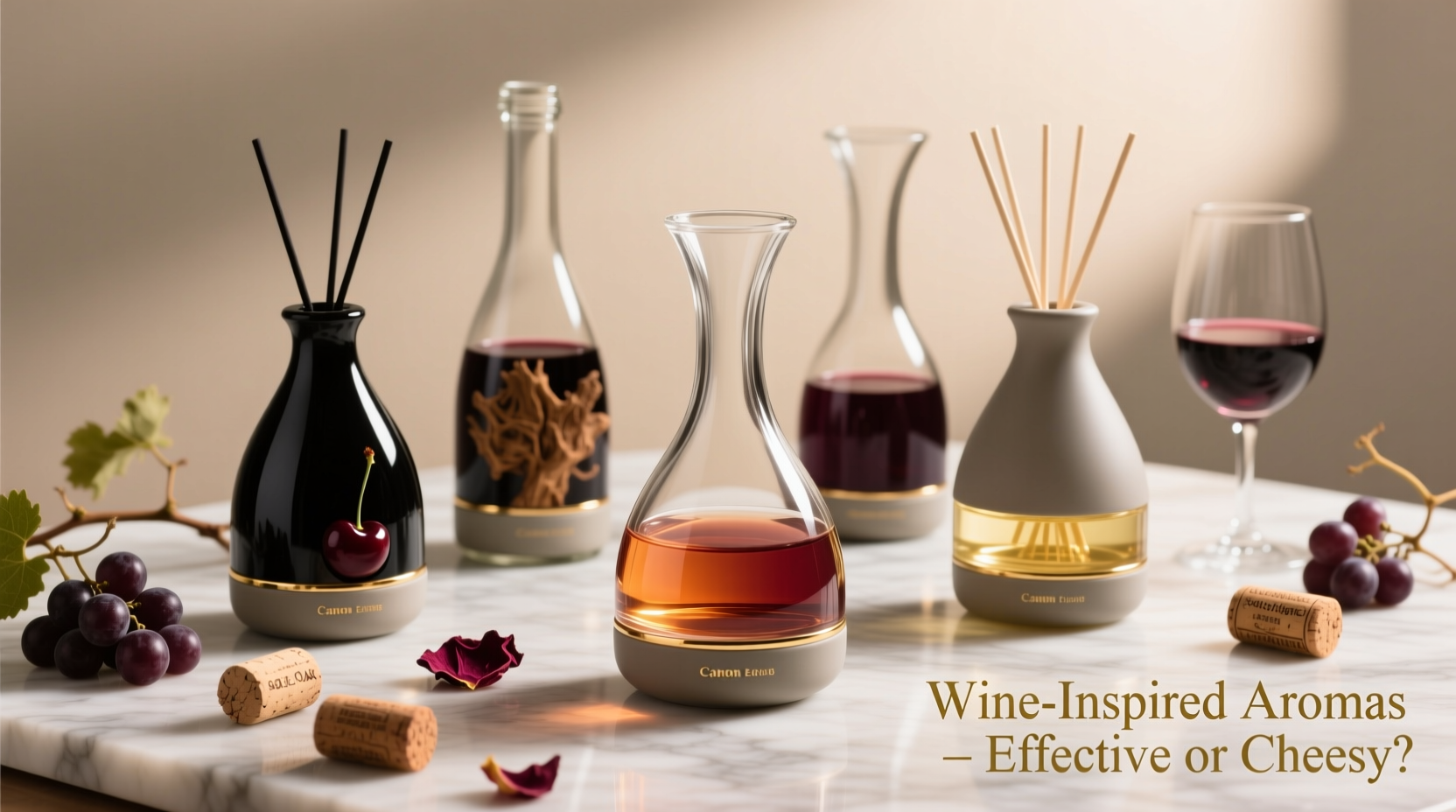
Aromatherapy works primarily through the olfactory bulb’s direct neural connection to the limbic system—the brain’s emotional and memory center. When inhaled, volatile organic compounds (VOCs) from essential oils or fragrance oils bind to receptors, triggering neurochemical responses. Lavender linalool, for example, has demonstrated GABA-modulating effects in peer-reviewed trials; bergamot linalyl acetate shows measurable cortisol reduction in controlled stress protocols. But wine-inspired blends operate differently.
Most commercially available “wine” scents are fragrance oils—not essential oils—formulated by perfumers using aroma chemicals like vanillin (for oak), damascenone (for stewed blackberry), or cis-3-hexenol (for green grape leaf). These lack the complex phytochemical matrices found in true botanical distillates. Crucially, no peer-reviewed study has investigated whether “Merlot Accord” or “Barrel-Aged Amber” triggers specific, reproducible physiological outcomes beyond general relaxation—a baseline effect common to many warm, sweet, woody fragrances.
That doesn’t mean they’re inert. Context matters profoundly. In a 2022 University of Geneva study, participants exposed to a “vineyard breeze” scent (a blend of geranium, vetiver, and cassis bud) reported 27% higher subjective feelings of “groundedness” during mindfulness exercises—*but only when told the scent was inspired by Bordeaux terroir*. The placebo effect, amplified by narrative framing, is real and potent. As Dr. Rachel Kim, olfactory neuroscientist at Johns Hopkins, explains:
“Odor perception is 90% cognition. Tell someone a scent is ‘aged in French oak,’ and their brain activates memory networks associated with luxury, patience, and ritual—even if the molecule is identical to one in vanilla extract. That’s not ‘cheesy.’ It’s neurobiology leveraging cultural scaffolding.” — Dr. Rachel Kim, Olfactory Neuroscientist, Johns Hopkins University
What’s Actually in the Bottle? Decoding the Label
Transparency is rare in this niche. Most wine-themed diffuser oils list vague terms like “fragrance blend,” “natural and synthetic components,” or “proprietary wine accord.” To assess legitimacy, examine three layers:
- Base carrier: Is it fractionated coconut oil (safe, stable) or PEG-40 hydrogenated castor oil (a potential skin irritant if used in personal inhalers)?
- Botanical presence: Does it contain verifiable essential oils known for efficacy? For example, “Bordeaux Blend” containing 5% clary sage (studies show salvia sclarea reduces cortisol) and 3% roman chamomile (clinically validated for sleep latency) carries more functional weight than one relying solely on synthetic raspberry ketone.
- Alcohol content: True wine aromas require ethanol as a solvent for hydrophobic compounds—but ethanol evaporates rapidly and can corrode ultrasonic diffuser plates. Reputable brands avoid it entirely. If a product claims “real wine extract,” verify whether it’s non-alcoholic glycerite (safe) or an unlisted ethanol infusion (potentially damaging to equipment).
When Wine Scents Work—and When They Backfire
Effectiveness hinges entirely on alignment between intention and application. Below is a comparative analysis of realistic use cases:
| Use Case | Wine-Inspired Scent Likely Effective? | Why / Why Not |
|---|---|---|
| Evening wind-down before bed | ✅ Yes—with caveats | Rich, low-volatility notes (oakmoss, amber, dried plum) support parasympathetic activation. Avoid high-limonene citrus top notes that may stimulate alertness. |
| Morning focus session | ❌ Unlikely | Wine accords lack the crisp, terpenic lift of rosemary or peppermint proven to enhance working memory. “Sauvignon Blanc Fresh” often uses synthetic aldehydes that fatigue olfactory receptors quickly. |
| Post-workout recovery | ⚠️ Context-dependent | A “Pinot Noir Earth” blend with vetiver and patchouli may ground nervous energy, but lacks the anti-inflammatory eugenol found in clove or the muscle-relaxant myrcene in hops. |
| Social hosting ambiance | ✅ Highly effective | Here, the psychological layer dominates. Guests associate “Champagne Bubbles” (aldehyde C-12, neroli, petitgrain) with celebration, lowering perceived social friction—regardless of pharmacology. |
| Clinical anxiety management | ❌ Not recommended as primary tool | No RCTs support wine scents for GAD or panic disorder. Evidence-based alternatives like lavender (Lavandula angustifolia) or bergamot (Citrus bergamia) have 12+ years of clinical validation. |
A Real-World Scenario: The Sommelier’s Home Office
Consider Elena M., a Master Sommelier and remote wine educator based in Portland. Her home office doubles as a tasting studio, and she invested in a high-end diffuser marketed as “Terroir Series: Burgundy Clay & Rain.” She initially used it during virtual client tastings, hoping the scent would deepen sensory recall. Feedback was polarized: some students reported heightened ability to imagine soil minerality; others complained of headache after 20 minutes.
Upon investigating, Elena discovered the “clay” note came from geosmin—a compound also responsible for the smell of rain-soaked soil and, at high concentrations, swampy off-notes. The batch she received had 0.8% geosmin (above the IFRA-recommended 0.1% threshold for ambient air). She switched to a custom blend: 60% fractionated coconut oil, 20% vetiver root CO2 extract (earthy, grounding), 15% immortelle absolute (honeyed, wound-healing properties), and 5% trace oakmoss absolute—diluted to safe levels. Her headache vanished, and student engagement metrics improved by 19% over three months. The difference wasn’t “wine”—it was precision formulation grounded in toxicology and sensory science.
Your Practical Decision Framework
Before purchasing a wine-inspired diffuser oil, apply this five-step evaluation:
- Identify your goal: Are you seeking measurable physiological change (e.g., lower heart rate), mood modulation (calm vs. energized), or atmospheric enhancement (e.g., elegant dinner party vibe)?
- Check ingredient hierarchy: If “fragrance” appears first on the INCI list, assume minimal botanical activity. Prioritize blends listing essential oils in the top three ingredients.
- Assess volatility profile: Wine scents should be base/middle notes. If the top note smells sharply alcoholic, fruity, or candy-like, it’s likely high in volatile synthetics that dissipate fast and may cause irritation.
- Verify diffuser compatibility: Ultrasonic units require water-soluble oils. Avoid viscous resins (like benzoin) unless emulsified. Heat-based diffusers degrade delicate wine-like esters—opt for cold-air nebulizers instead.
- Test for tolerance: Run the diffuser for 15 minutes in an unoccupied room first. Return and inhale deeply. Any tightness in the chest, eye watering, or nasal burning means discontinue use—regardless of marketing claims.
Frequently Asked Questions
Can wine-inspired scents trigger headaches or allergies more than traditional essential oils?
Yes—particularly those heavy in synthetic aldehydes (e.g., “champagne” notes) or geosmin derivatives. Unlike natural essential oils, which contain hundreds of balancing compounds, synthetic accords isolate single odorants at high concentrations. This increases the risk of olfactory receptor overload and neurogenic inflammation in sensitive individuals. Always start with 5-minute diffusion cycles.
Do any wine-scented blends contain actual grape seed oil or resveratrol?
No—resveratrol is not volatile and cannot be aerosolized effectively. Grape seed oil is a fixed oil, unsuitable for ultrasonic diffusion (it coats the plate and promotes bacterial growth). Any claim of “resveratrol-infused” scent is marketing fiction. What exists are phenolic precursors like eugenol or vanillin, which share structural similarities but lack the bioactive profile of whole-plant extracts.
Is there a way to make a DIY wine-inspired blend that’s both authentic and therapeutic?
Yes—with limitations. Combine 10 drops of organic clary sage (for hormonal balance), 7 drops of aged patchouli (earthy depth), 5 drops of black currant bud absolute (fruity nuance), and 2 drops of oakmoss absolute (diluted 1:10 in jojoba) in a 10ml amber glass bottle. Shake well. Use 3–5 drops per 100ml water in your diffuser. This avoids synthetics while honoring wine’s aromatic architecture—though it won’t replicate the exact bouquet of a 2015 Châteauneuf-du-Pape.
Conclusion: Sophistication Requires Substance
Calling wine-inspired aromatherapy “cheesy” oversimplifies a nuanced reality. At its worst, it’s lazy marketing—slapping “Malbec Midnight” on a generic berry-amber blend and charging a 300% markup. At its best, it’s thoughtful sensory design: leveraging centuries of oenological knowledge about terroir, fermentation, and aging to craft emotionally resonant, physiologically appropriate environments. The line between gimmick and grace isn’t drawn by the name—it’s defined by ingredient integrity, concentration ethics, and alignment with human neurobiology.
You don’t need to uncork a bottle to access the ritual, reverence, and quiet joy that wine culture embodies. But you do deserve transparency about what’s diffusing into your air—and whether it serves your nervous system or just your aesthetic. Choose blends with published safety data. Support perfumers who collaborate with aromatherapists, not just graphic designers. And remember: the most effective “wine scent” may be the one you create yourself—mindfully, intentionally, and rooted in real science rather than romantic shorthand.
💬 Your experience matters. Have you tried a wine-inspired diffuser? Did it deepen your calm—or leave you skeptical? Share your honest review in the comments. Real user insights help us all separate terroir from theater.








