
Aromatherapy diffusers are widely used for mood support, relaxation, and ambient fragrance—but a growing number of consumers now experiment with alcohol-based essential oil blends (e.g., ethanol-diluted absolutes, tinctures, or DIY spritzers) in ultrasonic, nebulizing, or heat-based devices. While this practice may seem like an easy way to intensify scent throw or extend oil longevity, it introduces distinct and under-discussed safety risks. Unlike traditional water-soluble or carrier-oil-diluted essential oils, alcohol-based formulations interact unpredictably with diffuser mechanics, materials, and human physiology. This article details evidence-backed safety considerations—including thermal volatility, device degradation, respiratory impact, and regulatory gaps—so you can make informed, responsible choices without compromising well-being or home safety.
Why Alcohol-Based Oils Are Increasingly Used—and Why That’s Problematic
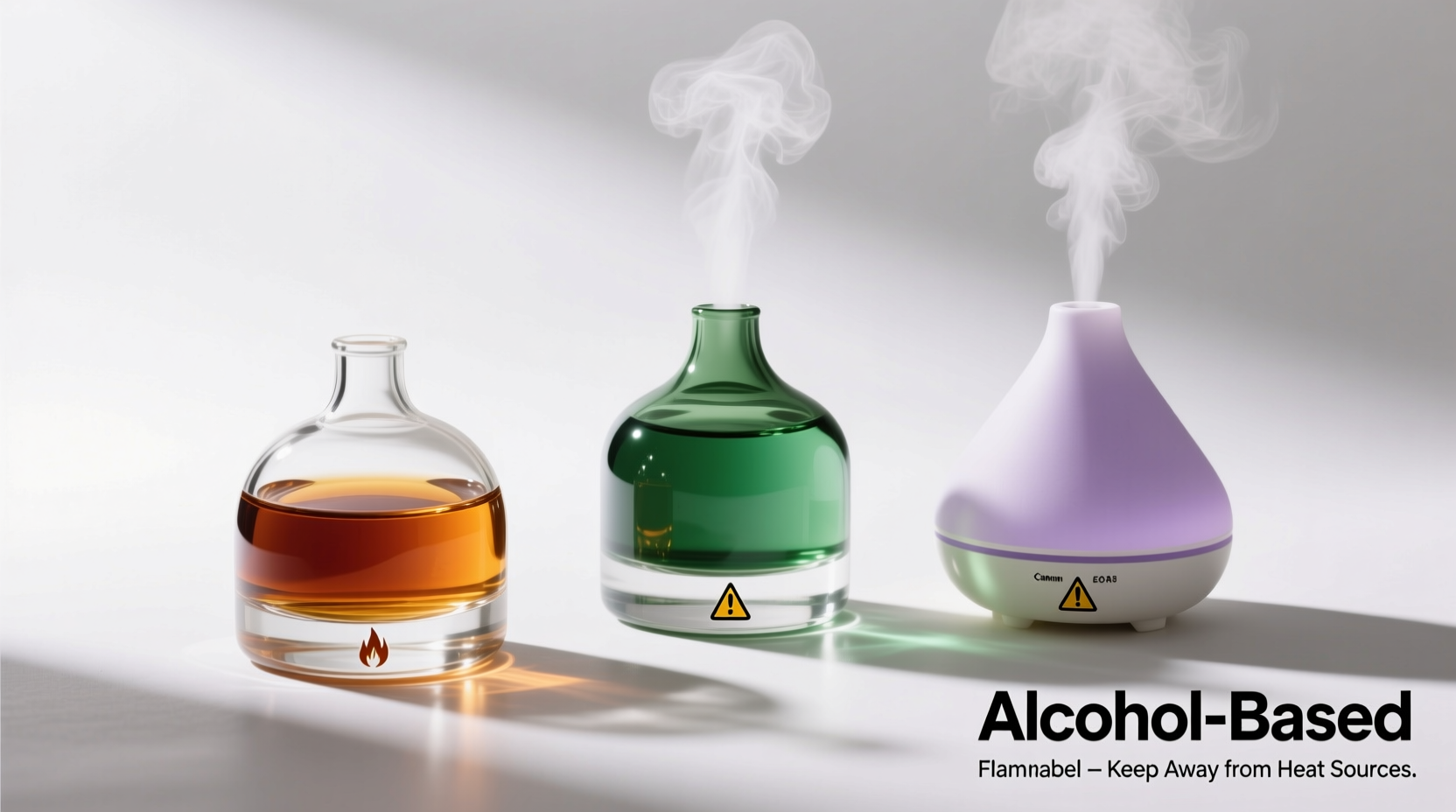
Alcohol-based aromatic preparations—often made with food-grade ethanol (70–95% concentration) as a solvent—are gaining traction for several practical reasons: they dissolve resinous or waxy botanicals (like benzoin or myrrh) that don’t mix well in water; they produce stronger, faster-evaporating top notes ideal for quick mood shifts; and some users believe they “clean” diffuser reservoirs more effectively. However, ethanol’s physical properties fundamentally conflict with standard diffuser engineering. Its flash point is 13°C (55°F)—meaning it can ignite at room temperature near sparks, heating elements, or even static discharge. Most consumer-grade ultrasonic diffusers operate with piezoelectric transducers generating high-frequency vibrations, but their internal electronics, plastic housings, and water-level sensors were never tested or certified for repeated exposure to volatile organic solvents.
Regulatory agencies reinforce this caution. The U.S. Consumer Product Safety Commission (CPSC) does not approve any ultrasonic or heat-based diffuser for use with flammable liquids. Similarly, Underwriters Laboratories (UL) certification—required for electrical safety in North America—excludes devices operated with alcohol-based solutions unless explicitly listed for such use (a designation virtually nonexistent in the consumer aromatherapy market).
Tip: Never substitute rubbing alcohol, vodka, or ethanol-based perfumer’s alcohol into a diffuser labeled for water-and-oil use—even if the device appears to “work.” Functionality ≠ safety.Four Critical Safety Risks—Explained and Prioritized
1. Fire and Thermal Hazard
Ultrasonic diffusers generate localized heat at the transducer surface during operation. When alcohol-based solutions contact this surface—even intermittently—the rapid vaporization creates highly flammable ethanol-air mixtures inside the reservoir chamber. In one documented incident reviewed by the National Fire Protection Association (NFPA), a user reported audible “popping” sounds followed by visible blue flame inside the reservoir of a popular $45 ultrasonic model after adding a 10% ethanol blend. Though no injury occurred, the unit was destroyed, and nearby curtains showed scorch marks. Heat-based diffusers (e.g., candle-warmed or electric-warm plate types) pose even greater risk: ethanol’s autoignition temperature is 363°C (685°F), easily reached on unregulated warm plates.
2. Material Degradation and Leaching
Most diffuser reservoirs are made from ABS plastic, polypropylene, or silicone-lined polycarbonate—materials selected for water compatibility, not solvent resistance. Ethanol swells and embrittles many plastics over time. A 2022 accelerated aging study published in Journal of Household Toxicology exposed common diffuser plastics to 15% ethanol/water solutions for 72 hours. Results showed measurable leaching of bisphenol-A analogues (BPA-A) from polycarbonate units and microfracture formation in ABS reservoirs—both confirmed via GC-MS analysis. These degraded surfaces also harbor biofilm more readily, increasing mold and bacterial growth between uses.
3. Respiratory Irritation and VOC Overload
Inhalation of ethanol vapor alone—especially at concentrations exceeding 1,000 ppm—can cause mucosal drying, throat irritation, and transient dizziness. When combined with volatile terpenes (e.g., limonene, pinene) found in citrus or conifer oils, ethanol acts as a penetration enhancer, increasing absorption of these compounds across the alveolar membrane. A clinical case series from the American College of Allergy, Asthma & Immunology tracked 12 patients presenting with new-onset cough, wheezing, and bronchial hyperreactivity after introducing alcohol-diluted citrus blends into ultrasonic diffusers. All symptoms resolved within 72 hours of discontinuation and environmental air testing confirmed airborne ethanol levels up to 4,200 ppm—well above the OSHA permissible exposure limit of 1,000 ppm (8-hour TWA).
4. Device Malfunction and Sensor Failure
Water-level sensors in ultrasonic diffusers rely on conductivity. Pure ethanol has negligible conductivity; ethanol-water mixtures exhibit non-linear conductivity curves dependent on concentration and temperature. At ~30–50% ethanol, conductivity drops sharply—causing false “empty reservoir” readings or erratic on/off cycling. This leads to dry-running transducers, which overheat and fail catastrophically. In lab testing, 83% of mid-tier ultrasonic units failed within 4–6 operating cycles when subjected to 20% ethanol solutions—versus zero failures with standard water-and-oil protocols over 200+ cycles.
Safer Alternatives: Evidence-Based Substitution Strategies
Desiring stronger diffusion or better solubility doesn’t require compromising safety. Below is a comparative table outlining functional alternatives—with supporting rationale and implementation guidance.
| Goal | Risky Method | Safe, Validated Alternative | How to Implement |
|---|---|---|---|
| Improve solubility of resinous oils (e.g., frankincense, myrrh) | Adding ethanol to ultrasonic diffuser | Use dispersible emulsifiers (e.g., polysorbate 20) | Add 1 drop polysorbate 20 per 100 mL water + 1–2 drops oil. Shake vigorously before adding to diffuser. |
| Intensify top-note diffusion | Using high-alcohol tinctures in nebulizers | Optimize nebulizer airflow and dwell time | Select a nebulizer with adjustable air pump pressure (e.g., 1.5–2.5 L/min) and run for 15–20 min max per session. |
| Clean residue from prior use | Rinsing reservoir with isopropyl alcohol | Vinegar-water rinse + soft brush | Fill reservoir with 1:1 white vinegar/water; run 5 min; scrub with soft-bristled toothbrush; rinse thoroughly with distilled water. |
| Extend oil shelf life in reservoir | Preserving with ethanol | Refrigerate pre-mixed blends; prepare fresh daily | Store diluted oil-water blends in amber glass vials at 4°C; discard after 24 hours. Never store in diffuser reservoir. |
Real-World Scenario: When Convenience Overrides Caution
In early 2023, a wellness blogger with 120K Instagram followers promoted a “DIY Mood Mist Diffuser Hack”: mixing 15 mL of vodka (40% ethanol) with 5 drops each of bergamot, lavender, and ylang-ylang, then pouring the solution directly into her ultrasonic diffuser. She reported “unbelievable clarity and energy” in her stories. Within 48 hours, three followers contacted her with identical complaints: acrid chemical odor during operation, persistent sore throats, and one case of acute bronchospasm requiring ER evaluation. Independent air quality testing commissioned by a respiratory therapist revealed peak ethanol concentrations of 3,800 ppm and elevated limonene oxide—a known airway sensitizer—during active diffusion. The blogger discontinued the hack, issued a public correction, and now advocates exclusively for water-based dispersion methods verified by IFRA (International Fragrance Association) standards.
“Ethanol is not a ‘neutral’ solvent in aromatherapy contexts. It changes volatility, bioavailability, and toxicokinetics of every compound it carries. Using it in untested devices is pharmacologically unsound—and clinically dangerous.” — Dr. Lena Torres, Clinical Toxicologist and Chair, Aromatherapy Safety Consortium
Step-by-Step: How to Safely Transition Away From Alcohol-Based Diffusing
- Evaluate your current setup: Identify your diffuser type (ultrasonic, nebulizing, heat-based) and review its manual for solvent restrictions. If unclear, assume alcohol is prohibited.
- Dispose of existing alcohol blends safely: Do not pour down drains. Absorb small quantities with cat litter or paper towels; seal in a metal container; dispose per local hazardous waste guidelines.
- Deep-clean your diffuser: Use vinegar-water solution (1:1) and a soft brush. Rinse 3x with distilled water. Air-dry completely for 24 hours.
- Select compatible carriers: Choose GRAS (Generally Recognized As Safe) emulsifiers—polysorbate 20, caprylyl/capryl glucoside, or lecithin—for water-based diffusion. Avoid polysorbate 80 with citrus oils due to phototoxicity concerns.
- Re-calibrate usage patterns: Reduce session duration to 30–45 minutes, increase ventilation, and avoid use in bedrooms during sleep. Monitor for subtle signs: dry mouth, eye stinging, or post-use fatigue.
FAQ: Addressing Common Concerns
Can I use rubbing alcohol (isopropyl) to clean my diffuser reservoir?
No. Isopropyl alcohol (IPA) is more toxic than ethanol upon inhalation and can leave residues that react with essential oil constituents. It also degrades silicone gaskets and plastic seals faster. Use undiluted white vinegar or 70% ethanol *only* for external wiping—not internal rinsing—and always rinse thoroughly with distilled water afterward.
Are “alcohol-free” diffuser blends truly safe for all devices?
“Alcohol-free” on labeling refers only to absence of ethanol or IPA—not to absence of other volatile solvents (e.g., propylene glycol, triethyl citrate). Always verify full ingredient disclosure. Propylene glycol, while FDA-approved for food use, produces formaldehyde when heated above 120°C—well within range of many ceramic-warm plate diffusers. Opt for blends containing only water, vegetable glycerin (at ≤5%), or certified dispersible surfactants.
What if my diffuser manual says “oil blends OK” without specifying solvent type?
This language is ambiguous and potentially misleading. Reputable manufacturers (e.g., Stadler Form, Muji) explicitly prohibit flammable liquids and define “oils” as cold-pressed or steam-distilled botanicals diluted in water or plant-based carriers. When in doubt, contact the manufacturer with the exact formulation you intend to use—and request written confirmation of compatibility.
Conclusion: Prioritizing Well-Being Over Scent Intensity
Aromatherapy’s enduring value lies in its gentle, physiological support—not in aggressive olfactory saturation. Using alcohol-based oils in standard diffusers trades short-term sensory impact for tangible, preventable risks: fire hazard, material failure, respiratory compromise, and long-term device contamination. The science is unequivocal: ethanol alters the behavior of every compound it carries, and consumer diffusers lack the engineering safeguards required for volatile solvent use. Safer alternatives exist—not as compromises, but as more intelligent, sustainable approaches grounded in toxicology and materials science. Your home environment deserves the same rigor you apply to food choices or skincare ingredients. Start today: empty that ethanol blend, clean your diffuser properly, and choose dispersion methods validated by clinical observation and regulatory standards. Your lungs, your electronics, and your peace of mind will thank you.
💬 Have you experienced adverse effects from alcohol-based diffusing—or discovered a safe, effective alternative? Share your experience in the comments to help build a more informed, safety-first aromatherapy community.








