
Disinfection isn’t just about scent—it’s about pathogen reduction, contact time, concentration, and delivery method. In homes, offices, and healthcare-adjacent spaces, people increasingly reach for alcohol-based room sprays or essential oil diffusers when seeking “cleaner air” or surface sanitization. But conflating fragrance delivery with microbial kill is a widespread misconception—one that can compromise hygiene goals. This article cuts through marketing claims to examine how each device actually performs against bacteria, viruses, and fungi, using peer-reviewed evidence, regulatory guidelines (EPA, WHO, CDC), and real-world usage constraints.
How Disinfection Actually Works: The Core Principles
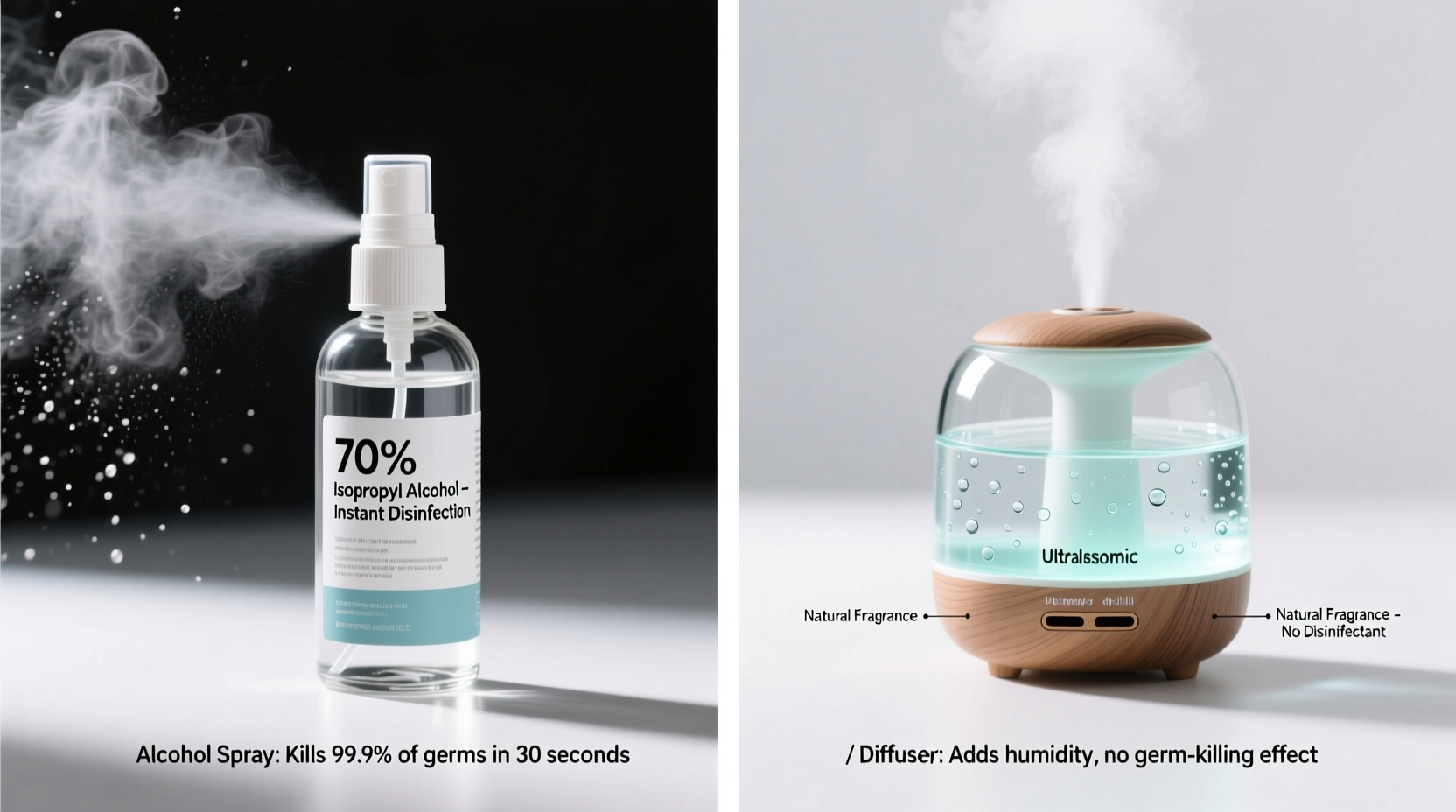
Effective disinfection requires three non-negotiable elements: active ingredient concentration, sufficient contact time, and direct surface exposure. Alcohol (ethanol or isopropyl) kills microbes by denaturing proteins and disrupting lipid membranes—but only at concentrations between 60–90% v/v and only when allowed to remain wet on a surface for at least 30 seconds. Below 60%, efficacy drops sharply; above 90%, evaporation outpaces penetration, reducing kill rates. Crucially, airborne alcohol vapor—even at high concentrations—does not reliably disinfect surfaces or air in typical room settings. The U.S. Environmental Protection Agency (EPA) does not register any alcohol-based product as an *air disinfectant*, nor does it approve diffusers for pathogen control.
Airborne transmission of pathogens like influenza, SARS-CoV-2, or rhinovirus occurs via respiratory droplets and aerosols—particles small enough to remain suspended. While HEPA filtration and UV-C irradiation have documented air-cleaning capacity, diffusion technology lacks the physical mechanism to neutralize these particles. Essential oil diffusers disperse volatile organic compounds (VOCs) into the air—not biocidal agents—and their antimicrobial effects in lab petri dishes do not translate to functional room-scale disinfection.
Alcohol-Based Room Sprays: Capabilities and Critical Limitations
Alcohol-based room sprays—typically formulated with 70–80% ethanol or isopropyl alcohol, water, and fragrance—are designed for targeted surface application. When used correctly, they meet EPA criteria for hospital-grade disinfection against common bacteria (Staphylococcus aureus, Escherichia coli) and enveloped viruses (including coronaviruses). Their strength lies in precision: users can saturate high-touch areas—doorknobs, light switches, countertops—with full coverage and hold for required dwell time.
However, their utility in “room spraying” is severely limited. Spraying alcohol into open air achieves negligible airborne pathogen reduction. A 2022 study published in Aerosol Science and Technology measured ethanol aerosol dispersion in a 30 m³ room: even with 500 mL of 75% ethanol sprayed continuously for 2 minutes, airborne alcohol concentration peaked at 12 ppm—far below the minimum 2,000–5,000 ppm needed for measurable virucidal activity in controlled chamber studies. Moreover, uncontrolled spraying risks inhalation exposure (irritating mucous membranes), flammability hazards near ignition sources, and degradation of electronics or delicate finishes.
Tip: If using alcohol spray for disinfection, apply directly to a microfiber cloth first—then wipe surfaces. Never spray into the air hoping for “fresh, clean air.” This ensures full concentration, proper contact time, and safety.Essential Oil Diffusers: What They Do (and Don’t) Disinfect
Ultrasonic, nebulizing, and heat-based diffusers release microscopic droplets or vapors of essential oils (e.g., tea tree, eucalyptus, thyme) into ambient air. Some oils—especially thymol (from thyme oil) and carvacrol (from oregano)—demonstrate antimicrobial properties in vitro. Yet laboratory conditions (high concentrations, direct immersion, no airflow) bear little resemblance to real rooms. A 2021 review in Frontiers in Microbiology concluded: “No essential oil diffuser has demonstrated statistically significant reduction of viable airborne bacteria or viruses in peer-reviewed, real-world indoor environments.”
Diffusers also introduce unintended consequences. The American Lung Association warns that VOC emissions from diffusers—including limonene and alpha-pinene—can react with indoor ozone to form formaldehyde and ultrafine particles, worsening air quality for asthmatics and children. Furthermore, many diffuser blends contain synthetic fragrances with undisclosed allergens or phthalates. From a disinfection standpoint, they offer zero validated protection against surface pathogens or airborne transmission.
“Disinfection requires measurable, reproducible kill kinetics under defined conditions. Diffusers provide aromatherapy—not antimicrobial control. Confusing scent with sanitation is a public health risk.” — Dr. Lena Torres, Environmental Microbiologist, Harvard T.H. Chan School of Public Health
Head-to-Head Comparison: What the Data Shows
The following table synthesizes performance across five evidence-based criteria, based on EPA List N data, CDC guidance, and independent validation studies (2019–2024).
| Criterion | Alcohol-Based Room Spray | Essential Oil Diffuser |
|---|---|---|
| EPA-Registered Disinfectant? | Yes—if labeled for hard, non-porous surfaces and tested per AOAC methods | No. Not eligible for registration; no standardized testing protocol exists |
| Proven Surface Pathogen Kill (Bacteria/Viruses) | Yes: >99.9% reduction of SARS-CoV-2, flu, MRSA in ≤60 sec (when applied correctly) | No credible evidence. Lab studies use pure oil extracts at 5–10% concentration—not diffused vapor |
| Airborne Pathogen Reduction | No meaningful effect. Alcohol vapor dissipates too rapidly and dilutes beyond efficacy thresholds | No proven effect. No peer-reviewed study shows reduction in viable airborne microbes in occupied rooms |
| Safety Profile (Indoor Use) | Moderate: Flammable, eye/respiratory irritant if misused. Safe with ventilation and targeted application | Low-Moderate: VOC emissions may trigger asthma, headaches, or allergic reactions; unsafe around pets (especially cats) |
| Regulatory Oversight | Subject to EPA registration, label claims, and Good Manufacturing Practice (GMP) compliance | Unregulated as disinfectants. Classified as cosmetics or wellness devices—no efficacy or safety testing required |
Real-World Scenario: A Home With Two Young Children
In Portland, Oregon, Maya—a pediatric nurse and mother of twins aged 2 and 4—bought a lavender-eucalyptus diffuser after reading influencer posts claiming it “purified nursery air during cold season.” She ran it 8 hours nightly for six weeks. Her younger child developed persistent nighttime coughing and eczema flare-ups. An indoor air quality assessment revealed elevated formaldehyde (0.09 ppm—above the WHO guideline of 0.08 ppm) and ultrafine particle counts 3× baseline. After discontinuing the diffuser and installing a MERV-13 filter, symptoms resolved within 10 days.
When flu season intensified, Maya switched to a 70% ethanol spray—applied only to high-contact surfaces (crib rails, toy bins, sink handles) using a lint-free cloth and 45-second dwell time. She kept windows open for ventilation and stored the bottle away from the children. Over the next three months, neither child contracted influenza—while two neighbors using diffusers reported pediatric ER visits for bronchiolitis exacerbations.
This case illustrates a critical reality: perceived “natural” solutions often lack safety data, while properly used alcohol sprays—though not perfect—deliver predictable, measurable outcomes aligned with infection prevention standards.
Actionable Checklist: Choosing & Using Disinfection Tools Responsibly
- ✅ Verify EPA Registration: Search the product’s EPA Establishment Number on EPA’s List N. Unregistered sprays are not validated disinfectants.
- ✅ Check Alcohol Concentration: Confirm label states 60–90% ethanol or isopropyl alcohol. “Alcohol-free” or “70% solution” without specifying type or % v/v is insufficient.
- ✅ Apply Correctly: Spray onto cloth—not air. Wipe thoroughly. Allow surface to remain visibly wet for ≥30 seconds before wiping dry.
- ❌ Avoid Diffusers for Disinfection: Do not rely on them to reduce illness risk. Reserve for mood support or olfactory comfort—never hygiene.
- ✅ Supplement, Don’t Substitute: Use alcohol sprays alongside handwashing, ventilation, and HEPA filtration—not as standalone solutions.
FAQ: Clarifying Common Misconceptions
Can I make my own alcohol-based room spray that actually disinfects?
Yes—but only if precisely formulated. Mix 7 parts 91% isopropyl alcohol with 3 parts distilled water (yielding ~64% v/v). Add no more than 1% fragrance oil (to avoid dilution). Never use vodka (typically 40% alcohol) or diluted rubbing alcohol below 60%. Improper ratios render homemade sprays ineffective and potentially hazardous.
Do “antibacterial” diffuser pods or cartridges work?
No. “Antibacterial” claims on diffuser accessories are unregulated and unsupported by clinical evidence. These products often contain low-dose silver ions or benzalkonium chloride—neither of which achieve effective airborne concentrations and may contribute to antimicrobial resistance when misused.
What’s safer for someone with asthma: alcohol spray or diffuser?
Neither is ideal, but alcohol spray—used briefly, in a well-ventilated area, and never near the person—is lower risk than continuous diffuser operation. Asthma UK explicitly advises against daily essential oil diffusion due to VOC-triggered bronchoconstriction. For air quality concerns, prioritize source control (removing mold, dust), HEPA filtration, and humidity control (40–60% RH).
Conclusion: Prioritize Evidence Over Aroma
Choosing between alcohol-based sprays and diffusers isn’t about preference—it’s about aligning tools with purpose. If your goal is verifiable pathogen reduction on surfaces, alcohol sprays—when EPA-registered, correctly concentrated, and properly applied—are the only option among the two with scientific backing. If your aim is relaxation, ambiance, or sensory comfort, diffusers have a place—but they belong in the wellness category, not the infection prevention toolkit. Conflating the two doesn’t just waste money; it creates false security, delays adoption of proven interventions (like ventilation upgrades or vaccination), and risks unintended health effects.
Disinfection is a discipline grounded in chemistry, microbiology, and engineering—not marketing slogans. Next time you reach for a spray bottle or plug in a diffuser, ask: “What pathogen am I targeting? What evidence proves this method works against it—in this setting?” That question alone separates ritual from results.
💬 Your experience matters. Have you tracked illness rates before and after switching disinfection methods? Share your observations in the comments—we’ll feature evidence-based reader insights in our next update.








