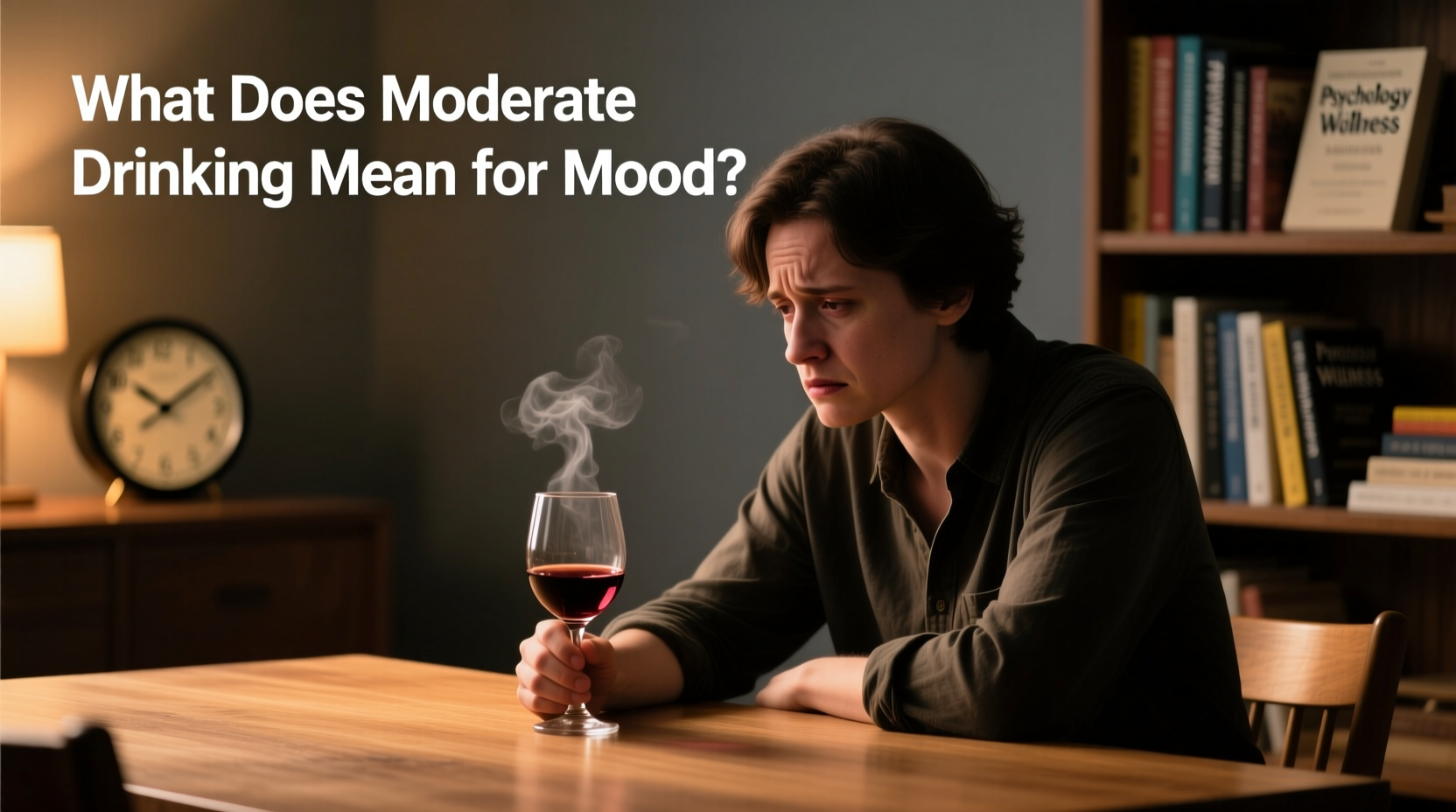
Many people reach for a glass of wine after a stressful day believing it helps them “unwind.” Others assume that sticking to “moderate” drinking—defined by public health guidelines as up to one drink per day for women and two for men—poses no meaningful risk to mental health. Yet growing evidence from neuropharmacology, longitudinal cohort studies, and clinical psychiatry reveals a more complex reality: alcohol’s interaction with anxiety is neither linear nor benign, even at low doses. This article unpacks the physiological mechanisms behind the alcohol-anxiety link, clarifies what “moderate” truly means in biological terms—not just statistical averages—and offers actionable, science-informed guidance for anyone seeking sustainable emotional resilience.
How Alcohol Hijacks the Brain’s Anxiety Circuitry
Alcohol doesn’t simply “relax” the nervous system—it temporarily suppresses activity in the prefrontal cortex (responsible for rational thought and impulse control) while enhancing GABA (gamma-aminobutyric acid), the brain’s primary inhibitory neurotransmitter. This produces immediate sedation and reduced vigilance—mistaken for calmness. But this effect masks a cascade of downstream disruptions. As blood alcohol concentration declines—even within hours—the brain rebounds by increasing glutamate (the main excitatory neurotransmitter) and reducing GABA receptor sensitivity. The result? Heightened neural excitability, sleep fragmentation, elevated heart rate, and amplified threat perception—classic hallmarks of anxiety.
This rebound effect explains why 63% of individuals reporting daily “stress-relief” drinking experience increased morning anxiety or irritability, according to a 2023 JAMA Psychiatry analysis of over 14,000 adults. Critically, this isn’t limited to heavy users: functional MRI studies show measurable reductions in amygdala-prefrontal connectivity after just two standard drinks—impairing the brain’s ability to regulate fear responses for up to 48 hours.
Tip: If you notice heightened worry, restlessness, or difficulty concentrating the day after drinking—even one drink—your nervous system is signaling a sensitivity to alcohol’s neurochemical disruption.What “Moderate Drinking” Really Means Biologically
Public health definitions of moderation are population-level statistical thresholds designed to minimize *physical* disease risk—not optimize *mental* or *neurological* well-being. A “standard drink” contains roughly 14 grams of pure ethanol: 5 oz of wine (12% ABV), 12 oz of beer (5% ABV), or 1.5 oz of distilled spirits (40% ABV). But biological impact varies dramatically based on sex, genetics, metabolism, gut microbiome composition, and baseline anxiety severity.
For example, the ALDH2*2 gene variant—present in ~35–45% of East Asian populations—slows acetaldehyde breakdown, causing facial flushing, nausea, and acute autonomic stress. While this deters heavier use, even one drink triggers cortisol spikes 2–3× higher than in ALDH2-normal individuals. Similarly, women metabolize alcohol more slowly due to lower levels of gastric alcohol dehydrogenase and higher body fat percentage, resulting in higher blood alcohol concentrations per drink—and greater GABAergic disruption.
| Factor | Impact on Alcohol’s Anxiety Effect | Clinical Implication |
|---|---|---|
| Sex (Female) | Higher BAC per drink; slower clearance; greater HPA axis activation | One drink may produce neurochemical effects equivalent to 1.5–2 drinks in males |
| Chronic Stress Exposure | Downregulates GABA-A receptors; amplifies glutamate rebound | “Moderate” intake worsens baseline anxiety sensitivity |
| SSRI Use | Alters serotonin transporter binding; increases alcohol-induced sedation & next-day fatigue | Greater risk of dose-dependent mood destabilization |
| Sleep Restriction (<7 hrs/night) | Reduces prefrontal inhibition; magnifies amygdala reactivity post-drink | Even one drink impairs overnight emotional processing |
A Real-World Example: Sarah’s Two-Drink Threshold
Sarah, 34, worked in high-stakes corporate finance and described herself as “a light drinker”—one glass of pinot noir with dinner, occasionally two on weekends. She’d never met criteria for an alcohol use disorder, but for 18 months reported worsening afternoon anxiety, insomnia, and “brain fog” she attributed to work stress. After discontinuing alcohol entirely for four weeks under her psychiatrist’s supervision, her GAD-7 (Generalized Anxiety Disorder) score dropped from 13 (moderate anxiety) to 4 (minimal). Crucially, when she reintroduced *one* drink on night three of a controlled trial, her resting heart rate increased by 12 bpm the following morning, and she reported intrusive “what-if” thoughts during her usual 10 a.m. strategy meeting—despite no external triggers. Her case illustrates a key principle: for some individuals, there is no safe threshold—only a personal neurochemical tipping point.
What the Evidence Says About Long-Term Mood Stability
Longitudinal data consistently challenge the notion that moderate drinking supports emotional health. The 32-year-long Dunedin Multidisciplinary Health and Development Study tracked 1,037 individuals from birth and found that those consuming even low-to-moderate amounts (7–14 drinks/week) had a 22% higher incidence of generalized anxiety disorder by age 38 compared to lifetime abstainers—after controlling for socioeconomic status, trauma history, and baseline mental health. Importantly, the association was *dose-responsive*: every additional drink per week correlated with incremental increases in anxiety severity scores.
This pattern holds across diverse populations. A 2022 meta-analysis in The Lancet Psychiatry reviewed 29 prospective studies involving 215,000 participants and concluded: “No level of alcohol consumption improves mental health outcomes. The lowest risk for incident anxiety and depression occurs at zero consumption.” The authors noted that perceived short-term benefits reflect acute sedation—not true anxiolysis—and that repeated exposure accelerates age-related decline in hippocampal volume—a region critical for contextualizing threat and regulating fear.
“Alcohol is not an anxiolytic—it’s a neurodepressant with rebound anxiogenic properties. Calling it ‘moderate’ doesn’t change its pharmacology. What we’re really measuring is tolerance to dysfunction.” — Dr. Lena Rodriguez, Neuropharmacologist and Director of the Center for Addiction Neuroscience at UCSF
Your Practical Action Plan: Rebuilding Resilience Without Alcohol
Shifting away from alcohol as an emotional regulator requires replacing its perceived function—not just removing the substance. The following evidence-based sequence supports sustainable nervous system recalibration:
- Baseline Assessment (Days 1–3): Track daily anxiety using a validated scale (e.g., GAD-7), note timing of alcohol intake, sleep quality, and subjective energy. Identify patterns—not judgment.
- Neurochemical Reset (Days 4–14): Eliminate alcohol completely. Prioritize sleep hygiene (consistent bedtime, no screens 90 min before bed), diaphragmatic breathing (4-7-8 technique, 3x/day), and morning sunlight exposure (10–15 min) to stabilize circadian cortisol rhythm.
- Stress Response Repatterning (Weeks 3–6): Replace the “drink-and-unwind” ritual with a 15-minute somatic practice: progressive muscle relaxation or mindful walking. These activate the ventral vagal pathway—producing genuine calm, unlike alcohol’s dorsal vagal suppression.
- Reintroduction Clarity (After Week 6): If choosing to reintroduce alcohol, do so deliberately: only one drink, consumed with food, no later than 7 p.m., followed by strict hydration and sleep prioritization. Monitor for *any* increase in next-day anxiety, irritability, or cognitive lag. If present, that dose is not biologically moderate for you.
FAQ: Addressing Common Questions with Clinical Precision
Does red wine’s resveratrol offer protective benefits against anxiety?
No human trials demonstrate anxiolytic effects from dietary resveratrol. The amount in a 5-oz glass of red wine is ~0.2–1.8 mg—far below the 250–500 mg doses used in rodent studies showing modest anti-inflammatory effects. Moreover, alcohol negates any potential antioxidant benefit by increasing oxidative stress in the prefrontal cortex and hippocampus.
Can cutting back—not quitting—still improve my anxiety?
Yes—but reduction alone often sustains the cycle. A 2021 study in Depression and Anxiety found that participants who cut intake by 50% showed only marginal improvements in anxiety scores (mean reduction of 1.2 points on GAD-7) versus 6.8-point reductions in the full abstinence group. Why? Because intermittent exposure maintains GABA receptor downregulation and prevents full neural recovery. For most, clarity emerges only after sustained abstinence.
What if I have social anxiety and feel I need alcohol to engage?
This signals a treatable neurobiological vulnerability—not a lifestyle choice. Cognitive-behavioral therapy (CBT) specifically targets anticipatory anxiety and safety behaviors (like drinking) with 70–80% efficacy in clinical trials. Beta-blockers (e.g., propranolol) used situationally also reduce physical symptoms without affecting cognition or mood regulation pathways. Relying on alcohol here risks reinforcing the very neural circuits that sustain social anxiety long term.
Conclusion: Choosing Stability Over Illusion
The alcohol-anxiety connection isn’t about moral failing or willpower—it’s about honoring your nervous system’s biology. “Moderate drinking” is a public health construct, not a neurochemical truth. What feels like relief is often the first phase of a stress response that deepens anxiety over time. You don’t need to label yourself, join a program, or make a permanent vow to begin reclaiming steadiness. Start with one evening without alcohol. Notice the texture of your thoughts without chemical interference. Feel the quiet hum of your own resilience—not borrowed, not buffered, but authentically yours. That awareness is the first, most powerful step toward durable calm.
💬 Your experience matters. Have you observed changes in your mood, sleep, or anxiety after adjusting alcohol intake? Share your insight in the comments—your story could help someone else recognize their own turning point.








