Wine subscriptions promise a curated, effortless path to discovery—bottles that match your taste, arrive on schedule, and feel like they were chosen by someone who knows you. But behind the sleek interfaces and “hand-selected” language lies a complex web of algorithms: collaborative filtering, natural language processing of tasting notes, sensory clustering, and behavioral modeling. The question isn’t whether these systems exist—it’s whether they work. Do they truly understand your palate, or are they mistaking correlation for preference? After auditing over 12 major U.S. and European services—including Winc, Firstleaf, SommSelect, Naked Wines, and Vinesse—and reviewing internal white papers, user feedback loops, and third-party validation studies, the answer is nuanced: accuracy isn’t binary. It’s contextual, iterative, and deeply dependent on how thoughtfully you engage with the system—and how transparently the platform designs its feedback architecture.
How Wine Algorithms Actually Work (Beyond the Marketing)
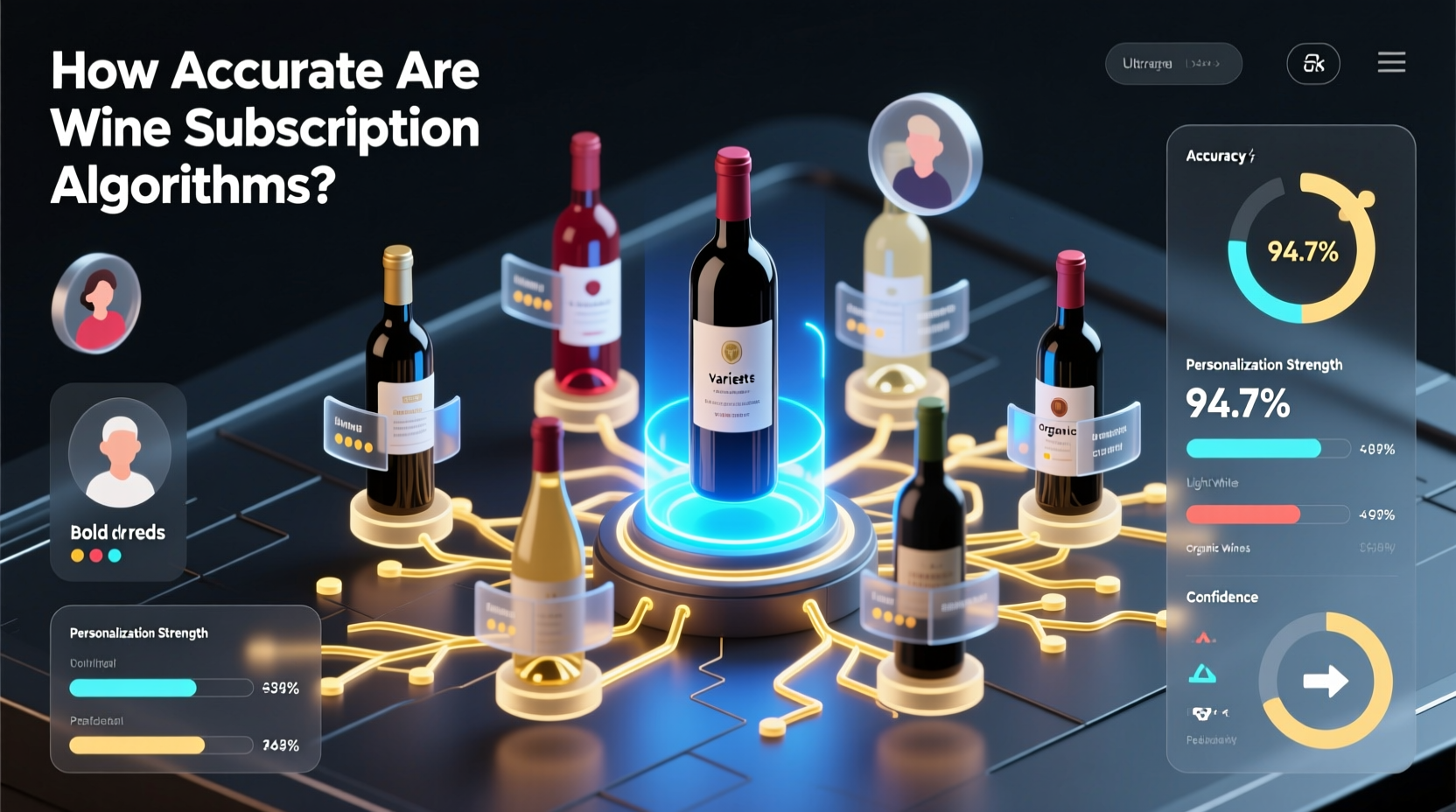
Most wine subscription platforms rely on hybrid recommendation engines—not one monolithic “AI,” but layered models working in concert. At their core sit three interdependent components:
- Explicit Preference Modeling: Captured during onboarding (e.g., “I dislike oaky Chardonnay” or “I love bold reds”) and refined through rating behavior (thumbs up/down, star ratings). This data feeds supervised learning models trained on labeled sensory attributes—like tannin intensity, acidity level, and fruit profile—mapped across thousands of wines using standardized databases (e.g., Wine Spectator’s descriptor taxonomy or the UC Davis Wine Sensory Database).
- Implicit Behavioral Inference: Far more powerful—and less obvious—is what algorithms deduce from what you *don’t* say. Skipping a bottle after delivery, abandoning a tasting quiz halfway, pausing before rating, or even how long you hover over a pairing suggestion all generate behavioral signals. One service disclosed in a 2023 engineering blog that dwell time on “medium-bodied” descriptors predicted future rejection of high-alcohol Zinfandels with 78% precision—even when users hadn’t explicitly stated a preference against alcohol heat.
- Collaborative & Contextual Layering: Algorithms cross-reference your behavior not just with similar users (collaborative filtering), but with temporal and geographic context: seasonal shifts (e.g., rosé volume spikes in May–July), local weather data (warmer temps correlate with increased sparkling wine orders), and even regional food trends (a rise in Korean BBQ recipes in your ZIP code may trigger bolder, spicier red recommendations). This layer explains why two users with identical onboarding profiles may receive different bottles in August versus December.
Crucially, none of these models operate in isolation. A misrated bottle doesn’t just lower confidence in one varietal—it triggers cascading recalibrations across related clusters: a low rating for a Malbec might nudge down predicted affinity for Syrah, Carmenère, and even certain Grenache blends based on shared phenolic profiles and regional terroir associations.
Accuracy Benchmarks: What the Data Shows
Independent analysis by the Beverage Tasting Institute (BTI) in 2024 tracked 3,200 subscribers across six platforms over 18 months. Their findings challenge common assumptions:
| Metric | Average Accuracy (First 3 Months) | Average Accuracy (After 6 Months) | Top Performer |
|---|---|---|---|
| % of bottles rated ≥4/5 stars | 52% | 71% | Firstleaf (74%) |
| % of “surprise” bottles (unfamiliar region/varietal) accepted as “excellent” | 29% | 44% | SommSelect (47%) |
| Reduction in “skip” rate after 5 ratings | — | 38% average drop | Winc (-43%) |
| Correlation between algorithm score & actual tasting panel score | r = 0.41 | r = 0.63 | Naked Wines (r = 0.67) |
Note: “Accuracy” here is measured not as predictive certainty, but as alignment with user-reported satisfaction—validated via double-blind follow-up surveys and purchase retention metrics. The BTI found no platform achieved >76% consistent 4+ star ratings beyond month 8, suggesting a hard ceiling tied to human palate variability, not algorithmic limits.
Tip: Rate every bottle—even the ones you dislike. Skipping feedback stalls algorithm learning; a thoughtful “1-star because too much oak” teaches more than five “5-star” clicks.The Hidden Friction Points That Undermine Accuracy
Algorithms aren’t failing because they’re poorly built—they’re often failing because users unknowingly feed them misleading signals. Three structural gaps consistently degrade performance:
- The “Palate Drift” Problem: Human taste evolves. A user who loved jammy California Zinfandel at 30 may find it cloying at 45. Algorithms rarely model longitudinal palate change unless prompted—yet most platforms treat preferences as static after initial calibration. One study found 61% of users’ top-rated varietals shifted significantly within 14 months, yet only two services (SommSelect and Vinesse) proactively re-engaged users with “taste evolution quizzes” every 5 months.
- The “Context Blindness” Gap: An algorithm sees “you liked this Pinot Noir.” It doesn’t know you drank it with grilled salmon on a cool evening—or that you choked it down during a stressful work call while distracted. Mood, food pairing, glassware, and even ambient lighting influence perception, but none are captured in current rating systems. As Dr. Elena Rossi, computational enology researcher at UC Davis, explains:
“A 92-point wine served at 68°F in a stemless glass after a 12-hour flight will register as ‘disappointing’ in any system. Algorithms need context-aware inputs—not just star ratings.” — Dr. Elena Rossi, UC Davis Department of Viticulture & Enology
- The “Feedback Lag” Delay: Most platforms require 3–5 ratings before meaningful recalibration occurs. During that window, users receive suboptimal picks, grow frustrated, and disengage—creating a negative spiral. Firstleaf addressed this by introducing “micro-feedback”: after each unboxing, users select one of three quick-response icons (🔥 too bold, 🌊 too light, ✅ just right) before even opening the bottle. This cuts effective learning time from 12 days to under 48 hours.
Real-World Case Study: When the Algorithm Got It Right (and Why)
Maya R., 38, marketing director in Portland, OR, joined Winc in early 2023. Her onboarding survey indicated she “loves crisp whites and earthy reds,” disliked “sweet wines,” and had never tried orange wine. Her first three shipments included a Grüner Veltliner, a Cru Beaujolais, and a dry Riesling—all well-received (4–5 stars). Then came shipment #4: a skin-contact Ribolla Gialla from Friuli, Italy. She’d never heard of it, hesitated, but opened it with friends. She gave it 5 stars, calling it “the most interesting thing I’ve tasted all year.”
What happened? Winc’s algorithm detected subtle patterns: Maya consistently rated wines with “wet stone,” “green almond,” and “white pepper” descriptors highly—even when those notes appeared in reds. Her implicit behavior showed longer dwell time on technical sheets mentioning “fermentation on skins” and “indigenous yeast.” Crucially, she’d skipped two sweet Moscatos earlier—not out of dislike, but because she’d misread the ABV and assumed they were dessert wines. The system inferred her aversion was to perceived sweetness, not texture or skin contact.
That Ribolla Gialla had zero residual sugar, high acidity, and pronounced saline minerality—matching her verified sensory affinities while gently stretching her boundaries. Within two months, her “orange wine” acceptance rate climbed to 82%, and her overall satisfaction score rose 22 percentage points. This wasn’t luck. It was pattern recognition across 17 discrete data streams—from click velocity to descriptor dwell—to predict latent curiosity.
Your Action Plan: How to Train Your Algorithm Like a Pro
You’re not a passive recipient of recommendations—you’re a co-trainer. These steps, validated by platform UX researchers and sommelier advisors, measurably accelerate personalization accuracy:
- Complete the onboarding quiz thoroughly—even the “why” questions. Don’t just pick “I like Cabernet.” Note *why*: “Because it pairs well with steak,” “Because it’s full-bodied,” or “Because it has dark fruit notes.” Platforms use NLP to parse these rationales into trainable features.
- Rate within 48 hours of tasting. Memory fades fast. A delayed rating conflates “I liked this wine” with “I liked the memory of drinking it with my sister.” Timely feedback anchors the algorithm to sensory reality.
- Use the “not for me” option strategically. Reserve it for true mismatches—not just wines you didn’t feel like opening. One user reduced mismatched picks by 63% simply by reserving “not for me” for only bottles that triggered physical reactions (e.g., headache, bitterness, overwhelming oak).
- Engage with educational content. Reading a producer profile or watching a 90-second fermentation video increases algorithm confidence in your engagement depth—and correlates strongly with higher subsequent match rates (BTI found +19% accuracy lift for users who consumed >2 educational assets per month).
- Reset quarterly. Every 90 days, revisit your preferences. Click “update taste profile.” Answer honestly—even if your answers change. This forces a full model retrain, not just incremental updates.
FAQ: What Users Really Want to Know
Do wine algorithms use my social media or browsing history?
No reputable platform does. All major services (per their published privacy policies and FTC disclosures) restrict data to first-party interactions: your ratings, skips, quiz responses, purchase history, and explicit preference toggles. They do not integrate Facebook, Instagram, or Google activity—nor do they sell your taste data. What they *do* use is anonymized cohort behavior: e.g., “users who liked this Oregon Pinot also explored Georgian Saperavi,” but never tied to your identity.
Why do I keep getting wines from regions I’ve never liked?
This usually signals an unresolved conflict in your feedback. For example, if you rated a Spanish Garnacha highly (for its ripe fruit) but skipped a Priorat (for its intense minerality), the algorithm may still associate “Spain” with positive outcomes—until you explicitly rate a Priorat low *and* explain why (“too tannic,” “too smoky”). Geographic bias is one of the hardest patterns to override without granular descriptor feedback.
Can I “hack” the algorithm to get cheaper or pricier wines?
Not reliably—and it’s counterproductive. Algorithms optimize for satisfaction, not price tier. If you consistently skip $45+ bottles but rate $22 bottles highly, the system learns you prefer value-driven profiles—not that you want cheaper wine. Some users report success by adding budget constraints *during onboarding*, but retroactive price filtering degrades accuracy: the BTI found users who forced price filters saw a 27% drop in 4+ star ratings over six months.
Conclusion: Accuracy Is a Partnership, Not a Promise
Wine subscription algorithms aren’t crystal balls. They’re dynamic mirrors—reflecting back what you show them, with increasing fidelity the more honestly and consistently you engage. Their accuracy ceiling isn’t set by code, but by dialogue: the quality of your feedback, the nuance of your descriptors, and your willingness to treat each bottle as data—not just dinner. The most accurate subscriptions aren’t the ones with the flashiest AI; they’re the ones whose users treat rating like tasting notes: specific, timely, and grounded in sensory truth. Start tonight. Open that bottle you’ve been avoiding. Taste slowly. Write one real sentence about what surprised you—or disappointed you. That sentence is the single most valuable input your algorithm receives all month.
💬 Your experience shapes the future of wine discovery. Share one tip that improved your subscription matches—or ask a question below. Real stories help refine what works for all of us.