It’s no longer just a niche curiosity at the back of a Brooklyn wine shop or a whispered recommendation at a Copenhagen supper club. Natural wine—unfiltered, unfined, low-intervention, often without added sulfites—is now commanding shelf space in Whole Foods, headlining sommelier-led tasting menus in Portland and Austin, and appearing in Instagram Stories with artisanal cheese boards and hand-thrown ceramic glasses. For a generation that came of age amid the 2008 financial crisis, climate anxiety, and algorithmic fatigue, natural wine isn’t just a beverage choice. It’s a cultural signal: a deliberate pause in an era of hyper-processing, opaque supply chains, and performative consumption.
This shift didn’t happen overnight. It’s the culmination of overlapping values—ethical sourcing, sensory authenticity, environmental accountability, and even aesthetic alignment—that resonate deeply with millennial priorities. But what separates this trend from previous food-and-drink fads is its staying power: natural wine sales grew 34% year-over-year in 2023 (Wine Intelligence), and 62% of U.S. consumers aged 27–42 say they’ve purchased “low-intervention” or “natural” wine in the past six months—a figure that jumps to 79% among urban professionals earning $85K+.
The Authenticity Imperative: Rejecting Industrial Gloss
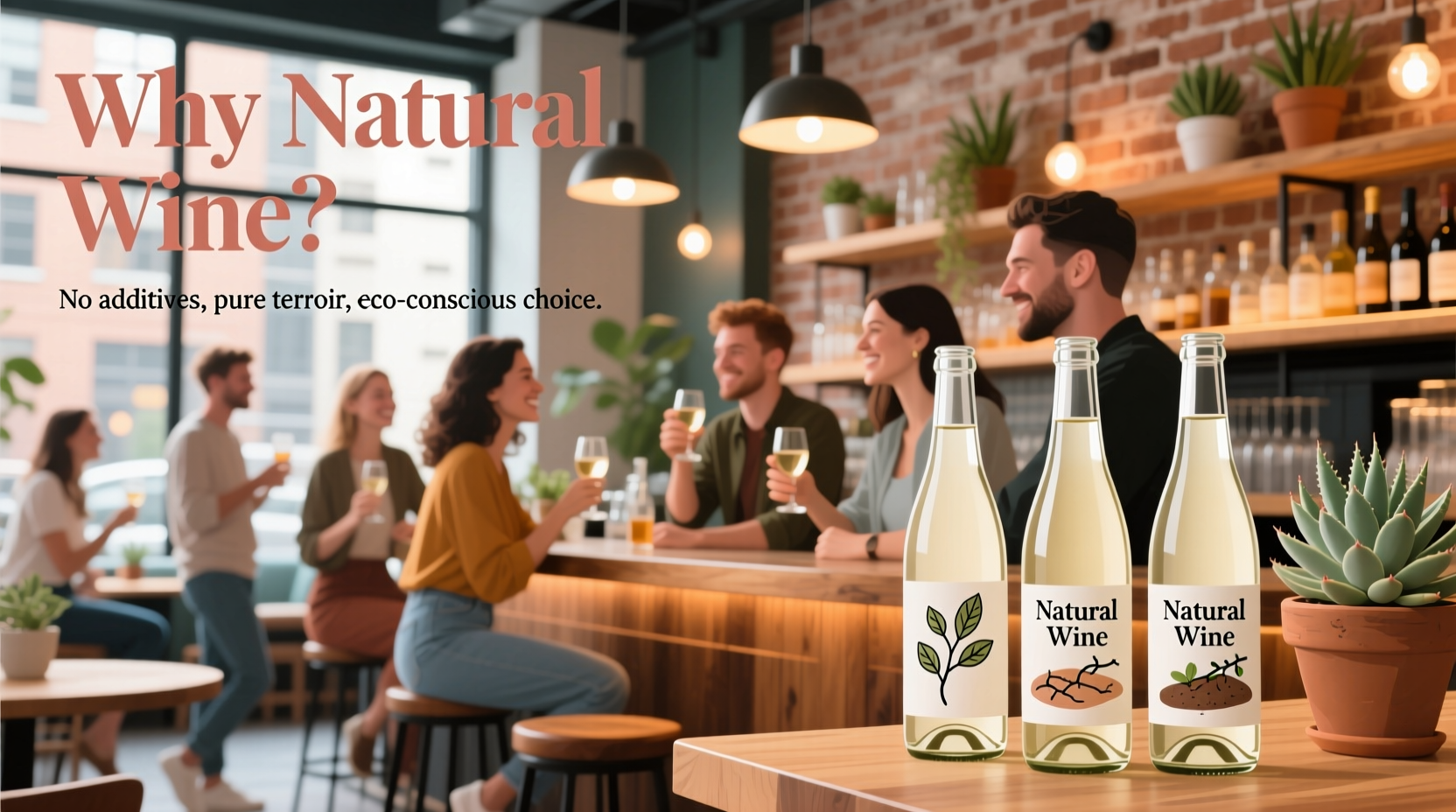
Millennials didn’t inherit a food system built on trust. They entered adulthood amid revelations about industrial farming subsidies, sugar-laden “healthy” snacks, and influencer-endorsed supplements with zero clinical backing. That skepticism extended to wine—long marketed through aspirational, often gendered imagery (“sophisticated,” “elegant,” “powerful”) while obscuring what actually happens in the cellar.
Natural wine flips the script. Its labels rarely feature châteaux or crest logos. Instead, you’ll find hand-drawn illustrations, handwritten batch numbers, or minimalist typography listing only grape variety, region, and vintage—sometimes with a note like “fermented in amphora,” “no SO₂ added,” or “bottled unfiltered.” There’s no gloss, no polish, no PR department smoothing over complexity. What you taste is what the vineyard, weather, and winemaker gave—not what marketing departments decided you should desire.
Tip: When exploring natural wine for the first time, start with low-alcohol, skin-contact whites (like Georgian Rkatsiteli) or light, carbonic reds (Beaujolais Nouveau-style). These tend to be more approachable and highlight texture over tannin.Sustainability as Non-Negotiable—Not a Buzzword
For many millennials, “sustainable” isn’t a marketing tagline—it’s a baseline expectation. A 2024 McKinsey Consumer Sustainability Survey found that 73% of millennials say they’d pay up to 15% more for products verified as environmentally responsible—and wine is no exception. Conventional viticulture accounts for nearly 1% of global pesticide use, with herbicides like glyphosate routinely applied between vine rows. In contrast, certified organic or biodynamic vineyards prohibit synthetic inputs entirely; many natural winemakers go further, practicing biodiversity (planting cover crops, hosting beehives, preserving hedgerows) and regenerative soil management.
Crucially, natural wine’s sustainability extends beyond the vineyard. Minimal intervention means less energy-intensive filtration, centrifugation, and temperature control. Bottling without added sulfites reduces reliance on industrial chemical production. And because many natural producers are small-scale and regional—think Loire Valley growers shipping direct to NYC retailers rather than bulk-shipping to multinational distributors—the carbon footprint shrinks significantly.
A Sensory Counter-Culture: Embracing “Flaws” as Features
Conventional wine education teaches us to identify and avoid “faults”: volatile acidity (VA), brettanomyces (“barnyard”), mousiness, or cloudiness. Natural wine challenges that orthodoxy—not by celebrating spoilage, but by redefining what constitutes character versus defect. A hint of VA can add lift and tang to a Gamay; a subtle funk from native fermentation can deepen the umami resonance of a skin-contact Ribolla Gialla; a slight haze signals the presence of lees and live microbes, not negligence.
This reframing reflects a broader generational shift in taste culture. Millennials grew up with sourdough starters, kombucha, funky cheeses, and third-wave coffee where terroir and process are celebrated—not sanitized. As sommelier and natural wine advocate Pascaline Lepeltier explains:
“Natural wine doesn’t ask you to love it instantly. It asks you to listen—to the vineyard, to the fermentation, to your own palate. That slowness, that attentiveness? That’s radical in a world optimized for speed and consensus.” — Pascaline Lepeltier, MS, co-author of Natural Wine For The People
This isn’t about rejecting technique—it’s about prioritizing intention. A natural winemaker may spend months monitoring wild yeast populations, adjusting pump-overs by feel, or tasting barrels daily. Their labor is tactile, iterative, and visible in the glass.
The Transparency Economy: From Black Box to Open Ledger
Millennials don’t just want to know *where* their wine comes from—they want to know *how* it got there. Natural wine thrives on radical transparency: producer names, vineyard maps, harvest dates, fermentation vessels, and even sulfur levels (often listed in parts per million) appear on labels or websites. Some producers publish full “winemaking diaries”; others host open-vineyard days or livestream barrel tastings.
This stands in stark contrast to the conventional wine industry’s opacity—where a $40 bottle might contain grapes sourced from three countries, blended across five vintages, filtered through diatomaceous earth, and dosed with commercial yeasts, enzymes, and color stabilizers—all legally permitted but rarely disclosed.
| Feature | Natural Wine | Conventional Wine |
|---|---|---|
| Added Sulfur Dioxide (SO₂) | Rarely added; if used, typically ≤30 ppm at bottling | Commonly 80–150+ ppm; often added at multiple stages |
| Filtration | Unfiltered or gravity-fined only | Often sterile-filtered or cross-flow filtered |
| Yeast | Native, ambient strains only | Frequently inoculated with lab-cultured Saccharomyces cerevisiae |
| Clarification Agents | None (or minimal egg white/bentonite) | Commonly uses isinglass, casein, gelatin, or PVPP |
| Traceability | Vineyard-specific, often single-parcel | May blend fruit from dozens of sites or regions |
Real-World Resonance: A Mini Case Study from Chicago
In 2021, Maya Chen, a 32-year-old UX designer and zero-waste advocate, launched “Vine & Root,” a natural wine subscription service focused exclusively on BIPOC and women-led producers. Her model was simple: curate 3 bottles monthly, each paired with a 2-minute audio story from the winemaker, plus compostable packaging and carbon-neutral shipping.
Within 18 months, Vine & Root had 1,200 subscribers—92% millennials—and expanded into pop-up retail spaces in Logan Square and Pilsen. What surprised Chen wasn’t just demand, but the nature of engagement: members regularly emailed questions about soil pH, requested harvest photos, and attended virtual “vineyard walks” hosted via Zoom. One subscriber wrote, “I finally understand why my Pinot Noir tastes like wet stone—not because the label said ‘minerality,’ but because I saw the limestone subsoil in the video and tasted it alongside the grower’s description.”
That connection—between land, labor, and liquid—is precisely what conventional distribution models obscure. Natural wine rebuilds it, one transparent transaction at a time.
Practical Entry Points: A 5-Step Exploration Framework
Jumping into natural wine can feel daunting—especially when bottles vary wildly in price, appearance, and flavor profile. Here’s a grounded, step-by-step path to build confidence and curiosity:
- Start with proven regions: Focus on areas with long-standing low-intervention traditions—Loire Valley (Chenin Blanc, Cabernet Franc), Jura (Savagnin, Poulsard), Campania (Falanghina, Aglianico), or Oregon’s Willamette Valley (Pinot Noir, Pinot Gris).
- Seek trusted importers: Look for labels distributed by companies like Louis/Dressner, Jenny & François, or Selection Massale—they vet producers rigorously and prioritize ethical practices.
- Read the back label—literally: Scan for terms like “organic,” “biodynamic,” “unfined,” “unfiltered,” “no added SO₂,” or “fermented with native yeasts.” Avoid vague claims like “crafted with care” or “small-batch” without specifics.
- Taste before you buy (when possible): Attend natural wine fairs (like RAW Wine or Tasting Table’s “Naked Wines” events) or visit shops with dedicated natural wine programs (e.g., Chambers Street Wines in NYC or Domaine LA in Los Angeles).
- Embrace variability: Accept that two bottles of the same wine, same vintage, may differ slightly. That’s not inconsistency—it’s evidence of living, uncontrolled fermentation.
FAQ: Addressing Common Questions Head-On
Does “natural” mean the wine is healthier?
Not necessarily—but it does mean fewer additives. Natural wines typically contain no artificial colors, flavors, or preservatives beyond minimal sulfur (if any). Alcohol content remains the primary health variable, and natural wines often have lower ABV (11–12.5%) due to earlier harvesting and spontaneous fermentation. That said, “healthier” shouldn’t be conflated with “health food”—moderation still applies.
Why do some natural wines taste “fizzy” or “sour”?
Many natural wines undergo partial or full malolactic fermentation (converting sharp malic acid to softer lactic acid)—but some skip it intentionally to preserve brightness. Others develop light effervescence (“pét-nat” style) from bottling before fermentation fully completes. Neither is a flaw; both reflect stylistic choices aligned with freshness and vitality.
Are all natural wines cloudy or funky?
No. While unfiltered wines may appear hazy, many natural producers achieve brilliant clarity through extended settling and gravity racking. Likewise, “funk” (from Brettanomyces or volatile acidity) is neither required nor universal—it’s one expression among many. A clean, precise, mineral-driven Chablis from a natural producer can be just as compelling as a wild, oxidative orange wine.
Conclusion: More Than a Trend—A Reclamation of Meaning
Natural wine’s rise among millennials isn’t about chasing novelty. It’s a quiet, collective reclamation: of time (slowing down to taste, to learn, to connect); of agency (choosing transparency over persuasion); of ecology (supporting farms that heal soil rather than deplete it); and of identity (drinking in alignment with values, not against them).
This isn’t a fad destined to fade with the next algorithm update. It’s a durable shift—one rooted in substance, sustained by community, and amplified by real-world impact. Every bottle opened, every producer supported, every conversation sparked about sulfites or soil health is a vote for a food system that honors complexity over convenience, integrity over image, and people over profit.
💬 Your palate is your compass. Try one natural wine this month—not to judge it, but to notice it. Then share what you discovered: the texture, the scent, the story behind the label. Because the future of wine isn’t written in boardrooms. It’s being poured, one honest glass at a time.