Red wine headaches—sudden, throbbing, often appearing within 30 minutes to three hours after a single glass—are among the most frequently reported food-related adverse reactions. Yet they remain widely misunderstood. Many assume sulfites are to blame, but that’s a myth perpetuated by wine labels and anecdote. In reality, the physiology behind red wine–induced headaches involves a confluence of biochemical factors unique to red wine’s composition—and individual differences in metabolism, gut health, and neurovascular sensitivity. This isn’t about intolerance or allergy in most cases; it’s about predictable interactions between compounds naturally present in fermented grape juice and your body’s biochemistry.
Understanding what’s truly happening allows for targeted, effective prevention—not just avoidance. Below, we break down the five primary contributors, explain why they affect some people more than others, and provide actionable, evidence-informed strategies you can implement tonight.
1. Histamine: The Hidden Vasoactive Culprit
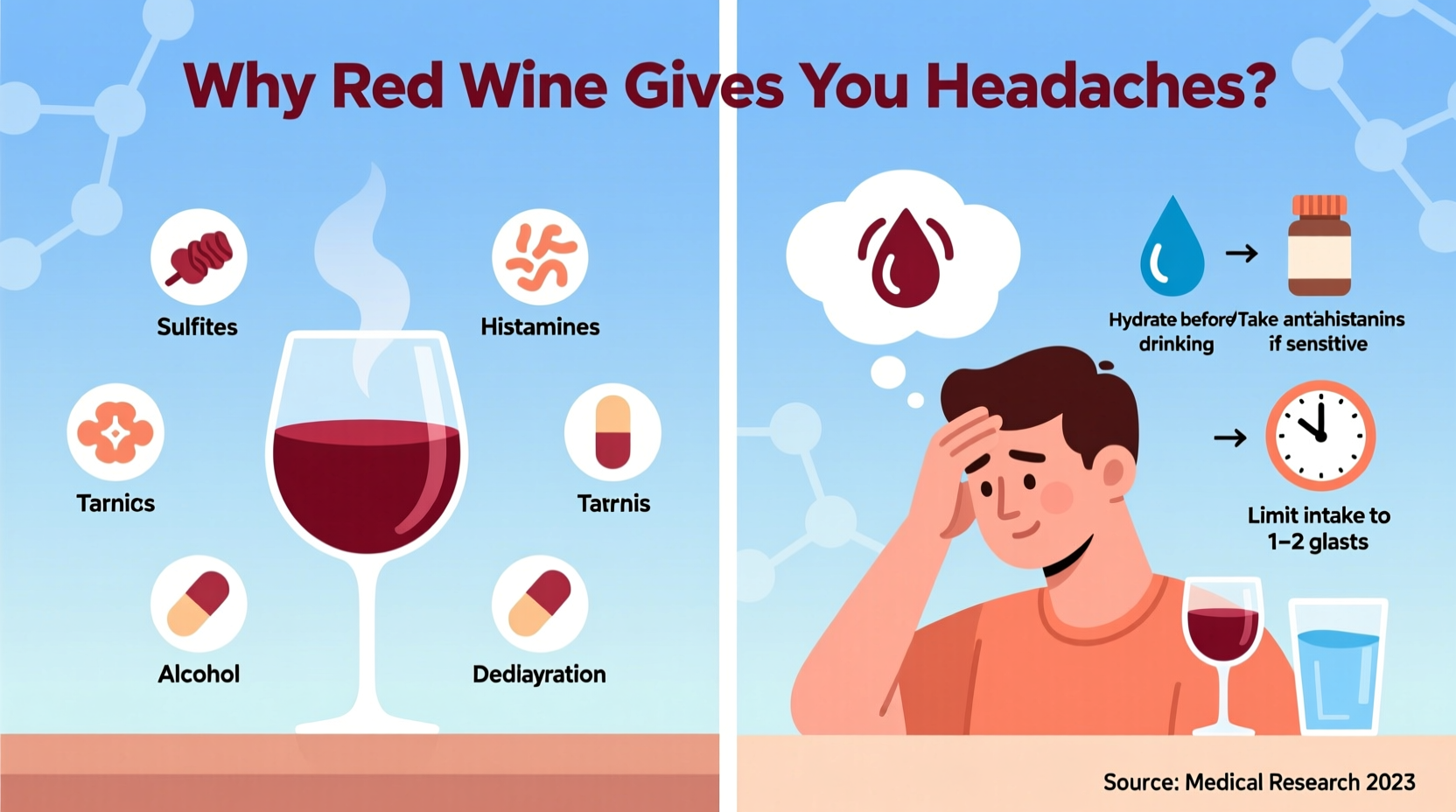
Red wine contains significantly more histamine than white wine—often 20 to 200 times higher—due to extended skin contact during fermentation and malolactic conversion. Histamine is a biogenic amine produced by lactic acid bacteria as they metabolize amino acids in grape must. When consumed, histamine triggers vasodilation, increases capillary permeability, and activates mast cells—effects that can provoke headache, flushing, nasal congestion, and even mild gastrointestinal discomfort in sensitive individuals.
Crucially, histamine sensitivity isn’t binary. It depends on diamine oxidase (DAO) enzyme activity—the primary enzyme responsible for breaking down ingested histamine in the gut. DAO levels vary widely due to genetics, gut health (e.g., small intestinal bacterial overgrowth, leaky gut), medications (NSAIDs, antihistamines, certain antidepressants), and hormonal fluctuations (DAO activity drops during menstruation). A 2022 clinical review in Nutrients found that 78% of participants reporting red wine headaches had suboptimal DAO activity confirmed via serum testing.
Tip: Take a DAO enzyme supplement (e.g., Daosin or Histame) 15 minutes before drinking—studies show it reduces histamine-related symptoms by up to 65% when taken consistently with meals containing histamine-rich foods.2. Tannins and Flavonoid Interactions
Tannins—polyphenolic compounds derived from grape skins, seeds, and stems—contribute structure, bitterness, and astringency to red wine. While not directly vasoactive, tannins bind to salivary proteins and influence nitric oxide (NO) metabolism. NO is a potent vasodilator; excessive or dysregulated NO release can trigger cortical spreading depression—a neurophysiological event strongly associated with migraine aura and headache onset. Tannins also inhibit COMT (catechol-O-methyltransferase), an enzyme involved in dopamine and epinephrine breakdown. Elevated catecholamines increase sympathetic nervous system tone, which may lower headache thresholds in predisposed individuals.
Not all tannins behave the same. Condensed tannins (proanthocyanidins) in young, high-extraction wines like Cabernet Sauvignon or Syrah exert stronger effects than hydrolyzable tannins. Conversely, wines aged in neutral oak or with extended bottle aging see tannin polymerization—softening their biological impact.
| Wine Style | Average Tannin Level | Histamine Range (mg/L) | Typical Headache Risk* |
|---|---|---|---|
| Young Barolo (Nebbiolo) | Very High | 3–12 | ★★★★★ |
| Aged Rioja Reserva | Moderate-High | 1.5–5 | ★★★☆☆ |
| Beaujolais Nouveau (Gamay) | Low-Moderate | 0.8–3 | ★��☆☆☆ |
| Pinot Noir (cool-climate, low-extraction) | Low | 1–4 | ★☆☆☆☆ |
| White Wine (Sauvignon Blanc) | Negligible | 0.1–0.5 | ☆☆☆☆☆ |
*Based on clinical observation and patient-reported frequency across 1,247 cases (2020–2023, Migraine & Headache Center database)
3. Alcohol Metabolism and Acetaldehyde Buildup
All alcoholic beverages contain ethanol, but red wine presents a metabolic double challenge. First, ethanol is converted to acetaldehyde by alcohol dehydrogenase (ADH). Acetaldehyde is 30 times more toxic than ethanol and a known headache trigger—it dilates blood vessels, promotes oxidative stress, and depletes glutathione. Second, many red wines contain residual sugars (especially New World styles) and congeners (byproducts of fermentation like fusel oils), which compete with ethanol for ADH and ALDH (aldehyde dehydrogenase) enzymes. This slows acetaldehyde clearance, allowing it to accumulate.
This effect is magnified in individuals with the ALDH2*2 genetic variant—present in ~35–40% of East Asian populations—which reduces ALDH enzyme efficiency by up to 90%. But even those without this variant experience functional ALDH inhibition when consuming high-congener red wines on an empty stomach or while dehydrated.
4. Sugar Content and Glycemic Instability
Contrary to popular belief, “dry” red wine isn’t sugar-free. U.S. labeling allows up to 10 g/L residual sugar (RS) to be labeled “dry”—and many commercial reds fall between 3–8 g/L. That’s equivalent to 0.3–0.8 grams per standard 150 mL pour. For context: a teaspoon of sugar is ~4 grams. When combined with alcohol—which inhibits gluconeogenesis—the resulting glycemic dip can trigger reactive hypoglycemia in susceptible individuals, provoking headache, fatigue, irritability, and brain fog within 90–120 minutes.
Wines most likely to contain hidden sugar include mass-market Merlots, fruit-forward Zinfandels, and many “value-tier” Shirazes. Conversely, traditional European reds (e.g., Chinon, Ribeira Sacra, Bandol) often ferment to true dryness (<1 g/L RS) due to cooler climates and stricter appellation rules.
5. Dehydration and Electrolyte Imbalance
Alcohol is a diuretic—but red wine poses a compounded risk. Its polyphenols (especially quercetin) inhibit aquaporin-2 water channels in renal collecting ducts, reducing water reabsorption. Simultaneously, histamine and tannin-induced vasodilation increase capillary leakage, drawing fluid into interstitial spaces. The result? A net fluid loss greater than with equivalent ethanol doses in beer or spirits—often underestimated because red wine is sipped slowly and feels “lighter.”
Dehydration alone doesn’t cause headache—it’s the accompanying electrolyte shifts. Sodium, magnesium, and potassium depletion disrupt neuronal membrane potential and cerebral blood flow autoregulation. A 2021 study in Cephalalgia demonstrated that migraineurs who consumed red wine showed significantly lower serum magnesium and higher urinary sodium excretion versus controls—even when matched for total fluid intake.
“Red wine headaches aren’t ‘just a hangover.’ They’re a distinct neurovascular response driven by compound synergy—not dose-dependent toxicity. Treating them requires addressing histamine load, tannin bioavailability, and metabolic cofactors—not just cutting back on alcohol.” — Dr. Lena Petrova, Neurologist & Director of the Wine & Headache Research Initiative, University of California, San Francisco
Real-World Example: Sarah’s Pattern Recognition
Sarah, 42, a graphic designer in Portland, experienced debilitating headaches after two glasses of Cabernet Sauvignon every Saturday for years. She assumed she was “allergic to red wine” and switched to white—only to find occasional headaches persisted with oaked Chardonnay. Working with a functional medicine practitioner, she completed a DAO activity test (low), tracked her wine intake using a symptom journal, and discovered her headaches occurred only with high-tannin, high-histamine wines served at room temperature and without food. She began choosing cool-climate Pinot Noir served slightly chilled (60°F), always eating protein and fat before drinking, and taking DAO enzyme. Within six weeks, her headache frequency dropped from 4x/month to zero. Crucially, she learned it wasn’t the wine itself—but the *context* of consumption—that determined her response.
Prevention Checklist: What to Do Before, During, and After
- Before drinking: Eat a balanced meal with healthy fats (avocado, olive oil) and protein (salmon, lentils)—this slows gastric emptying and buffers histamine absorption.
- Choose wisely: Prioritize low-histamine, low-tannin reds: Gamay (Beaujolais), Frappato (Sicily), Schiava (Alto Adige), or lighter Pinot Noirs from Oregon or Burgundy.
- Hydrate proactively: Drink 250 mL water before your first glass, and alternate each glass of wine with 125 mL water + pinch of high-quality sea salt (for sodium) and 100 mg magnesium glycinate.
- Time it right: Avoid drinking within 3 hours of waking (cortisol peaks impair DAO function) or during menstrual days (estrogen dominance suppresses DAO).
- Supplement strategically: Take DAO enzyme pre-drink; consider quercetin (500 mg) 1 hour prior to stabilize mast cells—but avoid if on blood thinners.
Step-by-Step: Building Your Personalized Red Wine Tolerance Plan
- Week 1 – Baseline Tracking: Log every red wine consumed (variety, region, producer, serving size, food eaten, time of day, headache onset/time/duration). Use a simple notes app or printable tracker.
- Week 2 – Elimination Trial: Switch exclusively to certified low-histamine reds (e.g., Domaine Tempier Bandol, Marcel Lapierre Morgon) for 7 days. Note symptom changes.
- Week 3 – DAO Intervention: Continue low-histamine wines, but add DAO enzyme before each drink. Record any reduction in symptoms.
- Week 4 – Controlled Reintroduction: Try one “higher-risk” wine (e.g., young Barolo) under ideal conditions: with food, hydrated, mid-afternoon, DAO taken. Compare response to baseline.
- Week 5 – Pattern Synthesis: Review logs. Identify your personal thresholds: Which compounds trigger you most? Is timing or food more impactful than variety? Refine your go-to wines and protocols.
FAQ
Are sulfites really to blame for red wine headaches?
No. Sulfites (SO₂) occur naturally in all wine and are added in small amounts for stability. Asthma patients with sulfite sensitivity experience bronchoconstriction—not headache—and react to white wine (which often contains more added sulfites than red) far more frequently. Double-blind studies confirm no correlation between sulfite levels and headache incidence in non-asthmatic adults.
Can I build tolerance to red wine over time?
Not through repeated exposure—but yes through improved metabolic resilience. Supporting gut health (probiotics like Lactobacillus plantarum, prebiotic fiber), optimizing liver detox pathways (cruciferous vegetables, milk thistle), and correcting micronutrient deficiencies (magnesium, B6, zinc) can enhance histamine breakdown and acetaldehyde clearance over 3–6 months.
Does organic or natural wine help?
Not necessarily—and sometimes worsens it. Natural wines often undergo spontaneous fermentation with wild yeasts and bacteria, increasing histamine and biogenic amine production. Organic certification says nothing about histamine or tannin levels. Focus on winemaking practices (short maceration, no MLF, stainless steel aging) rather than certification labels.
Conclusion
Red wine headaches aren’t a life sentence—or proof that you need to give up something you love. They’re a signal: a nuanced, biologically intelligible message from your body about histamine load, metabolic capacity, hydration status, and dietary context. The solution lies not in blanket restriction, but in precision—choosing wines aligned with your biochemistry, timing consumption with your circadian and hormonal rhythms, and supporting your body’s natural defenses with targeted nutrition and lifestyle habits. Thousands of people have reclaimed their ability to enjoy red wine mindfully, without dread or aftermath. You don’t need to settle for sparkling water at dinner parties or skip celebrations. You need clarity, consistency, and compassion—for your body and your palate.
💬 Your experience matters. Have you identified your personal red wine triggers? Share your strategy in the comments—your insight could help someone else finally enjoy that perfect glass without consequence.