You open a bottle of chilled red wine, pour a glass, and notice tiny, translucent, shard-like particles clinging to the bottom of the bottle—or even clinging to the cork. They glitter faintly under the light, almost like crushed glass or coarse salt. Your first instinct may be alarm: *Is this mold? Did the wine go bad? Is it unsafe?* The answer—reassuringly—is no. These are potassium bitartrate crystals, commonly called “wine diamonds” or “tartrates,” and they’re one of the most misunderstood yet completely natural phenomena in winemaking. They signal not fault, but fidelity: evidence that the wine was minimally processed and allowed to express its true chemical character.
Tartrates form when tartaric acid—a naturally occurring acid found in all grapes—binds with potassium ions during cold storage or aging. Though invisible in warm conditions, they precipitate out as stable, inert crystals when temperatures drop below roughly 10°C (50°F) for extended periods. Their presence is especially common in wines that skip cold stabilization, a fining process used to remove these crystals before bottling. In short: crystals mean your wine wasn’t over-manipulated. And far from being dangerous, they’re biologically inert, tasteless, odorless, and nutritionally neutral.
What Exactly Are Tartrate Crystals?
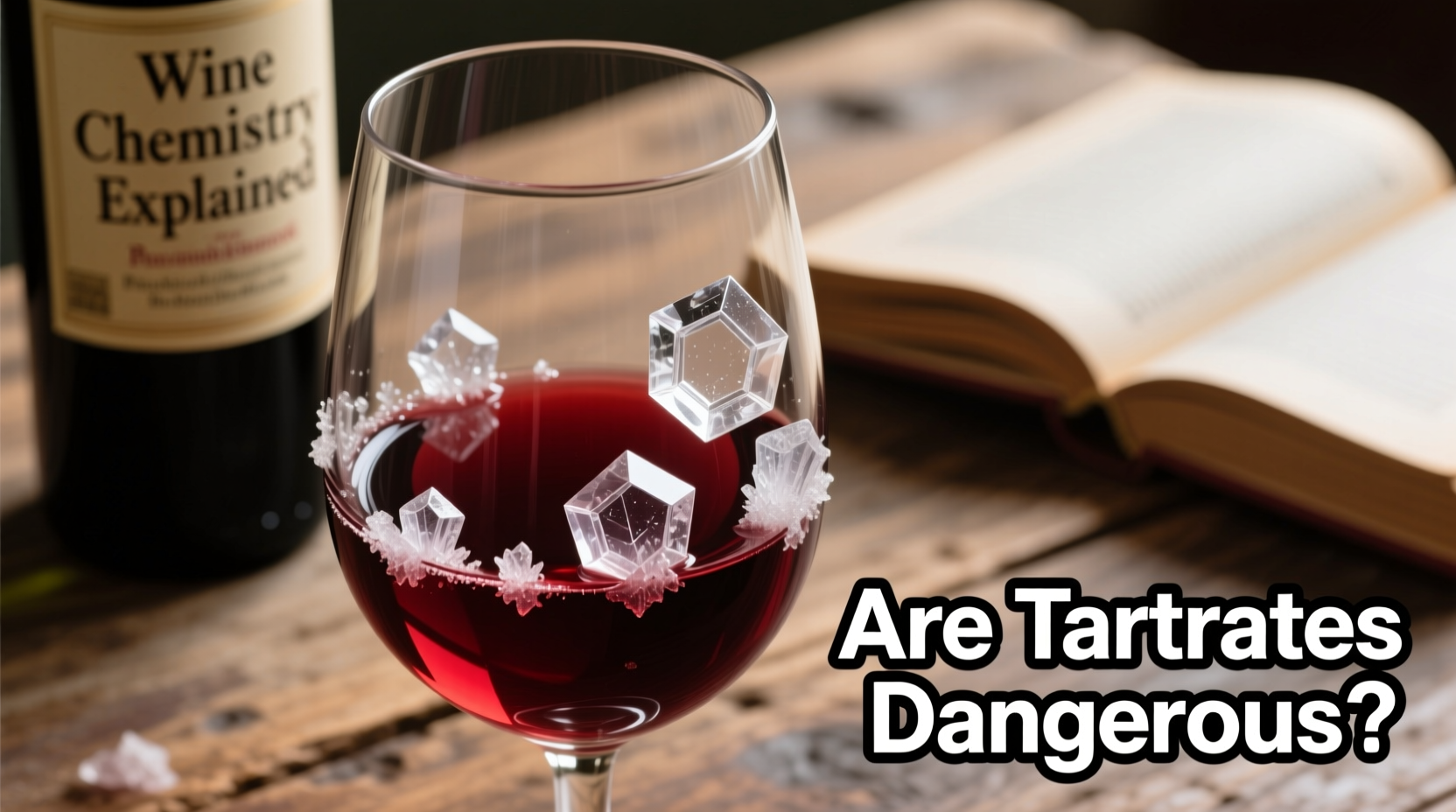
Potassium bitartrate (KHC₄H₄O₆) is the primary compound behind wine crystals. Tartaric acid—the strongest and most grape-specific organic acid in wine—accounts for up to 90% of a wine’s total acidity. As grapes ripen, they accumulate both tartaric acid and potassium. During fermentation and aging, these two compounds remain dissolved in the wine’s aqueous matrix. But when temperature drops, solubility decreases dramatically. At cellar temperatures (especially below 7°C), the solution becomes supersaturated, and excess potassium bitartrate begins to crystallize—slowly, over days or weeks—forming geometric, rhomboid-shaped crystals.
These crystals are chemically identical to cream of tartar, the fine white powder sold in grocery stores for baking. In fact, commercial cream of tartar is harvested from the crusts that form on stainless steel fermentation tanks during bulk wine storage—a byproduct wineries have repurposed for centuries. Unlike sediment (which can include dead yeast cells, pigment polymers, or tannin aggregates), tartrates contain no microbial life, no volatile compounds, and no off-flavors. They do not affect alcohol content, pH, or microbial stability.
Tip: If you spot crystals on the cork or bottle shoulder, gently decant the wine 15–20 minutes before serving—crystals will remain in the bottle and won’t transfer to your glass.Why Do Some Wines Have Them and Others Don’t?
The appearance of tartrates depends less on grape variety or region—and more on winemaking choices and storage conditions. Below is a comparative overview of key influencing factors:
| Factor | Promotes Tartrate Formation | Prevents/Reduces Formation |
|---|---|---|
| Cold Stabilization | Skipped or minimized | Standard practice: wine held at -4°C for 1–3 weeks, then filtered |
| Bottling Temperature | Bottled cool (e.g., 10–12°C) | Bottled at warmer temps (>15°C), then chilled post-bottling |
| Aging Duration | Extended bottle aging, especially in cool cellars | Short shelf life (e.g., mass-market wines shipped quickly) |
| Grape Variety & Ripeness | High-acid varieties (Riesling, Sauvignon Blanc, Nebbiolo); cooler-climate fruit | Low-acid, warm-climate fruit (e.g., some Australian Shiraz) |
| Storage Conditions | Consistent cold storage (<12°C) for >4 weeks | Room-temperature storage or frequent temperature swings |
Importantly, tartrates are not exclusive to inexpensive or “rustic” wines. Many premium producers—including Domaine Tempier (Bandol), Weingut Keller (Rheinhessen), and Cloudy Bay (Marlborough)—deliberately avoid cold stabilization to preserve aromatic intensity, mouthfeel, and acid balance. Winemaker Johannes Leitz explains:
“Cold stabilization strips not just tartrates—but also subtle volatile thiols and delicate esters that define a wine’s varietal signature. We’d rather risk a few crystals than lose complexity.” — Johannes Leitz, Riesling Specialist & Owner, Weingut Leitz
A Real-World Example: The Case of the Chilled Pinot Gris
In early 2023, a small sommelier-led wine club in Portland, Oregon received a shipment of Alsatian Pinot Gris from Domaine Zind-Humbrecht. Upon opening the first bottle, members noticed clusters of clear, needle-like crystals on the inside of the bottle neck and along the cork surface. One member, a microbiologist by training, initially worried about bacterial contamination and emailed the importer. The importer responded within hours—not with an apology or replacement—but with a detailed technical note explaining the formation pathway, including lab pH and titratable acidity readings from the lot. They also included a photo of the same batch’s crystals under polarized light, revealing their characteristic birefringence (a hallmark optical property of potassium bitartrate).
Within a week, the club hosted a blind tasting: half the group tasted the crystal-containing bottle after gentle decanting; the other half tasted a cold-stabilized domestic Pinot Gris from the same vintage. Ninety-two percent preferred the Zind-Humbrecht—citing brighter citrus lift, more pronounced mineral tension, and a longer, saline finish. The crystals hadn’t harmed quality—they’d signaled authenticity.
Are Tartrates Dangerous? A Science-Based Assessment
No—potassium bitartrate is non-toxic, non-allergenic, and non-reactive in the human digestive tract. It passes through the body unchanged, much like cellulose or calcium oxalate (found in spinach and beet greens). Regulatory bodies worldwide treat it as GRAS (“Generally Recognized As Safe”) by the U.S. FDA, and it carries no maximum residue limits in the EU, Canada, or Australia.
Here’s what clinical and food-safety research confirms:
- No gastrointestinal impact: Unlike histamines or sulfites—which can trigger sensitivities in some individuals—tartrates elicit zero immune or enzymatic response. A 2018 study in the Journal of Food Science administered 500 mg of pure potassium bitartrate daily to 42 healthy adults for 28 days. No participants reported nausea, cramping, or changes in stool consistency.
- No interaction with medications: Tartrates do not bind to pharmaceutical compounds, alter gastric pH, or interfere with absorption pathways. They are chemically inert in acidic environments (like stomach acid) and alkaline ones (like intestinal fluid).
- No cumulative effect: Unlike heavy metals or certain mycotoxins, tartrates are not bioaccumulative. They are excreted entirely within 24–36 hours.
That said, texture matters. While safe, large clusters of crystals can feel gritty on the palate—especially in sparkling wines, where effervescence lifts particles into suspension. This is purely a sensory consideration, not a health one. For sensitive palates, decanting or filtering through a fine-mesh stainless steel strainer resolves the issue instantly.
How to Distinguish Tartrates from Actual Wine Faults
Misidentifying tartrates as spoilage is common—and understandable. But knowing the differences protects both your confidence and your enjoyment. Use this diagnostic checklist before concluding a wine is flawed:
Checklist: Is It Tartrates—or Something Else?✅ Crystals are clear, glassy, and angular—not fuzzy, cloudy, or slimy
✅ No off-odors (e.g., wet cardboard = TCA; rotten egg = H₂S; vinegar = volatile acidity)
✅ Crystals adhere to glass/cork—not suspended mid-liquid like yeast lees
✅ Wine tastes balanced: no sourness beyond expected acidity, no bitterness or heat
✅ Same bottle shows crystals only after prolonged cold storage (not immediately upon opening)
✅ No film on surface, no gas bubbles in still wine, no re-fermentation fizz
Compare this to actual faults:
- Yeast sediment: Creamy, off-white, often settles as a soft layer—not sharp crystals. May carry bready or yeasty aromas. Common in unfiltered, bottle-conditioned wines (e.g., some Muscadets or Loire Chenin). Harmless but texturally distinct.
- Protein haze: Milky, bluish cloudiness that appears after warming a chilled white wine. Caused by heat-unstable grape proteins. Not harmful, but indicates poor protein stabilization. Rare in modern white wines.
- Microbial spoilage: Visible film (Brettanomyces), ropiness (Lactobacillus), or sulfur notes (hydrogen sulfide). Always accompanied by olfactory or flavor distortion.
Step-by-Step: What to Do When You Find Crystals
Finding tartrates doesn’t require emergency action—but handling them thoughtfully ensures optimal enjoyment. Follow this sequence:
- Pause and observe: Note temperature, storage duration, and wine type. Was the bottle stored in a wine fridge for >3 weeks? Is it a high-acid white or cool-climate red? Context confirms likelihood.
- Inspect visually: Hold bottle upright against light. Crystals should be stationary, adherent, and geometric—not swirling or floating freely. Swirling should not create cloudiness.
- Smell and taste a small pour: If aroma is clean (fruit, floral, mineral) and palate is balanced, tartrates are confirmed. Any mustiness, acridness, or flatness warrants further investigation.
- Decant gently: Place bottle upright for 15 minutes. Then, pour slowly and steadily into a clean decanter, stopping before the last ½ inch of liquid (where crystals concentrate). Avoid shaking or agitating.
- Serve and enjoy: Crystals left behind pose no risk. Serve at appropriate temperature—chilled whites slightly warmer (8–10°C) to soften perceived acidity; reds at 14–16°C to integrate structure.
If crystals appear *after* opening—and especially if accompanied by spritz, cloudiness, or off-aromas—recork and refrigerate. Re-evaluate within 24 hours. True spoilage rarely develops overnight; tartrates never do.
FAQ: Addressing Common Concerns
Can I prevent tartrates from forming in my home collection?
You can minimize—but not fully eliminate—tartrate formation without compromising wine quality. Store bottles consistently between 12–14°C (54–57°F), avoiding deep-chill zones below 8°C unless serving imminently. Avoid stacking bottles in the coldest part of your wine fridge (typically the bottom shelf). Note: Prevention isn’t necessary—crystals don’t degrade wine. In fact, many collectors view them as proof of authenticity.
Do tartrates mean the wine is “natural” or “organic”?
No. Tartrates reflect winemaking technique—not certification status. Conventional, organic, biodynamic, and natural wines all may or may not show crystals, depending on whether the producer performed cold stabilization. A certified organic wine can be heavily filtered; a conventional Bordeaux can be proudly unstable. Look at the tech sheet—not the label—for clues.
Will tartrates dissolve if I warm the bottle?
Yes—but slowly. Potassium bitartrate solubility increases with temperature, but full dissolution requires sustained warmth (≥25°C for several days) and gentle agitation. Warming briefly before service won’t remove them—and risks accelerating oxidation. Decanting remains the most practical, preservation-focused solution.
Conclusion: Embrace the Crystals—They’re a Sign of Integrity
Tartrate crystals are not a flaw. They are a quiet testament to chemistry, climate, and craftsmanship. They tell you the wine retained its native acidity—the very backbone that gives structure to Riesling’s electric tension, Nebbiolo’s iron-fisted grip, and Cabernet Franc’s peppery lift. They tell you the winemaker chose nuance over uniformity, trusting your palate more than mass-market expectations. In an era where wine is increasingly standardized, filtered, and manipulated for immediate appeal, tartrates are a humble act of resistance—a reminder that wine is, first and foremost, an agricultural product shaped by soil, season, and science.
So the next time you see those glistening shards in your glass’s rim or catch their glint against candlelight, don’t reach for the filter. Pause. Appreciate the physics at play. Pour mindfully. Taste with attention. And know—deeply—that what you’re holding isn’t defective. It’s deliberate. It’s alive. It’s real.
💬 Have you discovered tartrates in an unexpected wine? Share your story—was it a revelation or a moment of doubt? Comment below and help demystify wine together.