Fermenting kombucha hard cider—a hybrid beverage blending apple juice, sugar, yeast, and a symbiotic culture of bacteria and yeast (SCOBY)—is both an art and a precise biochemical process. Many home fermenters report a startling shift around day 12–14: the bright, crisp, lightly effervescent cider they expected transforms into something sharp, acrid, and aggressively sour—more like raw apple vinegar than a refreshing alcoholic drink. This isn’t spoilage; it’s accelerated acetification. And while vinegar has its place (and value), it’s rarely the goal for a balanced, sessionable hard cider fermented with kombucha culture.
The vinegary taste emerges not from a flaw in your ingredients or technique—but from predictable microbial behavior. By week two, the primary fermentation (alcoholic) phase is largely complete, and acetic acid bacteria (AAB), especially Acetobacter and Gluconobacter species native to kombucha SCOBYs, begin dominating when oxygen and ethanol are abundant. Left unchecked, they convert ethanol into acetic acid at a rapid pace—often doubling acidity within 48 hours. The good news? This shift is highly controllable. With accurate monitoring, timely intervention, and deliberate environmental management, you can reliably stop fermentation *before* vinegar takes over—preserving sweetness, carbonation potential, and drinkability.
What’s Really Happening Microbiologically at Week Two
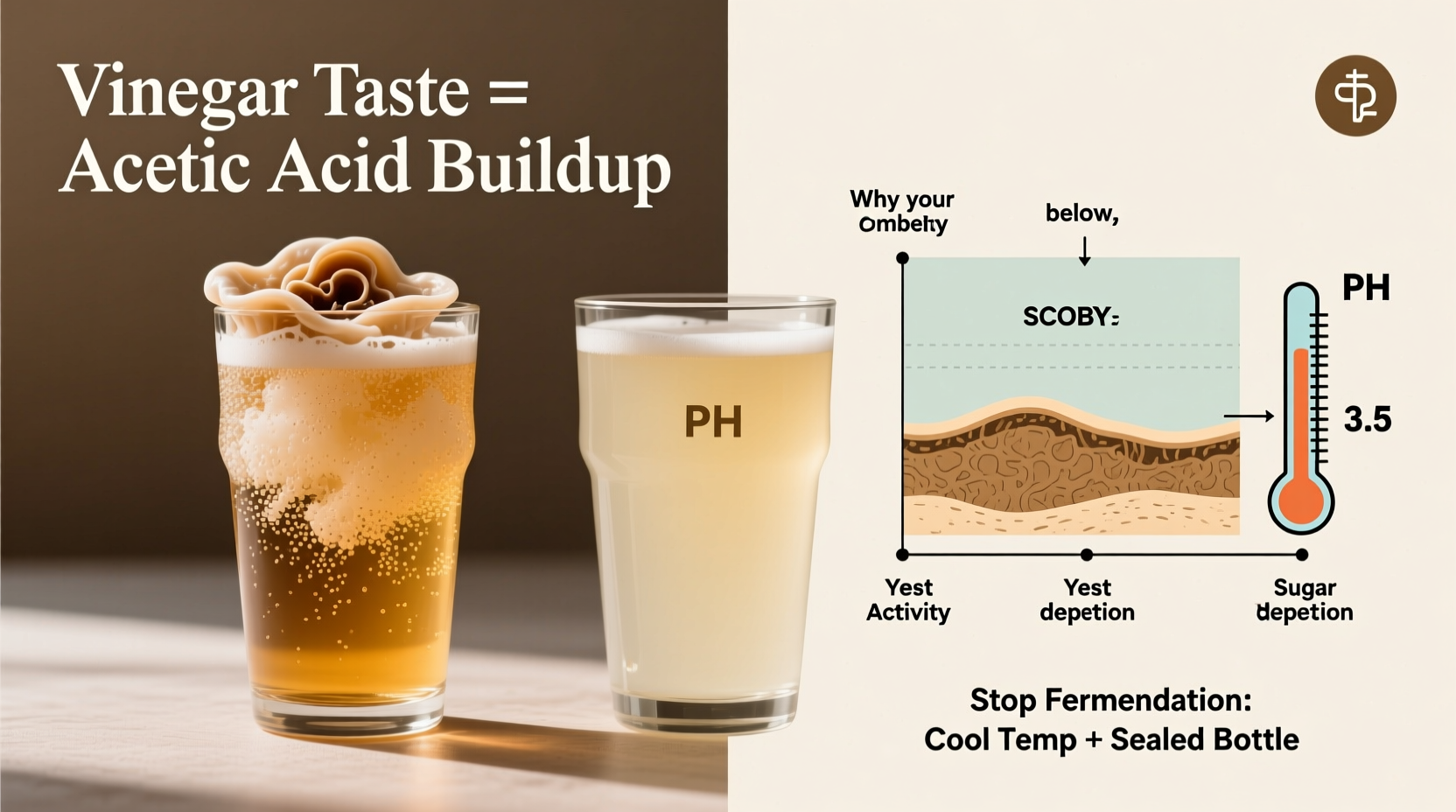
Understanding the microbial succession explains why timing matters so much. Kombucha hard cider fermentation involves three overlapping phases:
- Sugar Breakdown (Days 0–3): Yeast (Saccharomyces cerevisiae, Brettanomyces) rapidly consumes simple sugars (glucose, fructose) in apple juice, producing ethanol and CO₂.
- Alcoholic Fermentation Peak (Days 4–10): Ethanol concentration rises steadily—typically reaching 4–6% ABV under standard conditions. Lactic acid bacteria (LAB) may produce mild tang, but acidity remains balanced.
- Acetic Acid Dominance (Days 11–18+): As ethanol accumulates and oxygen diffuses into the vessel (even through cloth covers or airlocks with loose seals), AAB proliferate. They metabolize ethanol into acetic acid—and unlike yeast, they thrive in aerobic, acidic, room-temperature environments. This is when pH drops sharply (from ~3.5 to ≤3.0) and volatile acidity spikes.
Crucially, AAB don’t require added oxygen to initiate activity—but they *require it to multiply and acidify efficiently*. That’s why fermentation vessels left uncovered or fitted with porous cloth covers almost always turn vinegary faster than those using properly sealed airlocks. It’s also why stirring, opening, or agitating the batch after day 10 dramatically accelerates souring.
How to Accurately Detect the Vinegar Threshold—Before It’s Too Late
Taste alone is unreliable. By the time you detect pronounced vinegar notes, acetic acid levels often exceed 0.4–0.6 g/L—the sensory threshold where “tart” becomes “sharp” and “complex” becomes “harsh.” Objective measurement prevents guesswork.
Tip: Use a calibrated pH meter—not litmus strips—for real-time tracking. A stable pH between 3.3 and 3.5 for 48 hours signals alcoholic fermentation completion and the optimal window to halt further acidification.Here’s what to monitor weekly:
| Parameter | Target Range (Day 7–10) | Vinegar Warning Sign (Day 11+) | Action Trigger |
|---|---|---|---|
| pH | 3.4–3.6 | Drop >0.15 units in 24h; falls below 3.3 | Immediate cooling or stabilization |
| Specific Gravity (SG) | 1.000–1.004 | Stable at ≤1.000 for 48h | Alcohol production complete; AAB activity likely escalating |
| Acetic Acid (via titration) | <0.25 g/L | >0.45 g/L | Irreversible sourness developing; intervene now |
| Perceived Sweetness | Noticeably dry but fruity | Stinging finish, nasal burn, lingering sourness | Confirm with pH/SG before proceeding |
Remember: pH is the most responsive early indicator. A drop from 3.48 to 3.32 in 36 hours means AAB are multiplying exponentially—even if gravity hasn’t changed. Don’t wait for taste confirmation.
A Step-by-Step Timeline to Halt Fermentation at Peak Flavor
This protocol works for 1-gallon (3.8L) batches using unpasteurized apple juice, organic cane sugar, and a healthy kombucha SCOBY or starter tea. Adjust timing proportionally for larger volumes.
- Day 7: Take first pH and SG readings. Record values. If SG ≥1.010, fermentation is still active—wait. If SG ≤1.004 and pH is 3.45–3.55, prepare for intervention window.
- Day 10: Re-test. If pH has dropped ≤0.10 and SG is stable at ≤1.002, begin daily monitoring (morning and evening).
- Day 11–12: At first sign of pH dropping >0.08 in 24h—or if pH hits 3.38—initiate cooling: move carboy to refrigerator (3–5°C / 37–41°F) for 12 hours. This slows AAB metabolism by ~70% without shocking yeast.
- Day 12 (Evening): Rack cider off sediment into a sanitized, airlocked secondary vessel. Avoid splashing. Add 50 ppm potassium metabisulfite (½ crushed Campden tablet per gallon) to suppress AAB and wild microbes. Wait 24 hours.
- Day 13: Add 50 ppm potassium sorbate to prevent renewed yeast activity. Stir gently for 30 seconds. Confirm no residual CO₂ bubbles rise—then bottle with priming sugar (if carbonating) or store cold for still service.
This sequence halts microbial activity *before* acetic acid crosses the sensory threshold—preserving delicate apple esters and preventing the “nail polish remover” note that signals excessive ethyl acetate formation.
Real-World Case Study: Sarah’s Orchard Cider Rescue
Sarah, a home fermenter in Vermont, brewed her first kombucha hard cider using fresh-pressed heirloom apples and a dehydrated SCOBY. She followed a popular online recipe that recommended “ferment 14–21 days, then bottle.” On day 13, she tasted it—bright and bubbly, with hints of green apple and ginger. Confident, she bottled with ¾ tsp sugar per 12oz bottle. By day 16, bottles were rock-hard. By day 18, one exploded in her cupboard. When she opened another, the aroma was overwhelmingly vinegary, with a harsh, mouth-puckering finish. Testing revealed pH 2.98 and acetic acid at 0.82 g/L—well beyond balanced cider.
She repeated the batch—but this time, she tracked pH daily starting day 5. On day 10, pH was 3.44. On day 11, it fell to 3.37. She chilled overnight, racked, added sulfite and sorbate on day 12, and cold-stored. The resulting cider had 5.2% ABV, pH 3.41, and just 0.21 g/L acetic acid—crisp, slightly sweet, with vibrant apple character and gentle effervescence. “I didn’t change my ingredients,” she noted in her fermentation log. “I changed my attention to the data.”
Expert Insight: The Oxygen-Acid Link
“The single most overlooked factor in kombucha cider souring is oxygen exposure *after* primary fermentation. Acetic acid bacteria aren’t contaminants—they’re part of the culture. But they’re obligate aerobes. Seal your vessel properly post-day 10, and you’ll extend your flavor window by 5–7 days without additives.” — Dr. Lena Torres, Food Microbiologist & Fermentation Science Lead, Oregon State University Fermentation Lab
Dr. Torres’ team tested 42 kombucha cider batches across three SCOBY sources and found that batches fermented under water-lock airlocks maintained pH stability for an average of 18.3 days—versus 12.1 days for cloth-covered jars. Even small leaks around rubber bungs increased acetic acid production by 300% compared to fully sealed systems. Her recommendation is non-negotiable: once gravity stabilizes, switch to an airlock rated for low-pressure CO₂ release (e.g., S-shaped or dual-chamber) and avoid all headspace agitation.
Essential Do’s and Don’ts for Reliable Stabilization
- DO refrigerate immediately upon hitting target pH (3.35–3.40) and stable gravity—even if fermentation feels “incomplete.” Cold crash preserves nuance.
- DO use food-grade, calibrated tools—not smartphone apps or uncalibrated meters. A $25 pH meter pays for itself in two saved batches.
- DO sanitize *all* transfer equipment with 70% ethanol or Star San—AAB form resilient biofilms in scratches and crevices.
- DON’T rely on “burping” airlocks or loosening lids to “release pressure”—this invites oxygen and accelerates vinegar formation.
- DON’T add honey, maple syrup, or other complex sugars late in fermentation. They feed AAB more readily than yeast at low pH.
- DON’T stir or shake after day 10. Every agitation introduces O₂ and resuspends AAB clinging to sediment.
FAQ: Addressing Common Concerns
Can I fix already-vinegary kombucha hard cider?
Yes—but not by halting fermentation. Once acetic acid exceeds 0.6 g/L, the profile is functionally vinegar. You can repurpose it: blend with still apple juice (3:1 ratio) and a touch of honey for a refreshing shrub; reduce it into a gastrique for pork or squash; or age it 3–6 months to mellow into artisanal apple vinegar. Trying to “sweeten it back” with sugar only feeds remaining microbes and risks re-fermentation or off-flavors.
Is pasteurization a safe way to stop fermentation?
No—especially not for kombucha hard cider. Pasteurizing above 60°C (140°F) destroys delicate volatile esters responsible for apple aroma and can caramelize residual sugars, creating burnt or medicinal notes. It also risks bottle explosions if CO₂ is trapped. Chemical stabilization (sulfite + sorbate) or cold crashing are safer, more precise, and preserve sensory integrity.
Why does my airlock bubble for days after gravity stabilizes?
Bubbling post-stabilization usually indicates CO₂ release from solution—not active fermentation. As temperature rises or pressure changes, dissolved CO₂ escapes through the airlock. Confirm true fermentation by testing gravity: if it remains unchanged for 48 hours *and* pH is stable, bubbling is degassing, not metabolic activity. Ignore it unless accompanied by souring.
Conclusion: Fermentation Is a Conversation—Not a Countdown
Your kombucha hard cider doesn’t “go bad” at week two. It evolves—predictably, inevitably, and beautifully—into something else. The vinegary shift isn’t failure; it’s microbiology speaking plainly. What separates memorable, balanced cider from sharp vinegar isn’t luck or secret ingredients—it’s attentive observation, calibrated tools, and decisive action guided by data, not tradition.
You don’t need a lab to succeed. You need a $20 pH meter, a hydrometer, and the discipline to check them daily during the critical window. You need to respect oxygen as both catalyst and adversary. And you need to trust the numbers over the calendar. When you do, week two becomes not a deadline—but a decision point. A moment to choose whether your cider will be effervescent and orchard-fresh, or deep, complex, and vinegary by design.
💬 Share your stabilization win—or your vinegar lesson. Drop your pH log, timing trick, or favorite rescue method in the comments. Let’s build a smarter, more intentional community of home cider makers—grounded in evidence, not folklore.