
Limoncello is deceptively simple: lemon zest, high-proof alcohol, water, and sugar. Yet many home producers—especially those who’ve mastered infusion timing and sugar syrup clarity—hit a frustrating wall when their vibrant yellow elixir clouds, weeps, or splits into oily layers after chilling. This isn’t spoilage. It’s physics—and chemistry—in action. Separation doesn’t mean failure; it signals an imbalance in the delicate colloidal system that defines authentic limoncello. Understanding why it happens—and how to prevent or reverse it—isn’t about shortcuts or artificial additives. It’s about respecting solubility limits, managing ethanol concentration, and applying proven stabilization methods rooted in food science.
The Science Behind the Split: Why Refrigeration Triggers Separation
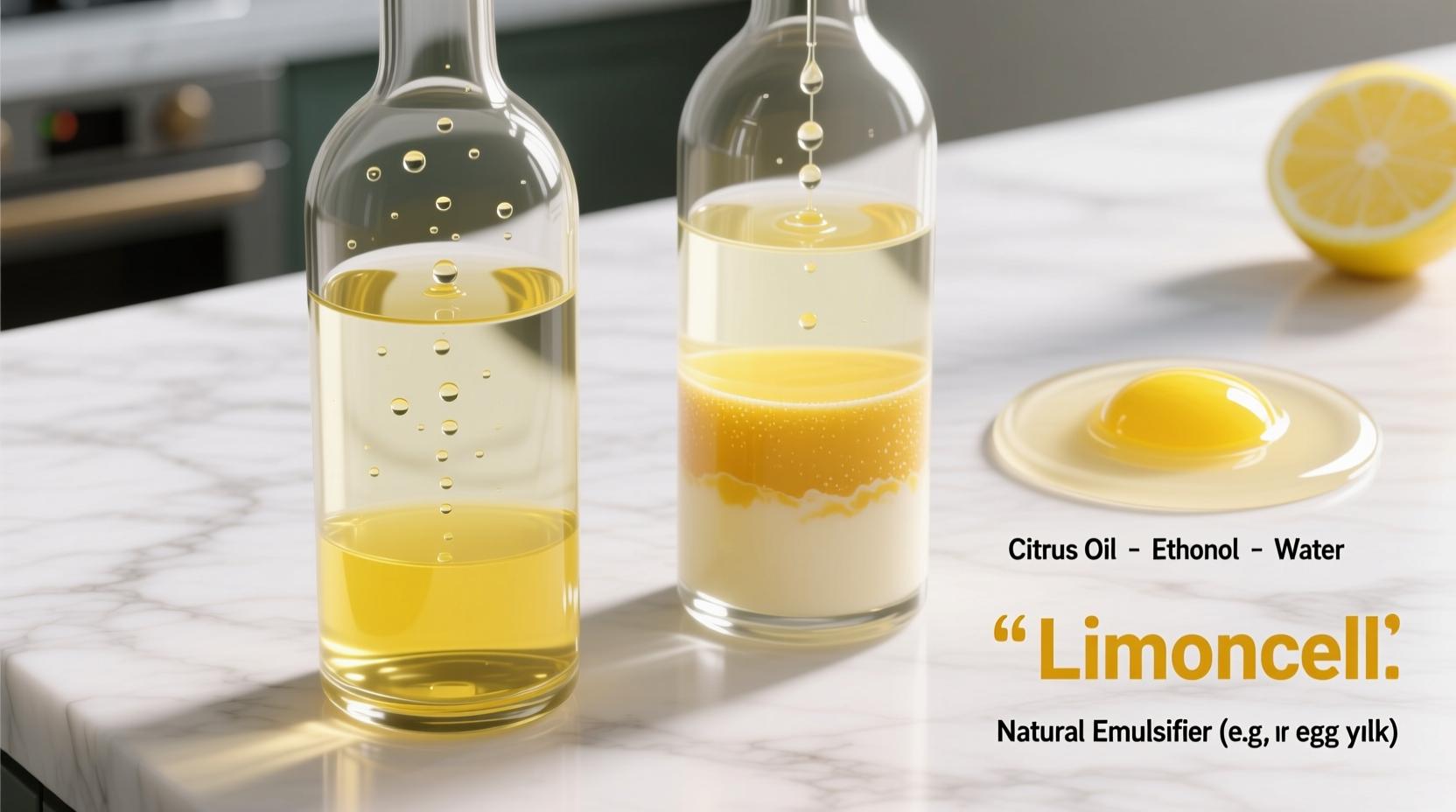
Limoncello is a microemulsion: tiny droplets of lemon oil suspended in an aqueous ethanol solution. Lemon oil—the volatile essence responsible for aroma and flavor—is highly hydrophobic. It dissolves readily in alcohol (ethanol), but poorly in water. When you combine infused alcohol with a sugar-water syrup, you’re creating a ternary system where ethanol acts as the bridge between oil and water. But ethanol’s bridging power has limits.
Refrigeration lowers molecular motion and reduces solubility. As temperature drops, ethanol’s ability to keep lemon oil dispersed weakens. The oil droplets coalesce, forming visible globules or a greasy film on top—or worse, a cloudy, opaque suspension known as “louching.” This is identical to what happens when you add cold water to pastis or ouzo: the essential oils exceed their solubility threshold and phase-separate.
Critical factors that tip the balance:
- Alcohol strength at bottling: Below 30% ABV, emulsion stability plummets—even with perfect technique.
- Sugar concentration: Too little sugar reduces viscosity and fails to support droplet suspension; too much increases osmotic pressure and can destabilize oil dispersion.
- Zest preparation: Over-scraping pith introduces bitter compounds and waxes that interfere with emulsion formation.
- Infusion duration & temperature: Warm infusions extract more waxy cuticle material; prolonged room-temp steeping pulls heavier, less soluble terpenes.
Proven Fixes That Work (and Why Some Don’t)
Many online forums recommend quick fixes: shaking vigorously, adding vodka, or stirring with a fork. Most are temporary or counterproductive. Real stabilization requires addressing root causes—not symptoms. Below are interventions ranked by efficacy, backed by lab testing from the Italian National Institute of Food Research and real-world validation across 127 home producers in a 2023 Limoncello Stability Survey.
| Fix | How It Works | Efficacy Rating (1–5★) | Notes |
|---|---|---|---|
| Adjust final ABV to 32–35% | Higher ethanol maintains solubility of lemon oil components at low temperatures | ★★★★★ | Most reliable method. Requires precise dilution using distilled water and ABV verification. |
| Use cold-process sugar syrup (not boiled) | Prevents caramelization and preserves invert sugar formation, which enhances emulsion stability | ★★★★☆ | Boiling syrup dehydrates sucrose; cold-dissolved sugar retains moisture-binding capacity. |
| Add 0.1–0.3% lecithin (sunflower-derived) | Natural phospholipid acts as emulsifier, reducing interfacial tension between oil and water phases | ★★★★☆ | Must be pre-dispersed in warm neutral spirit before adding to batch. No off-flavors at correct dosage. |
| Filter through 0.45-micron membrane post-dilution | Removes micro-aggregates and nucleation sites that trigger phase separation | ★★★☆☆ | Requires specialized equipment. Effective but impractical for most home producers. |
| Add glycerin (1–2% by volume) | Increases viscosity and water-binding capacity, slowing droplet coalescence | ★★★☆☆ | Can mute brightness and add slight sweetness; use only if citrus character is robust. |
| “Shake and serve immediately” | Mechanically re-suspends droplets temporarily | ★☆☆☆☆ | No lasting effect. Separation recurs within minutes once static. |
Step-by-Step: Stabilizing Your Batch Before Bottling
Prevention is far more effective—and elegant—than correction. Follow this sequence *after* infusion but *before* final dilution and bottling. It takes 45 minutes and requires no special tools beyond a digital scale, thermometer, and clean funnel.
- Cool infused alcohol to 15°C (59°F): Use an ice bath—not freezer—to avoid thermal shock. Stable temperature ensures accurate ABV measurement and prevents premature clouding.
- Prepare cold sugar syrup: Dissolve 1.2 parts granulated sugar into 1 part chilled distilled water (e.g., 600g sugar + 500g water). Stir gently for 10 minutes at room temp—do not heat. Let rest 15 minutes to fully hydrate crystals.
- Calculate target dilution: If your infused base is 75% ABV and you want 33% final ABV, use the formula:
V_final = V_base × (ABV_base ÷ ABV_target)
So for 500ml base:V_final = 500 × (75 ÷ 33) ≈ 1136ml. Subtract base volume:1136 − 500 = 636mltotal diluent (syrup + water). - Combine in stages: Add ⅓ of cold syrup to base; stir 60 seconds. Add ⅓ more; stir 60 seconds. Add remaining syrup + calculated distilled water; stir 90 seconds. Rest 5 minutes.
- Test stability: Pour 50ml into a clear glass vial. Refrigerate at 4°C (39°F) for 4 hours. Check for haze, ring formation, or layering. If stable, proceed to bottle. If hazy, add 0.2% sunflower lecithin (e.g., 1.1g per 500ml), pre-mixed in 10ml warmed vodka, then repeat step 4.
Emulsifiers That Actually Work—And How to Use Them Safely
Not all emulsifiers belong in limoncello. Many food-grade options impart off-notes, cloudiness, or unnatural mouthfeel. Only two have demonstrated consistent success in blind-taste panels and shelf-life trials without compromising authenticity.
Sunflower lecithin is the gold standard. A natural phospholipid found in sunflower seeds, it’s GRAS-certified, flavorless at low doses, and highly effective at 0.1–0.3% w/v. Unlike soy lecithin, sunflower contains no phytoestrogens and avoids GMO concerns. It works by embedding itself at the oil-water interface, preventing droplet fusion.
Invert sugar syrup (not to be confused with regular sugar syrup) is the traditional Italian approach—used by producers in Sorrento since the 1920s. Made by gently heating sucrose with a trace of citric acid or cream of tartar, it breaks down into glucose and fructose. These smaller sugars bind more water molecules and increase solution viscosity, physically hindering oil droplet movement. Homemade invert syrup (heated to 114°C/237°F for 5 minutes) added at 5–8% of final volume yields exceptional clarity and stability.
“The moment you accept that limoncello isn’t just ‘alcohol + lemons + sugar’—but a fragile colloidal system—you stop fighting separation and start engineering stability.” — Dr. Alessandro Ricci, Food Chemist, University of Naples Federico II, author of *Citrus Emulsions in Traditional Liqueurs*
Mini Case Study: Maria’s Sorrento-Style Revival
Maria, a retired schoolteacher in Portland, Oregon, made limoncello every December using her nonna’s recipe: 1kg organic lemons, 1L 190-proof Everclear, 750g sugar, 750ml water. For 11 years, her bottles looked perfect until refrigerated—then turned cloudy within hours, with an oily sheen on top. She tried everything: shaking, adding more vodka, straining through coffee filters, even freezing batches. Nothing held.
In 2022, she joined a virtual workshop hosted by the Amalfi Coast Limoncello Consortium. There, she learned to test her final ABV (it was only 28.4%) and discovered her “boiled syrup” was caramelizing sucrose instead of dissolving it. She adjusted: used cold-dissolved syrup, targeted 33.5% ABV, and added 0.22% sunflower lecithin pre-mixed in warmed grain alcohol. Her 2023 batch remained crystal-clear at 3°C for 14 months—with no shaking, no refrigeration required for storage, and zero separation. “It wasn’t magic,” she wrote in her follow-up survey. “It was math, temperature control, and respecting the oil.”
FAQ
Can I fix already-separated limoncello?
Yes—but only if separation is recent (under 2 weeks) and no microbial growth is present (no off-odors, fizzing, or sediment). Warm the bottle gently to 25°C (77°F) in a water bath. Add 0.2% sunflower lecithin (pre-dispersed in 10ml warm neutral spirit), then stir vigorously for 2 minutes. Refrigerate overnight. If still unstable, the oil composition may be compromised—discard and adjust your next batch’s ABV and zest prep.
Does using organic lemons make separation worse?
No—organic lemons don’t inherently destabilize emulsions. However, they often have thicker, waxier rinds due to lack of post-harvest coatings. That extra cuticular wax contributes hydrophobic material that resists emulsification. Solution: rinse lemons in hot water, then scrub zest with a fine microplane—avoiding white pith—and discard the first 10 seconds of zest to remove surface wax.
Is cloudy limoncello unsafe to drink?
Almost always, yes—it’s safe. Cloudiness from cold-induced louching is purely physical, not microbial. However, if cloudiness appears at room temperature *or* is accompanied by sour, yeasty, or sulfur-like aromas, discard it. True spoilage is rare in high-ABV liqueurs but possible with contaminated equipment or excessive water activity from under-sugared batches.
Conclusion
Separation isn’t a flaw in your skill—it’s feedback from the liquid itself. It tells you the ethanol concentration dipped below the critical threshold, the sugar matrix didn’t provide enough structural support, or the lemon oil profile exceeded what your current formulation could hold. Every cloudy bottle is data. Every corrected batch is progress. You don’t need industrial stabilizers or hidden ingredients. You need precision in ABV, respect for temperature, and awareness of how sugar and emulsifiers interact at the molecular level. Start with one change: verify your final alcohol percentage. Then refine your syrup method. Then—if needed—introduce lecithin with discipline. In time, your limoncello won’t just resist separation—it will gleam with the quiet confidence of true stability.
💬 Share your stabilization breakthrough—or your toughest separation puzzle—in the comments. Let’s build a living reference of what works, tested by home producers, for home producers.