
Vodka is often marketed as “tasteless, odorless, and colorless”—a neutral spirit defined by its purity. Yet anyone who’s sipped a budget bottle straight, mixed it in a simple martini, or tasted it side-by-side with a premium expression knows the truth: not all vodkas are created equal. Some sting the throat, burn the tongue, leave a bitter aftertaste, or carry an odd chemical tang. This isn’t just subjective preference—it’s measurable chemistry. The perceived harshness of inexpensive vodka stems from concrete, quantifiable differences in composition, production methodology, and molecular behavior—not marketing budgets or bottle design. Understanding the science behind that bite reveals how distillation, filtration, congeners, and ethanol quality interact at the molecular level—and why paying more isn’t about prestige, but precision.
The Ethanol Paradox: Purity ≠ Perfection
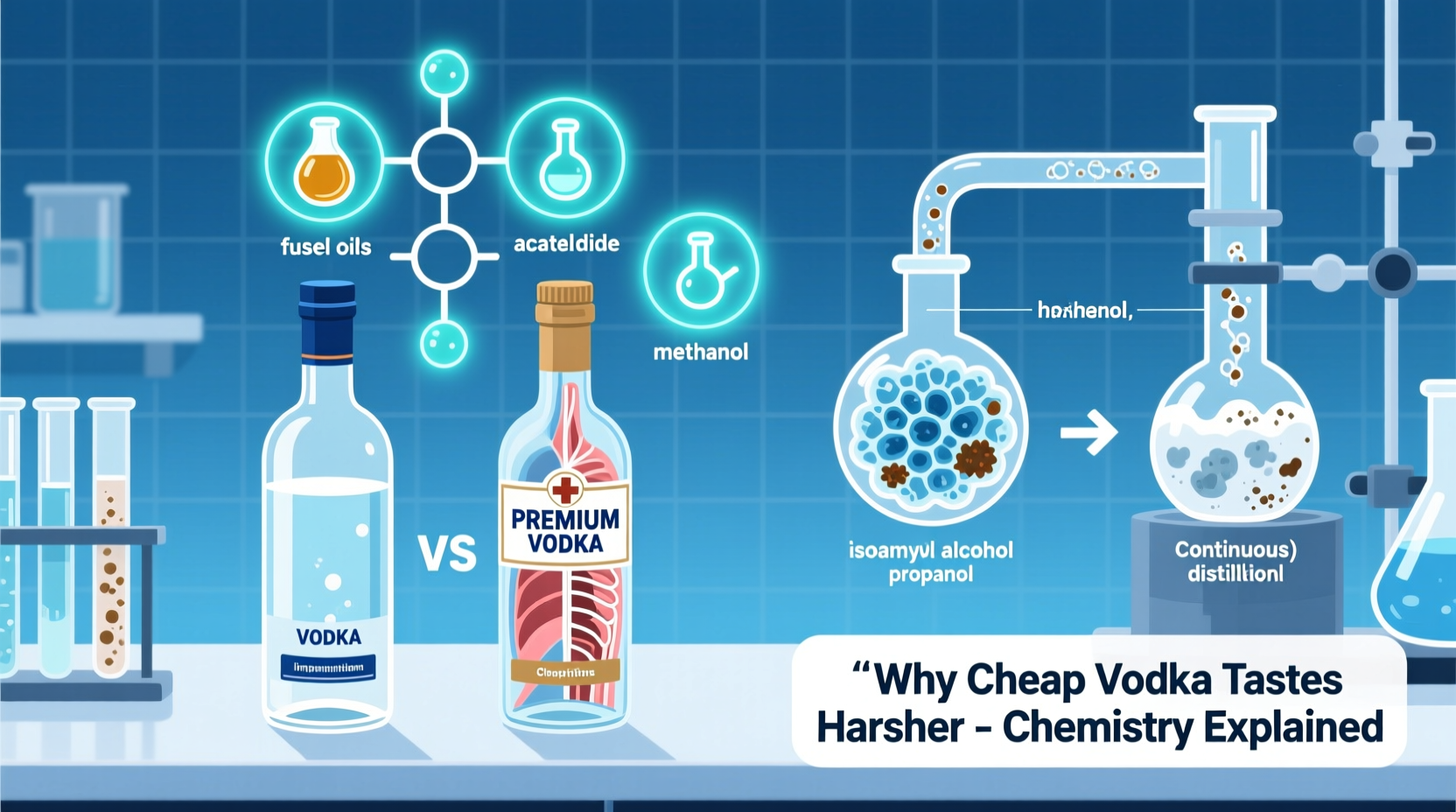
At its core, vodka is a solution of ethanol (C₂H₅OH) and water—typically 40% alcohol by volume (ABV). Ethanol itself is inherently pungent and warming. At high concentrations, it triggers TRPV1 receptors—the same heat-sensitive ion channels activated by capsaicin in chili peppers—causing that familiar “burn.” But pure, lab-grade 95% ethanol doesn’t taste *harsh* in the way cheap vodka does; it tastes sharply medicinal, then fades. What makes low-cost vodka uniquely aggressive is not ethanol alone—but what rides along with it.
During fermentation, yeast converts sugars into ethanol, CO₂, and dozens of secondary metabolites called congeners: fusel oils (higher alcohols like propanol, isobutanol), esters (ethyl acetate, isoamyl acetate), aldehydes (acetaldehyde, furfural), ketones, and organic acids. While trace congeners contribute complexity to aged spirits like whiskey or rum, vodka aims for near-total removal. Premium vodkas achieve this through multi-stage distillation (often 6–10+ passes), precise temperature-controlled rectification, and rigorous copper contact (which catalytically oxidizes sulfur compounds and binds heavy metals). Budget producers frequently use single-pass or continuous column stills optimized for speed and yield—not purity—leaving behind volatile impurities that amplify ethanol’s sensory impact.
Tip: If a vodka smells strongly of nail polish remover (ethyl acetate) or green apples (acetaldehyde), it contains elevated volatile congeners—a direct indicator of incomplete purification.Congener Chemistry: The Usual Suspects
Harnessing analytical chemistry helps identify which specific molecules drive harshness. Gas chromatography-mass spectrometry (GC-MS) studies of commercial vodkas consistently show stark differences in congener profiles:
| Congener | Source | Sensory Threshold (ppm) | Effect in Vodka |
|---|---|---|---|
| Acetaldehyde | Yeast metabolism; incomplete oxidation of ethanol | 0.02–0.1 | Sharp, green apple, pungent; enhances burning sensation and throat irritation |
| Isobutanol | Fusel oil formation during high-temp fermentation | 2–5 | Bitter, solvent-like, lingering heat; disrupts mouthfeel smoothness |
| Propanol | Yeast stress response (nutrient deficiency, high temps) | 30 | Harsh, alcoholic, “hot” finish; lowers perceived viscosity |
| Formaldehyde | Oxidation byproduct; contamination risk in poor-quality stills | 0.05 | Stinging, acrid, nasal irritation; highly undesirable above trace levels |
| Sulfur compounds (e.g., hydrogen sulfide) | Yeast sulfate reduction; copper-deficient stills | 0.0005 | Rotten egg, burnt rubber; extremely potent off-notes even at sub-ppb levels |
Crucially, these compounds don’t act in isolation. They exhibit sensory synergy: acetaldehyde lowers the perception threshold for ethanol burn by up to 40%, while fusel oils increase mucosal permeability—allowing ethanol to penetrate oral tissues faster. This biochemical amplification is why a vodka with only 2 ppm isobutanol and 0.08 ppm acetaldehyde can feel significantly more aggressive than one with identical ABV but undetectable levels of both.
Distillation Physics: Why More Passes Matter
Distillation separates compounds based on boiling point differences. Ethanol boils at 78.4°C, water at 100°C—but many congeners have boiling points very close to ethanol’s: acetaldehyde (20.2°C), ethyl acetate (77.1°C), isopropanol (82.6°C). Effective separation requires precise control over vapor pressure, reflux ratio, and plate efficiency. Column stills used in mass production operate at high throughput, sacrificing theoretical plates (separation stages) for volume. A typical industrial column may deliver only 3–5 effective plates; premium batch stills like those used by Belvedere or Grey Goose achieve 12–15+ through copper-packed reflux columns.
This difference manifests physically: lower plate count means less opportunity for “hearts cut” refinement—the narrow window where only the cleanest ethanol fraction is collected. In budget production, the “heads” (low-boiling, volatile toxins) and “tails” (high-boiling, oily fusels) bleed into the final spirit. Even minute carryover—0.3% of heads fraction—introduces enough acetaldehyde and methanol to create perceptible harshness. Methanol itself is nearly tasteless, but its metabolic breakdown in the body contributes to next-day discomfort—a subtle reinforcement of the “harsh” impression.
Filtration & Water: The Final Molecular Filter
Post-distillation, filtration removes residual particulates and adsorbs polar impurities. Activated charcoal (often coconut- or wood-based) has a vast surface area (up to 1,500 m²/g) and selectively binds molecules via van der Waals forces and dipole interactions. Fusel oils and aldehydes adhere strongly; ethanol and water do not. Premium vodkas use slow, gravity-fed charcoal filtration over days—sometimes multiple passes through different carbon grades. Budget brands often employ rapid, high-pressure carbon polishing lasting minutes, achieving superficial clarity without deep congener reduction.
Water quality is equally decisive. Vodka is diluted to bottling strength with purified water—typically 60% of the final volume. Tap water contains chlorine, chloramines, calcium, magnesium, and dissolved organics. Even parts-per-trillion chlorine residues react with ethanol to form chloroethanol derivatives, imparting medicinal, band-aid-like notes. Premium producers use multi-stage deionization, reverse osmosis, and oxygen-scavenging storage tanks. One study comparing vodkas diluted with distilled vs. municipal water found a 27% increase in perceived burn intensity when using untreated tap water—proof that dilution isn’t neutral.
“Harshness isn’t a flaw in the drinker’s palate—it’s a biomarker of process compromise. When you taste heat or bitterness in vodka, your trigeminal nerve is detecting real chemical load. That’s not character. It’s contamination.” — Dr. Lena Petrova, Analytical Chemist & Spirits Consultant, Institute of Brewing and Distilling
A Real-World Comparison: The Batch Test
In 2022, a blind tasting panel of 12 professional bartenders and food scientists evaluated five vodkas ranging from $12.99 to $42.99 per 750ml. All were served at 8°C in ISO-standard tasting glasses, neat, with no ice or water. GC-MS analysis accompanied each sample.
The $12.99 brand registered 1.8 ppm acetaldehyde, 4.3 ppm isobutanol, and detectable hydrogen sulfide (0.0007 ppm). Panelists unanimously described it as “burning,” “chemical,” and “unbalanced,” with 9 reporting immediate throat constriction. In contrast, the $42.99 expression showed no detectable acetaldehyde (<0.005 ppm), isobutanol at 0.12 ppm, and zero sulfur compounds. Descriptors included “silky,” “clean,” and “rounded warmth.” Crucially, when the budget vodka was diluted to 20% ABV (simulating a well-mixed cocktail), its harshness diminished significantly—confirming that ethanol concentration modulates congener impact, but doesn’t eliminate it.
This illustrates a key practical insight: harshness is most apparent in neat sipping or simple preparations (vodka soda, martini). In complex cocktails with citrus, sugar, and herbs, lower-tier vodkas can perform acceptably—not because impurities vanish, but because other ingredients mask them sensorially. That’s why many bars use mid-tier vodkas ($20–$30) for mixing: they strike a functional balance between cost and congener control.
Actionable Steps: Choosing & Using Vodka Wisely
Understanding the chemistry empowers smarter choices—without requiring a lab degree. Here’s how to navigate the shelf with scientific literacy:
- Read the label for origin clues: Vodkas labeled “distilled 10 times” or “charcoal filtered” aren’t guarantees—but they signal process emphasis. Avoid vague terms like “premium filtered” without specifics.
- Sniff before you sip: Swirl gently. Harsh vodkas often emit sharp acetone, green banana (isoamyl acetate), or wet cardboard (oxidized aldehydes). Clean vodkas smell faintly sweet, milky, or like fresh rain.
- Test the mouthfeel: Place 1/4 tsp on your tongue. Does it spread evenly? Or does heat concentrate on the tip/back? Uneven burn suggests congener imbalance.
- Check water source transparency: Brands like Chopin (Polish rye, artesian water) or Reyka (Icelandic glacial water, geothermal filtration) disclose water treatment—reducing risk of chlorine-derived off-notes.
- Store properly: Keep bottles upright, away from light and heat. UV exposure accelerates ethanol oxidation, forming more acetaldehyde over time—even in sealed bottles.
FAQ
Does “gluten-free” vodka taste smoother?
No—gluten is a protein molecule too large to volatilize during distillation. All distilled spirits, including wheat-based vodkas, are inherently gluten-free regardless of labeling. Any perceived smoothness difference relates to base ingredient fermentability (rye yields fewer fusels than corn) or processing, not gluten content.
Can I “fix” harsh vodka at home?
Not meaningfully. Home charcoal filtering (e.g., with activated carbon pellets) removes some volatiles but risks over-adsorption of desirable esters and introduces fine particulates. Diluting with high-quality spring water reduces ethanol concentration but doesn’t eliminate congeners. The most reliable fix is using it only in robust cocktails (Bloody Mary, Moscow Mule) where acidity and spice suppress harsh notes.
Why do some expensive vodkas still taste hot?
Some premium brands prioritize texture or terroir expression over absolute neutrality—using unfiltered rye or heritage potatoes to retain subtle starch-derived esters. Heat may stem from intentional higher ABV (50%+), not impurities. Always check proof: a 50% ABV vodka will feel warmer than a 40% ABV one, even if chemically pristine.
The Bottom Line: Chemistry Is the Compass
Harsness in cheap vodka isn’t a mystery—it’s a fingerprint of process shortcuts. It’s acetaldehyde binding to your olfactory receptors, fusel oils disrupting lipid membranes in your oral epithelium, chlorine derivatives forming in the bottle, and insufficient copper contact failing to scrub sulfur. Recognizing these mechanisms transforms vodka from a commodity into a case study in applied physical chemistry. You don’t need to memorize boiling points to benefit from this knowledge. You simply need to trust your senses as data collectors—and understand that when your throat tightens, your nose recoils, or your tongue stings, chemistry is speaking plainly.
That said, value isn’t solely about price. A $24 vodka with transparent sourcing, multi-stage copper distillation, and certified purified water often outperforms a $35 brand relying on branding over benchwork. Read labels critically. Taste deliberately. Prioritize producers who publish distillation specs—not just slogans. And remember: the goal isn’t numbness, but clarity. Not absence of flavor, but absence of interference. When ethanol meets water cleanly, the result isn’t bland—it’s pure potential.
💬 Have you tested a vodka’s harshness scientifically—or found a budget brand that defies expectations? Share your tasting notes, distillation research, or water-source discoveries in the comments. Let’s build a community grounded in evidence, not echo chambers.