That unmistakable aroma—like a damp gym sock left in a hot car, or a skunk’s defensive spray—isn’t just an off-flavor. It’s a precise, photochemical reaction rooted in hop chemistry. And while it’s often associated with inexpensive lagers sold in clear or green glass bottles, the phenomenon isn’t about price alone. It’s about physics, botany, and packaging choices that date back over half a century. Understanding this reaction reveals more than why your $2.99 six-pack smells funky—it exposes a fundamental tension in brewing: how to preserve the aromatic complexity of hops without sacrificing shelf stability or accessibility.
The Chemistry Behind the Skunk: Isomerization and Photolysis
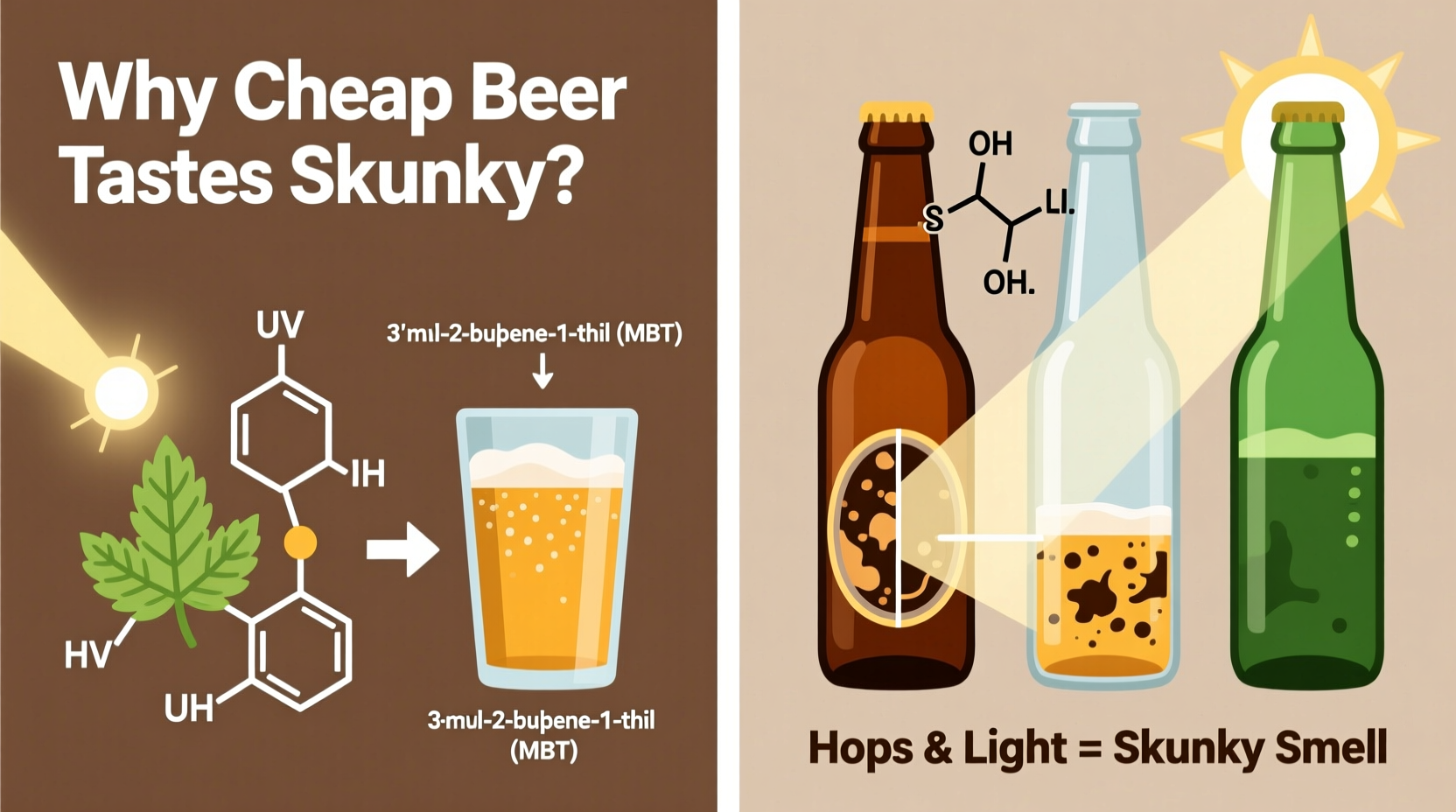
Hops contain alpha acids—primarily humulone—which are isomerized during the boil into iso-alpha acids. These compounds provide bitterness and contribute to foam stability. But they’re also the unwitting catalyst for skunking. When beer is exposed to light—especially wavelengths between 350–500 nm (blue to near-UV light)—a photochemical reaction occurs. Riboflavin (vitamin B₂), naturally present in beer as a byproduct of yeast metabolism, acts as a photosensitizer. Under light, riboflavin absorbs photons and transfers energy to iso-alpha acids, cleaving them into highly reactive free radicals. One key fragment—the 3-methylbut-2-ene-1-thiol (MBT)—is identical to the compound found in skunk spray. MBT has an odor detection threshold of just 4 parts per trillion—lower than almost any other known compound. A single drop in an Olympic-sized swimming pool would still be perceptible.
This reaction doesn’t require heat or time. It can occur in seconds under direct sunlight or fluorescent lighting. Once formed, MBT is stable and irreversible. No amount of chilling or decanting will remove it. The beer isn’t “spoiled” in the microbial sense—no pathogens grow, and it’s safe to drink—but its sensory profile is permanently altered.
Why Clear and Green Bottles Are the Usual Suspects
Not all packaging transmits damaging light equally. Brown glass blocks up to 90% of light in the critical 350–500 nm range. Green glass blocks about 60–70%. Clear glass? Less than 10%. That’s why historically, many European lager brands—particularly those targeting export markets—opted for brown glass early on, while others prioritized aesthetics and cost savings.
The irony is that “cheap” beer isn’t inherently more skunk-prone. Many budget-friendly craft lagers use proper packaging and fresh hop extracts. Conversely, some premium imports bottled in green glass—especially if shipped through hot, sunlit warehouses or displayed under store lights—can develop noticeable MBT within days. Price becomes a proxy because low-cost producers often cut corners elsewhere: using older hop pellets, skipping light-stable hop derivatives, or relying on high-volume bottling lines where bottle orientation and storage conditions aren’t tightly controlled.
| Packaging Type | Light Transmission (350–500 nm) | Typical Use Case | Risk Level for Skunking |
|---|---|---|---|
| Brown glass bottle | <10% | Premium craft lagers, German pilsners, many US microbrews | Low |
| Green glass bottle | 30–40% | Many European imports (e.g., Heineken, Beck’s), some domestic macros | High (especially if stored improperly) |
| Clear glass bottle | >90% | Some Mexican lagers (e.g., Corona, though now often served with lime), novelty brands | Very High |
| Cans (aluminum) | 0% | Growing share of craft and macro production; ideal for hoppy styles | Negligible |
| Tap (stainless steel lines + opaque tubing) | 0% | On-premise draft systems with proper maintenance | Negligible (if lines are clean and CO₂ pressure stable) |
How Brewers Fight Back: Hop Derivatives and Process Innovation
Recognizing the problem decades ago, brewers developed workarounds—not just for cheap beer, but for all light-sensitive styles. Tetrahop® and Hexahop® are hydrogenated derivatives of iso-alpha acids. Their molecular structure lacks the vulnerable side chain that photolysis targets. They deliver consistent bitterness without the skunk risk, though they lack the nuanced aromatic qualities of whole-cone or cryo-hopped beers. Many large-scale lager producers use these derivatives exclusively in their light-exposed packaging.
Another innovation is reduced-IBU hopping: using fewer iso-alpha acids overall and compensating with late-kettle or whirlpool hop additions rich in essential oils (myrcene, humulene, caryophyllene). These oils contribute aroma without generating as much photolabile material. Some brewers also add antioxidants like ascorbic acid (vitamin C) to scavenge free radicals before MBT forms—though this is more common in fruit-forward sours than traditional lagers.
Crucially, modern quality control tracks “lightstruck units” (LSUs) — a metric combining spectral irradiance, exposure duration, and beer absorbance at 350 nm. Leading breweries monitor LSU accumulation throughout distribution, adjusting warehouse lighting, pallet wrapping, and even retail display guidelines accordingly.
Tip: If you buy beer in clear or green glass, inspect the label for phrases like “brewed with tetrahop,” “light-stable hops,” or “protected from light.” These indicate intentional mitigation—not just marketing fluff.A Real-World Example: The Corona Paradox
In 2019, a small independent brewery in Portland, Oregon, launched a crisp, rice-forward lager inspired by Mexican-style pilsners. They packaged it in clear 12-oz bottles with minimalist labeling—intentionally evoking the aesthetic of global brands. Within three weeks of hitting shelves, customers began reporting “wet cardboard” and “burnt rubber” notes—not classic skunk, but precursors to full MBT formation. Lab analysis confirmed elevated riboflavin levels and early-stage photolytic breakdown.
The brewery responded not by abandoning clear glass, but by redesigning their supply chain: switching to UV-filtering shrink-wrap for pallets, mandating black-out curtains in retail coolers, and adding a subtle “Store in Dark, Cool Place” icon on every label. They also reformulated with a blend of standard and tetrahop extracts—keeping 70% of the original bitterness profile while eliminating the photoreactive fraction. Sales rebounded within two months, and customer complaints dropped by 94%. The lesson wasn’t that clear glass was “wrong”—it was that light management must be systemic, not incidental.
What Drinkers Can Do: A Practical Checklist
You don’t need a lab or a cold room to protect your beer. Sensory degradation begins the moment light hits the bottle—even indoors. Here’s what works, backed by brewing science:
- Inspect before purchase: Avoid bottles with visible condensation inside the glass (indicates temperature cycling) or those displayed in direct sunlight or under fluorescent fixtures near windows.
- Transport smartly: Carry beer home in an insulated bag or box—not in a clear plastic sack left on a hot car seat.
- Store correctly: Keep beer upright in a dark cupboard or pantry, away from windows, LED strip lights, or under-cabinet lighting. Ideal storage temp: 38–45°F (3–7°C) for lagers; up to 55°F (13°C) for stouts or barleywines.
- Open with intention: Pour immediately after opening. Don’t let a half-full bottle sit uncovered on the counter—even ambient kitchen light degrades aroma compounds in minutes.
- Choose cans when possible: Aluminum provides total light blockage and superior oxygen barrier versus most crown caps.
Expert Insight: From the Lab to the Taproom
“The myth that ‘skunked’ means spoiled is dangerous—it lets people dismiss legitimate quality failures. MBT formation is 100% preventable with current technology. When I see it in a $12 craft lager, it tells me either the brewer skipped light-stable hop options, or their distributor stores beer in unshaded loading docks. There’s no excuse in 2024.” — Dr. Lena Torres, Senior Flavor Chemist, Siebel Institute of Technology
Dr. Torres’ point underscores a critical shift: skunking is no longer a “necessary evil” of mass production. It’s a signal of process neglect. Even small breweries now access affordable light-stable hop products and UV-monitoring tools. The persistence of skunky beer reflects economic decisions—not technical limitations.
Frequently Asked Questions
Does refrigeration prevent skunking?
No. Cold temperatures slow microbial spoilage and oxidation, but they do nothing to inhibit photochemical reactions. MBT forms just as readily at 34°F (1°C) as at 75°F (24°C) if light is present. Refrigeration only helps post-opening, by slowing further volatile loss.
Can I “fix” skunky beer by adding lime or salt?
Not chemically—no ingredient neutralizes MBT. Lime may mask the aroma slightly through contrast (citrus brightness vs. sulfur dankness), and salt can suppress bitterness perception, but the compound remains. This is why the Corona-lime ritual persists culturally, not scientifically.
Do all hoppy beers skunk equally?
No. Hazy IPAs and double dry-hopped beers are actually less prone—because their hop character comes overwhelmingly from volatile oils added late, not from iso-alpha acids formed during boiling. However, they’re far more vulnerable to oxidation and light-induced “grapefruit pith” or “catty” notes from myrcene degradation. So while they won’t smell skunky, poor light protection still ruins them—just differently.
Why This Matters Beyond Taste
Skunking isn’t merely a sensory nuisance. It’s a gateway to understanding broader issues in food and beverage science: how natural compounds interact with environmental energy, how economics shape sensory outcomes, and how consumer habits reinforce—or disrupt—quality standards. When we accept skunky beer as “normal,” we normalize preventable compromise. Every time you choose a can over a green bottle, or ask your local shop to rotate stock from the back cooler, you vote for better stewardship of ingredients and intentionality in production.
That $2.99 lager doesn’t have to taste like a skunk. Neither does the $14 farmhouse saison. What separates them isn’t cost—it’s respect for chemistry, consistency in execution, and transparency in communication. The next time you crack open a cold one, pause for two seconds. Look at the packaging. Check the storage. Smell before you sip. You’re not just tasting beer—you’re reading a real-time report on supply chain integrity, botanical fidelity, and human attention to detail.
💬 Your observations matter. Next time you detect skunkiness—or the absence of it—note the brand, package, and where you bought it. Share your findings in the comments. Real-world data helps brewers improve, retailers adjust, and consumers demand better. The future of beer isn’t just hoppier or stronger—it’s smarter, safer, and more sensitively made.