Mulled wine occupies a rare cultural sweet spot: it’s both ritual and refreshment, comfort and craft. Yet beneath its spiced aroma and ruby glow lies a quiet but persistent divide—one that flares up every December in kitchens, pubs, and Christmas markets across Europe and North America. One person stirs their glass with satisfaction at 55°C, calling it “perfectly aromatic.” Another recoils, insisting the wine must reach 78°C—“hot enough to steam the spices awake, but never bubbling.” This isn’t mere preference; it’s a convergence of chemistry, physiology, tradition, and memory. Understanding why requires stepping beyond temperature dials and into the subtle interplay of volatile compounds, oral thermoreception, regional heritage, and even historical safety practices.
The Science of Heat and Aroma Release
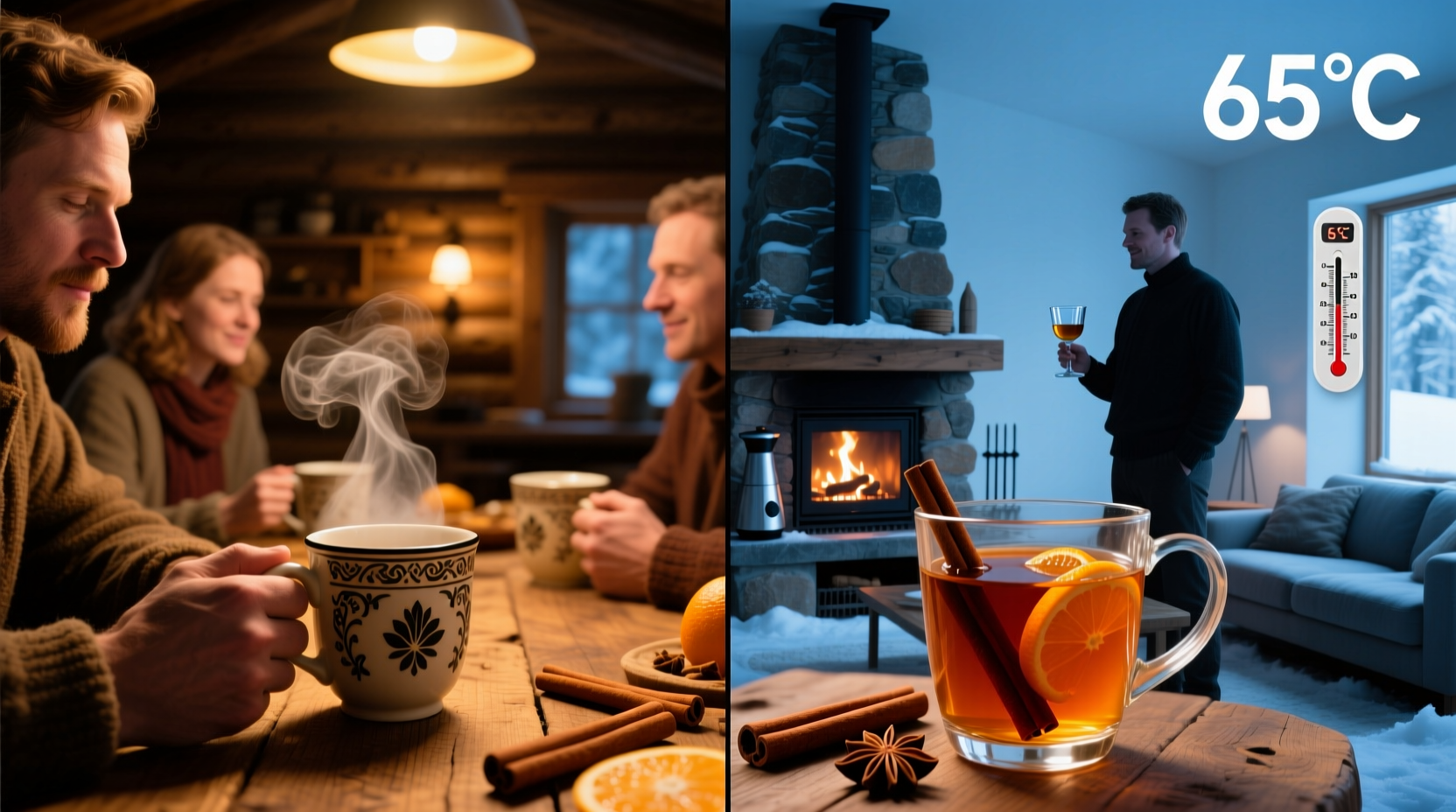
Wine’s bouquet is built on hundreds of volatile organic compounds (VOCs)—esters, terpenes, aldehydes, and lactones—that evaporate at different temperatures. Mulled wine relies on heat to coax out spice oils (eugenol from cloves, cinnamaldehyde from cinnamon) and fruit esters (ethyl hexanoate from oranges), but excessive heat destroys them. Research published in the Journal of Agricultural and Food Chemistry shows that key aromatic compounds begin degrading above 80°C: limonene (citrus brightness) volatilizes too rapidly, vanillin oxidizes into less pleasant phenolic notes, and delicate floral terpenes like linalool disappear entirely.
At the same time, ethanol—the carrier for many aromas—boils at 78.4°C. When mulled wine approaches or exceeds this point, alcohol evaporates faster than the spice volatiles can infuse, thinning the mouthfeel and muting complexity. A wine held at 60–72°C retains optimal ethanol-soluble aroma concentration while allowing slow, controlled extraction of polyphenols from citrus peel and whole spices. That narrow window explains why “hot but not boiling” isn’t pedantry—it’s thermodynamic precision.
Tip: Use an instant-read thermometer—not guesswork. Insert it midway into the pot, away from the base, and stir gently before reading. The ideal serving range is 62–70°C.Thermal Perception and the Human Palate
Our tongue and oral mucosa contain TRPV1 receptors—heat-sensitive ion channels activated above ~43°C. These receptors don’t just signal “hot”; they modulate taste perception. Studies in Chemical Senses demonstrate that warmth between 45–60°C enhances sweetness and suppresses bitterness—a crucial effect for mulled wine, which often contains tannic reds and tart citrus. But above 65°C, TRPV1 activation triggers mild pain signals, overriding flavor nuance and narrowing attention to thermal sensation alone.
This creates two distinct experiential profiles:
- Warm (48–58°C): Gentle, enveloping, soothing. Ideal for those prioritizing comfort, low-stimulation relaxation, or pairing with rich desserts. Common in Nordic and British traditions where mulled wine functions more as a nightcap than a centerpiece.
- Hot-but-not-boiling (62–72°C): Vibrant, assertive, aromatic. Maximizes spice diffusion and lifts the wine’s structure without scalding. Preferred in German Glühwein culture, Austrian Punsch, and Czech Víno Zahřáté, where presentation, steam, and immediate olfactory impact are part of the ritual.
Individual variation matters too. Older adults often report diminished thermal sensitivity, making warmer temperatures feel milder—and thus more approachable. Conversely, younger tasters may perceive 65°C as intensely hot, gravitating toward lower ranges for sustained sipping.
Regional Traditions and Historical Constraints
Temperature preferences aren’t arbitrary—they’re rooted in centuries of practice, equipment, and necessity. In medieval Europe, boiling wine was common—not for flavor, but for safety. Unpasteurized water sources contaminated with pathogens made heated wine a pragmatic alternative. Boiling killed microbes, but also stripped character. Over time, as sanitation improved and wine quality rose, the practice evolved: heat became a tool for enhancement, not sterilization.
Regional divergence emerged alongside local tools:
| Region | Traditional Vessel | Typical Temp Range | Rationale |
|---|---|---|---|
| Germany & Austria | Copper or enamel kettles with wide bases | 68–72°C | Even, rapid heating; designed to hold heat without scorching. Reflects urban market culture—wine served quickly, steaming, in ceramic mugs. |
| Scandinavia | Heavy cast-iron pots or insulated thermoses | 50–58°C | Emphasis on prolonged warmth during long winter evenings. Prioritizes retention over intensity. |
| UK & Ireland | Stovetop saucepans, often with gentle simmer | 52–60°C | Influenced by punch culture—lower heat preserves brandy or port additions and prevents alcohol burn-off. |
| France (Alsace) | Ceramic vin chaud pots with clay liners | 58–64°C | Clay absorbs excess heat, smoothing peaks. Focus on balance—fruit, spice, and wine harmony over boldness. |
These vessels didn’t just hold wine—they shaped expectations. A copper kettle invites urgency; a cast-iron pot invites patience. Preference, then, becomes habit encoded in hardware.
A Mini Case Study: The Leipzig Glühwein Stand
In Leipzig’s historic Christmas market, Frau Helga has sold Glühwein from the same stall since 1987. Her recipe—Spatburgunder (Pinot Noir), star anise, fresh orange zest, and a whisper of honey—hasn’t changed. But her method has. For decades, she heated batches to exactly 70°C using a calibrated gas burner, checking with a mercury thermometer she inherited from her father. Customers lined up for the “Helga Steam”—a visible plume rising from each mug, carrying cinnamon and clove so vivid it could be tasted before the first sip.
Then, in 2019, a young student from Dresden asked if she’d ever tried serving it cooler. “It’s not Glühwein,” Helga replied. But curiosity won. She prepared a batch at 55°C, served in pre-warmed mugs. Three customers returned—not to complain, but to ask for seconds. “It tastes… rounder,” said one. “Like the wine is speaking, not shouting.” Helga began offering two versions: “Tradition” (69°C) and “Silent Spice” (56°C). Sales split almost evenly. What surprised her most wasn’t the demand for warmth—but how many patrons, especially women over 60 and those with sensitive palates, chose the lower temperature not for gentleness, but for clarity. “They say they taste the orange first,” she told me, wiping her counter. “Not the heat.”
Expert Insight: The Oenologist’s Perspective
“The difference between ‘warm’ and ‘hot-but-not-boiling’ mulled wine is the difference between infusion and extraction. At lower temperatures, you’re coaxing out soluble aromatic glycosides—compounds bound to sugar molecules that release slowly and sweetly. At higher temperatures, you’re hydrolyzing those bonds rapidly, releasing free terpenes and aglycones that are more volatile and pungent. Neither is wrong—but they deliver fundamentally different sensory architectures. A skilled mulled wine maker doesn’t chase temperature; they chase intention.” — Dr. Lena Vogt, Senior Oenologist, Geisenheim University Institute of Viticulture & Enology
Step-by-Step Guide: Achieving Your Ideal Temperature Profile
Whether you lean warm or hot, consistency starts with control—not guesswork. Follow this sequence for repeatable results:
- Select your base wisely: Choose a dry, medium-bodied red with moderate tannins (e.g., Grenache, Tempranillo, or Blaufränkisch). Avoid heavily oaked or high-alcohol wines (>14.5%)—they become harsh when heated.
- Pre-warm spices separately: Gently toast whole spices (cinnamon sticks, cloves, star anise) in a dry pan for 60–90 seconds until fragrant. This activates essential oils without burning.
- Infuse cold, then heat: Combine wine, citrus zest (not juice—acid degrades under heat), and toasted spices in a pot. Let steep 30 minutes at room temperature before heating. This begins enzymatic release without thermal shock.
- Heat gradually: Place over low-medium heat. Stir continuously. Never let it simmer or bubble. Use a thermometer—target your desired range (see table below).
- Strain and serve immediately: Remove from heat the moment it hits target temp. Strain through a fine-mesh sieve into pre-warmed mugs. Residual heat will raise temp by 1–2°C.
- Adjust sweetness last: Add honey, sugar, or maple syrup only after straining and just before serving. Heat caramelizes sugars, altering flavor balance.
Do’s and Don’ts of Mulled Wine Temperature Management
| Action | Do | Don’t |
|---|---|---|
| Heating Method | Use low, even heat—induction or gas with flame diffuser | Boil or use high heat; never microwave (uneven, scorches spices) |
| Timing | Heat no longer than 15–20 minutes total infusion + heating time | Simmer for 45+ minutes—degrades fruit esters and oxidizes wine |
| Serving | Pre-warm mugs with hot water; dry thoroughly before pouring | Serve in cold ceramic or glass—causes rapid cooling and condensation |
| Storage | Cool completely, refrigerate up to 3 days; reheat gently to target temp | Reboil leftovers—accelerates alcohol loss and bitterness |
FAQ
Can I make mulled wine in a slow cooker?
Yes—but with caution. Set to “warm” (not low), and monitor closely. Most slow cookers on “warm” hover around 65–75°C, but models vary widely. Insert a thermometer hourly. Stir every 20 minutes to prevent localized overheating at the base. Never leave unattended for more than 2 hours.
Why does my mulled wine taste bitter when I heat it too long?
Bitterness arises from two sources: over-extraction of tannins from grape skins and stems (especially in cheaper wines), and thermal degradation of citrus pith and zest. Prolonged heat breaks down flavonoid glycosides into bitter aglycones. Always use only the colored zest—not white pith—and remove spices after heating, not before serving.
Is there a safe minimum temperature to avoid microbial risk?
For commercially produced, sulfited wine, microbial risk is negligible—even at room temperature. Pasteurization isn’t needed. The 60°C+ range is about flavor integrity, not food safety. However, if adding raw egg (as in some historic recipes) or unpasteurized cider, heat to at least 63°C for 1 minute to ensure pathogen reduction.
Conclusion
Mulled wine’s temperature debate is rarely about physics alone. It’s about what we seek in winter: some want the hush of warmth—the soft boundary between wakefulness and rest, where spice lingers like memory. Others crave the spark of heat—the moment aroma leaps from the mug, sharp and alive, anchoring us in the present. Neither is superior. Both are valid expressions of care, culture, and chemistry. The real mastery lies not in defending one temperature as “correct,” but in understanding what each range delivers—and choosing deliberately. Next time you stir that pot, pause before the first wisp of steam rises. Ask yourself: Do I want the wine to embrace me—or awaken me? Then set your thermometer, trust your palate, and pour with purpose.
💬 Your turn: What’s your ideal mulled wine temperature—and what memory or moment does it bring to mind? Share your story in the comments. Let’s map the warmth, one degree at a time.