Cilantro appears with quiet confidence on cocktail menus across the globe: muddled into margaritas, floated atop palomas, or steeped in house-made syrups for herbal complexity. Yet for a significant minority of drinkers, that first sip triggers an immediate, visceral recoil—not just dislike, but genuine disgust. They don’t taste freshness or citrusy brightness. They taste soap. Or burnt tires. Or raw potatoes left too long in the sun. This isn’t mere preference. It’s a sensory experience so distinct, so biologically rooted, that it reshapes drink design, bar training, and even social hospitality. Understanding why cilantro polarizes drinkers—especially in liquid form—requires stepping beyond culinary opinion and into the molecular architecture of human taste and smell.
The Soapy Surprise: What Cilantro Actually Smells (and Tastes) Like
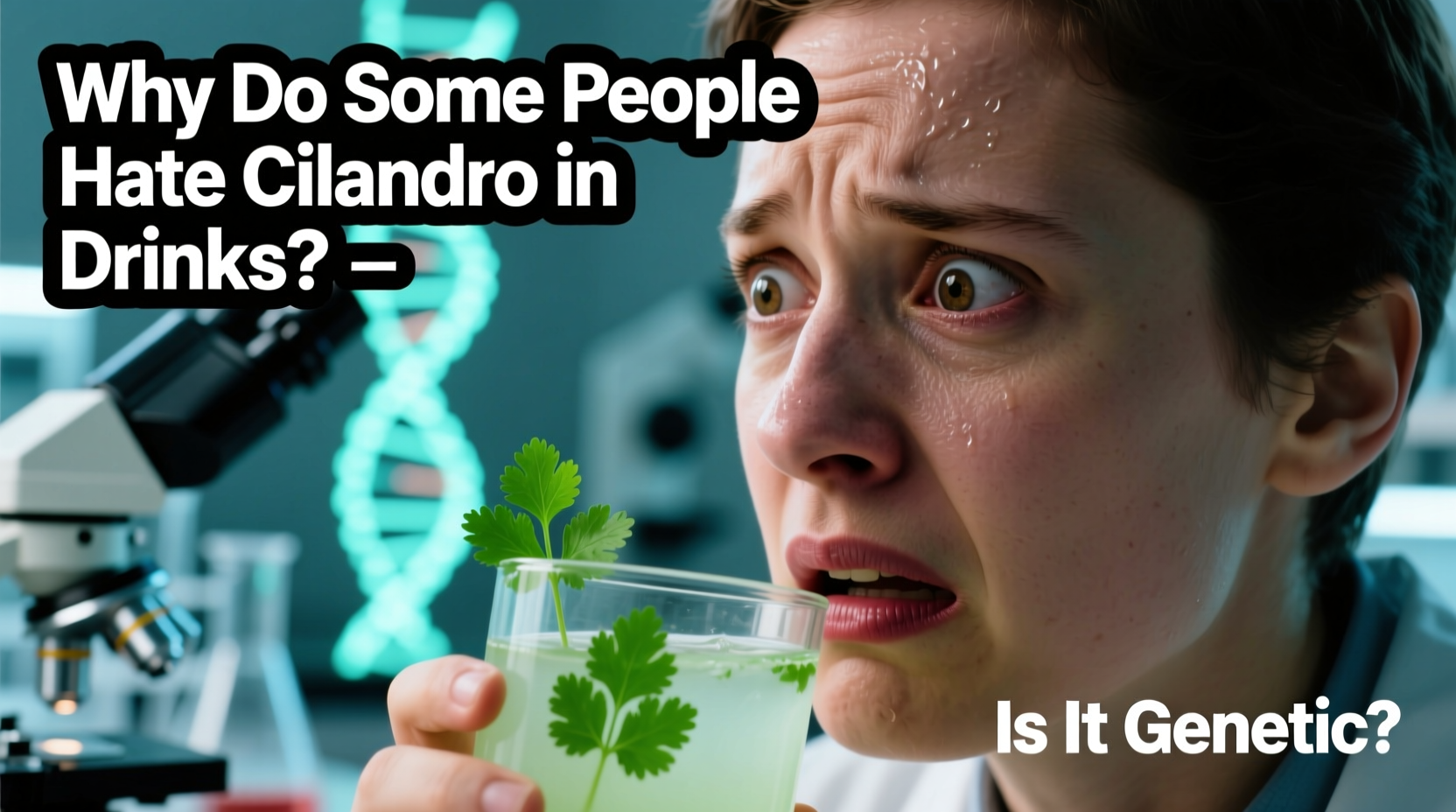
Cilantro’s divisive nature begins not on the tongue, but in the nose. While we often speak of “taste,” up to 80% of what we perceive as flavor comes from retronasal olfaction—the process by which volatile compounds travel from the back of the mouth to the olfactory epithelium. In cilantro leaves, the dominant volatile compounds are unsaturated aldehydes, particularly (E)-2-decenal and (E)-2-dodecenal. These molecules are chemically similar to those found in soaps, lotions, and certain industrial cleaners. For most people, these aldehydes register as bright, green, citrus-herbal notes—think lime zest crossed with crushed stems. But for others, the same molecules activate olfactory receptors linked to detergent-like perceptions.
This divergence isn’t about palate sensitivity or childhood exposure alone. It reflects a fundamental difference in sensory hardware. Unlike salt or sugar detection—which rely on broadly conserved taste receptors—cilantro perception hinges on highly variable olfactory receptor genes. And one gene, in particular, has been rigorously validated across multiple studies: OR6A2.
The Genetic Switch: OR6A2 and the Soap Receptor
Published in the journal Chemical Senses in 2012, a landmark genome-wide association study led by researchers at the Monell Chemical Senses Center analyzed over 30,000 participants across multiple populations. The team identified a single nucleotide polymorphism (SNP) near the OR6A2 gene—rs72921001—as strongly correlated with cilantro aversion. OR6A2 encodes an olfactory receptor protein expressed in the nasal epithelium. Crucially, this receptor binds strongly to the very aldehyde compounds abundant in cilantro.
Individuals carrying two copies of the “A” allele (AA genotype) are significantly more likely to perceive cilantro as soapy or foul. Those with one copy (AG) show intermediate sensitivity—some report mild aversion, others neutrality. Those with two “G” alleles (GG) overwhelmingly describe cilantro as fresh and pleasant. Population data reveals striking variation: roughly 4–14% of East Asians, 17% of Europeans, and up to 21% of people of African descent carry the AA genotype and report strong aversion. In contrast, only about 3–7% of South Asians and Latin Americans exhibit this genetic profile—consistent with cilantro’s deep culinary integration in those regions.
“The OR6A2 finding wasn’t just statistically robust—it was replicable across ethnic groups and confirmed via functional assays. We didn’t just observe correlation; we demonstrated that the receptor physically responds to cilantro aldehydes.” — Dr. Charles J. Wysocki, Senior Research Scientist, Monell Chemical Senses Center
Importantly, this is not a “taste disorder” or a learned bias. It’s a genetically mediated difference in sensory transduction—akin to how some people hear dog whistles while others cannot, or how certain individuals perceive asparagus urine odor and others remain oblivious. In drinks, where aroma dominates perception and dilution can amplify volatility, this genetic difference becomes especially pronounced.
Why Drinks Amplify the Aversion (More Than Food)
While cilantro aversion occurs in both food and beverage contexts, its impact is disproportionately acute in cocktails and non-alcoholic drinks. Several interlocking factors explain why:
- Dilution & Volatility: Water-based or alcohol-based liquids extract and volatilize cilantro’s aldehydes more efficiently than solid matrices like salsas or salads. Chilling, shaking, and carbonation further enhance aromatic release—flooding the olfactory system with soap-like notes before the drink even reaches the lips.
- Lack of Masking Complexity: In dishes like Thai curry or Indian chutney, cilantro is surrounded by potent counterpoints—chili heat, fermented fish sauce, toasted cumin, coconut fat—that blunt or reinterpret its aldehydes. In a drink, especially a simple highball or spritz, there’s far less structural complexity to buffer the initial olfactory shock.
- Temperature & Serving Vessel: Cold temperatures suppress bitter and sour perception but heighten aromatic clarity. A chilled copper mug or narrow coupe concentrates vapors directly under the nose, intensifying the first impression. Warm food, by contrast, allows gradual sensory integration.
- Psychological Priming: When someone sees “cilantro” listed on a menu, they may brace for discomfort—activating anticipatory disgust responses that lower hedonic thresholds. In food, visual cues are often obscured (e.g., finely chopped); in drinks, garnishes float visibly, and muddled herbs are unmistakable.
Practical Strategies for Bartenders, Mixologists, and Home Enthusiasts
Recognizing cilantro aversion as biological—not behavioral—shifts the conversation from persuasion to accommodation. Here’s how professionals and home enthusiasts can respond thoughtfully:
Step-by-Step: Designing Cilantro-Inclusive Drink Menus
- Assess your audience: Review local demographic data or conduct anonymous pre-service polls. High prevalence in urban centers with large East Asian or European populations warrants extra caution.
- Label transparently: Use clear descriptors (“cilantro-infused,” “fresh cilantro garnish”)—never vague terms like “herbal finish” or “bright note.” Avoid surprise.
- Offer modular customization: Serve cilantro as a separate garnish or side tincture—not pre-mixed. Let guests control exposure.
- Develop thoughtful alternatives: Create parallel versions: mint-cucumber for freshness, basil-lemon for green citrus, or shiso for complex herbal lift—none of which trigger OR6A2-mediated aversion.
- Educate staff: Train servers to recognize neutral language (“Some guests find cilantro soapy—would you like it omitted?”) rather than dismissive phrasing (“It’s just herbs!”).
| Strategy | Why It Works | Potential Pitfall |
|---|---|---|
| Infuse cilantro into simple syrup (strained), then use sparingly | Reduces raw aldehyde load while retaining subtle top-note brightness | Over-infusion (>2 hours) reintroduces soapy volatility |
| Pair with high-acid ingredients (lime, grapefruit, verjus) | Acidity disrupts aldehyde binding to OR6A2 receptors, softening perception | Excess acid overwhelms balance; test ratios incrementally |
| Use cilantro root (not leaves) for earthy depth | Root contains different terpenes (e.g., limonene) with no OR6A2 affinity | Root must be thoroughly scrubbed and used in small quantities to avoid bitterness |
| Substitute Vietnamese coriander (rau răm) | Shares citrus-herbal profile but lacks decenal aldehydes entirely | Less widely available; requires sourcing verification |
Real-World Impact: A Bar Manager’s Experience in Portland
When Maya Chen launched her Southeast Asian-inspired bar “Lotus & Lime” in Portland’s Alberta Arts District, cilantro featured prominently—in a signature “Green Ghost” cocktail (tequila, yuzu, cilantro syrup, saline). Within three weeks, 12% of negative online reviews mentioned “soapy aftertaste.” Not “too much herb,” not “not my thing”—“like drinking dishwater.” Initially defensive, Maya surveyed 87 regulars: 19% reported strong aversion, aligning closely with regional genetic estimates. She pivoted—not by removing cilantro, but by redesigning service.
She introduced a “Cilantro Choice Card” at every table: a small, elegant card listing three options—“Cilantro Syrup Included,” “Cilantro Garnish Only,” or “Cilantro-Free Version (Basil-Lime)” —with no judgment implied. Staff were trained to present it neutrally during order-taking. She also reformulated the syrup, reducing infusion time from 4 hours to 45 minutes and adding a touch of citric acid. Within six weeks, cilantro-related complaints dropped to 0.8%. More tellingly, orders of the basil-lime version rose 300%, indicating demand for inclusive alternatives had been unmet—not absent.
“It wasn’t about winning people over,” Maya reflected. “It was about respecting that their nose works differently. Once we stopped treating it as pickiness and started treating it as physiology, everything clicked.”
FAQ: Addressing Common Misconceptions
Is cilantro aversion caused by poor gut health or nutrient deficiency?
No credible evidence links cilantro aversion to microbiome composition, zinc levels, or detoxification capacity. Early speculation about “heavy metal detox” or “poor digestion” has been debunked by controlled genetic and sensory studies. The mechanism is strictly olfactory receptor–mediated, not metabolic.
Can children “grow out of” hating cilantro?
Genetic expression of OR6A2 is stable from early childhood onward. While flavor preferences evolve with exposure and cultural context, the underlying soapy perception remains consistent in AA carriers. What may change is coping strategy—not sensory biology.
If I hate cilantro in drinks, will I also hate parsley, dill, or basil?
Unlikely. Parsley shares some aldehydes but at much lower concentrations and with masking flavonoids. Dill and basil activate entirely different receptor sets (e.g., OR2J3 for basil’s linalool). Cilantro aversion is highly specific—not a broad “herb intolerance.”
Conclusion: Beyond Preference, Toward Precision Hospitality
Cilantro aversion is neither a flaw nor a quirk—it’s a textbook example of human sensory diversity made visible (and drinkable). Recognizing it as genetic reframes hospitality from assumption to intentionality. It asks bartenders to move beyond “just stir well” to “how does this molecule land in 20% of my guests’ noses?” It invites home mixologists to experiment not just with flavors, but with perceptual architecture—understanding that a half-second of aroma can define an entire experience. And it reminds all of us that taste is never universal. It’s personal, inherited, and deeply embodied.
Next time you reach for cilantro in a drink, pause. Consider the invisible genetic landscape your guest carries—and design not just for your own palate, but for the full spectrum of human perception. Because the most sophisticated cocktail isn’t the one with the rarest spirit or most intricate garnish. It’s the one that meets every guest exactly where their biology begins.
💬 Have you encountered cilantro aversion behind the bar—or experienced it yourself? Share your adaptation strategies, alternative herbs, or surprising discoveries in the comments. Let’s build a more inclusive, scientifically grounded culture of drink-making—together.