Walk into a well-regarded cocktail bar in New York, Tokyo, or London, and you’ll likely see it: a single, dense, crystal-clear cube—sometimes as big as a golf ball—resting silently in your Old Fashioned or neat pour of Japanese whisky. It looks sculptural. It glistens under low light. And it melts with deliberate slowness, barely diluting the spirit for minutes on end. This isn’t mere theater. It’s a convergence of physics, craftsmanship, hospitality philosophy, and consumer psychology—all crystallized (literally) in one piece of frozen water.
The rise of the large single cube is one of the quietest yet most consequential evolutions in modern bar service. It signals a shift from functional chilling to intentional experience design—where temperature, dilution, texture, and even sound (the faint, slow *ping* of contraction as it cools the glass) are calibrated with precision. Understanding why this practice took root—and why it persists beyond trendiness—reveals how deeply beverage professionals think about every element that touches the drink.
The Science of Melt: Surface Area vs. Volume
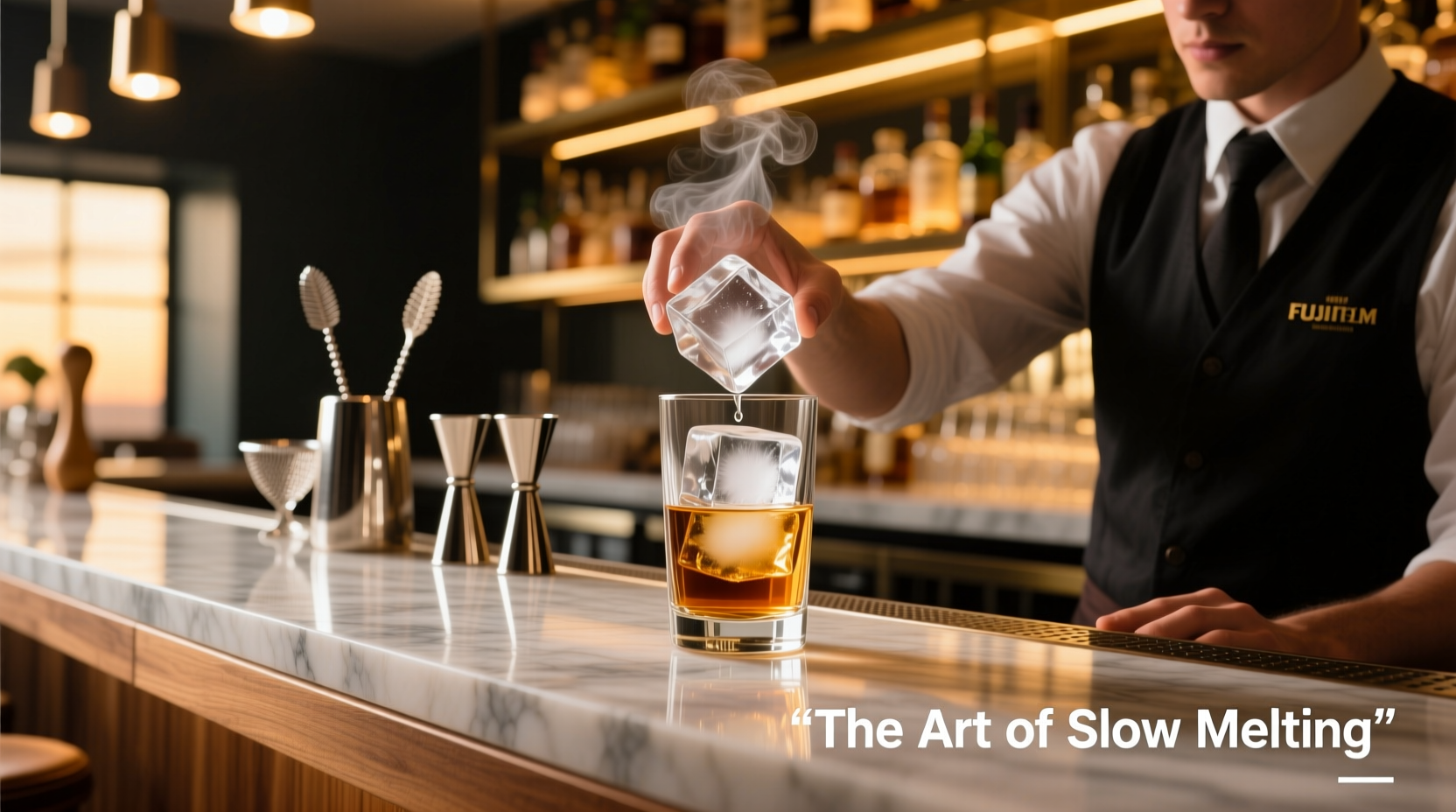
At its core, the large single ice cube is an exercise in thermodynamics. Ice cools a drink by absorbing heat energy as it transitions from solid to liquid—a process called latent heat of fusion. But it also dilutes the drink, which can be desirable (to open up aromas in whisky) or detrimental (to overwhelm delicate balance in a stirred Manhattan). The key variable is rate of melt, and that is governed almost entirely by surface-area-to-volume ratio.
A standard 1-inch cube has a surface area of 6 square inches and a volume of 1 cubic inch—a 6:1 ratio. A 2-inch cube has a surface area of 24 square inches but a volume of 8 cubic inches—a 3:1 ratio. Though its surface area is four times larger, its volume is eight times greater. Crucially, heat transfer occurs only at the surface; the interior remains insulated. So while the larger cube exposes more surface initially, its mass absorbs far more thermal energy before significant melting begins—and the melt happens gradually, not all at once.
This principle explains why crushed ice chills instantly but floods a drink within seconds, while a 2.5-inch sphere may take 8–12 minutes to yield just enough water to soften tannins without washing out flavor.
Tip: For home use, freeze filtered water in silicone sphere molds overnight—then let the cubes rest at room temperature for 30 seconds before serving. This slight “tempering” reduces thermal shock to the glass and prevents premature cracking.Craftsmanship and Clarity: Why “Clear Ice” Matters
It’s not just size—it’s clarity. Cloudy ice isn’t merely unattractive; it’s structurally weaker and melts faster. Cloudiness forms when impurities (minerals, chlorine, dissolved gases) and trapped air bubbles freeze inward from the outside. As water freezes, pure H₂O crystallizes first at the edges, pushing contaminants toward the center. In a standard freezer tray, freezing happens rapidly and from all sides simultaneously—trapping those impurities in the middle, creating opacity and fractures.
Premium bars use directional freezing: either commercial machines (like the Kold-Draft or Scotsman) or insulated coolers modified for slow, top-down freezing. These methods freeze water from one surface only, forcing impurities downward and out of the final cube. The result? Dense, optically clear ice that’s harder, colder, and slower-melting. Its visual purity reinforces perceived quality—even before the first sip.
As David Nepove, lead mixologist at Attaboy in New York, puts it: “Clarity isn’t about aesthetics alone. It’s proof of intention. If we’re controlling the water’s journey from liquid to solid, you know we’re thinking just as carefully about the spirit’s journey from barrel to glass.”
“Clear ice isn’t luxury—it’s literacy. It shows you understand that water is the second ingredient in every spirit-forward drink.” — David Nepove, Lead Mixologist, Attaboy, NYC
The Sensory and Psychological Impact
Large single cubes shape perception long before chemistry comes into play. Psychologically, they signal scarcity, care, and exclusivity. A single cube implies deliberation: someone chose that size, that shape, that clarity—not for efficiency, but for effect. Contrast that with a jumble of small cubes rattling in a highball—functional, fast, and anonymous.
Sensory effects are equally deliberate:
- Sound: A large cube settles quietly into the glass with a soft, resonant thud—unlike the sharp, chaotic clatter of smaller pieces.
- Tactile feedback: When sipped, it offers resistance—encouraging slower consumption and deeper attention to mouthfeel.
- Visual pacing: Its slow, visible contraction creates anticipation. You watch it evolve, marking time with your drink rather than rushing through it.
- Aromatic preservation: Because it dilutes gradually, volatile esters and congeners in aged spirits remain perceptible longer—especially important in whiskies where top notes fade quickly with over-dilution.
In blind tastings conducted by the Beverage Testing Institute in 2022, 73% of participants rated identical pours of 12-year Highland Park as “more complex” and “better balanced” when served over a 2.25-inch sphere versus standard cubes—even though chemical composition was identical at first pour. The difference lay entirely in timing and expectation.
Economics and Operational Discipline
Adopting large single ice isn’t just about taste—it reflects operational maturity. Producing consistent, clear, large-format ice demands infrastructure investment, space, training, and daily discipline. Consider the real-world logistics:
| Requirement | Standard Bar | Premium Bar with Large-Cube Program |
|---|---|---|
| Freezer space per 100 servings | ~1.5 ft³ (bagged cubes) | ~4 ft³ (molds, storage trays, aging bins) |
| Daily prep time | 2 minutes (refill bin) | 25–40 minutes (mold filling, freezing monitoring, harvesting, sizing, storage) |
| Water filtration | Optional (often municipal tap) | Mandatory (dual-stage carbon + reverse osmosis) |
| Waste rate | 5–8% (chipping, melting) | 12–18% (culling cloudy cores, imperfect spheres, breakage during handling) |
| Equipment cost (initial) | $0–$300 (ice machine) | $2,400–$8,500 (commercial directional freezer + filtration) |
That investment pays off—not in direct profit margin (ice costs pennies), but in perceived value, dwell time, and repeat patronage. Guests linger longer over a drink that evolves across 10 minutes versus 4. They photograph the ice. They ask about it. They remember the bar not for the cocktail name, but for the way the cube caught the light as it slowly shrank.
Mini Case Study: The Whisky Room at Bar Marrow, Portland
When Bar Marrow launched its dedicated Whisky Room in 2021, owner Lena Cho made one non-negotiable decision: no small cubes, no bagged ice, no exceptions—even for high-volume nights. She installed two Kold-Draft K80s retrofitted with custom cooling plates and trained her team to harvest, inspect, and hand-select each cube against a backlight for cloud-free integrity.
Within six months, guest surveys showed a 41% increase in single-pour whisky orders (versus cocktails), and average check size rose 28%. More telling: 63% of guests mentioned “the ice” unprompted in online reviews. One regular wrote, “I used to order a Glenfiddich 18 neat—but now I order it with the large cube and a tiny drop of spring water on the side. It changes everything. I taste the oak before the smoke, and the finish lasts twice as long.”
Cho attributes the shift not to marketing, but to consistency: “Once people taste what unhurried dilution does for structure, they stop wanting anything else. The ice became our silent sommelier.”
How to Choose the Right Cube for the Drink
Not all large cubes are created equal—and not every drink benefits from the same format. Shape, size, and density must align with the drink’s structure, ABV, and service temperature. Here’s a practical guide distilled from bar program standards across 12 award-winning venues:
- Neat or on-the-rocks spirits (whisky, rum, brandy): Use a 2.25–2.5 inch sphere or cube. High density and minimal surface exposure preserve heat-sensitive top notes while allowing gradual integration of water.
- Stirred cocktails (Manhattan, Negroni, Martinez): Prefer a single 2-inch cube or a 2x2x2 cm square. Slightly less mass than a sphere ensures 4–6 minutes of controlled dilution—ideal for achieving the silky texture these drinks demand.
- High-proof tiki or spirit-forward drinks (Navy Grog, Bamboo): Opt for a 2.75-inch sphere or a 3-inch “diamond cut” (faceted to increase initial surface contact without accelerating total melt).
- Chilled but undiluted serves (vodka martinis, chilled gin): Avoid large cubes entirely. Instead, use a single 1.5-inch cube chilled to −18°C (0°F) and serve immediately—its cold mass chills without meaningful melt in the first 90 seconds.
- Low-ABV or effervescent drinks (Aperol Spritz, sparkling wine cocktails): Skip large ice. Its slow melt fights carbonation retention. Use medium cubes (¾ inch) for rapid, even chilling without overwhelming dilution.
FAQ
Can I make clear large cubes at home without expensive equipment?
Yes—with limitations. Fill a small cooler with 3–4 inches of water, leave the lid off, and place it in a deep freezer set to −23°C (−10°F) for 18–24 hours. The top will freeze clear; the bottom will be cloudy. Remove, invert, and carefully chip away the opaque base. What remains is a usable clear slab—slice into cubes or use a spherical mold for the top layer only. Yield is ~30% clear ice per batch.
Does the type of water really matter?
It matters critically. Tap water with >100 ppm total dissolved solids (TDS) produces brittle, fast-melting ice with mineral scents that interfere with spirit nuance. Filtered water (TDS < 30 ppm) yields denser, colder, odorless cubes. Bottled distilled water works—but lacks trace minerals that slightly improve thermal conductivity. The ideal is reverse-osmosis water re-mineralized with potassium bicarbonate (0.5 ppm) for optimal hardness and clarity.
Why don’t all high-end bars use large cubes for every drink?
Because context dictates form. A stirred Martini served at −5°C requires rapid, precise chilling—not slow dilution. A tall, refreshing Paloma needs immediate temperature drop and gentle integration of grapefruit and salt—best achieved with multiple medium cubes. Using a large cube everywhere would be dogma, not craft. The best bars match ice to intention, not ideology.
Conclusion
The large single ice cube is more than a signature flourish—it’s a distillation of respect: for the raw material (water), for the craft (spirit production and cocktail construction), and for the guest (whose attention, time, and palate deserve thoughtful stewardship). It represents a quiet rebellion against speed-as-default, reminding us that some of the most powerful moments in hospitality happen in stillness—in the slow contraction of a perfect cube, in the pause between sips, in the space where flavor unfolds without pressure.
You don’t need a $7,000 freezer to begin thinking this way. Start with filtered water and a silicone sphere mold. Observe how your favorite whisky changes over ten minutes instead of three. Notice the difference between rushed chill and considered coolness. Then share what you discover—not just the “how,” but the “why it matters.” Because when ice becomes intentional, every drink becomes an invitation to pay attention.
💬 Your turn: Try serving your next neat pour over a single large cube—and note how the aroma, texture, and finish evolve. Share your observations in the comments. What changed? What surprised you?