
Airport duty-free shops are often the first stop for travelers seeking premium Scotch, Japanese whisky, or French cognac at prices that seem suspiciously low—sometimes 30–50% below city-center retailers. That $85 bottle of Macallan 12 you’d pay $120 for downtown appears for $72 in Terminal 3. It’s not a marketing illusion. It’s a tightly engineered convergence of international tax law, customs geography, and supply chain discipline. The price advantage isn’t accidental—it’s structural, legally sanctioned, and deeply rooted in how sovereign borders intersect with consumption, movement, and fiscal policy.
The Duty-Free Zone: Not Just “No Tax”—It’s a Legal Jurisdiction
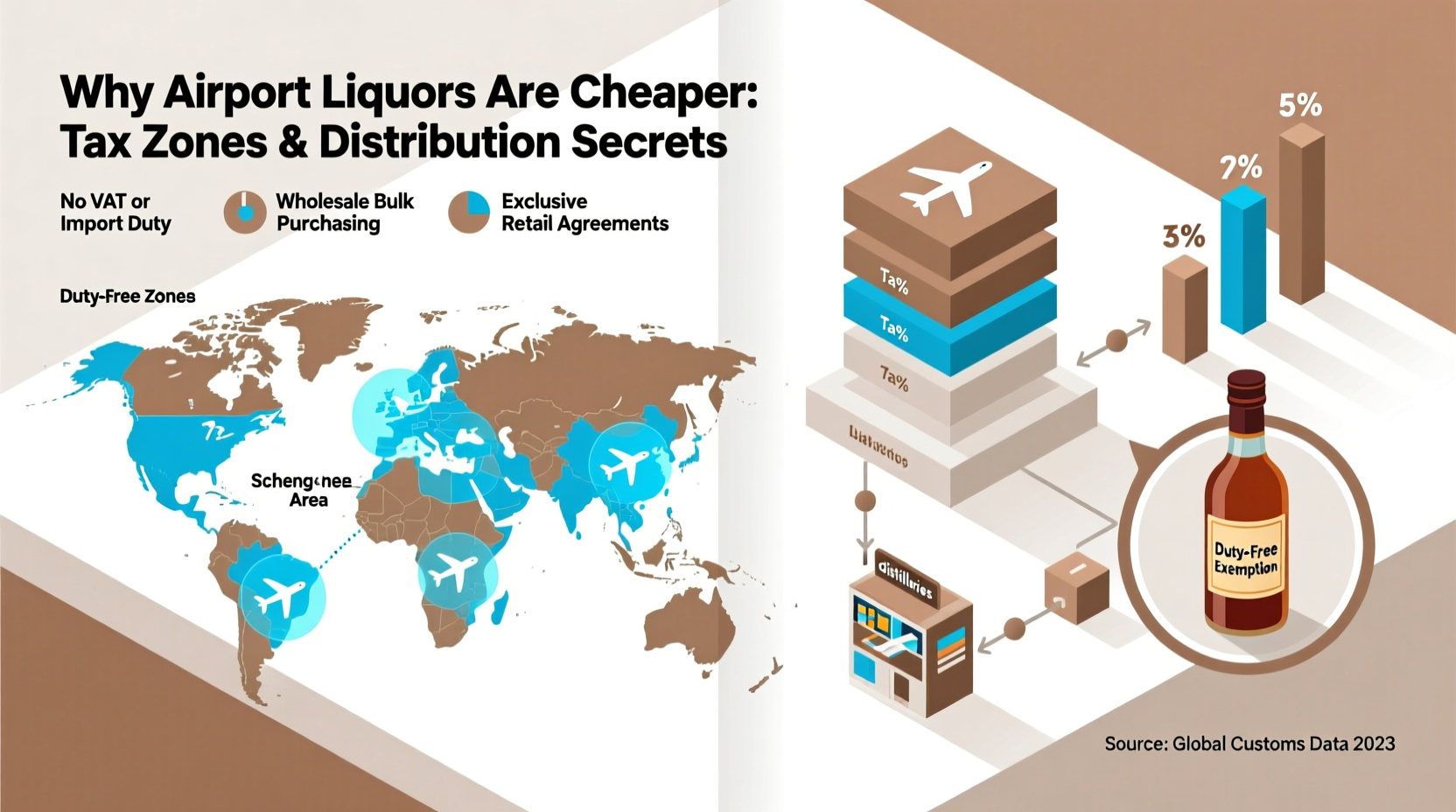
Airport duty-free shops operate within internationally recognized duty-free zones, defined under the 1963 World Customs Organization (WCO) International Convention on the Simplification and Harmonization of Customs Procedures. These zones are physically located *within* national territory but treated as *outside* the country’s customs and tax jurisdiction—for specific purposes.
When a passenger purchases liquor in a duty-free shop, three taxes are typically suspended:
- Import duty: Levied on goods crossing national borders for domestic sale.
- Excise tax: A per-unit levy applied to alcohol, tobacco, and fuel—often the largest component of retail price (e.g., £28.74 per liter of pure alcohol in the UK; $13.50 per proof gallon in the U.S.).
- VAT/GST: Value-added tax or goods and services tax—usually 15–27% across Europe, 10% in Japan, 5% in Singapore.
Crucially, this exemption applies only if the goods leave the country. The moment the bottle clears immigration and is carried onto an international flight, it exits the domestic tax system permanently. No invoice is filed with the domestic revenue authority. No excise stamp is affixed. No VAT return is generated.
Tip: Duty-free pricing reflects *actual tax suspension*, not retailer discounting. If your flight is canceled or you’re denied boarding, most airports require you to surrender or repurchase duty-free items—at full domestic price—because the tax exemption was contingent on export.How Distribution Bypasses Traditional Retail Friction
Domestic liquor distribution in most countries follows a rigid, multi-tiered system designed for regulatory control—not efficiency. In the U.S., for example, federal law mandates separation between producers, distributors, and retailers (the “three-tier system”). Each tier adds markup: 15–25% for distributor margin, 20–35% for retailer overhead, plus compliance costs for licensing, reporting, and age verification.
Airport duty-free operates outside this framework. Here’s how:
- Direct procurement: Major duty-free operators like Dufry, Lagardère Travel Retail, or DFS buy directly from distilleries or authorized brand owners—cutting out domestic distributors entirely.
- Consolidated logistics hubs: Liquor flows through centralized regional warehouses (e.g., Dufry’s hub in Luxembourg or Changi Airport’s bonded logistics park), where inventory is managed under single customs bond agreements—reducing handling, documentation, and storage redundancy.
- No shelf-life pressure: Unlike supermarkets or wine shops, duty-free stores rarely face markdown cycles. Inventory turnover is predictable (tied to flight schedules), and stock is replenished weekly—not daily—allowing bulk purchasing power and volume-based discounts unavailable to small retailers.
- Zero consumer-facing compliance overhead: No ID scanners, no cash register excise reporting, no state-mandated product labeling beyond ICAO standards. This saves 3–7% in operational labor and software licensing costs.
This leaner model enables duty-free operators to absorb modest margins while still undercutting domestic prices—even after accounting for airport rent, security fees, and currency conversion spreads.
Tax Zones in Practice: A Global Comparison
Tax suspension isn’t uniform worldwide. Its magnitude depends on national excise structures and how strictly airports enforce export conditions. Below is how key markets compare for a standard 750ml bottle of blended Scotch whisky:
| Country | Typical Domestic Retail Price (USD) | Duty-Free Price (USD) | Key Tax Components Avoided | Export Verification Method |
|---|---|---|---|---|
| United Kingdom | $98 | $62 | £28.74 excise + 20% VAT | Boarding pass scan + passport check at point of sale |
| Germany | $104 | $67 | €13.03 spirits tax + 19% VAT | Flight confirmation shown on mobile device |
| Singapore | $89 | $58 | SGD 80.20 excise (≈$59) + 9% GST | Pre-departure QR code linked to flight manifest |
| Japan | $112 | $74 | ¥220,000/liter ethanol tax + 10% consumption tax | QR-linked e-ticket verification at kiosk |
| United States | $85 | $72 | None (no federal excise waiver)—but avoids state-level markups & local sales tax | Passport + boarding pass required; no tax refund upon re-entry |
Note the outlier: the U.S. has no federal duty-free exemption for alcohol purchased *by U.S. residents*. The savings come from avoiding state-controlled distribution monopolies (e.g., Pennsylvania’s PLCB markup of 30%) and local sales tax—making U.S. airport liquor cheaper than domestic stores, but far less discounted than in Europe or Asia.
Real-World Example: How a Single Bottle Moves Through the System
In late 2023, Diageo shipped 12,000 cases of Johnnie Walker Black Label from its Glasgow bottling plant to Dufry’s European Consolidation Center in Luxembourg. Each case carried a WCO-compliant “bonded goods” declaration, exempting it from EU import formalities. From Luxembourg, pallets were routed via temperature-controlled truck to Frankfurt Airport’s dedicated duty-free warehouse—a facility operating under German customs bond number DE-BF-002871.
At Frankfurt, bottles were scanned into Dufry’s inventory management system, assigned to Terminal 1’s World Duty Free store, and displayed without domestic health warnings or excise stamps. When a passenger flying to Bangkok purchased one bottle, the POS system verified her Thai Airways boarding pass and passport nationality before processing payment in EUR. Customs officials received an automated manifest update confirming export—no physical inspection occurred. The bottle never entered Germany’s domestic market. No excise duty was accrued. No VAT was charged. The €18.40 excise liability that would have applied had it been sold in Berlin simply evaporated at the gate.
This entire chain—from Glasgow to gate—takes 11 days. A parallel shipment destined for Berlin’s retail market would have taken 22 days, passed through three licensed distributors, incurred four separate tax filings, and borne five layers of margin.
Expert Insight: The Regulatory Tightrope
The integrity of duty-free pricing relies on strict enforcement—and regulators know it. When loopholes emerge, penalties follow swiftly.
“The moment duty-free becomes a loophole for domestic consumption, the entire system collapses. That’s why HMRC audits UK airport retailers quarterly—and why Singapore Customs conducts unannounced ‘exit lane’ checks on 5% of departing passengers carrying alcohol. Compliance isn’t bureaucracy—it’s the price of privilege.”
— Sarah Lin, Former Head of Duty-Free Policy, UK HM Revenue & Customs (2015–2022)
Lin oversaw the 2019 reform that mandated digital boarding pass verification across all UK airports—eliminating manual “honor system” exports that had allowed up to 12% of duty-free alcohol to leak back into domestic circulation. Her team calculated that non-compliance cost the UK Treasury £142 million annually in foregone excise revenue.
What You Should Know Before You Buy
Not all airport liquor offers equal value—and some “discounts” mask hidden trade-offs. Use this checklist before making your next purchase:
Checklist: Smart Duty-Free Liquor Buying- ✅ Verify your destination qualifies: Duty-free exemption applies only to international flights—not domestic or regional routes (e.g., London–Edinburgh or Tokyo–Osaka).
- ✅ Compare net price—not headline discount: Subtract domestic VAT/GST and known excise rates to calculate true tax avoidance. A “40% off” sign may reflect inflated baseline pricing.
- ✅ Check bottle integrity: Look for tamper-evident seals, batch codes matching distillery records, and absence of “airport exclusive” labels that sometimes indicate lower-tier blends.
- ✅ Confirm carry-on compliance: Liquids over 100ml must be sealed in a secure, transparent, tamper-evident bag provided at the point of sale—required by ICAO Annex 17.
- ✅ Review home-country allowances: Bringing alcohol into your destination may trigger customs duties there (e.g., India permits only 2L; exceeding it incurs 150% duty).
FAQ: Clarifying Common Misconceptions
Do duty-free shops make less profit per bottle?
No—they often earn comparable or higher margins. While pre-tax prices are lower, duty-free operators benefit from massive scale (airports move 2.1 billion liters of spirits annually, per TFWA 2023 data), near-zero shrinkage (loss/theft rates under 0.2% vs. 1.8% in urban retail), and minimal marketing spend (foot traffic is guaranteed). Their gross margin averages 32%, versus 24% for specialty liquor stores.
Why don’t domestic retailers just replicate this model?
They legally cannot. National tax statutes (e.g., the U.S. Internal Revenue Code §5001, UK Finance Act 1994, EU Directive 92/12/EEC) explicitly prohibit excise suspension for goods sold into the domestic market—even if physically located at an airport. Attempts to create “quasi-duty-free” models (e.g., post-security shops open to transit passengers) have been struck down by courts for violating the “export condition” requirement.
Is duty-free liquor older or better quality than domestic versions?
Not inherently. Age statements and production standards are regulated globally (e.g., Scotch Whisky Regulations 2009). However, duty-free bottlings sometimes feature unique cask finishes or travel-retail exclusives—designed to drive category trial. Always check the label: “Travel Retail Exclusive” means it’s not available domestically, but doesn’t guarantee superior age or maturation.
Conclusion: Price Is Geography—and Knowledge Is Leverage
Airport liquor isn’t cheap because it’s discounted. It’s cheaper because it exists in a different legal and fiscal universe—one where tax liability vanishes not through corporate generosity, but through precise jurisdictional alignment. Understanding this reveals more than just shopping strategy: it illuminates how global trade, sovereignty, and consumption are negotiated at the tarmac level. Next time you walk past those gleaming shelves, remember—you’re not browsing a store. You’re standing at the seam between two tax regimes, holding a product whose price was set not by demand, but by departure gates and customs bonds.
Don’t just buy smarter—buy with context. Compare net tax savings, verify export compliance, and recognize that every euro or dollar saved reflects decades of treaty negotiation, not retail goodwill. And if you’ve navigated a complex duty-free claim, spotted a misleading “exclusive” label, or successfully argued for a refund after a flight change—share your experience in the comments. Real-world insights like yours help travelers turn logistical nuance into tangible value.
💬 Your insight matters. Have you uncovered a hidden duty-free pricing pattern—or been caught by an unexpected customs rule? Share your story below and help others navigate the intersection of travel, tax, and taste.