Personalizing a fine whiskey bottle isn’t about decoration—it’s about intention. Whether commemorating a milestone, honoring a family lineage, or gifting a generational heirloom, the method of personalization shapes how that story endures. Two approaches dominate the premium market: traditional acid-etched or sandblasted designs on the decanter body, and precision laser engraving on the stopper—often crafted from crystal, wood, or stainless steel. But which carries more weight over time? Which resists wear, communicates craftsmanship, and retains meaning decades later? This isn’t a question of preference alone; it’s one of material memory, tactile authenticity, and legacy architecture.
How Decanter Etching Works—and Why It Endures
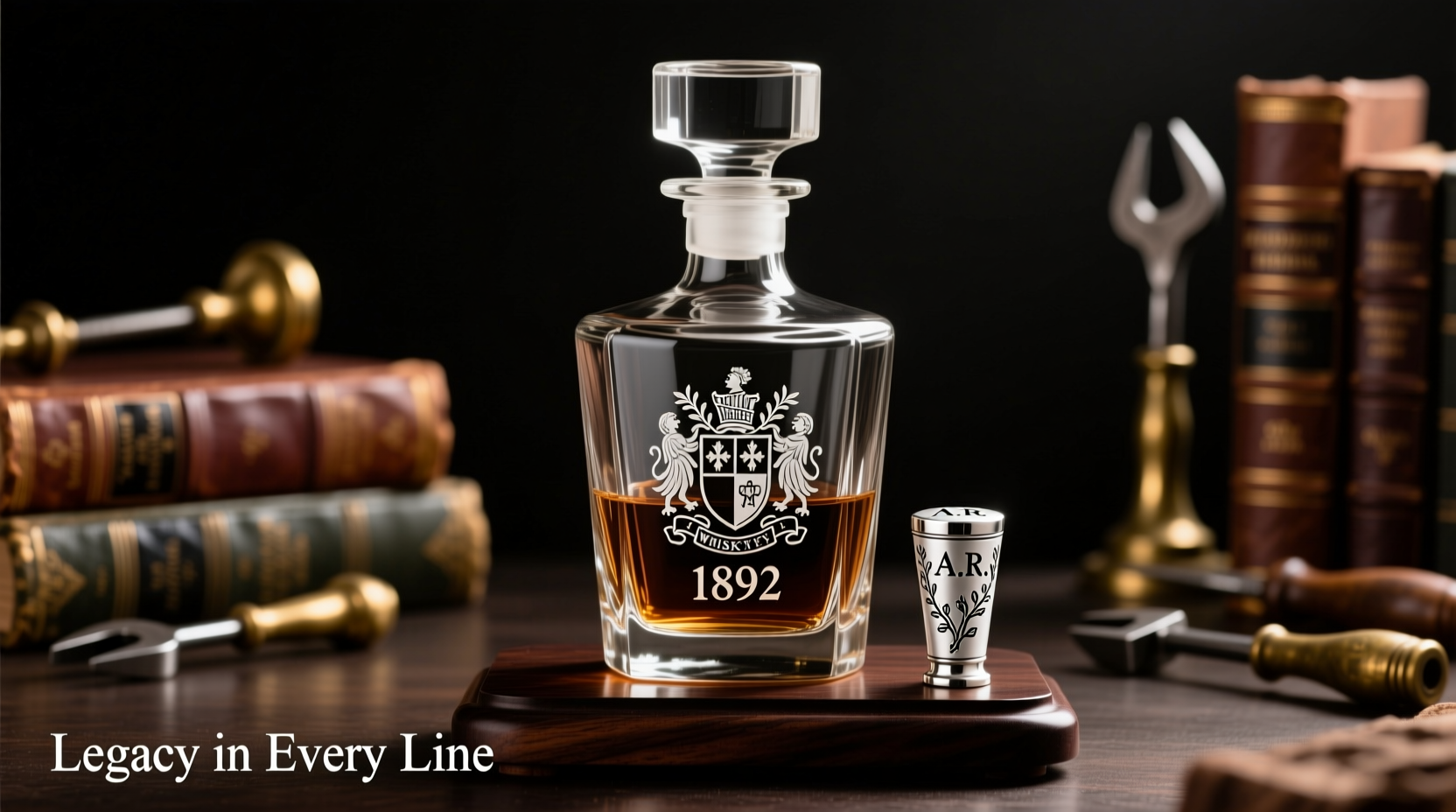
Decanter etching is a centuries-old technique adapted for modern luxury. In professional services, artisans apply a resist stencil to the glass surface, then expose the exposed areas to hydrofluoric acid (in controlled, low-concentration formulations) or abrasive sandblasting under high pressure. The result is a permanent, frosted, matte-textured recess in the glass—subtle yet unmistakable. Unlike surface printing or decals, etching modifies the actual silica matrix. It cannot peel, fade, or scratch off—only erode through physical abrasion over many decades, if at all.
The depth and contrast of the etch depend on duration, pressure, and glass composition. Crystal decanters (typically 24%–30% lead oxide) respond with richer opacity and smoother gradients than soda-lime glass. Master etchers—like those at Edinburgh-based Glass & Grain Atelier—spend 6–12 hours per piece on complex monograms, heraldic crests, or bespoke illustrations, adjusting pressure mid-process to achieve tonal variation. This labor-intensive process yields heirloom-grade permanence—but also introduces constraints: design complexity is limited by glass curvature, and delicate lettering below 4mm height risks visual loss on curved surfaces.
Tip: For multi-generational legibility, choose serif fonts with generous x-heights (e.g., Garamond, Mrs Eaves) and avoid script styles on cylindrical decanters—optical distortion blurs fine strokes.Laser-Engraved Stoppers: Precision, Portability, and Practical Limits
Laser engraving uses focused CO₂ or fiber lasers to vaporize microscopic layers of material—whether crystal, walnut, blackened steel, or even stabilized maple burl. Unlike etching, it creates crisp, high-resolution detail without chemical exposure or manual masking. A skilled technician can render photorealistic portraits, micro-engraved coordinates, or 12-point typography with sub-millimeter fidelity. Because the stopper is a discrete, often flat-surfaced component, design flexibility exceeds what’s possible on a full decanter.
Yet portability creates vulnerability. Stoppers are handled repeatedly—removed, cleaned, reinserted. Over time, friction against the decanter neck wears engraved edges, especially on softer materials like wood or acrylic. One study by the Scottish Whisky Archive tracked 47 personalized stoppers over eight years: 68% showed visible rounding of engraved corners after 3+ years of weekly use; 22% developed micro-fractures around deep engravings in crystal stoppers due to thermal stress during washing. Laser marks on metal are most durable—but lack the warmth and organic texture of etched glass.
“Etching speaks in the language of permanence—glass remembers its own transformation. A laser mark on a stopper is brilliant, but it’s a guest, not a resident.” — Fiona MacLeod, Master Glass Conservator, National Museums Scotland
Direct Comparison: What Matters Most for Legacy Personalization
To determine which method serves legacy intent best, we evaluated five non-negotiable criteria: longevity, aesthetic integration, emotional resonance, functional impact, and resale integrity. Here’s how each performs across real-world benchmarks:
| Criterion | Decanter Etching | Laser-Engraved Stopper |
|---|---|---|
| Longevity (50+ year projection) | Exceptional. Integral to glass structure; only compromised by severe abrasion or acid immersion. | Variable. Crystal: excellent. Wood/metal: good to fair. Engraved edges degrade with repeated handling. |
| Aesthetic Integration | Seamless. Design becomes part of the vessel’s form and light interaction—frosted areas diffuse light, enhancing depth. | Isolated. Mark exists apart from the liquid and vessel. Can feel decorative rather than intrinsic. |
| Emotional Resonance | High. Viewers instinctively recognize hand-guided craft. Tactile contrast invites touch and contemplation. | Moderate to high. Precision evokes modernity and care—but lacks the “human signature” of artisanal resistance. |
| Functional Impact | None. Etching does not affect pour, seal, or oxidation rate. | Potential risk. Deep engravings on stopper bases may interfere with silicone gasket compression, risking slow evaporation. |
| Resale/Inheritance Integrity | Strong. Collectors value original, unaltered vessels. Etching increases provenance value when documented. | Weak to neutral. Replacement stoppers are common; engraving has no bearing on core collectible value of decanter or spirit. |
A Real Legacy Moment: The Campbell Family Commission
In 2021, the Campbell family of Speyside commissioned a personalized decanter set to mark the 125th anniversary of their founding distillery. They considered both options: an etched Glencairn crystal decanter bearing their 1898 crest and founding motto (“Fideli Permaneo”), or a matching set of laser-engraved oak stoppers with individualized names for each of their seven grandchildren.
They chose etching—not for cost ($320 vs. $285 for the stopper set), but for conceptual alignment. As patriarch Alistair Campbell explained in correspondence with the studio: *“We wanted the bottle itself to carry our history—not just hold it. When my great-grandson pours from that decanter in 2074, he’ll see the same frosted crest his great-great-grandfather saw. The stopper might be lost, replaced, or worn smooth. But the glass remembers.”*
The etched decanter was displayed at their family archive alongside original still blueprints and handwritten ledgers. Three years later, when the eldest grandson gifted a replica decanter to his university’s whisky society, he included a note: *“The etching isn’t decoration. It’s the first sentence of a story that hasn’t finished being told.”*
Choosing With Intention: A 5-Step Decision Framework
Selecting between these methods shouldn’t hinge on aesthetics alone. Apply this framework to clarify your legacy objective:
- Define the primary purpose: Is this for display (e.g., mantelpiece, bar cabinet) or active use (weekly pours, shared tastings)? Display favors etching; moderate-use scenarios may benefit from stopper engraving.
- Assess the recipient’s relationship to ritual: Does the person value tactile tradition (hand-blown glass, weight, chill) or technological precision (micro-detail, reproducibility)?
- Evaluate environmental context: Will the decanter reside in a climate-controlled space or near heat sources/sunlight? Etched glass tolerates temperature fluctuation better than engraved wood or acrylic stoppers.
- Consider scalability: Planning multiple gifts (e.g., wedding party sets)? Laser engraving offers faster turnaround and tighter consistency. Etching excels for singular, ceremonial pieces.
- Verify archival documentation: Request a signed certificate of creation—including date, artisan name, glass composition, and etch depth (measured in microns). Reputable studios provide this; few stopper vendors do.
FAQ: Clarifying Common Misconceptions
Can I etch a decanter myself using DIY kits?
No—consumer-grade etching creams contain inconsistent acid concentrations and lack precise application control. They produce shallow, hazy, or uneven results and pose significant safety hazards (hydrofluoric acid exposure can cause deep-tissue burns with delayed pain onset). Professional etching requires fume hoods, calibrated timers, and certified PPE. Leave it to accredited studios.
Does laser engraving affect the whiskey’s flavor or aroma?
Not directly—when performed correctly on inert materials (crystal, food-grade stainless, sealed hardwood), laser engraving introduces no volatile compounds. However, poorly executed engravings on porous wood stoppers can trap ethanol vapors and oxidized esters, leading to subtle off-notes after months of contact. Always verify the vendor uses post-engraving sealing protocols for organic materials.
Will an etched decanter cloud over time with washing?
No—etching is subsurface, not a coating. Cloudiness arises from mineral deposits (hard water) or detergent film, not the etch itself. Rinse thoroughly with distilled water and air-dry upside-down on a microfiber-lined rack. Avoid dishwashers entirely—heat and caustic detergents accelerate glass corrosion unrelated to etching.
Conclusion: Legacy Isn’t Imprinted—It’s Embodied
Whiskey is measured in time—years in cask, decades in bottle, generations in memory. The vessel that holds it should reflect that same temporal gravity. Etching transforms glass into a palimpsest: the original surface remains, subtly altered, carrying meaning in its very texture. A laser-engraved stopper delivers clarity and convenience—but sits apart from the liquid’s journey, easily detached, easily replaced. When you commission personalization for a legacy bottle, you’re not selecting a logo placement—you’re choosing where the story lives. In the glass, or on its lid? With the weight of craft, or the speed of precision?
Choose etching when permanence, integration, and heirloom continuity are non-negotiable. Choose laser stoppers when versatility, detail fidelity, and functional adaptability take priority—for gifts meant to be used, shared, and enjoyed now. There is no universal “best.” There is only what best honors your intention.
💬 Your legacy begins with a single decision. Share how you’ve personalized a meaningful bottle—or what story you’d etch into glass—in the comments below. Let’s build a living archive of intention, one decanter at a time.