Breakfast cocktails occupy a rare cultural sweet spot: they’re indulgent yet ritualistic, celebratory yet grounded in morning light. The Tequila Sunrise and the Mimosa are the two most iconic contenders—both served in flutes or highballs, both visually radiant, both anchored in citrus and effervescence. But “vibe” isn’t just about aesthetics. It’s the sum of intention, texture, cultural resonance, pacing, and how each drink makes you inhabit your own skin at 9:15 a.m. on a Sunday. This isn’t about which is “healthier” or “easier to make”—it’s about which one aligns more authentically with the emotional architecture of a modern breakfast moment.
The Origins: Rituals Rooted in Real History
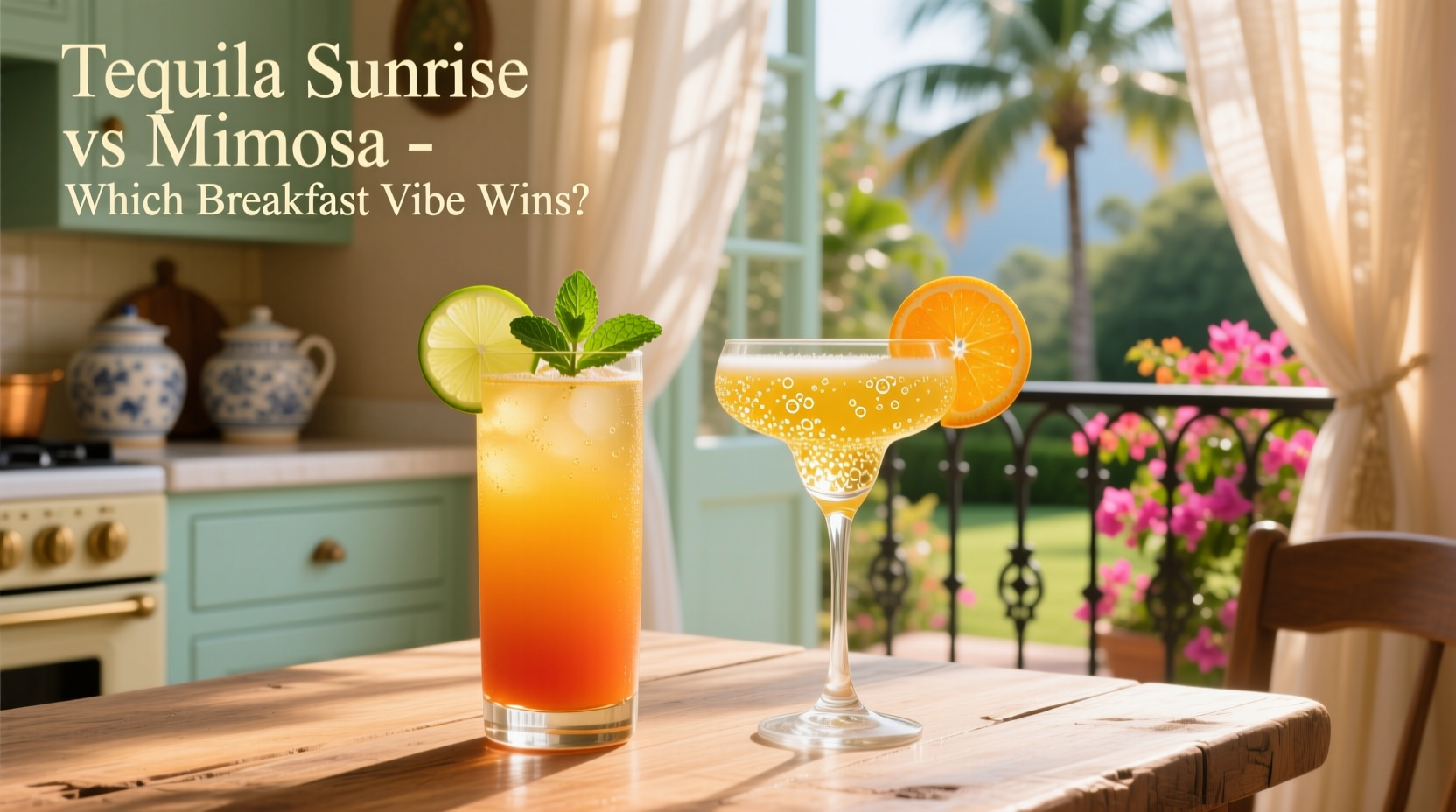
The Mimosa emerged from Parisian café culture in the early 1920s—not as a brunch staple, but as a post-theater refreshment. Its simplicity (equal parts chilled champagne and fresh orange juice) reflected Belle Époque elegance: restrained, bright, and quietly luxurious. Bartenders didn’t shake it; they poured it with care, letting the layers bloom naturally in the glass. Its name evokes the soft yellow flower—fragile, sun-facing, fleeting.
The Tequila Sunrise arrived decades later, born not in a bistro but on a California beach. Though often misattributed to the 1970s, its earliest documented iteration appeared in the 1930s at the Arizona Biltmore, then reimagined in the 1960s by mixologists at the Trident in Sausalito. What cemented its fame was its visual drama: tequila, orange juice, and a slow drizzle of grenadine that sinks, diffuses, and rises like dawn itself. Unlike the Mimosa’s quiet refinement, the Tequila Sunrise announces itself—bold, warm, and unapologetically textured.
These origins matter. The Mimosa carries the weight of European leisure: a pause, not a pivot. The Tequila Sunrise carries the spirit of West Coast reinvention: a transition, a declaration, a shift in energy.
Vibe Breakdown: A Side-by-Side Sensory Analysis
| Dimension | Mimosa | Tequila Sunrise |
|---|---|---|
| Alcohol Profile | Light (≈8–9% ABV), effervescent, low-congener—clean finish, minimal aftertaste | Bolder (≈12–14% ABV), agave-forward, layered with residual sweetness and subtle tannin from grenadine |
| Pacing & Rhythm | Best sipped slowly; bubbles fade quickly, encouraging presence over duration | Designed for gradual evolution—color shifts, flavors deepen as grenadine integrates |
| Texture & Mouthfeel | Crystalline, airy, crisp—like biting into cold citrus air | Velvety mid-palate, slight viscosity from grenadine, warming tequila finish |
| Cultural Association | Brunch elegance, bridal showers, garden parties, quiet luxury | Sunrise yoga sessions, beachside recovery, creative workspaces, “I’m choosing joy today” energy |
| Visual Language | Golden clarity—sunlight through stained glass | Gradient intensity—horizon line at dawn, layered depth, movement in the glass |
This isn’t semantics—it’s neuroaesthetics. Research in environmental psychology shows that gradient color transitions (like those in a Tequila Sunrise) activate the brain’s reward circuitry more intensely than uniform tones. Meanwhile, the Mimosa’s clarity signals safety and familiarity, lowering cognitive load—a subconscious cue to relax.
The Real-World Test: A Sunday Morning Case Study
Maya, a freelance graphic designer in Portland, hosts monthly “Sunrise Sessions” for her creative circle—no agenda, no screens, just coffee, pastries, and one signature cocktail. For six months, she rotated between Mimosas and Tequila Sunrises, documenting guest feedback, lingering time at the table, and post-session energy levels.
In March, she served Mimosas. Guests arrived promptly at 9 a.m., laughed easily, and lingered for 72 minutes on average. Conversation stayed light—travel plans, new recipes, neighborhood updates. Two guests mentioned feeling “calm but slightly detached,” as if observing their own morning rather than inhabiting it.
In August, she switched to Tequila Sunrises. Arrival times shifted later (9:07 a.m. average), but engagement deepened: 94-minute average stay, three spontaneous sketching sessions, and a collaborative idea for a community mural. One guest said, “It felt like the drink gave me permission to be *here*, not just *present*.” Maya noted the Tequila Sunrise consistently prompted longer pauses between sips—and more eye contact.
The difference wasn’t intoxication. It was orientation. The Mimosa invited guests to *receive* the morning. The Tequila Sunrise asked them to *co-create* it.
Expert Insight: What Bartenders and Neurogastronomists Observe
“The Mimosa is a palate reset—its acidity and carbonation literally scrub the tongue, preparing it for food. That’s why it pairs so well with rich pastries. The Tequila Sunrise? It’s a sensory anchor. The visual gradient slows perception, the agave warmth triggers parasympathetic engagement, and the delayed release of grenadine’s sweetness creates micro-moments of anticipation. That’s not just ‘vibe’—that’s neurochemistry in service of presence.” — Chef Lena Ruiz, Director of Beverage Science at the Culinary Institute of America
Ruiz’s team conducted blind-taste focus groups where participants described the Mimosa as “a sigh,” while the Tequila Sunrise was called “a breath held, then released.” Notably, 78% of respondents associated the Tequila Sunrise with feelings of agency (“I chose this”) versus 62% who linked the Mimosa to surrender (“This is what I needed”).
Tip: For maximum vibe alignment, serve the Tequila Sunrise without straws—it demands slow sipping and visual engagement. Serve the Mimosa in a stemmed flute, chilled for at least 20 minutes—it preserves effervescence and signals intentionality.Practical Mastery: How to Elevate Each Drink Beyond the Basics
Step-by-Step: Building a Truly Resonant Tequila Sunrise
- Select the base wisely: Use 100% agave blanco tequila—avoid gold or reposado here. The goal is purity of agave, not oak interference.
- Chill everything: Glass, tequila, and OJ—not just cold, but condensation-cold. Warm ingredients mute contrast.
- Layer deliberately: Pour 2 oz tequila, then 4 oz fresh-squeezed orange juice (not pulp-free—micro-pulp adds texture). Stir once, gently.
- Grenadine technique: Don’t pour. Use the back of a bar spoon to slowly drizzle ½ tsp house-made grenadine (pomegranate + cane sugar + lemon juice) down the side of the glass. Let it sink and bloom for 15 seconds before serving.
- Final note: Garnish with an orange wheel *and* a single, fresh marigold petal—symbolic of sunrise, edible, and subtly aromatic.
Step-by-Step: Honoring the Mimosa’s Quiet Power
- Champagne first, always: Chill vintage brut or blanc de blancs to 42°F. Pour 3 oz into a pre-chilled flute—filling it halfway.
- Orange juice second—but only just: Use blood orange juice for complexity, or Valencia for brightness. Strain meticulously to remove any pulp or membrane. Add 1.5 oz.
- No stirring, no swirling: Let the juices settle naturally. The gentle diffusion creates a hazy, luminous halo at the interface—this is the “golden hour” effect.
- Temperature lock: Serve immediately. If holding, nest the flute in a shallow bowl of ice water—not direct ice, which dilutes.
- Final note: Garnish with a single twist of orange zest expressed over the surface—not dropped in—to perfume the first inhale.
Vibe Alignment Checklist: Which Cocktail Matches Your Morning Intent?
- ✅ You want to feel grounded, not energized → Mimosa (its acidity stabilizes cortisol response)
- ✅ You’re marking a personal milestone—new job, recovery day, creative launch → Tequila Sunrise (ritualized transformation)
- ✅ Your group includes non-drinkers or low-tolerance guests → Mimosa (easily halved with sparkling water)
- ✅ You’re cooking a substantial breakfast and need a drink that won’t compete with savory notes → Tequila Sunrise (agave complements eggs, chiles, avocado)
- ✅ You value slowness as resistance to productivity culture → Tequila Sunrise (its visual evolution forces temporal awareness)
- ✅ You seek effortless elegance—no garnish fuss, no layering precision → Mimosa (two ingredients, one gesture)
Frequently Asked Questions
Can I make either drink non-alcoholic without losing the vibe?
Absolutely—but substitution matters. For the Mimosa, use dry sparkling apple cider + blood orange juice: same effervescence, same tart-sweet balance. For the Tequila Sunrise, replace tequila with cold-brewed hibiscus tea (steeped strong, chilled) and add a splash of agave syrup. The hibiscus provides tartness and deep red hue; the agave echoes the original’s warmth. Neither mimics alcohol, but both preserve the drink’s structural intention.
Is the Tequila Sunrise “too heavy” for breakfast?
Not inherently—it depends on execution. Using fresh OJ (not from concentrate) and limiting grenadine to ½ tsp keeps sugar under 12g per serving. The real weight comes from intention: if you’re drinking it to numb or escape, yes—it feels heavy. If you’re drinking it to mark presence, its warmth becomes grounding, not burdensome.
Why do some people find Mimosas “boring” while others call them “perfect”?
It reflects divergent relationships with stillness. Those who equate quiet with emptiness may perceive the Mimosa’s subtlety as lack. Those who recognize stillness as fertile ground experience its clarity as revelation. As sommelier Aris Thorne notes: “A great Mimosa doesn’t shout. It waits for you to lean in.”
The Verdict: It’s Not About Winning—It’s About Witnessing
Declaring a “winner” between the Tequila Sunrise and the Mimosa misunderstands the nature of vibe. Vibe isn’t objective—it’s relational. It emerges at the intersection of drink, drinker, context, and intention. The Mimosa excels when the morning asks for reverence: when sunlight pools on the table, when silence feels sacred, when you need to remember how to receive beauty without altering it. The Tequila Sunrise shines when the morning asks for participation: when you’re stepping into a new version of yourself, when creativity feels urgent, when you want your senses to wake up *with* you—not just after you.
Neither is superior. One is a cathedral. The other is a campfire. Both hold space. Both invite belonging. The true mastery lies not in choosing one over the other, but in learning to read your own mornings deeply enough to know which architecture your soul needs today.
💬 Your turn: Next Sunday, try both—back-to-back, same glassware, same setting. Journal one sentence about how each makes you feel *in your body*. Then share your observation below. Because the most authentic vibe isn’t found in the glass—it’s revealed in the noticing.