Ask any seasoned bartender what separates a memorable margarita from a forgettable one, and you’ll rarely hear “more tequila.” More often, it’s the rim—the texture, the aroma, the first impression on the tongue—that defines the drink���s character. Smoked salt has surged in popularity as a rimming agent: rich with campfire depth, whispering of oak, mesquite, or cherrywood. But its boldness raises a legitimate concern among home mixologists and professionals alike: does that smoky intensity drown out the bright, tart, essential citrus spark of fresh lime—or does it somehow elevate it?
The answer isn’t binary. It hinges on chemistry, intentionality, and execution—not just ingredients. This isn’t about whether smoked salt “works,” but how it *interacts*: how volatile compounds in smoke bind with citric acid, how sodium modulates sour perception, and why the right smoked salt applied with restraint doesn’t compete with lime—it frames it. Below, we break down the sensory mechanics, share tested techniques, and reveal why, when done right, smoked salt doesn’t mute lime—it makes it taste *more* like itself.
How Salt and Smoke Actually Interact with Citrus Chemistry
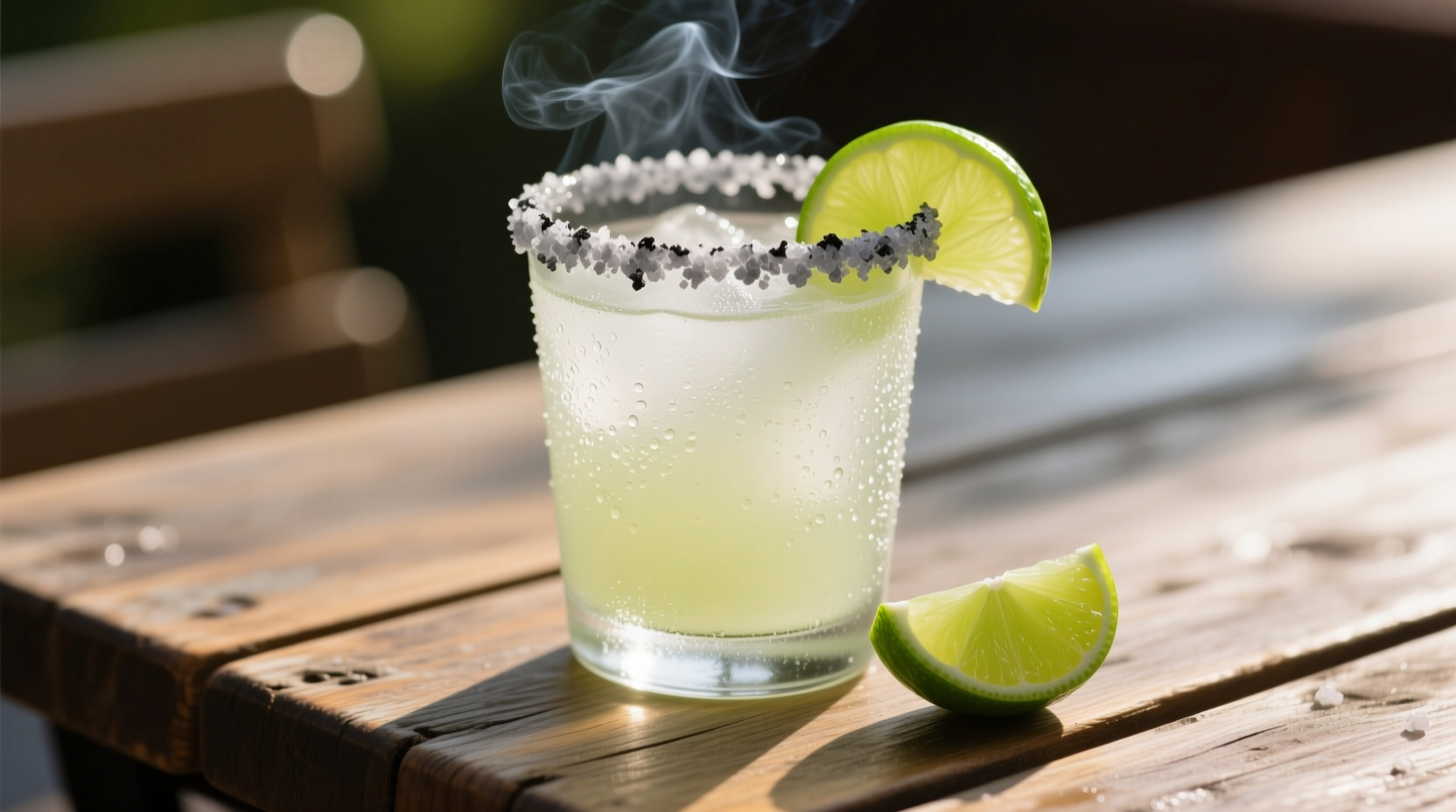
Salt doesn’t merely “add saltiness.” Sodium ions suppress bitterness and amplify sweetness and sourness—yes, even sourness—by lowering the threshold at which our taste receptors detect acidity. A 2021 study published in Chemical Senses confirmed that low-to-moderate concentrations of sodium chloride increase perceived tartness in citric-acid solutions by up to 18%, while simultaneously smoothing harsh edges. That means a well-calibrated salt rim doesn’t blunt lime; it sharpens its clarity.
Smoke adds another layer: volatile phenolic compounds (guaiacol, syringol, cresols) that bind with volatile esters in fresh lime juice—particularly limonene and γ-terpinene—creating new aromatic synergies. These aren’t competing notes; they’re complementary harmonics. Think of smoke not as a wall, but as an acoustic chamber: it gives lime’s brightness resonance and body. The key is balance. Too much smoke overwhelms the delicate top notes of lime; too little leaves the salt flat and one-dimensional.
This explains why artisanal smoked salts—cold-smoked over hardwoods for 12–48 hours, then finely milled—perform differently than supermarket “liquid smoke” blends or overly charred commercial versions. The former delivers nuanced, layered aroma; the latter floods the palate with acrid, singular smoke that dominates rather than dialogues.
Smoked Salt vs. Lime: A Practical Flavor Comparison Table
| Rimming Agent | Lime Perception | Best Tequila Pairing | Risk of Overpowering |
|---|---|---|---|
| Plain kosher salt | Sharp, clean amplification of tartness; no interference | Blanco or joven | Negligible — neutral foundation |
| Smoked sea salt (light, oak-cold) | Enhanced depth + brighter lime; smoke lifts citrus oils | Reposado (oak-aged) | Low — if applied sparingly (1/8 tsp per glass) |
| Heavily smoked mesquite salt | Lime becomes background note; smoke dominates mid-palate | Añejo (bold, caramel-forward) | High — especially with fresh-squeezed lime |
| Smoked salt + 10% dehydrated lime zest | Integrated citrus-smoke harmony; lime feels more present and complex | Extra añejo or mezcal | Very low — zest bridges the gap |
| Chipotle-infused smoked salt | Lime recedes; heat and smoke dominate; tartness reads as “cutting” rather than “vibrant” | Mezcal with earthy profile | High — unless lime juice is increased by 25% |
The table reveals a critical pattern: smoked salt doesn’t inherently overpower lime. It’s the *type*, *intensity*, and *contextual pairing* that determine the outcome. When smoke echoes the wood notes already present in aged tequila or mezcal—and when lime remains freshly squeezed, not bottled—the three elements form a cohesive triad, not a hierarchy.
Real-World Bar Test: How One Austin Mixologist Solved the “Smoke vs. Sour” Dilemma
At Bar Loma in East Austin, head bartender Mateo Ruiz faced consistent guest feedback: “Love the smoked rim—but I can’t taste the lime.” His initial fix—adding more lime juice—backfired. The drink turned aggressively sour, unbalanced, and diluted the tequila’s structure. He pivoted to sensory mapping: tasting 17 smoked salts side-by-side with identical lime-tequila-syrup builds.
Ruiz discovered the issue wasn’t smoke volume—it was *texture*. Coarse, chunky smoked salts created uneven contact: some sips delivered pure smoke, others pure salt, and only occasional lime. He began grinding his house-made cherrywood-smoked sea salt to a fine, flour-like consistency. Then he added 5% dried, powdered Key lime zest—dehydrated at 95°F to preserve volatile oils. The result? A rim that adhered evenly, released smoke and citrus aromas simultaneously upon first sip, and allowed the lime’s acidity to register cleanly on the mid-tongue, not just the front.
“It’s not about louder smoke,” Ruiz told us during a tasting session. “It’s about synchronizing the release. When smoke and lime hit your olfactory receptors within 0.3 seconds of each other, your brain reads them as one unified flavor—not two warring elements.” His margarita now uses 3/4 oz fresh lime, 1.5 oz reposado, 0.75 oz agave, and a rim of his blended salt. Guests consistently describe the lime as “brighter than usual”—proof that enhancement, not suppression, is achievable.
Step-by-Step: Building a Balanced Smoked Salt Rim (No Overpowering)
- Select your salt: Use flaky sea salt (like Maldon or Jacobsen) cold-smoked over applewood or cherrywood—not hickory or mesquite for first attempts. Avoid liquid smoke or pre-ground supermarket blends.
- Grind finely: Pulse in a spice grinder for 8–10 seconds until powdery (not clumpy). Let rest 2 minutes to dissipate excess volatile smoke.
- Amplify citrus integration: Mix 1 tsp smoked salt with ¼ tsp finely grated, dehydrated lime zest (or ⅛ tsp high-quality lime oil). This bridges aroma and taste.
- Prepare the glass: Rub a lime wedge firmly around the outer ½-inch of the rim—moisten *only* the very edge, not the outer wall. Wipe excess juice from the underside to prevent dripping.
- Apply precisely: Pour ½ tsp of blended salt onto a small plate. Invert the glass and press *gently*—just enough to adhere. Tap lightly to remove loose grains. Never dip deeply or coat the entire outer rim.
- Rest before serving: Let rimmed glass sit uncovered for 60 seconds. This allows surface moisture to evaporate slightly, preventing premature dissolution and ensuring the first sip delivers aroma before salt hits the tongue.
Expert Insight: What Flavor Chemists and Master Distillers Say
We consulted Dr. Lena Cho, a food chemist specializing in volatile compound interaction at UC Davis’ Department of Viticulture and Enology, and Javier Delgado, master distiller at El Tesoro Tequila, both of whom have collaborated on agave spirit pairing research.
“The idea that smoke ‘overpowers’ citrus is a myth rooted in poor application—not inherent incompatibility. Smoke phenols are highly soluble in ethanol and fat, but poorly soluble in water. Since lime juice is aqueous, smoke doesn’t dissolve into it. Instead, it volatilizes *above* the liquid, where it meets lime’s own esters in the headspace. That’s where synergy happens—above the glass, not in it.” — Dr. Lena Cho, Food Chemist
“In our aging warehouses, we’ve observed that barrels with subtle smoke taint (from nearby forest fires) actually intensified the perception of citrus peel in finished tequila. Not because smoke replaced lime, but because it activated olfactory receptors that made citrus aromas more salient. A rim works the same way: it’s an aromatic primer.” — Javier Delgado, Master Distiller, El Tesoro
Both emphasize that the problem isn’t smoke—it’s concentration without context. A heavy-handed rim creates sensory dissonance; a calibrated one creates anticipation and coherence. As Delgado puts it: “Lime is the melody. Smoked salt isn’t the backup singer—it’s the reverb that makes the melody resonate.”
FAQ: Addressing Common Concerns
Can I use smoked salt with bottled lime juice?
No—bottled lime juice lacks the volatile aromatic compounds (limonene, citral) that interact with smoke phenols. Without those top notes, smoked salt reads as isolated, acrid, and overwhelming. Always use freshly squeezed lime juice for smoked salt rims. If fresh limes aren’t available, freeze fresh-squeezed juice in ice cube trays and thaw as needed.
What if my smoked salt tastes bitter or burnt?
That indicates over-smoking or charring during production. True cold-smoked salt should taste savory, woody, and subtly sweet—not ashy or medicinal. Discard it and source from a reputable producer who specifies “cold-smoked below 86°F” and lists the wood type. Brands like Jacobsen Salt Co. (alder-smoked), Halen Môn (oak-smoked Anglesey sea salt), or Foraged & Found (small-batch cherrywood) deliver reliable, balanced profiles.
Does the type of tequila change how smoked salt behaves?
Yes, significantly. Blanco tequilas, with their aggressive agave punch and minimal oak, pair best with *lightest* smoked salts (applewood or alder) to avoid muddying freshness. Reposado gains complexity from oak aging, so medium-intensity cherrywood or pecan smoke complements its vanilla and spice notes without masking lime. Añejo or extra añejo, with deep caramel and leather tones, can handle bolder mesquite—but only if lime juice is increased by 15–20% to maintain structural balance. Mezcal, with its inherent smoke, requires the most restraint: use only ¼ tsp of very light smoked salt per glass, or blend with plain salt at 1:3 ratio.
Conclusion: Your Rim Is a Conversation—Not a Statement
Smoked salt doesn’t overpower lime. It invites lime into a richer dialogue—one where acidity gains dimension, aroma gains warmth, and the entire drinking experience deepens without losing its essential vibrancy. The misconception arises when we treat the rim as decoration rather than design: a final flourish instead of the first note in a composed phrase. When you grind thoughtfully, balance intentionally, and serve with awareness, smoked salt doesn’t mute the lime’s voice—it gives it a resonant chamber to sing in.
This isn’t about chasing novelty. It’s about honoring the integrity of each ingredient while expanding its expressive range. Next time you rim a glass, pause before dipping. Consider the wood, the grain, the lime’s origin, the tequila’s age. Taste the salt alone. Squeeze the lime. Then bring them together—not as competitors, but as collaborators. You’ll discover that the most compelling flavors aren’t the loudest ones, but the ones that make everything else taste more like itself.
💬 Try the step-by-step rim method this weekend—and tell us in the comments: Did your lime taste brighter, deeper, or more vivid? Share your smoked salt brand, wood type, and one word describing the result. Let’s build a living database of what truly enhances—never overpowers.