Neutrality in vodka is not the absence of character—it’s the precision of omission. For the classic martini, where just three ingredients (vodka, dry vermouth, and a garnish) demand flawless balance, any residual grain sweetness, solvent-like heat, or vegetal tang can destabilize the drink’s architecture. That’s why bartenders at Michelin-starred bars and home enthusiasts refining their craft increasingly scrutinize vodka’s provenance—not just its ABV or price tag. The distinction between single-origin and grain-blend vodkas goes far beyond marketing: it reflects divergent philosophies of distillation, agricultural intention, and sensory control. This isn’t about “better” in absolute terms; it’s about *cleaner neutrality*—a specific, measurable quality defined by minimal aromatic interference, seamless mouthfeel, and structural transparency in the glass.
What “Cleaner Neutrality” Really Means in Practice
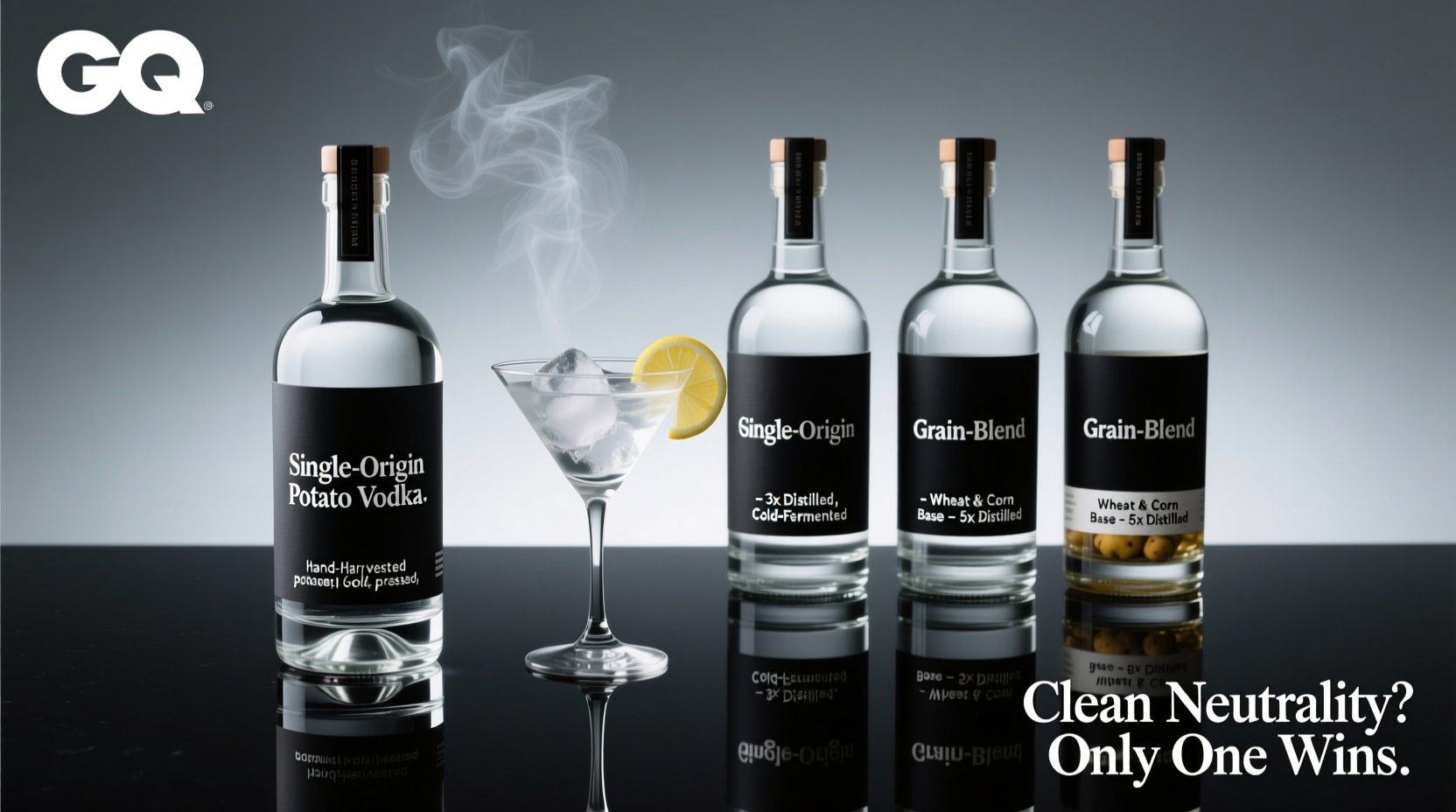
Cleaner neutrality isn’t flavorlessness. It’s the elimination of off-notes that compete with vermouth’s herbal complexity or distract from the saline lift of an olive brine or citrus oil. In a properly stirred 5:1 martini served at −2°C, cleaner neutrality manifests as:
- Zero detectable ethanol burn—no harsh alcohol spike on the mid-palate;
- No residual cereal sweetness—no corny, bready, or oat-like notes that muddy vermouth’s dryness;
- No vegetal or grassy undertones—especially important when using botanical-forward vermouths like Dolin Dry or Noilly Prat;
- A silky, almost viscous texture that carries vermouth evenly without diluting its aromatic presence;
- Aftertaste that vanishes cleanly—no lingering bitterness, metallic tinge, or solvent echo.
This standard is rarely met by mass-market vodkas, regardless of triple-distillation claims. It emerges instead from deliberate sourcing, minimal processing, and rigorous sensory triage—conditions more consistently achieved in single-origin production than in industrial grain blends.
How Single-Origin Vodka Achieves Precision Neutrality
Single-origin vodka begins with one harvest, one field, one varietal—typically winter rye, heirloom wheat, or heritage barley grown in mineral-rich soils with documented microclimates. Distillers like Chase Distillery (Herefordshire, UK), St. George Spirits (California), and Nordic Distillery (Sweden) treat grain like Pinot Noir: terroir matters because starch composition, protein content, and natural enzyme profiles directly influence fermentation efficiency and congeners profile.
During fermentation, single-origin grains yield more predictable yeast metabolites. Rye, for example, produces fewer fusel oils than corn under controlled low-temperature fermentation. That means less post-distillation burden on carbon filtration—a process that, while effective, can strip desirable mouthfeel along with impurities. As master distiller Lars Williams of Empirical Spirits observes:
“Blending grains is like mixing paint to get gray—you start with color and try to neutralize it. Single-origin is like starting with white canvas: you preserve purity by avoiding contamination at the source. Our Swedish winter rye vodka spends 72 hours fermenting at 14°C—not 30°C—because slower metabolism yields cleaner esters and virtually no acetaldehyde.” — Lars Williams, Co-Founder & Master Distiller, Empirical Spirits
Crucially, single-origin producers often skip the “rectification” step common in large-scale blending: repeated redistillation in column stills designed for volume, not nuance. Instead, they use batch copper pot stills with precise cut points—discarding the “heads” (methanol, acetone) and “tails” (fusel oils, fatty acids) with surgical accuracy. The result is a spirit that requires less aggressive post-distillation treatment, preserving a subtle, clean mouth-coating texture essential for martini viscosity.
The Structural Compromises of Grain-Blend Vodkas
Grain-blend vodkas combine corn, wheat, rye, and sometimes sorghum or potatoes—not for synergy, but for cost efficiency and consistency across harvests. Blending masks variability: a weak rye crop gets balanced with high-yield corn; drought-stressed wheat is offset by moisture-tolerant sorghum. But this functional flexibility comes at a sensory cost.
Each grain contributes distinct congener families:
| Grain | Predominant Congeners | Martini Impact |
|---|---|---|
| Corn | Ethyl lactate, diacetyl, higher alcohols | Buttery, slightly sweet finish; competes with vermouth’s herbaceousness |
| Wheat | Ethyl acetate, isoamyl alcohol | Creamy mouthfeel but potential solvent note if tails not fully removed |
| Rye | Phenethyl acetate, ethyl decanoate | Spicy, peppery edge—desirable in whiskey, disruptive in martini |
| Potato | Long-chain fatty acids, glycerol | Heavy, oily texture; dulls vermouth’s lift |
To reconcile these competing profiles, grain-blend producers rely heavily on multi-stage carbon filtration—often passing spirit through activated charcoal columns three or four times. While effective at removing volatiles, over-filtration depletes esters responsible for mouthfeel cohesion. The result is a vodka that reads “neutral” on paper but feels thin, hollow, or aggressively drying in the martini—lacking the viscous suspension needed to integrate vermouth seamlessly.
Tip: When tasting vodka neat for martini suitability, chill it to 4°C and sip slowly. If your tongue detects any warmth, sweetness, or after-burn before the swallow, it will amplify in the martini—especially when diluted to 28% ABV.A Real-World Martini Comparison: Bar Sotto, Los Angeles
At Bar Sotto—a 32-seat cocktail den known for its obsessive vermouth program—bartender Maya Chen ran a blind tasting with eight vodkas across two categories. Guests included sommeliers, vermouth importers, and longtime martini drinkers. Each martini was built identically: 60ml vodka, 12ml Dolin Dry, stirred 32 seconds with cracked ice, strained into a chilled Nick & Nora glass, garnished with orange twist.
The results were revealing. Single-origin entries—Chase English Rye Vodka, Karlsson’s Gold (Swedish new potatoes), and St. George All Purpose—delivered consistent clarity: vermouth’s chamomile and gentian notes remained articulate; the spirit provided structure without presence. One guest noted, “It’s like the vodka stepped back and let the vermouth speak.”
Grain-blend vodkas showed divergence. Two premium blends (one wheat-corn, one rye-wheat-potato) performed adequately but revealed faint cereal sweetness that muted the orange oil’s brightness. Three mainstream blends introduced detectable heat and a short, drying finish—causing guests to add extra vermouth to compensate, unbalancing the ratio. As Chen observed: “The grain-blends didn’t fail. They just required editing—more stirring, colder glassware, adjusted ratios. The single-origin ones worked as written.”
How to Choose & Use Vodka for Premium Martinis: A Practical Guide
Selecting the right vodka isn’t about price or prestige—it’s about matching production logic to your martini goals. Follow this sequence:
- Identify your vermouth profile: Herbal & floral (e.g., Cocchi Americano) pairs best with ultra-clean, high-starch vodkas (wheat or potato). Bitter-dominant (e.g., Carpano Antica Formula Dry) benefits from a touch of textural weight—opt for single-origin rye with restrained spice.
- Check the distillation method: Prioritize batch pot-distilled vodkas. Avoid those listing “continuous column distillation” without specifying cut-point rigor—this often signals volume-driven production.
- Review the filtration claim: “Charcoal filtered” is standard. “No carbon filtration” or “minimal post-distillation treatment” is preferable—indicating confidence in the raw spirit.
- Verify origin specificity: “Distilled in France” is meaningless. Look for “100% French winter wheat, grown in Champagne,” or “Single-estate rye, harvested September 2023.”
- Test the chill response: Freeze vodka for 90 minutes. Pour 25ml into a pre-chilled glass. Swirl. Does it coat the sides evenly? Does aroma vanish within 3 seconds? If yes, it has the viscosity and volatility profile for martini excellence.
FAQ: Addressing Common Martini-Vodka Questions
Does organic grain guarantee cleaner neutrality?
No. Organic certification addresses pesticide use—not starch purity, fermentation hygiene, or distillation precision. A non-organic, single-estate rye grown with precision irrigation and fermented under strict temperature control will outperform an organic blend with inconsistent grain maturity.
Can I use a grain-blend vodka successfully in a martini?
Yes—if you adjust technique. Stir longer (45+ seconds) to maximize chilling and dilution, use a colder glass (−10°C freezer-chilled), and reduce vermouth to 9ml to counteract perceived sweetness. But this compensates for the spirit’s limitations rather than leveraging its strengths.
Why does temperature matter so much for neutrality?
Volatile compounds become more perceptible as temperature rises. A vodka that tastes clean at 4°C may reveal ethanol sharpness or ester fruitiness at 12°C—the temperature it reaches 90 seconds after pouring. Premium martinis are served between −2°C and 0°C for this reason: cold suppresses unwanted volatiles while preserving texture.
Conclusion: Neutrality Is a Discipline, Not a Default
Choosing single-origin vodka for martinis isn’t elitism—it’s alignment. It’s recognizing that neutrality isn’t passive; it’s actively cultivated through soil stewardship, fermentation discipline, and distillation restraint. Grain-blend vodkas serve vital roles—in high-volume bars, in flavored applications, in budget-conscious home bars—but they operate on different design principles. When your goal is a martini where vermouth’s nuance remains undimmed, where the spirit functions as architecture rather than ornament, single-origin delivers what grain-blends cannot: a foundation of quiet, unwavering clarity.
Start with one bottle—Chase English Rye, Karlsson’s Gold, or a local craft distiller using single-harvest grain. Stir it with 12ml Dolin Dry. Taste without garnish first. Then with orange oil expressed over the surface. Notice how the spirit behaves—not as a flavor, but as a vessel. That’s cleaner neutrality in action: invisible, essential, and utterly intentional.
💬 Have you tasted the difference in your own martini? Share your top single-origin pick—and what vermouth pairing surprised you—in the comments. Let’s build a living reference for clean, confident martinis.