Ask any seasoned bartender what gives a cocktail its soulful depth—and chances are, they’ll point not to a fancy syrup or rare bitters, but to the rum in the shaker. Yet confusion persists: Is “dark rum” simply aged rum? Is “rum” always light? And why does one pour deliver unmistakable warmth, spice, and weight while another stays bright and breezy—even when both come from the same island, same distillery, and same sugarcane source?
The truth lies not in marketing labels but in process, time, and intention. “Rum” is a category defined by law—distilled from sugarcane byproducts—but “dark rum” is a sensory promise: richness, resonance, and layered complexity. What separates them isn’t just color; it’s chemistry, craft, and context. This article dissects the tangible factors that make dark rum richer in cocktails—not as a matter of preference, but of measurable impact on mouthfeel, aroma persistence, and structural balance.
What “Rum” Really Means (and Why It’s Not a Single Flavor)
Under international standards—including those of the U.S. TTB, EU, and Caribbean Rum Association—“rum” must be distilled from fermented sugarcane juice, molasses, or syrup, with an alcohol-by-volume (ABV) between 37% and 80%. That’s it. No minimum aging. No required barrel type. No stipulation about color, proof, or congeners. A 37% ABV column-still distillate filtered to clarity and bottled the same week qualifies as “rum.” So does a 63% pot-still rum aged 22 years in ex-bourbon casks.
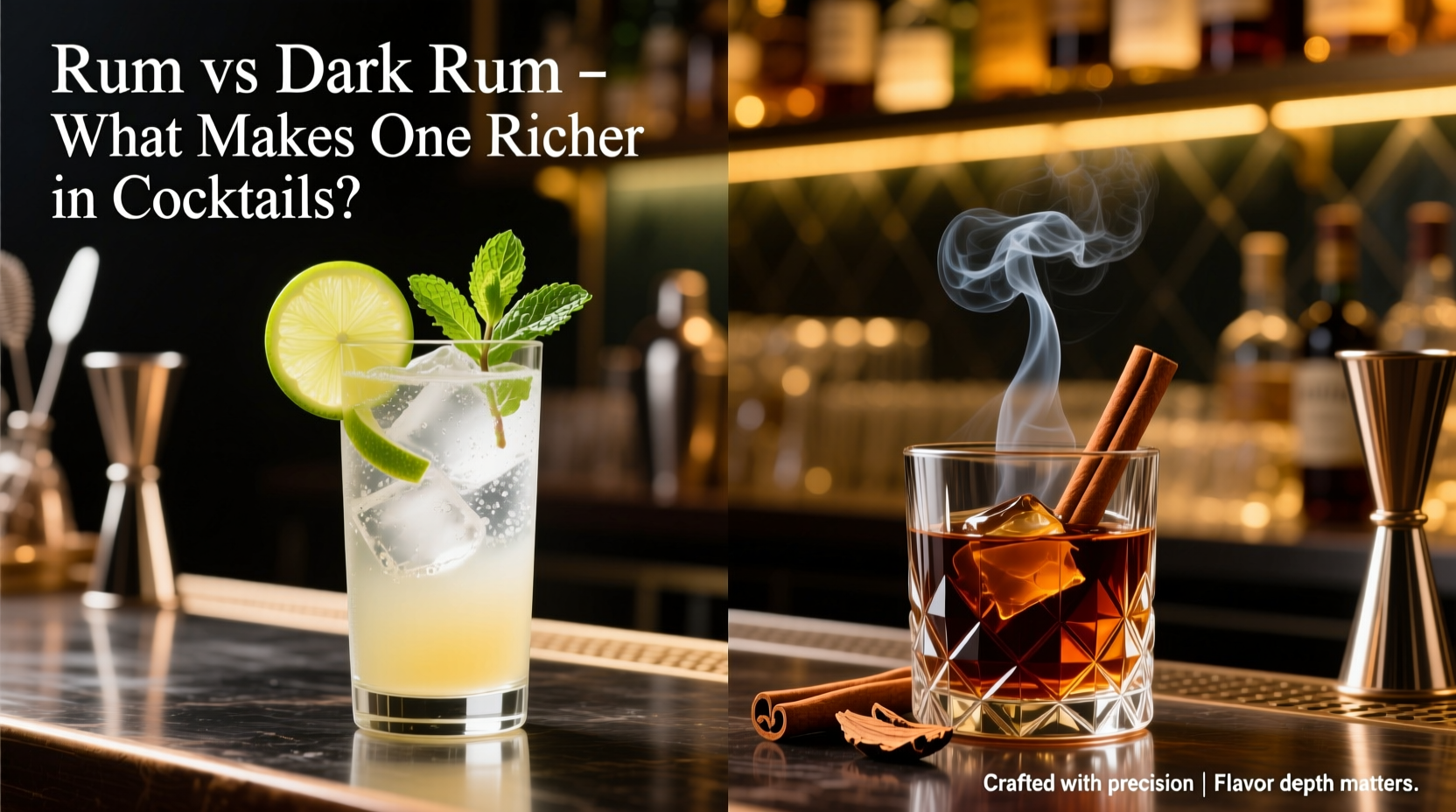
This legal breadth explains why “rum” as a standalone term often signals lightness—not because light rums are inferior, but because they’re engineered for neutrality. Most are distilled at high proof (often above 90% ABV), stripped of heavier esters and fatty acids, then charcoal-filtered to remove color and volatile compounds. The result is clean, crisp, and highly mixable—but low in body and aromatic density.
In contrast, dark rum emerges from deliberate choices: lower distillation proof, retention of congeners, intentional barrel contact, and sometimes added caramel for consistency—not deception, but stabilization. As master blender Joy Spence, Appleton Estate’s longtime Master Blender (the first Black female master blender in the spirits industry), explains:
“Light rum is like a well-tuned violin—precise and clear. Dark rum is the full string section: cello, bass, viola—all playing together. You don’t add richness with sugar or dye. You coax it out of time, wood, and the still itself.” — Joy Spence, Master Blender, Appleton Estate (2005–2022)
The Four Pillars of Richness: How Dark Rum Earns Its Depth
Richness in cocktails isn’t just about sweetness or heaviness—it’s the interplay of viscosity, aromatic complexity, flavor persistence, and textural roundness. Dark rum achieves this through four interconnected pillars:
- Molasses Base & Fermentation Length: While light rums often use refined molasses syrup, premium dark rums frequently start with blackstrap or high-ester molasses—richer in minerals, amino acids, and fermentable solids. Extended fermentation (up to 7–14 days vs. 24–48 hours for light styles) produces higher levels of fruity esters (ethyl acetate, isoamyl acetate) and spicy phenols (guaiacol, eugenol). These compounds survive distillation and form the aromatic backbone.
- Distillation Method & Proof: Pot stills retain more congeners than column stills. Distilling at lower proofs (60–75% ABV) preserves heavier alcohols (fusel oils), organic acids, and esters—contributing to oiliness, warmth, and lingering finish. Light rums, distilled to 90%+ ABV, shed these intentionally.
- Aging Duration & Cask Influence: Aging in charred oak (especially ex-bourbon or sherry casks) contributes vanillin, tannins, lactones (coconut, woody notes), and Maillard reaction products (caramel, toasted almond, dried fruit). A 3-year dark rum develops significantly more soluble lignin derivatives than a 6-month light rum—even if both age in similar barrels.
- Post-Distillation Integration: Many dark rums undergo “marrying”—blending multiple ages or cask types, then resting in large vats for months. This allows esters and aldehydes to recombine into new, smoother compounds (acetal formation), softening harsh edges and amplifying mouth-coating texture.
Rum vs Dark Rum: A Practical Comparison Table
| Factor | Light Rum | Dark Rum |
|---|---|---|
| Typical ABV Range | 37–40% (often 37.5% for EU standard) | 40–65% (commonly 43–46% for premium blends) |
| Distillation Method | Multi-column still; high-proof (>90% ABV) | Pot still, hybrid, or lower-proof column; often <75% ABV |
| Aging Requirement | None (unaged common); if aged, often <1 year | Typically ≥1 year; premium expressions 3–25+ years |
| Key Flavor Compounds | Ethyl hexanoate (apple), low ester count, minimal tannins | Ethyl decanoate (wax, fruit), guaiacol (smoke), vanillin, oak lactones |
| Cocktail Role | Structure, brightness, effervescence (e.g., Mojito, Daiquiri) | Body, depth, backbone (e.g., Dark ’n’ Stormy, Rum Old Fashioned) |
When Richness Becomes a Liability (and When It’s Essential)
Richness isn’t universally superior—it’s contextual. A heavy, 8-year Jamaican dark rum would overwhelm a delicate Ti’ Punch, where agricole rhum’s grassy precision shines. Conversely, substituting light rum in a Navy Grog drowns its citrus and spice in thinness, collapsing the drink’s architectural balance.
Consider the Dark ’n’ Stormy—a deceptively simple highball of dark rum and ginger beer. Its magic relies on three non-negotiable elements: the rum’s viscosity to cling to ginger’s fiery carbonation, its roasted molasses notes to mirror ginger’s pungency, and its oak-derived tannins to cut through sweetness without acidity. Replace it with light rum, and the drink becomes fizzy water with vague sweetness—no structure, no grip, no finish.
That’s why understanding richness means understanding function. In stirred drinks (Old Fashioneds, Manhattans), dark rum provides mouthfeel that carries bitters and sweeteners. In tiki-style layered drinks (Zombie, Mai Tai), it anchors the blend—its density prevents the lighter rums from floating away, ensuring every sip delivers integrated flavor.
Mini Case Study: The Trinidad Sour Transformation
At Bar Carta in Portland, bartender Mateo Ruiz redesigned their Trinidad Sour—a drink traditionally built with Angostura bitters, orgeat, lemon, and rye whiskey—to feature rum instead of rye. His first attempt used a 4-year column-still Trinidadian rum. The result was sharp, disjointed, and overly acidic. “It tasted like bitters and lemon fighting,” he recalls.
He switched to a 7-year pot-still Trinidad dark rum—specifically Caroni-influenced, with heavy tar and rubber notes softened by oak. Instantly, the drink cohered: the rum’s oily texture buffered the lemon’s acidity, its smoky depth echoed the bitters’ gentian, and its residual sweetness harmonized with orgeat. The transformation wasn’t about “stronger” flavor—it was about molecular compatibility. The dark rum didn’t dominate; it mediated.
That shift—from solvent to scaffold—is the functional definition of richness in cocktails.
Your Dark Rum Selection Checklist
Not all dark rums deliver equal richness. Use this checklist before purchasing or ordering:
- ✅ Check the distillation method: Look for “pot still,” “traditional copper pot,” or “double-distilled” on the label. Avoid “column distilled” if depth is your goal.
- ✅ Verify aging statements: “Aged 3 years” is stronger evidence of richness than “dark” or “black” alone. “Solera aged” or “multi-vintage blend” also signal complexity.
- ✅ Scan for origin cues: Jamaica (high-ester), Guyana (Demerara, heavy body), Martinique (rhum agricole vieux), and Trinidad (Caroni-style) consistently produce rich profiles.
- ✅ Read the ABV: Rums at 46% ABV or higher retain more congeners and deliver greater textural presence than standard 40% bottlings.
- ✅ Avoid artificial coloring claims: If the label says “no added caramel,” it signals the color—and thus much of the richness—comes from barrel interaction, not additives.
Step-by-Step: Building a Richer Cocktail with Dark Rum
Using dark rum effectively requires technique—not just substitution. Follow this sequence to maximize its richness without muddying the drink:
- Chill your glassware thoroughly—cold surfaces slow dilution and preserve the rum’s viscous texture longer.
- Use less dilution: Stir (don’t shake) spirit-forward drinks for only 25–30 seconds—just enough to chill and integrate, not over-dilute.
- Choose low-water-content modifiers: Opt for rich syrups (2:1 sugar:water), demerara syrup, or aged liqueurs (e.g., Amaro Montenegro) instead of simple syrup or fresh juices that thin the body.
- Layer thoughtfully: In highballs, pour dark rum first, then gently float ginger beer or cola over the back of a spoon to preserve its density at the base.
- Finish with fat-washing (optional but effective): For ultra-rich applications (e.g., a Rum Manhattan), infuse the rum with toasted coconut oil (0.5% by volume), then freeze-filter to remove solids—adding subtle creaminess without dairy.
FAQ
Is dark rum always sweeter than light rum?
No. Most dark rums contain little to no added sugar—any perceived sweetness comes from caramelized oak compounds (vanillin, furfural) and esters formed during aging. Light rums may actually contain more added sweeteners to mask harshness. Always check the producer’s transparency statements or third-party lab tests (e.g., the Rum Project database).
Can I substitute dark rum for light rum in a Daiquiri?
You can—but it transforms the drink entirely. A traditional Daiquiri relies on light rum’s agility to let lime and sugar sing. Using dark rum creates a richer, more savory, almost cordial-like variation (sometimes called a “Daiquiri Noir”). To balance it, reduce lime juice by 0.25 oz and add 0.125 oz of rich demerara syrup. Stir instead of shake for silkier texture.
Does aging always make rum richer?
Not linearly. Rum aged too long in hot climates (e.g., Jamaica, Barbados) can become overly woody or tannic—drying rather than enriching. Peak richness for most tropical-aged rums occurs between 3–12 years. Beyond that, evaporation (“angel’s share”) concentrates alcohol but may strip volatile top notes essential for aromatic lift.
Conclusion
Richness in cocktails isn’t indulgence—it’s intentionality. Dark rum earns its depth through time, tradition, and tactile craftsmanship: the slow fermentation that builds esters, the patient aging that coaxes tannins from oak, the thoughtful blending that marries volatility into harmony. When you reach for a dark rum, you’re not choosing “heavier” liquid—you’re selecting a tool with distinct physical properties: higher viscosity, broader aromatic spectrum, and greater structural integrity.
That knowledge changes everything—from how you stir a Rum Old Fashioned to how you layer a Painkiller, from why your Dark ’n’ Stormy tastes flat with the wrong bottle to how a single switch can resurrect a tired menu. Mastery begins not with memorizing brands, but with understanding what richness *does*—and how to invite it in with purpose.
💬 Have you discovered a dark rum that transformed your favorite cocktail? Share your pairing breakthrough in the comments—what rum, what drink, and what changed? Let’s build a living library of richness, one honest pour at a time.