Complexity in rum isn’t measured in alcohol strength or age statements—it lives in the interplay of fermentation microbes, distillation philosophy, climate-driven maturation, and centuries of cultural intention. Unlike whiskies bound by strict regional regulations or brandy defined by grape varietals, rum remains gloriously unstandardized. That freedom allows for extraordinary divergence: a 12-year agricole can taste like wet limestone and crushed sugarcane leaves, while a pot-still Jamaican overproof might explode with overripe pineapple, diesel fumes, and blackstrap molasses. But among this dazzling spectrum, one origin consistently achieves a density of flavor, texture, and aromatic nuance that challenges even seasoned tasters—not through sheer intensity, but through architectural coherence. That origin is Jamaica—but not all Jamaican rum qualifies. The answer lies deeper: in the convergence of specific estates, traditional methods, and microbial ecosystems found nowhere else on Earth.
Jamaica: Where Microbial Terroir Builds Flavor Architecture
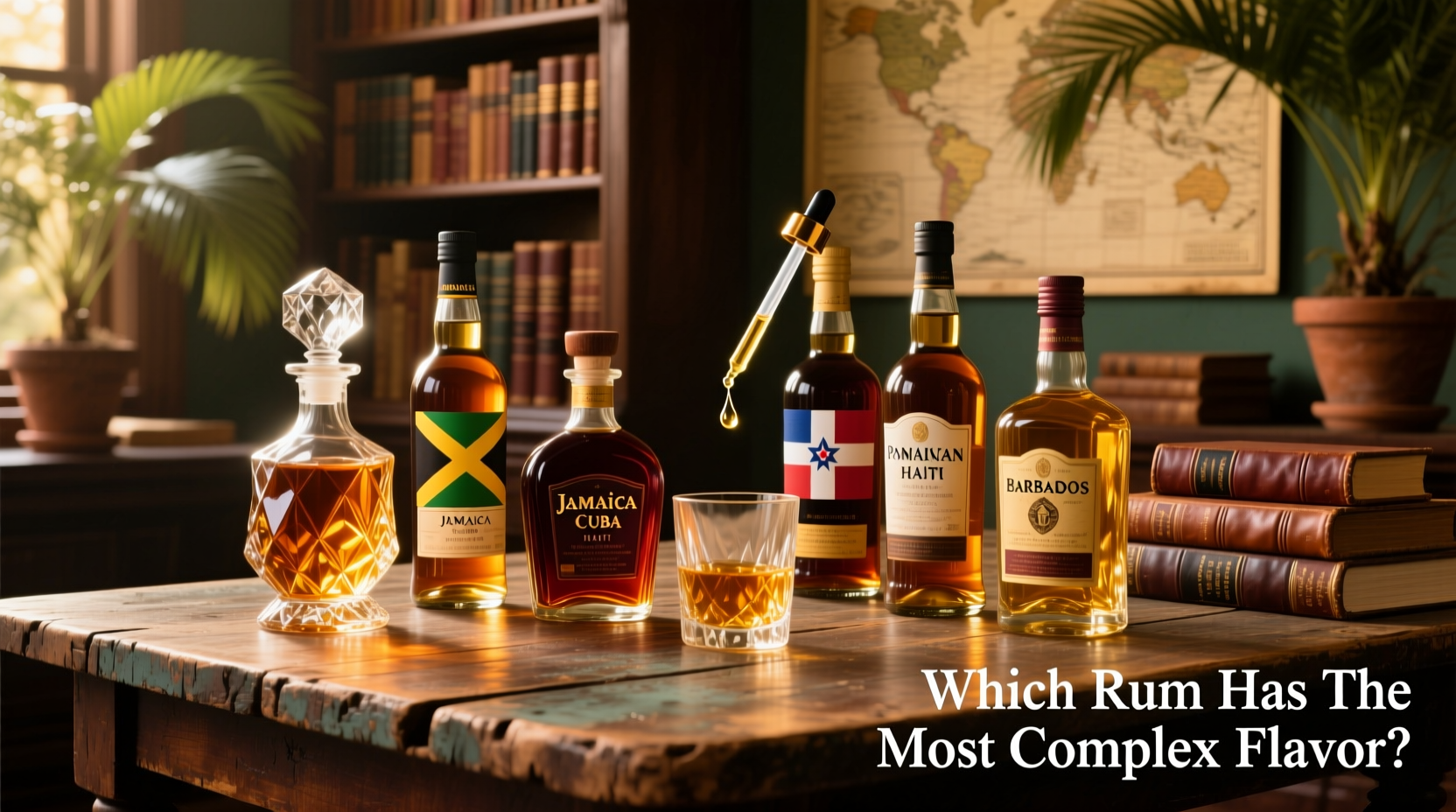
Jamaican rum complexity begins long before distillation—in the fermenter. While most rums use commercial yeast strains for speed and predictability, traditional Jamaican producers (notably Worthy Park, Hampden Estate, and Long Pond) rely on wild, open-air fermentation using dunder pits and muck—fermented backset rich in lactic acid bacteria, yeasts, and volatile esters. Fermentation lasts up to 14 days, sometimes longer, creating an environment where Lactobacillus, Pediococcus, and native Saccharomyces strains co-evolve, generating hundreds of esters. Ethyl hexanoate (pineapple), ethyl octanoate (banana), and ethyl decanoate (waxy, floral, honeyed) accumulate at levels rarely seen elsewhere. A single Hampden DOK (Diplomatic Overseas Killa) cask can register over 1,000 parts per million (ppm) of esters—compared to 200 ppm in a typical Barbadian rum or under 50 ppm in a Cuban column-still product.
This isn’t mere “funk.” It’s biochemical layering: top notes of tropical fruit and citrus peel; mid-palate richness of roasted nuts, brown butter, and dark honey; and a finish that unfolds in stages—first saline minerality, then clove and dried fig, finally a lingering, almost tannic grip reminiscent of aged red wine. Complexity here is structural: each sip reveals new dimensions without contradiction, because the high-ester profile is balanced by precise copper pot still distillation and careful barrel selection—often ex-bourbon, but increasingly first-fill sherry and cognac casks that add oxidative depth without masking the core character.
Tip: To appreciate Jamaican rum complexity, serve at room temperature in a tulip glass—and let it breathe for 5–7 minutes. The esters evolve dramatically as volatile compounds settle and deeper notes emerge.Martinique: Agricole’s Precision vs. Depth
Martinique’s AOC-designated rhum agricole is undeniably sophisticated—but its complexity operates on a different axis. Made exclusively from fresh sugarcane juice (not molasses), it emphasizes terroir expression: volcanic soil, Atlantic winds, and microclimates shape varietals like Blanc de Blancs or Blue Cane. Distillation occurs in single-column Savalle stills, yielding a lighter, more linear spirit than Jamaican pot stills. Aged expressions like Clément XO or Neisson Réserve Spéciale offer elegance—grapefruit pith, white pepper, toasted coconut, and wet stone—but their structure is vertical rather than horizontal. Flavors are refined, integrated, and impeccably balanced, yet they rarely achieve the multi-tiered revelation of a well-aged Hampden or Worthy Park. As master blender Hervé Lassègue explains: “Agricole is architecture in marble—clean lines, perfect proportion. Jamaican rum is architecture in weathered limestone: eroded, porous, full of hidden chambers.”
“Complexity isn’t loudness. It’s the ability of a rum to hold your attention for three minutes after the last sip—and make you question what you just tasted. Only Jamaican pot stills, fermented with true muck, deliver that sustained resonance.” — Luca Gargano, Founder of Velier and author of *Rhum: The Spirit of the Caribbean*
Barbados: Balance as a Form of Sophistication
Barbados offers perhaps the most harmonious rum tradition in the world. Home to Mount Gay (est. 1703), Foursquare, and Doorly’s, it blends pot and column stills with remarkable finesse. Foursquare’s Exceptional Cask Series—like the 2006 Port Cask or 2005 Zinfandel Finish—demonstrates how wood integration can deepen complexity without sacrificing clarity. These rums show layers: caramelized banana, cedar, pipe tobacco, and salted caramel—but the transitions are seamless, almost serene. This is complexity through integration, not confrontation. Yet it lacks the microbial tension that defines Jamaican depth. As Master Blender Richard Seale observes, “Barbadian rum teaches patience and respect for process. But if you seek a spirit that argues with itself—then resolves beautifully—that conversation happens most fiercely in Jamaica.”
Guadeloupe & Nicaragua: Contrasting Paths to Intrigue
Guadeloupe produces two distinct styles: the grassy, herbal agricoles of Domaine du Marquisat (using column stills), and the heavier, more robust rums of Damoiseau and Bielle, often distilled on hybrid stills that retain more congeners. Bielle’s 2009 Single Cask (aged 12 years) delivers impressive depth—candied orange, licorice root, and damp forest floor—but its complexity feels more linear than multidimensional. It rewards contemplation, yet doesn’t surprise across multiple sips.
Nicaragua represents a newer frontier. Flor de Caña’s ultra-aged expressions (25 Years, 30 Years) achieve remarkable smoothness and oxidative richness—walnut oil, dried fig, and antique leather—but their refinement comes at the cost of raw character. Column-distilled and filtered, they prioritize elegance over fermentative intensity. Their complexity is polished, like a museum sculpture: impressive, intentional, but less alive than a Jamaican rum vibrating with microbial memory.
| Country/Region | Base Material | Distillation Method | Signature Complexity Drivers | Limits to Layering |
|---|---|---|---|---|
| Jamaica | Molasses | Copper pot still (often double or triple retort) | Wild fermentation, dunder/muck pits, 7–14 day fermentation, high-ester production | Can overwhelm untrained palates; requires skilled blending to balance |
| Martinique | Fresh cane juice | Single-column Savalle still | Varietal cane, volcanic terroir, precise aging in French oak | Lighter congener profile limits textural weight and finish length |
| Barbados | Molasses | Hybrid (pot + column) | Blending mastery, diverse cask types (sherry, port, bourbon), consistent climate | Emphasis on harmony can mute contrasting flavor revelations |
| Guadeloupe | Molasses & cane juice | Column or hybrid stills | Volcanic soil influence, humid tropics, varied cask finishes | Inconsistent regulation leads to stylistic fragmentation |
| Nicaragua | Molasses | Multi-column continuous still | Altitude-driven slow maturation, extended aging, filtration | Filtration removes esters and fatty acids critical to aromatic complexity |
The Case of Worthy Park’s Rum Barreling Experiment (2017–2023)
In 2017, Worthy Park launched an internal study comparing identical rum distillate aged in five cask types: ex-bourbon, ex-sherry, ex-cognac, virgin oak, and ex-PX sherry. All barrels were filled at the same time, stored in the same warehouse, and sampled quarterly. What emerged wasn’t just variation—it was a masterclass in how complexity multiplies when microbial foundation meets wood chemistry.
The ex-bourbon cask revealed classic Jamaican funk—green mango, wet clay, and burnt sugar—but remained tightly wound for 36 months. At 48 months, the ex-sherry cask began showing profound duality: raisin compote and black olive tapenade against a backbone of fermented guava. By month 60, the ex-PX sherry cask achieved something rare: a nose of beeswax, star anise, and petrichor, followed by a palate that cycled through candied ginger, smoked paprika, and cold-brew coffee, finishing with a saline, almost iodine-like lift. Crucially, this evolution only occurred because the base spirit contained over 800 ppm esters—low-ester rums in the same casks showed muted, one-dimensional results. The experiment confirmed that Jamaican rum’s complexity isn’t just about fermentation or wood—it’s the dialogue between them. No other origin provides a base spirit with such biochemical richness to begin that conversation.
How to Taste for True Complexity: A 5-Step Protocol
Identifying complexity requires method—not just preference. Follow this sequence to move beyond “I like it” to “I understand why it’s complex.”
- Observe without nosing: Note color, viscosity, and legs. Thick legs suggest glycerol and ester density—common in long-fermented Jamaican rums.
- Nose at arm’s length: Identify primary aromas (fruit, spice, earth). Then swirl and nose again—do new notes appear? Complexity reveals itself in successive waves.
- Taste neat, then with 1–2 drops of water: Water releases esters trapped in ethanol. In high-ester rums, this often unlocks floral or mineral notes absent initially.
- Hold the spirit in your mouth for 10 seconds: Map where flavors land—front (citrus, heat), mid (fruit, nuttiness), back (spice, tannin). True complexity engages all zones distinctly.
- Assess the finish duration and evolution: Time how long flavor persists. Then ask: does it change? A shift from sweet → savory → saline signals structural complexity.
FAQ
Does higher proof always mean more complexity?
No. While many complex Jamaican rums are cask strength (55–65% ABV), proof alone doesn’t guarantee depth. A 65% ABV column-still rum may be hot and one-dimensional, whereas a 46% ABV Worthy Park single cask delivers layered nuance. Complexity arises from congener diversity—not ethanol concentration.
Can I find complex rum outside Jamaica without paying $200+?
Yes—but look for independent bottlers specializing in high-ester Jamaican stock: Habitation Velier, Rum Artesanal, or The Whisky Exchange’s “Jamaican Rum Project.” Their 7–12 year offerings often retail between $85–$140 and showcase unblended estate character far more transparently than premium branded releases.
Why don’t more countries replicate Jamaica’s muck fermentation?
It’s extremely difficult to control. Muck pits require decades of microbial succession—new pits lack the biodiversity to generate authentic ester profiles. Attempts in Australia, Mexico, and even Barbados have yielded inconsistent, often off-putting results. Jamaica’s ecosystem is irreplicable, shaped by soil, humidity, and inherited knowledge passed down through generations of distillers.
Conclusion: Complexity Is a Conversation—And Jamaica Speaks First
Rum’s global tapestry is rich with merit: Martinique’s agricole is a lesson in purity, Barbados teaches equilibrium, Nicaragua masters refinement. But complexity—the kind that demands repeated tasting, inspires note-taking, and reshapes your understanding of what spirit can do—is rooted in biological audacity. Jamaica’s commitment to wild fermentation, copper pot distillation, and fearless expression creates rums that don’t just taste good—they think aloud. They challenge, reward, and evolve in the glass. They carry the breath of tropical air, the memory of volcanic soil, and the patience of centuries-old distilling families. To seek complexity in rum is to seek dialogue—with place, with process, with time. Jamaica doesn’t just participate in that conversation. It begins it.
💬 Have you experienced a Jamaican rum that redefined your palate? Share your tasting notes, bottle recommendations, or questions below—we’re building a community of curious, discerning rum lovers.