Walk into any boutique wine shop or progressive restaurant in Brooklyn, Paris, or Melbourne, and you’ll see them: cloudy bottles with hand-drawn labels, minimal text, sometimes even a faint haze swirling inside the glass. Natural wine has surged from fringe curiosity to mainstream fixture—yet confusion lingers. Is it truly healthier? Or is “natural” simply marketing shorthand for “less filtered, less manipulated”? The answer isn’t binary. It’s layered—rooted in agricultural ethics, microbial reality, sensory preference, and measurable chemistry. This article dissects the natural wine movement not as a trend, but as a set of deliberate choices—and examines what those choices mean for your palate, your body, and your understanding of what wine *is*.
What “Natural Wine” Actually Means (and Why Definitions Vary)
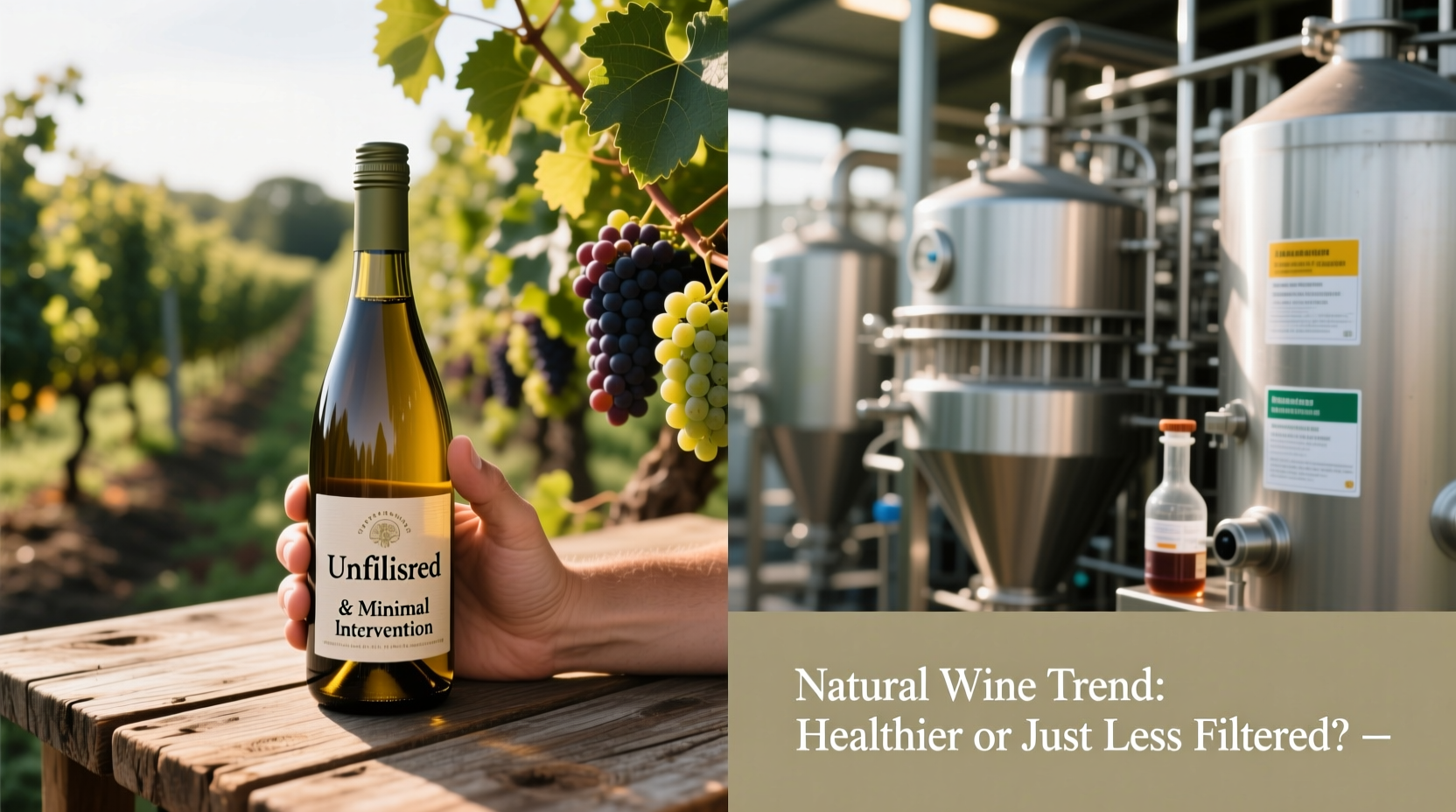
There is no legal, international definition of natural wine. No governing body certifies it. Unlike organic or biodynamic wine—which have codified standards in the EU, USA, and Australia—“natural” remains an artisanal ethos, not a regulated category. That said, consensus among leading advocates (like France’s La Renaissance des Appellations group or the US-based Natural Wine Association) centers on three non-negotiable principles:
- Vineyard practice: Grapes grown organically or biodynamically—no synthetic pesticides, herbicides, or fertilizers.
- Minimal intervention in the cellar: Native yeasts only (no commercial yeast strains), no added sugars (chaptalization), no acidification or de-acidification, no fining agents (like egg whites or bentonite clay), and no sterile filtration.
- No—or near-zero—added sulfites: Typically under 30 mg/L total SO₂ (compared to 150–200 mg/L in conventional wines). Many natural producers add none at bottling.
This framework prioritizes transparency and terroir expression—but it also introduces variability. A natural wine may be cloudy, fizzy, or carry barnyard, sourdough, or bruised apple notes—not because it’s flawed, but because it reflects the unmediated life of the grape and its microbes.
Tip: When tasting natural wine, serve it slightly cooler than room temperature (12–14°C / 54–57°F) and decant if cloudy—this softens volatile notes and integrates texture.The Filtration Question: What’s Really Removed (and Why)
Filtration in conventional winemaking serves two primary purposes: microbial stability and visual clarity. Sterile filtration (using membranes with pores smaller than 0.45 microns) removes all yeast and bacteria—including spoilage organisms like Acetobacter (which turns wine to vinegar) and Lactobacillus (which can cause mousiness or excessive volatility). It also strips out fine particles that contribute to haze.
Natural winemakers reject this step—not out of negligence, but conviction. They believe filtration dulls aromatic complexity and disrupts the wine’s living character. Instead, they rely on time, careful racking, and stable cellar temperatures to encourage sedimentation. The result? Wines that may contain residual yeast, harmless lees, or trace populations of native microbes. These are rarely hazardous—but they can evolve unpredictably in bottle.
Crucially, skipping filtration doesn’t mean skipping sanitation. Reputable natural producers clean barrels and tanks rigorously—often with steam or ozone—and maintain strict hygiene protocols. As sommelier and natural wine educator Isabelle Legeron MW explains:
“Natural wine isn’t ‘dirty’ wine. It’s wine made with respect for biology—not fear of it. The absence of filtration demands greater attention to vine health, harvest timing, and cellar hygiene. It’s harder, not easier.” — Isabelle Legeron MW, founder of RAW Wine Fair
Health Claims: What Science Says (and Doesn’t Say)
Proponents often cite lower sulfite levels, higher polyphenol retention, and absence of additives as health advantages. Let’s separate evidence from assumption.
Sulfites: While some individuals report headaches or congestion after drinking conventional wine, clinical studies have failed to link sulfites to these symptoms in the general population. The EU mandates sulfite labeling above 10 mg/L precisely because a small subset of asthmatics (estimated at 1 in 100) may react. For most people, the difference between 25 mg/L (natural) and 125 mg/L (conventional) is physiologically irrelevant. What matters more is overall alcohol intake—since ethanol metabolism produces acetaldehyde, a known toxin.
Polyphenols and antioxidants: Unfiltered wines may retain marginally higher concentrations of skin-derived compounds like resveratrol and anthocyanins—especially in reds—because they avoid adsorption onto filter pads or fining agents. However, the absolute increase is modest (studies show ~5–12% higher total phenolics), and bioavailability remains low. You’d need to drink several glasses daily to approach doses used in clinical trials—making dietary sources (grapes, berries, dark chocolate) far more efficient.
The real health variable? Alcohol itself. Natural wine isn’t lower in alcohol. In fact, some spontaneous fermentations stall at higher residual sugar levels, leading to “pet-nat” styles with unexpected spritz and moderate ABV—but others finish bone-dry at 13.5–14.5%. There is no evidence that natural wine confers protective cardiovascular benefits beyond those associated with moderate consumption of any quality wine.
A Real-World Example: Domaine Dujac’s Shift in Burgundy
In 2012, Domaine Dujac—a respected, fourth-generation estate in Morey-Saint-Denis—began experimenting with natural techniques across one parcel of old-vine Pinot Noir. They stopped adding sulfur at crush, used only indigenous yeasts, and bottled without filtration. The first vintage was polarizing: critics noted vibrant wild strawberry and forest floor notes—but also a slight oxidative edge and uneven bottle-to-bottle consistency.
Over five vintages, the team adjusted—harvesting earlier to preserve acidity, lowering fermentation temperatures, and aging longer on fine lees to build structure. By 2018, their “Les Malconsorts Nature” cuvée earned praise for its energy and purity—without sacrificing stability. Importantly, lab analysis showed no meaningful difference in histamine or biogenic amine levels (compounds sometimes blamed for “wine headaches”) compared to their conventionally made counterparts from adjacent plots. The change wasn’t biochemical—it was philosophical, sensory, and agronomic.
This case underscores a critical point: natural wine isn’t inherently “healthier,” but it can reflect deeper soil health, lower copper residues (from organic sprays), and reduced carbon footprint—benefits that accrue to ecosystems long before they reach your glass.
Natural Wine: A Practical Comparison Table
| Factor | Conventional Wine | Natural Wine |
|---|---|---|
| Grape Inputs | Often non-organic; may use synthetic fungicides (e.g., boscalid) and herbicides | Certified organic or biodynamic; zero synthetic inputs |
| Yeast | Commercial strains selected for reliability, speed, and flavor profile | Exclusively native, ambient yeasts—slower, less predictable |
| Fining & Filtration | Commonly fined (with egg, milk, fish proteins) and sterile-filtered | Unfined and unfiltered; may be cloudy or sediment-prone |
| Sulfur Dioxide (SO₂) | Typically 80–200 mg/L total (added at multiple stages) | Usually <30 mg/L total; often zero added at bottling |
| Stability & Shelf Life | Highly stable; consistent bottle-to-bottle; 3–10+ year shelf life | Variable; best consumed within 1–3 years; sensitive to heat/light |
Your Natural Wine Checklist: How to Choose Thoughtfully
If you’re curious about natural wine—not as a lifestyle upgrade, but as a conscious choice—use this actionable checklist before buying or ordering:
- Check the label for transparency: Look for terms like “sans soufre ajouté” (no added sulfur), “vin naturel,” or certifications like Demeter (biodynamic) or Ecocert (organic). Avoid vague terms like “crafted with care” or “old-world style.”
- Seek trusted importers or retailers: Specialists like Jenny & François (USA), Les Caves du Père Jules (France), or Liberty Wines (UK) vet producers rigorously—not just for philosophy, but for technical competence.
- Ask about storage history: Natural wines degrade faster when exposed to heat or light. If buying retail, confirm the shop stores bottles in climate-controlled conditions—not near windows or heating vents.
- Start with lower-risk styles: Skin-contact whites (“orange wines”) from Georgia or Slovenia tend to be more stable than delicate, low-alcohol pet-nats. Cru Beaujolais (e.g., Lapierre, Foillard) offers accessible entry points.
- Taste mindfully—not medically: Note how the wine makes you feel over 24 hours—not just during consumption. Track sleep quality, digestion, and energy. Correlation isn’t causation, but patterns matter.
FAQ: Clearing Up Common Misconceptions
Does natural wine contain more histamines than conventional wine?
No robust evidence supports this. Histamine levels depend more on grape variety (e.g., Syrah and Grenache naturally contain more), fermentation temperature, and bacterial activity during malolactic conversion—factors present in both natural and conventional production. Some natural wines skip malolactic fermentation entirely, potentially reducing histamine formation.
Can natural wine cause worse hangovers?
Hangover severity correlates most strongly with dehydration, congeners (found in darker spirits), and total alcohol consumed—not production method. That said, inconsistent bottling practices in some natural wines may lead to higher volatile acidity or residual CO₂, which can irritate the stomach in sensitive individuals. Moderation remains the single most effective hangover prevention.
Is natural wine vegan?
Yes—by default. Since natural wine avoids animal-derived fining agents (egg whites, gelatin, isinglass), it is inherently vegan. Conventional wines using such agents are not, unless explicitly labeled vegan-friendly.
The Bottom Line: Healthier for Whom—and for What?
Natural wine isn’t healthier for your liver, heart, or immune system in any clinically significant way—unless you’re among the rare individuals sensitive to sulfites or commercial yeast metabolites. Its true value lies elsewhere: in supporting regenerative agriculture, preserving microbial biodiversity in vineyards, reducing chemical runoff into watersheds, and honoring fermentation as a living process rather than an industrial input-output system.
It asks something of the drinker: patience with variation, openness to texture and nuance, and willingness to engage with wine as a seasonal, site-specific expression—not a standardized product. That engagement fosters deeper appreciation, slower consumption, and more intentional choices. And that, perhaps, is where the real health benefit resides: not in molecules, but in mindset.
So next time you choose a cloudy Gamay or a petillant Chenin, do it not because you believe it’s “better for you,” but because you value the hands that tended the vines, the microbes that transformed the juice, and the quiet rebellion against homogenization it represents. That intention—grounded, curious, and respectful—is the most nourishing ingredient of all.
💬 Have you tried natural wine recently? Did a particular bottle surprise or challenge you? Share your honest experience in the comments—we’re building a community grounded in curiosity, not dogma.