
Agave spirits are experiencing global acclaim—but behind the smoky sips and crisp reposados lies a critical divergence in ecological responsibility. While both mezcal and tequila originate from the same botanical family—Agavaceae—their regulatory frameworks, production scales, and cultural stewardship lead to markedly different sustainability outcomes. Tequila, governed by a strict Denomination of Origin (DO) and overseen by the Tequila Regulatory Council (CRT), prioritizes consistency and export readiness. Mezcal, regulated under its own DO since 2003 but historically rooted in decentralized, small-batch traditions across nine Mexican states, often embeds sustainability not as compliance, but as inherited practice. This article examines how sustainability manifests—not in marketing claims, but in the tangible realities of field, fire, fermentation, and still.
1. Agave Sourcing & Biodiversity Stewardship
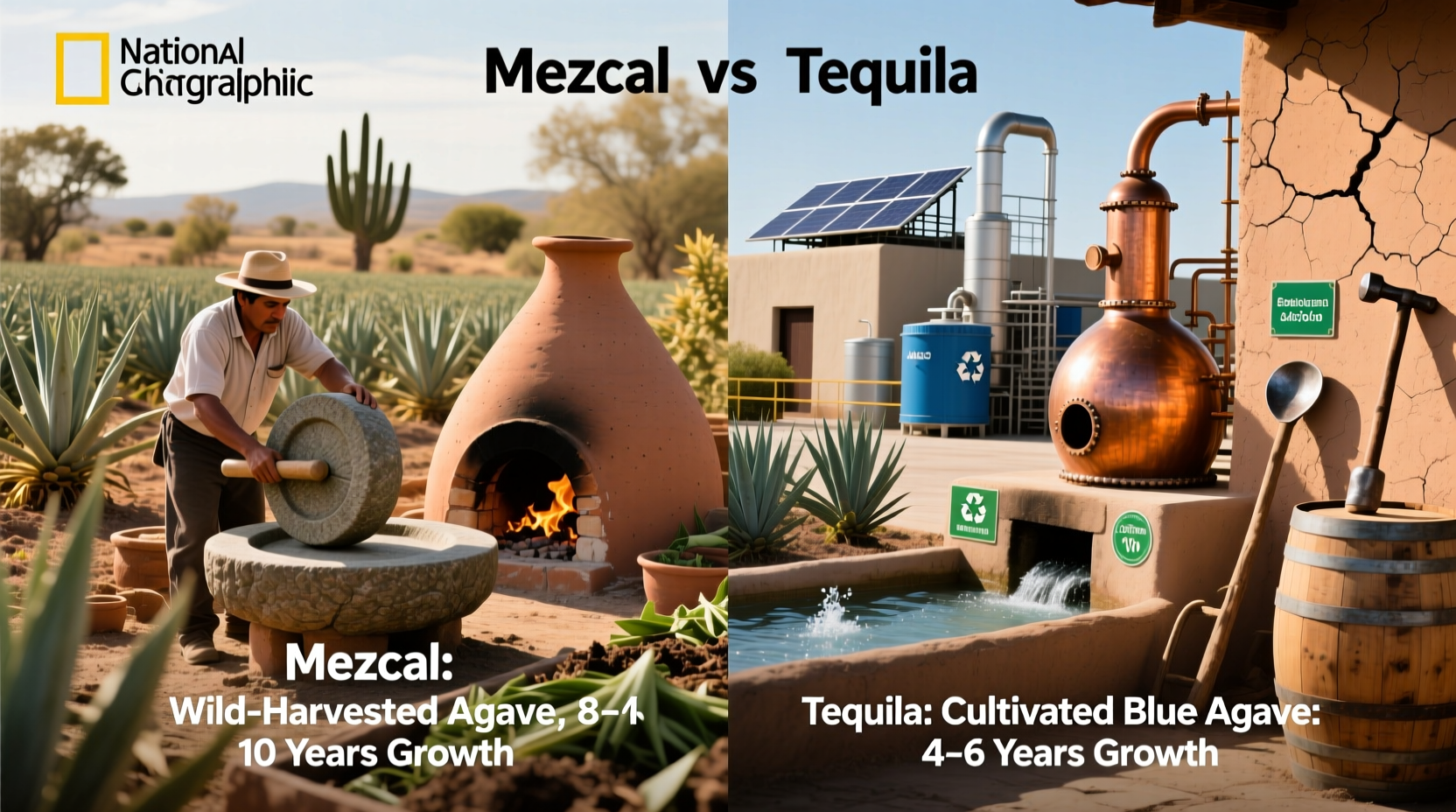
The foundation of any agave spirit’s sustainability is its raw material—and here, the contrast is stark. Tequila is legally restricted to Agave tequilana Weber azul, grown almost exclusively in monoculture plantations across Jalisco and limited municipalities in four other states. Over 95% of commercial agave for tequila is cultivated from cloned “maguey babies” (bulbils), accelerating genetic erosion. According to the University of Guadalajara’s 2022 Agave Resilience Report, monoculture fields have seen a 40% decline in native pollinator activity over the past two decades, and soil organic matter has dropped by an average of 3.2% per year due to intensive irrigation and herbicide use.
Mezcal, by contrast, permits over 30 recognized species—including espadín, arroqueño, cupreata, and tepeztate—and mandates wild or semi-cultivated harvesting in most cases. In Oaxaca’s Sierra Norte, families like the Cruz family in San Juan del Río follow tlachiquero principles: harvesting only mature plants (8–12 years old), leaving at least 10% of flowering stalks (quiotes) to seed naturally, and rotating harvest zones every 5–7 years. This mimics natural succession and sustains microhabitats for bats, moths, and endemic birds.
Tip: When selecting a bottle, look for batch-specific agave species and origin on the label—e.g., “100% Agave cupreata, San Luis Potosí”—not just “100% agave.” Species transparency signals traceability and ecological intention.2. Thermal Energy & Fuel Use in Roasting
Roasting transforms agave’s complex fructans into fermentable sugars—and it’s where carbon footprint diverges most dramatically. Tequila producers overwhelmingly use stainless-steel autoclaves or diffusers, heated by natural gas or electricity. These methods reduce roasting time from days to hours, achieving high yield but sacrificing volatile aromatic compounds and generating significant CO₂ emissions per liter. A 2023 CRT lifecycle analysis found that industrial roasting contributes 37% of tequila’s total carbon footprint—averaging 2.8 kg CO₂e per liter of final spirit.
Traditional mezcal relies on earthen pit ovens (hornos): rock-lined pits filled with firewood (often sustainably harvested copal, oak, or mesquite), covered with agave piñas and earth. Though labor-intensive and slower (up to 72 hours), this method emits less CO₂ per unit when fuel is sourced responsibly—and crucially, sequesters carbon in the form of biochar-enriched soil post-roast. At Real Minero in Minas de Oaxaca, maestro mezcalero Don Valente García oversees a closed-loop wood system: pruned branches from his agave nursery are dried for 18 months, then burned in measured quantities; ash is returned to nursery beds to raise pH and retain moisture.
“An autoclave gives you control. A horno gives you conversation—with the land, the wood, the heat, the time. You don’t force the agave. You listen.” — Don Valente García, third-generation mezcalero, Real Minero (Oaxaca)
3. Fermentation, Water Use, and Wastewater Management
Fermentation accounts for nearly half of water consumption in agave distillation—and the approaches differ structurally. Tequila producers commonly use temperature-controlled stainless vats inoculated with commercial yeast strains. This allows rapid, predictable fermentation (48–72 hours) but requires substantial chilled water for cooling and generates acidic, high-BOD (biological oxygen demand) wastewater rich in residual sugars and ethanol. Without treatment, such effluent can deplete oxygen in local streams—a documented issue near large-scale distilleries in Amatitán.
Most traditional mezcaleros rely on spontaneous fermentation in open-air wooden vats (often pine or encino), using native yeasts and lactic acid bacteria from the local environment. Fermentation lasts 7–14 days, requiring no external cooling and producing lower-volume, less acidic leachate. Many palenques (mezcal distilleries) channel spent fibers (bagazo) and fermented wash into compost piles layered with manure and ash—creating nutrient-dense soil amendments used in agave nurseries or maize fields. At Paloma y Lluvia in Durango, this compost cycle reduces freshwater demand by 60% compared to conventional irrigation.
| Practice | Tequila (Industrial Scale) | Mezcal (Traditional Palenque) |
|---|---|---|
| Average Fermentation Time | 2–3 days | 7–14 days |
| Primary Vessel | Stainless steel, temperature-controlled | Open wooden vats, ambient |
| Water Use per Liter Spirit | 12–18 L | 4–7 L |
| Waste Stream Treatment | Often centralized municipal or proprietary systems | On-site composting, mulching, or infiltration beds |
| Yeast Source | Commercial monocultures | Wild, airborne, and vessel-embedded microbiota |
4. Distillation Methods & Byproduct Utilization
Both spirits undergo double distillation—but equipment and residue handling reveal deeper values. Tequila’s copper pot stills (required for “100% agave” designation) produce clean, refined distillate, yet bagazo is frequently discarded or sold for low-value biomass fuel. Some larger brands now partner with biogas startups, but adoption remains below 25% industry-wide.
Mezcal’s alembic-style stills—often handmade copper or hybrid copper-clad clay—are smaller, less efficient per run, but highly adaptable. Crucially, bagazo is rarely waste: it becomes mulch, animal bedding, construction filler for adobe walls, or substrate for cultivating edible mushrooms like pleurotus. At El Jolgorio in San Luis Potosí, bagazo is sun-dried, mixed with clay and straw, and pressed into bricks used to rebuild community schoolhouses—a practice documented since the 1940s.
Step-by-Step: How a Sustainable Palenque Manages Bagazo
- Post-distillation: Bagazo is removed hot and spread in thin layers on shaded, permeable ground.
- Cooling & Aeration: Turned daily for 3 days to prevent anaerobic souring.
- Composting: Layered 30 cm deep with manure, ash, and kitchen scraps; turned weekly for 6–8 weeks.
- Maturation: Cured for 30 days before application to agave nursery beds or maize fields.
- Verification: Soil pH and organic matter tested biannually by regional agronomists from UNAM’s Agave Program.
5. Socioeconomic Sustainability: Land Tenure, Labor, and Knowledge Transfer
Sustainability cannot be reduced to carbon metrics—it must include human resilience. Tequila’s DO requires certified land ownership or long-term leases, favoring corporate estates and cooperatives backed by multinational investment. While wages are generally higher than regional averages, seasonal labor (especially during harvest) often lacks formal contracts or social security. The CRT’s 2023 Labor Equity Report noted that only 12% of contracted jimadores (agave harvesters) receive health insurance through their employer.
Mezcal’s regulatory body, the Consejo Regulador del Mezcal (CRM), recognizes communal land tenure (eijidos) and family-owned plots as legitimate sources. Over 85% of mezcal production originates from palenques employing fewer than 10 people—most intergenerational, with knowledge passed orally and through apprenticeship. Organizations like the Mezcaloteca and the Oaxacan NGO CEMDA support legal titling for women-led palenques and fund bilingual (Spanish/Zapotec) agroecology workshops for youth. In Santiago Matatlán, the collective “Las Comadres del Mezcal” now certifies 22 female distillers whose bottles carry QR codes linking to video interviews about their land stewardship practices.
Tip: Support producers who list individual maestro names, palenque locations, and agave species—not just brand names. Transparency in provenance reflects accountability in practice.Mini Case Study: The Espadín Paradox in San Dionisio Ocotepec
In the highlands of Oaxaca, the village of San Dionisio Ocotepec faced a crisis by 2018: demand for espadín mezcal had tripled, prompting some families to clear native oak-pine forest for agave monoculture. Soil erosion increased; spring flows dwindled. Rather than ban expansion, the community council partnered with the nonprofit Fundación Maguey to pilot a “Three-Zone System”: Zone 1 (existing forest) protected under communal covenant; Zone 2 (transition) planted with mixed native trees and interspersed espadín; Zone 3 (agricultural) reserved for high-density espadín—but only using vegetative propagation from select mother plants, with mandatory 30% shade canopy from native trees. Within five years, beekeeping income rose 220%, spring recharge improved by 18%, and certified “Zona Mixta” mezcal commands a 35% price premium globally. It’s not anti-growth—it’s growth calibrated to carrying capacity.
FAQ
Does “100% agave” guarantee sustainable production?
No. “100% agave” only certifies that no neutral spirits or additives were used. It says nothing about water sourcing, fuel type, labor conditions, or agave cultivation method. A tequila labeled “100% agave” may still rely on irrigated monoculture and gas-fired autoclaves.
Are all mezcals more sustainable than tequilas?
Not inherently. Industrial-scale mezcal operations—particularly those using diffusers, steam autoclaves, or imported agave—can match or exceed tequila’s environmental impact. Authentic sustainability resides in verified practices, not category alone. Look for CRM certification *plus* third-party verification like the Mezcal Certification Program (MCP) or Slow Food Presidium status.
Can consumers influence sustainability through purchasing choices?
Yes—directly. Choosing bottles with full traceability (species, municipality, maestro name), supporting independent importers who audit palenques (e.g., Montelobos, Del Maguey), and avoiding “ultra-premium” tequilas with excessive packaging or air-freighted distribution all shift market incentives. Every purchase votes for a specific relationship to land and labor.
Conclusion
Sustainability in agave distillation isn’t a checklist—it’s a continuum of choices made at every stage: whether to let an agave flower or cut its quiote, whether to burn copal or propane, whether to compost bagazo or landfill it, whether to teach a granddaughter how to read the smoke rising from the horno or outsource fermentation to a lab. Tequila’s rigor delivers consistency; mezcal’s diversity holds ecological memory. Neither is universally “better.” But the most resilient producers—whether a CRT-certified tequileria investing in solar-powered stills or a CRM-registered palenque reviving pre-Hispanic polyculture—share one trait: they treat the agave not as raw material, but as kin. That shift in perspective—from extraction to reciprocity—is where true sustainability begins. Your next pour doesn’t need to be perfect. It only needs to be intentional.
💬 What sustainability practice surprised you most? Share your observations—or a bottle that changed how you think about agave—in the comments. Let’s deepen the conversation beyond the tasting notes.