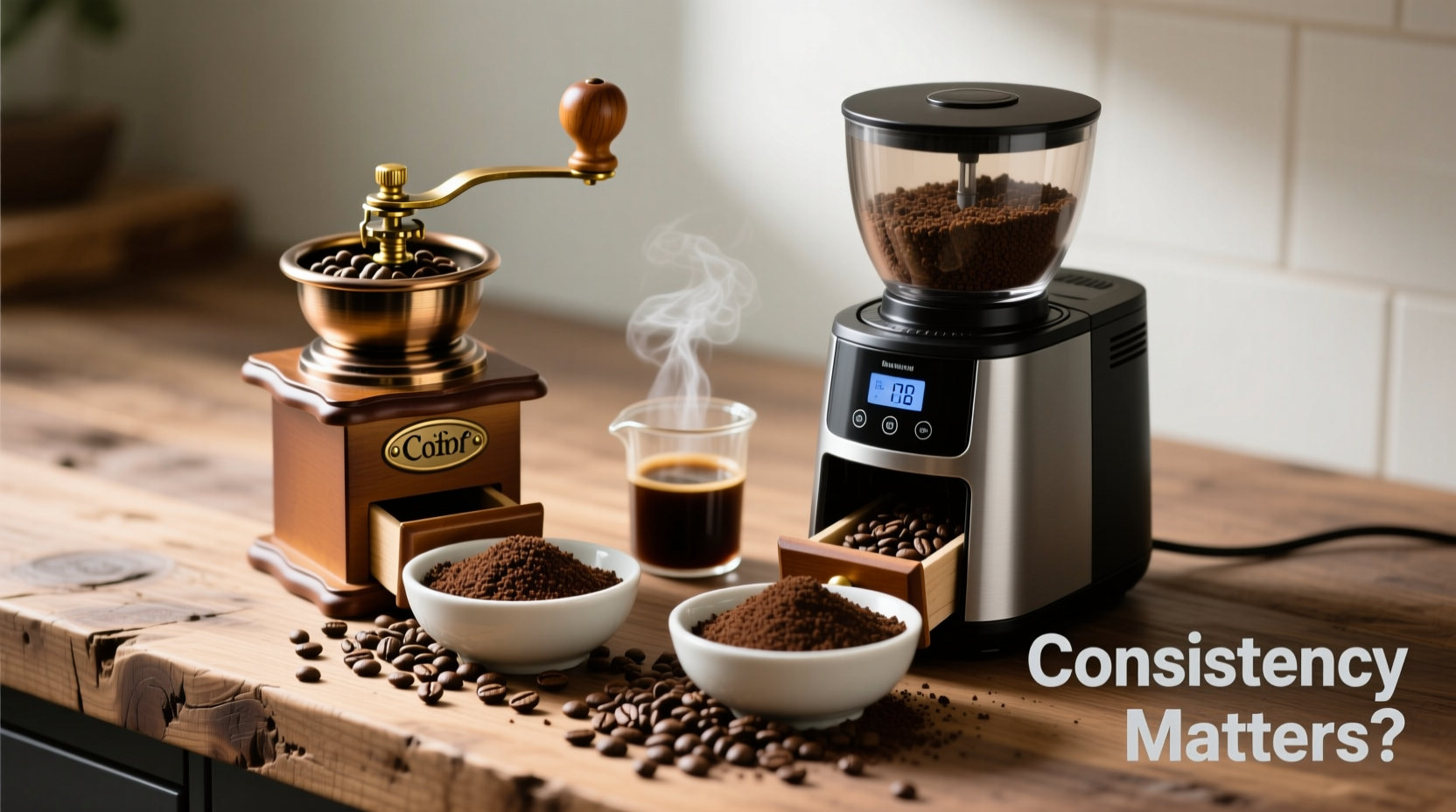
For coffee lovers, the journey from bean to cup is more than a routine—it’s a ritual. And one of the most critical steps in that process is grinding. Whether you use a manual hand grinder or an electric burr model, the decision affects not just convenience, but flavor. Many assume that as long as the beans are fresh and the brewing method sound, the grinder type is secondary. But does it really matter? More specifically, does the consistency of the grind—dictated by the grinder—affect the taste of your coffee?
The short answer is yes. Grind consistency directly influences extraction, which in turn shapes body, acidity, sweetness, and balance in your final cup. But the deeper question is whether manual and electric grinders produce different levels of consistency, and if so, how much that difference matters in practice.
Why Grind Consistency Matters for Taste
Coffee extraction occurs when hot water dissolves soluble compounds from ground coffee. The goal is balanced extraction—neither under-extracted (sour, weak) nor over-extracted (bitter, harsh). This balance depends heavily on particle size uniformity.
When grounds vary widely in size, smaller particles extract quickly while larger ones lag behind. This leads to uneven extraction: some parts of the coffee become bitter, others sour. Uniform particles ensure they all release their flavors at a similar rate, resulting in a cleaner, more harmonious cup.
This principle holds true across all brewing methods—espresso, pour-over, French press, Aeropress—but especially in methods with shorter contact times like espresso or V60, where precision is paramount.
“Grind consistency is arguably the single most important variable after freshness. It’s the foundation of repeatable, high-quality extraction.” — James Hoffmann, World Barista Champion and coffee educator
Manual vs Electric: How They Work Differently
At the heart of the debate is the mechanism each grinder uses to crush beans.
- Manual grinders rely on human-powered burrs—typically conical ceramic or steel—that rotate as you turn a handle. The beans pass through a fixed gap between the burrs, producing grounds.
- Electric grinders use motor-driven burrs (flat or conical) that spin rapidly, processing beans automatically once powered on.
While both types can use burr mechanisms (as opposed to blade grinders, which chop inconsistently), their performance varies due to design, build quality, and operational dynamics.
Burr Quality and Design
High-end manual grinders like the 1Zpresso JX-Pro or Timemore C2 feature precision-engineered conical burrs capable of producing remarkably even particles. However, many budget models use lower-grade materials or looser tolerances, leading to more fines and boulders (over- and under-ground particles).
Electric grinders span a broader range. Entry-level models may suffer from heat buildup and inconsistent motor speed, but mid-to-high-tier machines like the Baratza Encore or Eureka Mignon offer micro-adjustments, powerful motors, and industrial-grade burrs designed for stability and uniform output.
Speed and Heat Generation
Electric grinders operate faster, which introduces friction and heat. Excessive heat can prematurely warm beans, altering volatile compounds before brewing. While modern electric models manage this well, cheaper ones risk slight roast degradation during grinding.
Manual grinders generate almost no heat, preserving delicate aromatic oils. This makes them ideal for light roasts where floral and citrus notes are easily compromised.
Tip: If using an electric grinder, let it rest between large batches to prevent heat accumulation.Do Manual Grinders Really Match Electric Ones in Consistency?
It depends on the model—and your expectations. A top-tier manual grinder can rival entry-level electric burr grinders in consistency. However, most electric grinders in the $150–$300 range outperform similarly priced manual options in particle distribution.
A 2022 study by Clive Coffee analyzed grind particle spread using laser diffraction. Results showed that while premium manual grinders (e.g., Kono SCS-3 or Flyhalf Lab MK2) achieved narrow distributions, they still produced slightly more fines than high-end electric models like the Niche Zero or DF64.
That said, the difference is often imperceptible in drip or immersion brewing. Where it becomes noticeable is in espresso, where pressure amplifies inconsistencies. Even small variations in particle size can lead to channeling—where water bypasses dense areas—resulting in sour shots or excessive bitterness.
Real-World Example: Home Brewer Comparison
Consider Sarah, a home barista in Portland who switched from a blade grinder to a manual Hario Skerton Pro. Her morning pour-overs went from muddy and flat to bright and layered. Encouraged, she upgraded to a Baratza Virtuoso+, an electric burr grinder.
She noticed her extractions became more predictable. Her brew time stabilized, and subtle tasting notes—like bergamot in a Kenyan AA or chocolate in a Guatemalan—became more pronounced. She wasn’t doing anything differently; the improved consistency simply allowed the coffee to express itself more fully.
But when traveling, she used her compact manual grinder and found that with careful technique, she could achieve 85–90% of the same result. For her, the trade-off in effort was worth the portability and quiet operation.
Comparison Table: Key Differences at a Glance
| Feature | Manual Grinder | Electric Grinder |
|---|---|---|
| Grind Consistency | Good to excellent (high-end models) | Excellent (mid-range and up) |
| Heat Generation | Negligible | Moderate (varies by model) |
| Speed | Slow (1–3 minutes per dose) | Fast (15–30 seconds) |
| Noise Level | Very quiet | Loud (especially budget models) |
| Portability | High (no power needed) | Low (requires outlet) |
| Maintenance | Simple, infrequent | More frequent (motor, burrs) |
| Cost Range | $30–$250 | $100–$500+ |
| Best For | Pour-over, camping, travel, quiet environments | Daily use, espresso, families, high volume |
How to Maximize Consistency Regardless of Grinder Type
Even the best grinder won’t deliver optimal results without proper technique. Here’s how to get the most out of either tool:
Step-by-Step Guide to Better Grinding
- Dose accurately: Use a digital scale to measure beans before grinding. Inconsistencies often start here.
- Calibrate your grind setting: Adjust based on brew method. For example, pour-over typically requires medium-fine (like table salt), while French press needs coarse (like breadcrumbs).
- Grind steadily: With manual grinders, maintain consistent turning speed. Jerky motion causes uneven burr engagement.
- Clean burrs monthly: Oily residues and static cling affect flow and particle separation. Brush out old grounds regularly.
- Use fresh beans: Stale beans fracture unpredictably, increasing boulders regardless of grinder quality.
Checklist: Choosing the Right Grinder for Your Needs
- ☐ Define your primary brewing method (espresso, pour-over, French press, etc.)
- ☐ Determine daily coffee volume (single cup vs. multiple servings)
- ☐ Assess space and noise tolerance (kitchen vs. shared apartment)
- ☐ Set a realistic budget ($50, $150, $300+)
- ☐ Prioritize features: consistency, speed, portability, adjustability
- ☐ Research reviews focusing on particle distribution, not just price
Frequently Asked Questions
Can a blade grinder ever produce consistent results?
No. Blade grinders chop beans randomly, creating a wide range of particle sizes. They lack the precision needed for even extraction, leading to unbalanced, often bitter or sour coffee. They’re acceptable only for French press in a pinch, but even then, results are inferior.
Is it worth upgrading from a manual to an electric grinder?
If you brew daily, value convenience, or make espresso, yes. The time saved and consistency gained—especially with a quality electric model—can elevate your coffee experience significantly. However, if you enjoy the ritual and brew occasionally, a good manual grinder remains a valid, cost-effective choice.
Do expensive manual grinders outperform cheap electric ones?
Often, yes. A $180 manual grinder like the 1Zpresso Q2 may match or exceed a $70 electric burr grinder in consistency. However, avoid comparing high-end manual models to budget electric ones—they serve different markets. For serious brewing, invest in a decent electric grinder (e.g., Baratza Encore) or a premium manual option.
The Verdict: Yes, Consistency Changes Taste—But Context Matters
Grind consistency absolutely changes the taste of coffee. Uneven particles create uneven extraction, muting sweetness, exaggerating bitterness, and flattening complexity. Both manual and electric grinders can achieve high consistency, but electric models—particularly mid-tier and above—tend to do so more reliably and efficiently.
That doesn’t mean manual grinders are inferior. For travelers, minimalist brewers, or those who appreciate the meditative rhythm of hand-grinding, they offer exceptional performance relative to size and cost. Some enthusiasts even prefer them for delicate light roasts, citing less heat and vibration.
The key is alignment: match your grinder to your lifestyle, brewing goals, and palate. A competitive barista needs precision and repeatability—electric wins. A remote worker sipping one pour-over a day might cherish the quiet focus of a manual crank.
“The grinder is the heart of the coffee setup. Without control over particle size, everything else—water, roast, technique—is compromised.” — Scott Rao, coffee processing consultant and author
Final Thoughts and Call to Action
Your grinder isn’t just a tool—it’s a flavor shaper. Whether manual or electric, its ability to deliver consistent particles determines how faithfully your coffee expresses its origin, roast, and craft. Don’t underestimate the ripple effect a better grind has on your entire brewing process.
If you're still using a blade grinder, consider upgrading. If you're on the fence between manual and electric, test both within your preferred brewing context. Taste the difference side by side. You might be surprised how much clarity, sweetness, and aroma emerge from a few microns of grind improvement.
🚀 Ready to transform your coffee experience? Start by evaluating your current grinder’s consistency. Try a side-by-side brew with a friend’s machine or invest in a trusted mid-range model. Share your findings, experiment boldly, and taste the precision.