Bourbon’s proof—the measure of its alcohol-by-volume (ABV) multiplied by two—isn’t just a number on the label. It’s a lever that shifts everything: aroma intensity, mouthfeel texture, spice perception, oak integration, and even how much water you’ll want to add. At 80 proof (40% ABV), a bourbon may feel approachable but muted; at 130+ proof (65%+ ABV), it can deliver staggering complexity—but also overwhelm or numb the palate. The “sweet spot” isn’t universal. It’s personal, contextual, and deeply rooted in chemistry, craft, and consumption habit. This isn’t about declaring one proof superior. It’s about understanding *why* proof matters—and how to navigate the spectrum with intention.
What Proof Really Measures—and Why It Matters Beyond Alcohol
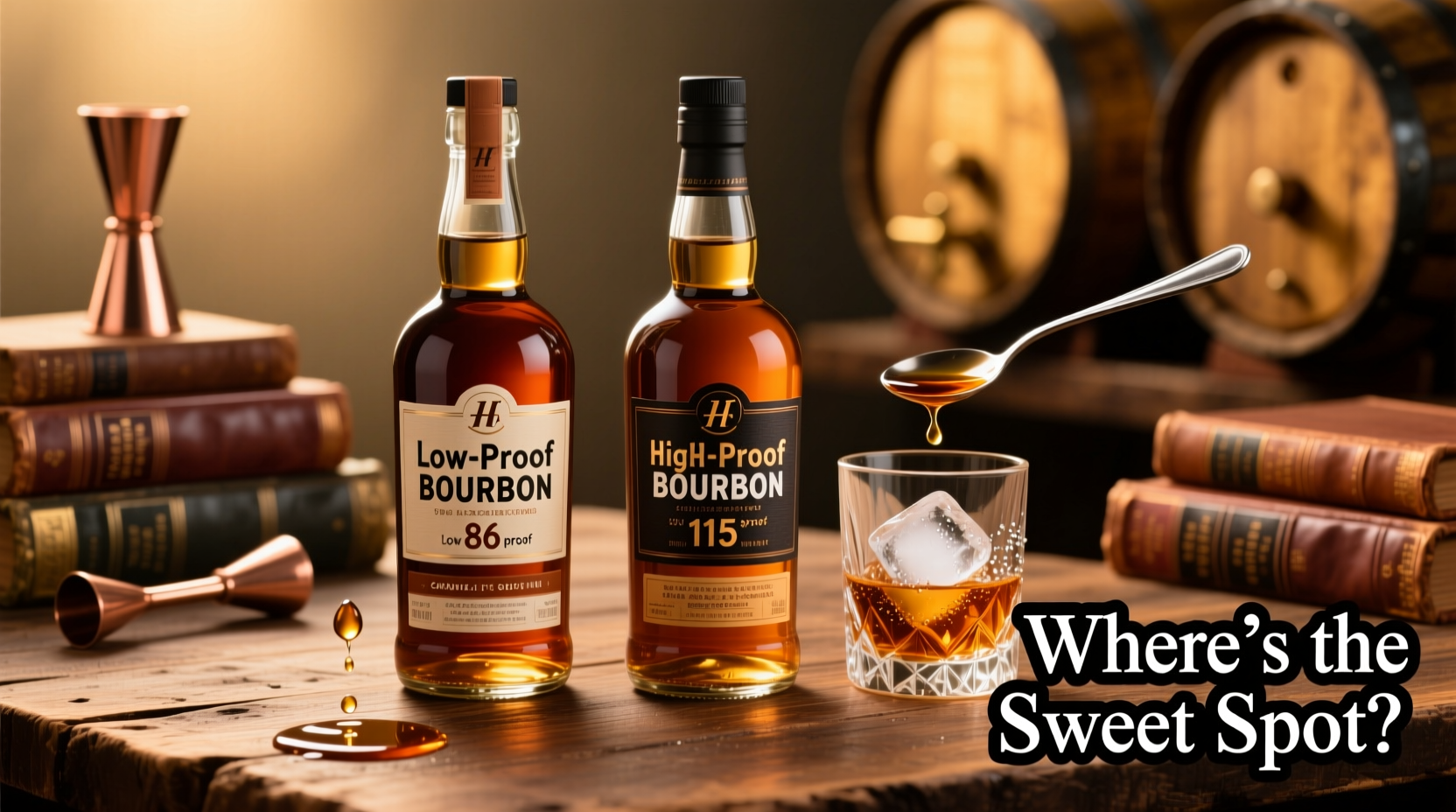
Proof is a legacy measurement: in the U.S., it’s simply twice the ABV. So 90 proof = 45% alcohol, 100 proof = 50% ABV, and so on. But alcohol isn’t inert filler—it’s a solvent, a carrier, and a structural element. At lower proofs, water dominates the matrix, softening tannins, smoothing ethanol burn, and allowing subtler notes (vanilla bean, toasted almond, dried cherry) to emerge without competition. At higher proofs, ethanol extracts more volatile aromatic compounds from the barrel—think clove oil, black pepper, sawdust, and dark chocolate—while also amplifying perceived heat and drying the palate.
Crucially, proof affects extraction *during aging*. Distillers confirm that higher-entry proofs (e.g., barreling at 125 proof instead of 115) yield more aggressive wood interaction—not necessarily more “oak,” but more lignin breakdown, which generates spicy, resinous notes. Conversely, lower-entry proofs (100–105) favor slower, gentler hemicellulose degradation, yielding more caramel, maple, and baked fruit character. What ends up in the bottle reflects both entry proof *and* final proof—and those choices cascade into every sip.
The Low-Proof Landscape: Accessibility, Balance, and Hidden Nuance
Bourbons bottled at 80–90 proof (40–45% ABV) make up nearly 60% of shelf space. Brands like Jim Beam White Label (86 proof), Evan Williams Black Label (86), and Maker’s Mark (90) anchor this category. Their appeal is immediate: low barrier to entry, minimal burn, easy sipping neat or on ice. But dismissing them as “entry-level” overlooks their deliberate design.
At these proofs, congeners—flavor compounds like esters and lactones—are more evenly suspended in water. This promotes harmony: the sweetness of corn, the nuttiness of rye, and the creaminess of barrel char integrate smoothly. There’s less ethanol volatility to mask delicate floral or citrus top notes. A well-crafted 86-proof bourbon can offer remarkable clarity—like listening to a string quartet without amplification: quieter, but every instrument distinctly audible.
That said, low proof carries trade-offs. Excessive dilution (especially below 80 proof) risks flattening structure, muting finish length, and encouraging artificial sweeteners or flavor additives to compensate—a practice permitted under U.S. labeling rules for “blended bourbon.” Authentic low-proof bourbons earn their balance through grain selection and precise aging, not shortcuts.
Tip: Try tasting a low-proof bourbon side-by-side with a few drops of distilled water added to a high-proof pour. You’ll often find the flavor profiles converge—proving that proof is less about “strength” and more about concentration and delivery.The High-Proof Reality: Power, Precision, and Palate Discipline
Bourbons at 110 proof and above (55%+ ABV) command attention—not just for their heat, but for their density of information. Elijah Craig Barrel Proof (typically 120–135 proof), Booker’s (121–131), and Stagg Jr. (124–130) exemplify this tier. These are not “for show.” They’re tools for the engaged taster: uncut, unfiltered, and minimally diluted, preserving the exact expression as it left the barrel.
High proof delivers three distinct advantages: First, heightened aromatic lift—ethanol volatilizes esters and terpenes more readily, pushing complex layers (blackberry jam, pipe tobacco, wet stone) into the nose. Second, textural richness—higher alcohol increases viscosity, lending an oily, coating mouthfeel that extends finish dramatically. Third, dilution flexibility—you control the water, not the distiller. Adding ½ tsp of room-temp water to a 125-proof pour can unlock entirely new dimensions, whereas adding the same amount to an 86-proof bourbon barely registers.
Yet high proof demands respect. Without mindful dilution, it can anesthetize taste buds, suppress sweetness, and exaggerate bitterness from over-extracted oak. It’s rarely ideal for cocktails requiring balance (e.g., an Old Fashioned), where excessive ethanol competes with bitters and sugar. And it’s physically demanding: sustained sipping above 120 proof fatigues the palate faster than lower-proof alternatives.
“Proof is the distiller’s first edit. Bottling at cask strength means trusting the barrel—and the drinker—to decide when it’s ready. That’s not bravado. It’s humility wrapped in alcohol.” — Chris Morris, Master Distiller, Woodford Reserve
Finding Your Personal Sweet Spot: A Data-Informed Framework
The sweet spot isn’t fixed at 100 proof—or any single number. It’s where *your* palate, *your* context, and *the bourbon’s* profile intersect. To locate it, consider four variables:
- Palate Sensitivity: If ethanol burn distracts you more than enhances, start at 90–95 proof and work up gradually.
- Consumption Context: Neat sipping after dinner? 95–105 proof offers richness without fatigue. Cocktails? 90–100 proof blends seamlessly. Serious tasting sessions? 110–120 proof gives maximum insight.
- Age & Barrel Impact: A 15-year bourbon at 100 proof may taste woody and dry; the same age at 115 proof can feel vibrant and spicy. Younger bourbons (4–6 years) often shine brightest between 105–115 proof, where their bold grain character isn’t subdued.
- Water Integration: High-proof bourbons reward precise dilution. Use a pipette or eyedropper: start with 1–2 drops per 1/2 oz pour, stir gently, and wait 30 seconds before re-evaluating. Most reveal peak harmony between 100–110 proof *after* dilution.
| Proof Range | Typical ABV | Best For | Cautions |
|---|---|---|---|
| 80–89 | 40–44.5% | Beginners, highball mixers, daily sipping, dessert pairings | Can lack finish depth; watch for added flavors in budget bottlings |
| 90–99 | 45–49.5% | Balance seekers, cocktail base, nuanced neat sipping | Rarely pushes boundaries—may feel “safe” to experienced tasters |
| 100–109 | 50–54.5% | Flavor-forward exploration, food pairing (grilled meats, aged cheddar), versatile neat use | May require slight dilution for extended sessions |
| 110–119 | 55–59.5% | Serious tasting, unlocking barrel nuance, water-customized sipping | Overpowering neat; avoid in stirred cocktails unless balanced carefully |
| 120+ | 60%+ | Distiller’s intent study, advanced dilution practice, collectors’ reference | Not for casual sipping; requires technique and patience |
Mini Case Study: How One Taster Found Her 103-Proof Epiphany
Sarah, a graphic designer and bourbon enthusiast for seven years, had always gravitated toward 90-proof bottles—comfortable, consistent, easy to share. She’d tried high-proof pours but found them “harsh” and “one-note.” Then she attended a guided tasting hosted by a Kentucky distillery’s sensory team. They poured three expressions from the same batch, cut to different proofs: 92, 103, and 115.
At 92, she tasted caramel and oak—pleasant, but familiar. At 115, her nose recoiled slightly; her tongue registered heat before flavor. But at 103? Something clicked. The vanilla and cinnamon she’d sensed faintly at 92 now bloomed, layered with black tea tannin and a hint of orange zest. The finish lingered 20 seconds longer. Later, she learned this was the batch’s natural “barrel proof”—the point where wood extraction, grain character, and alcohol synergy aligned without artificial adjustment. She now seeks 100–105 proof as her default, using a small water dropper to fine-tune each pour. “It’s not stronger,” she says. “It’s *clearer*.”
Your Actionable Proof Optimization Checklist
- ✅ Start low, ascend intentionally: Taste a 90-proof bourbon neat, then try the same brand’s 100-proof expression—no water first, then add 2 drops.
- ✅ Control temperature: Serve all bourbons between 62–68°F (17–20°C). Warmer temps amplify ethanol burn; cooler temps mute aromatics.
- ✅ Use proper glassware: Tulip-shaped glasses (like Glencairn) concentrate vapors at 100+ proof; wider bowls suit 90–95 proof for air integration.
- ✅ Track your reactions: Note not just “I like this,” but *what changed* with proof—e.g., “At 105, the rye spice became peppery instead of medicinal.”
- ✅ Respect the water: Always have room-temperature distilled water nearby. Never add ice to high-proof bourbon—it dilutes unevenly and chills too aggressively.
FAQ: Clarifying Common Proof Confusion
Does higher proof mean older or better bourbon?
No. Age and proof are independent variables. A 3-year-old bourbon can be bottled at 125 proof; a 23-year-old may be cut to 90 proof to tame excessive oak. Age tells you time in barrel; proof tells you concentration and distiller intent. Neither guarantees quality—only context for evaluation.
Why do some bourbons taste “hotter” at the same proof?
Proof measures alcohol volume—but perceived heat depends on congener composition, pH, ester-to-alcohol ratio, and even the water source used for dilution. A bourbon high in fusel oils (e.g., from heavy rye mash bills) will feel spicier at 100 proof than one rich in smooth lactones (e.g., high-corn, slow-fermented). Grain bill and fermentation matter as much as ABV.
Can I safely dilute cask-strength bourbon to 90 proof at home?
Absolutely—and it’s encouraged. Use the formula: (Current Volume × Current ABV) ÷ Target ABV = Final Volume. For example, to bring 100 ml of 63% ABV bourbon to 45% ABV: (100 × 63) ÷ 45 = 140 ml total → add 40 ml distilled water. Stir gently and let rest 10 minutes before tasting. This replicates what distillers do—just with your personal calibration.
The Sweet Spot Is Yours to Define—Not Discover
There is no universal “best” proof. The sweet spot isn’t a destination on a chart—it’s the moment your attention fully engages with the liquid: when heat recedes and flavor advances, when the finish lingers not because of alcohol, but because of memory, when water doesn’t fix a flaw but reveals a layer you hadn’t noticed. It might be 94 proof on a Tuesday evening with dark chocolate. It might be 108 proof on a Saturday morning, neat, after reading the distiller’s tasting notes. It might shift as your palate evolves, your glassware changes, or your kitchen light alters the way you perceive color and viscosity.
What matters isn’t chasing numbers—but cultivating awareness. Taste deliberately. Compare thoughtfully. Dilute patiently. Record honestly. Let proof become a conversation, not a verdict. The most rewarding bourbons aren’t the strongest or the softest—they’re the ones that meet you where you are, and invite you just a little further.
💬 Your turn: What’s the proof that consistently surprises you—whether it’s a 92 that tastes like 105, or a 118 that drinks like 100? Share your sweet spot discovery in the comments. Let’s map the spectrum—together.