For decades, “low alcohol wine” carried a quiet stigma—associated with hospital corners, unconvincing fruit punches, or bottles that tasted like grape-infused rainwater. Yet today, shelves overflow with 5.5% ABV rosés, 8.5% Pinot Noirs, and even sparkling wines clocking in at 0.5% ABV. This isn’t just marketing noise. It reflects a cultural pivot: more people are choosing intentionality over inertia when it comes to alcohol. But does lowering the alcohol content actually serve moderation—or does it sacrifice too much in structure, flavor, and satiety to be truly satisfying? The answer lies not in absolutes, but in how these wines are made, how they’re tasted, and how they fit into a person’s broader relationship with alcohol.
What “Low Alcohol” Really Means—and Why Definitions Vary
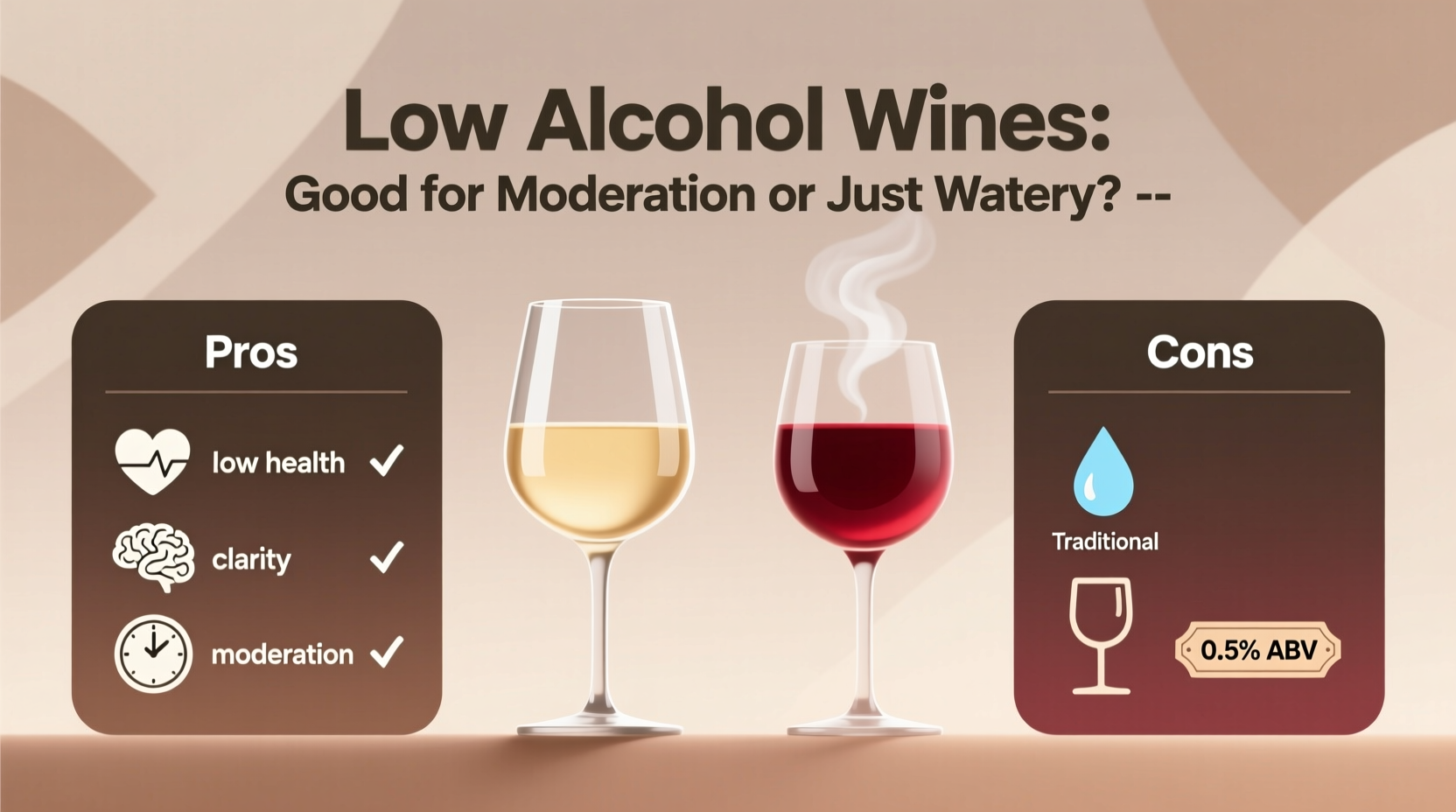
Legally, “low alcohol wine” has no universal definition. In the EU, wines under 8.5% ABV may be labeled *faible teneur en alcool*; in the UK, “low alcohol” typically means ≤1.2% ABV (though many products marketed as such sit between 5.5–8.5%). In the US, the TTB permits “non-alcoholic” labeling only for beverages containing ≤0.5% ABV—and anything above that must declare its precise alcohol percentage. Crucially, low alcohol ≠ non-alcoholic. Most low alcohol wines retain enough ethanol to deliver mild physiological effects—like slight vasodilation or subtle relaxation—but avoid the cognitive slowing, disrupted sleep architecture, and next-day fatigue associated with standard 13–14.5% ABV table wines.
The confusion starts with terminology. “Dealcoholized” wines (e.g., 0.0% ABV) undergo full fermentation followed by alcohol removal via vacuum distillation or reverse osmosis—processes that inevitably strip volatile aromatic compounds. “Low alcohol” wines, by contrast, are usually made *without* removing alcohol post-fermentation. Instead, winemakers intervene earlier: harvesting grapes earlier (lower sugar = less potential alcohol), using yeast strains with lower alcohol tolerance, fermenting at cooler temperatures to stall fermentation, or blending finished wine with unfermented grape must (a technique called *süssreserve*, common in Germany).
Tip: Look past the label’s “low alcohol” claim—check the ABV number. A wine at 7.8% ABV delivers markedly different effects than one at 0.3%. If your goal is reduced intake without total abstinence, target 5.5–8.5% ABV. If you’re avoiding alcohol entirely (e.g., during pregnancy or medication use), only 0.0% or ≤0.5% ABV options are appropriate.The Taste Question: Why Some Bottles Fall Flat (and Others Shine)
“Watery” is the most frequent complaint—and it’s often justified. When alcohol drops below ~10% ABV, several sensory elements shift. Ethanol contributes viscosity, mouthfeel, and acts as a solvent for aromatic esters and phenolic compounds. Remove too much, and the wine can feel thin, hollow, or disjointed—especially if acidity isn’t carefully balanced or residual sugar isn’t thoughtfully integrated. Many early-generation low alcohol wines overcorrected with added sugar, resulting in cloying, one-dimensional profiles.
But modern producers are solving this. In Spain, Bodegas y Viñedos Langa crafts a 7.5% ABV Verdejo using pre-fermentation cryo-maceration and native yeasts—preserving citrus zest and fennel notes while retaining a creamy mid-palate. In New Zealand, Te Whare Ra’s 8.2% Riesling balances bright lime and wet stone with 8 g/L residual sugar and zinging acidity—creating tension, not dilution. What separates successful low alcohol wines isn’t just lower ABV—it’s structural integrity: sufficient acidity to lift the palate, judicious residual sugar to round edges, and careful oak or lees contact to add texture where alcohol once provided weight.
“The best low alcohol wines don’t try to mimic full-strength versions. They embrace their own identity—lighter, brighter, more food-flexible. When we stop judging them against 13.5% Chardonnay, we start tasting what they offer: freshness, drinkability, and genuine terroir expression at lower intensity.” — Dr. Laura Siviero, Oenologist & Lead Researcher, Institute of Wine Science, University of Adelaide
Moderation in Practice: How Low Alcohol Wines Fit Into Real-Life Habits
Mindful drinking isn’t about rigid rules—it’s about reducing harm while preserving pleasure. Public Health England defines moderate alcohol consumption as ≤14 units/week for adults (≈112g pure ethanol), spread over three or more days. For context: one 175ml glass of 13% red wine contains ~2.3 units; the same pour of 7% wine contains ~1.2 units. That difference adds up meaningfully across a week.
Yet the psychological dimension matters just as much. Studies published in Addiction (2022) found that drinkers who switched to low alcohol wines for six weeks reported significantly higher self-efficacy around portion control and reduced “spillover” drinking (e.g., having “just one more” because the first didn’t satisfy). Why? Lower alcohol wines often deliver faster sensory feedback—bright acidity, aromatic lift, clean finish—that signals satiety sooner. You’re less likely to chase a muted sensation with repeated pours.
Still, moderation requires awareness—not substitution. Drinking three glasses of 8% wine still delivers ~2.9 units, nearly matching two glasses of 13% wine (~4.6 units). The benefit emerges when low alcohol enables consistency: choosing a 6.5% rosé at lunch instead of skipping alcohol altogether, or opting for a 7% sparkling wine at dinner rather than defaulting to a heavier red.
How to Choose—and Enjoy—Low Alcohol Wines With Intention
Selecting a low alcohol wine isn’t about grabbing the lowest ABV on the shelf. It’s about matching the wine’s profile to your context, palate, and goals. Below is a practical, evidence-informed decision framework:
- Identify your primary goal: Is it reducing weekly intake? Improving sleep quality? Avoiding hangovers? Supporting medication adherence? Or simply exploring lighter styles?
- Match ABV to occasion: For daytime meals or work events, aim for 5.5–7.5% ABV. For relaxed evening sipping, 7.5–8.5% offers more complexity without heaviness.
- Prioritize balance over buzz: Scan the back label (or producer website) for residual sugar (RS) and total acidity (TA). Ideal RS for dry styles: ≤4 g/L. For off-dry, 6–12 g/L works well if TA is ≥6.5 g/L (as tartaric acid).
- Seek transparency: Reputable producers disclose harvest date, yeast strain, and whether dealcoholization was used. Avoid brands that list “natural flavors” or “aroma enhancers”—these often mask structural weakness.
- Taste before committing: Try a single bottle before buying a case. Serve at correct temperature (white/rosé: 8–10°C; light reds: 12–14°C) to assess texture and length fairly.
| Style | Ideal ABV Range | Key Structural Cues to Look For | Food Pairing Strengths |
|---|---|---|---|
| Sparkling (traditional method) | 6.0–8.0% | Fine, persistent mousse; crisp malic/lactic balance; no bitterness | Oysters, fried chicken, goat cheese salads |
| Dry Rosé (Provence-style) | 5.5–7.5% | Saline minerality; restrained strawberry/rhubarb; clean finish | Grilled shrimp, tomato-based pasta, falafel |
| Light Red (Gamay, Schiava) | 7.0–8.5% | Juicy red fruit; supple tannins; vibrant acidity | Pizza, charcuterie, mushroom risotto |
| Aromatic White (Riesling, Albariño) | 7.0–8.5% | Lime zest or jasmine lift; racy acidity; subtle petrol or saline note | Spicy Thai, ceviche, roasted vegetables |
| Off-Dry Still (Müller-Thurgau, Kerner) | 7.5–8.5% | Harmonious sugar-acid ratio (not syrupy); floral/herbal top notes | Curry, pork belly, blue cheese |
Real-World Experience: A Week With Low Alcohol Wines
Sarah, 42, a project manager in Portland, Oregon, began tracking her alcohol intake after noticing afternoon fatigue and inconsistent sleep. She’d regularly drink two glasses of Cabernet Sauvignon (14% ABV) with dinner, then sometimes a third “to unwind.” Her average weekly intake was 21 units—well above public health guidance.
She committed to a four-week trial: replacing her standard red with a certified organic 7.8% Gamay from Oregon’s Willamette Valley. She kept portions consistent (150ml), served it slightly chilled, and paired it intentionally with her meals. By week two, she noticed she rarely poured a second glass—“The first felt complete. It had brightness and fruit, but didn’t coat my tongue or make me sluggish.” By week four, her average weekly intake dropped to 11.5 units. More importantly, her sleep latency decreased by 22 minutes (per wearable data), and she reported greater mental clarity during morning stand-up meetings.
Sarah didn’t view the switch as deprivation. “It felt like upgrading—not downgrading. I wasn’t sacrificing ritual; I was refining it.” Her experience mirrors clinical findings: low alcohol wines support sustainable habit change when chosen for sensory satisfaction—not just numerical reduction.
FAQ
Do low alcohol wines have fewer calories than regular wines?
Yes—but the difference is modest and depends on residual sugar. Ethanol provides 7 calories per gram; sugar, 4 calories per gram. A 13% ABV wine averages ~125 calories per 150ml glass. A 7% ABV wine with similar sugar levels averages ~95–105 calories. However, some low alcohol wines add sugar to compensate for body loss, potentially negating the calorie advantage. Always check the label: lower ABV + low RS = lowest calorie option.
Can I cook with low alcohol wines?
Absolutely—and often more effectively than high-alcohol versions. Because they contain less ethanol, they reduce faster and integrate more seamlessly into sauces without leaving a harsh, boozy edge. A 6.5% Sauvignon Blanc works beautifully in a white wine sauce for fish; a 7.2% Pinot Noir adds depth to mushroom gravy without overpowering. Just avoid 0.0% wines for cooking—they lack the complex esters developed during fermentation.
Are sulfites higher in low alcohol wines?
No—sulfite levels depend on winemaking choices (e.g., sanitation, oxygen exposure), not alcohol content. In fact, many low alcohol wines use minimal intervention and carry lower total sulfites (<30 ppm free SO₂) than conventional bottlings (often 50–100 ppm). Check the label: “low sulfite” or “no added sulfites” claims are independent of ABV.
Conclusion: Beyond the Binary
Calling low alcohol wines “just watery” dismisses both technological progress and lived experience. Yes, poorly made examples exist—thin, sweet, or aromatically vacant. But so do poorly made full-alcohol wines. The meaningful question isn’t whether low alcohol wines are “good”—it’s whether they serve your values, physiology, and pleasure. When crafted with integrity, they offer something rare in today’s beverage landscape: authenticity without excess, sociability without sedation, and tradition reimagined for contemporary well-being.
They aren’t a magic solution. Moderation still requires attention to portion, pace, and pattern. But they do provide a tangible, pleasurable tool—one that meets people where they are, rather than demanding they choose between indulgence and abstinence. If you’ve written off low alcohol wines based on an old memory or a single disappointing bottle, give them another look. Read the ABV. Seek out producers transparent about their methods. Taste with curiosity, not comparison. You might discover that lighter doesn’t mean lesser—it means more space for presence, for choice, for joy that lingers long after the last sip.
💬 Have you found a low alcohol wine that changed your perspective? Share your standout bottle, region, or tasting note in the comments—we’ll feature reader favorites in our next deep-dive roundup.