For decades, tequila held a near-monopoly on agave spirits in global bars and homes—clean, crisp, often citrus-forward, and reliably approachable. Then mezcal arrived: smoky, complex, sometimes challenging, and undeniably magnetic. Its signature smoke isn’t an additive or a gimmick—it’s born from centuries-old traditions of roasting agave hearts in earthen pits lined with volcanic rock and firewood. But that intensity divides drinkers. Some find it revelatory—a layered, earthy depth that transforms cocktails and sipping rituals alike. Others recoil at the first whiff, mistaking smoke for ash, tar, or even burnt rubber. The question isn’t whether mezcal is “better” than tequila. It’s whether its defining characteristic—the smoke—is *worth* the sensory commitment, especially when you’re paying premium prices and navigating a category rife with inconsistency.
This isn’t about declaring winners. It’s about understanding what that smoke actually represents: terroir, craft, time, and intention. And crucially—what trade-offs it demands in mixability, accessibility, and consistency. Below, we break down the science, the culture, the palate, and the practical realities—so you can decide, with confidence, whether mezcal’s intensity earns its place in your glass.
How Smoke Is Made: Pit-Roasting vs. Steam Autoclaves
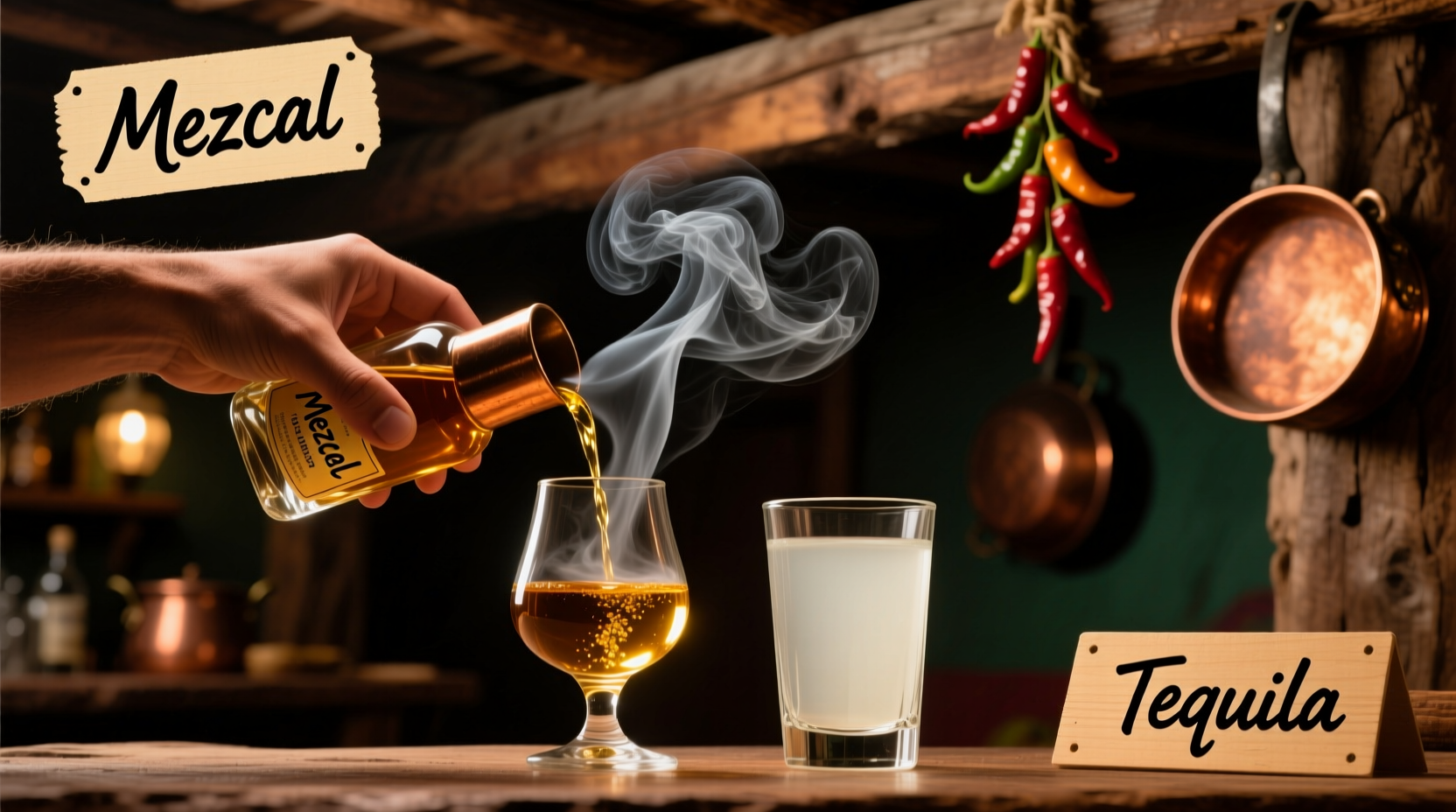
The fundamental difference between mezcal’s smoke and tequila’s relative neutrality lies not in the agave plant itself—but in how the piñas (hearts) are cooked. Tequila, by law, must be made from blue Weber agave. Nearly all large-scale producers steam-cook their piñas in stainless steel autoclaves or brick ovens—efficient, temperature-controlled, and clean. This yields fermentable sugars with bright, vegetal, and citrus notes: lime zest, green apple, wet stone, and white pepper.
Mezcal, by contrast, is defined by diversity—not just in agave species (over 30 legally recognized, from espadín to tobaziche to wild tepextate), but in cooking method. While some modern mezcaleros use above-ground brick ovens, the most traditional—and most aromatic—method remains the palenque pit roast. A conical pit is dug into the earth, lined with river stones, and fired with local hardwoods (mesquite, oak, guava, or copal) for up to 48 hours. Once the stones glow red, the agave piñas are placed atop them, covered with fiber-rich agave leaves, maguey fibers, and thick layers of earth. They bake slowly for 5–7 days, transforming starches into sugars while absorbing volatile phenolic compounds from the smoke—guaiacol, syringol, cresols—that deliver the unmistakable campfire, leather, and charred herb aromas.
This isn’t “smoke flavor” in the sense of liquid smoke or barbecue seasoning. It’s a molecular imprint—deep, integrated, and inseparable from the spirit’s structure. As master distiller Aquilino García López of Real Minero explains:
“The smoke isn’t added. It’s remembered. When you taste smoke in a good mezcal, you’re tasting the mountain where the agave grew, the wood that burned in the palenque, and the hands that covered the pit. Remove the smoke, and you remove the story.” — Aquilino García López, third-generation mezcalero, Oaxaca
Tasting Reality: Beyond the First Whiff
That initial smoke note—intense, sometimes medicinal or iodine-like—can dominate the nose and overwhelm unprepared palates. But trained tasters know smoke is rarely the whole story. In well-made mezcal, it functions as a framework—not a wall. Beneath the campfire aroma lie layers shaped by agave variety, altitude, soil, fermentation, and distillation.
Consider espadín, the most common mezcal agave (accounting for ~90% of production). A high-elevation, slow-roasted espadín may open with toasted almond and damp forest floor, then unfold into ripe pear, black pepper, and a saline finish—smoke present but balanced, like charcoal grilling enhancing, not masking, the ingredient. Compare that to a young, high-proof blanco tequila: vibrant agave, sharp citrus, and a clean, almost medicinal lift—refreshing, but less textural and less evocative of place.
Tip: Let mezcal breathe for 2–3 minutes in the glass before nosing. The alcohol vapors dissipate first, allowing the deeper, sweeter, and more floral notes beneath the smoke to emerge.Smoke also behaves differently in cocktails. In a Mezcal Old Fashioned, it replaces the bitters’ spice with something richer and more primal—complementing orange oil and chocolate bitters without clashing. In a Paloma, however, aggressive smoke can mute grapefruit’s brightness. That’s where understanding intensity matters.
Mezcal Intensity Spectrum: Not All Smoke Is Equal
“Smoky” is a blunt descriptor. Mezcal’s smoke ranges from whisper-thin to full-throated roar—and much depends on producer intent, agave maturity, and roast duration. To navigate this, consider these four intensity tiers:
| Intensity Level | Roast Profile | Typical Agave | Cocktail Suitability | Sipping Notes |
|---|---|---|---|---|
| Subtle | Shorter pit roast (3–4 days); lighter wood (copal or fruitwood) | Young espadín, barril | High—works in margaritas, spritzes, gin-style serves | Charred corn, dried herbs, light cedar; smoke recedes quickly |
| Moderate | Classic 5–6 day roast; oak or mesquite | Mature espadín, arroqueño | Medium—excellent in smoky Negronis or Oaxacan Old Fashioneds | Grilled pineapple, black tea, leather, medium-length smoky finish |
| Robust | Extended roast (6–7+ days); dense hardwoods; higher smoke contact | Cuishe, tepextate, tobalá | Low—best neat or with a single ice cube | Burnt sugar, wet clay, smoked ham, medicinal herbs; long, savory finish |
| Extreme | Experimental roasts; multiple wood types; wild agave with high phenolic content | Wild papalometl, jabalí | Negligible—strictly for experienced sippers seeking challenge | Iodine, tar, roasted chile, volcanic ash; polarizing and unforgettable |
This spectrum means “mezcal” isn’t one experience—it’s dozens. And unlike tequila, where blanco, reposado, and añejo denote aging time, mezcal’s character is set before distillation begins. Choosing wisely starts with knowing your threshold—and respecting the spirit’s integrity.
A Real-World Shift: When Smoke Changed a Bartender’s Mind
In 2019, Maya Ruiz managed bar programs for three high-volume restaurants in Portland. She stocked only two mezcals—both labeled “beginner-friendly”—and used them almost exclusively in house margaritas. “I thought smoke was a crutch,” she admits. “Like adding bacon to everything. It masked flaws.” That changed during a trip to San Juan del Río, Oaxaca, where she visited the palenque of Don Lorenzo Ángeles. She watched him select piñas by tapping them with a machete, heard the hollow thud of perfect ripeness, and helped cover the pit with earth after the roasting began. Three days later, she tasted the freshly distilled first-run espadín—unaged, unfiltered, 48% ABV.
“It smelled like rain on hot rocks and fresh tortillas. There was smoke—but also jasmine, green mango, and something deeply mineral. I’d never tasted agave that felt so *alive*. Back home, I pulled every mezcal off the back bar and re-tasted them blind. Half were industrial—over-smoked, thin, or artificially flavored. But the other half? They had the same clarity I’d tasted in Oaxaca. I rebuilt the entire program around those. Our ‘Oaxacan Sour’ now uses a subtle, high-elevation espadín—not because it’s trendy, but because its smoke lifts the egg white foam instead of flattening it.”
Maya’s pivot wasn’t about loving smoke. It was about recognizing that authentic smoke carries information—not noise.
Your Practical Decision Guide: 5 Steps to Choose Wisely
You don’t need to become an agave anthropologist to make a smart choice. Use this actionable sequence to determine whether mezcal’s intensity aligns with your preferences, budget, and habits:
- Start with context, not category. Ask: Am I looking for a new cocktail base, a contemplative sipper, or a conversation piece? If versatility and crowd appeal matter most, begin with a subtly smoked espadín (look for “Joven” or “Artisanal” labels and producers like El Silencio, Del Maguey’s “Chichicapa,” or Vago’s “Elote”).
- Read the roast note—not just the agave. Reputable importers (like Mezcalistas, Sombra Imports, or Unión de Productores) often specify wood type and roast duration. Avoid bottles that say “smoky flavor added” or list “natural smoke flavor” in ingredients—these are red flags for artificial enhancement.
- Check the ABV. Mezcals bottled between 42–46% ABV tend to integrate smoke more smoothly than 50%+ expressions, where alcohol can amplify harsh phenolics. Reserve high-proof bottlings for experienced sippers.
- Try before you commit—or buy small. Many specialty retailers sell 50ml tasting bottles. Treat mezcal like wine: sample three expressions side-by-side (e.g., a subtle espadín, a moderate arroqueño, and a robust tobaziche) to calibrate your personal smoke tolerance.
- Store and serve intentionally. Keep mezcal upright in a cool, dark cabinet (light degrades delicate volatile compounds). Serve at 60–65°F—not chilled—so aromatics fully express. Never add ice to high-intensity mezcals; it contracts the smoke and dulls nuance.
Frequently Asked Questions
Does all mezcal have to be smoky?
No—though most traditional pit-roasted mezcals do. Some producers use above-ground clay or brick ovens (horno de ladrillo), which yield gentler, fruit-forward profiles with minimal smoke. These are still legally mezcal, but they behave more like complex tequilas. Look for terms like “horno” or “oven-roasted” on the label.
Can I substitute mezcal for tequila in any cocktail?
Technically yes—but functionally, no. Substituting a robust mezcal for blanco tequila in a classic Margarita will transform it into something darker, heavier, and less refreshing. Instead, match intensity: use subtle mezcal in citrus-forward drinks, moderate mezcal in stirred, spirit-forward cocktails (Manhattans, Boulevardiers), and reserve robust styles for neat sipping or minimalist serves (mezcal + orange twist).
Why is mezcal often more expensive than tequila?
Three primary reasons: labor (pit roasting is 7x more time-intensive than autoclaving), scale (most palenques produce under 5,000 liters annually vs. tequila giants producing millions), and agave scarcity (wild and semi-wild varieties take 12–25 years to mature, versus blue Weber’s 7–10 years). You’re paying for time, terrain, and tradition—not marketing.
Conclusion: Smoke as Invitation, Not Obstacle
Mezcal’s smoke isn’t a hurdle to overcome—it’s an invitation to slow down, pay attention, and engage with a spirit shaped by land, fire, and human patience. Its intensity doesn’t exist to alienate; it exists to anchor. When you taste that campfire note, you’re not just tasting flavor—you’re tasting the Oaxacan highlands, the rhythm of harvest season, and a lineage of knowledge passed hand-to-hand across generations. That’s worth something. But worth *your* time, palate, and budget? That depends on whether you seek refreshment—or revelation.
If you’ve reached this point curious—not convinced, not skeptical, but genuinely curious—start small. Pick one bottle labeled “Espadín, Artisanal, Pit-Roasted.” Pour a measure into a proper copita or tulip glass. Breathe. Wait. Notice how the smoke softens, how fruit emerges, how the finish lingers with quiet complexity. You might find, as many do, that the intensity wasn’t overwhelming at all—it was simply waiting for you to arrive.
💬 Have a mezcal moment that changed your mind? Share your first-encounter story—or your go-to low-smoke bottle—in the comments. Let’s build a smarter, more thoughtful agave community—together.