
That $8 pint at your local taproom—or the $14 six-pack of hazy IPA sitting next to a $7 case of macro lager—doesn’t just raise eyebrows. It sparks real debate among drinkers who care about taste, transparency, and value. Price alone doesn��t tell the story. What matters is what you’re actually paying for: time, intention, raw materials, labor, and risk. Craft brewers typically operate on razor-thin margins, often reinvesting 85% of revenue back into ingredients, equipment maintenance, and compliance—not marketing or shareholder dividends. Meanwhile, the largest global brewers benefit from economies of scale that reduce per-unit costs by up to 60% over small independents. But cost efficiency isn’t the same as value. This article breaks down the economics, sensory experience, and cultural context behind craft beer pricing—not to justify it blindly, but to help you decide, with clarity and confidence, whether the premium aligns with your priorities as a drinker.
What “Craft” Actually Means—And Why It Costs More
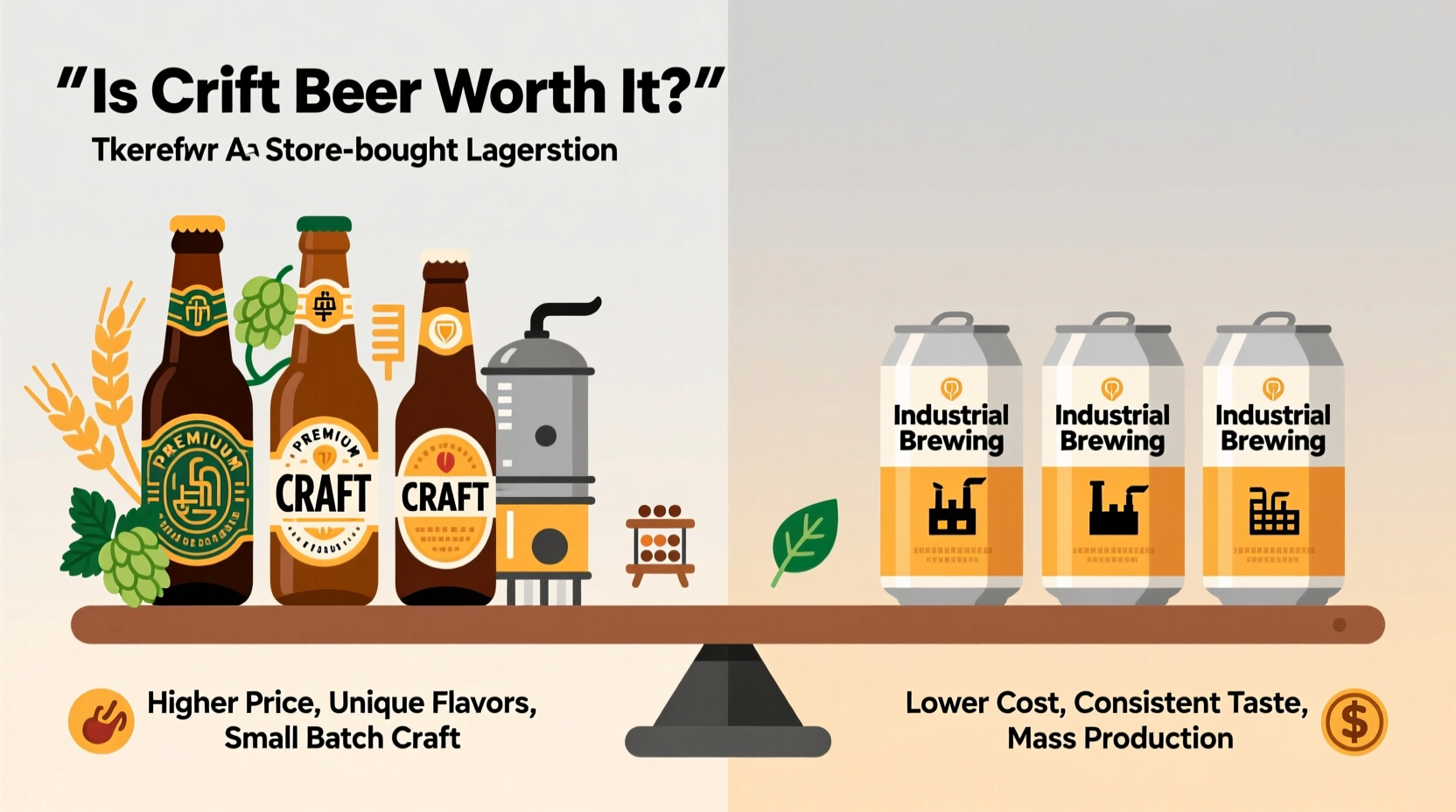
The Brewers Association defines a craft brewer as small (annual production under 6 million barrels), independent (less than 25% owned by a non-craft entity), and traditional (brewing beer using malted barley and other fermentable grains, with emphasis on flavor). These constraints aren’t arbitrary—they directly shape cost structure. A 15-barrel brewhouse produces roughly 465 gallons per batch. To match the output of one day’s run at a major brewery (which can exceed 1 million gallons), a small brewery would need to brew continuously for over 2,000 days—nearly six years.
Ingredient sourcing adds another layer. While macro lagers rely heavily on adjuncts like corn syrup and rice to lighten body and cut costs, most craft breweries use 100% malted barley, often locally sourced or specialty-roasted. Hop costs are especially telling: a single pound of Citra hops in peak season can cost $25–$35; a typical double IPA uses 2–4 pounds per barrel. That’s $50–$140 in hops alone for 31 gallons—before yeast, labor, packaging, or rent. By contrast, a standard lager may use less than 0.2 pounds of lower-cost, pelletized hops per barrel.
Tip: Check the label or brewery website for ingredient transparency. If it lists “malted barley, hops, water, yeast”—not “rice solids” or “corn syrup”—you’re likely paying for fewer compromises and more flavor integrity.A Real-World Cost Breakdown: Per-Ounce Analysis
Let’s compare two widely available products: a 12-ounce bottle of Sierra Nevada Pale Ale (a benchmark craft beer) and a 12-ounce bottle of Budweiser. At time of writing, average U.S. retail prices are $2.49 and $1.19 respectively. But unit cost tells only part of the story. The table below calculates cost per fluid ounce *and* accounts for alcohol-by-volume (ABV) and typical serving expectations.
| Attribute | Sierra Nevada Pale Ale | Budweiser |
|---|---|---|
| Price per 12 oz bottle | $2.49 | $1.19 |
| Cost per fluid ounce | $0.2075 | $0.0992 |
| ABV | 5.6% | 5.0% |
| Alcohol content per bottle (oz) | 0.672 oz pure alcohol | 0.600 oz pure alcohol |
| Cost per ounce of alcohol | $3.71 | $1.98 |
| Typical consumption pace (per session) | 1–2 bottles (savoring flavor) | 2–4 bottles (refreshment-focused) |
| Estimated sensory engagement time per bottle | 12–18 minutes | 4–7 minutes |
This reveals a crucial nuance: craft beer isn’t priced to be consumed faster—it’s priced to be experienced longer. The higher cost per ounce of alcohol reflects not just production expense, but an intentional design for slower, more attentive drinking. You’re not just buying ethanol; you’re buying aroma compounds from hand-selected hops, mouthfeel from unfiltered proteins, and complexity from extended fermentation schedules.
A Mini Case Study: How One Brewery Navigates the Margin Squeeze
In Portland, Oregon, Level Head Brewing launched in 2020 with a mission to produce clean, expressive lagers—traditionally one of the most technically demanding and time-intensive beer styles. Their Helles takes 28 days from mash-in to packaging: 90-minute decoction mashes, 21-day cold fermentation and lagering, and zero filtration. They pay $1.85 per pound for German-grown Pilsner malt (vs. $0.62 for domestic base malt used in macro lagers) and source noble hops exclusively from family farms in Bavaria.
Despite charging $13.99 for a four-pack of 16-ounce cans, their gross margin sits at 22%—well below the 35–40% industry target for sustainability. Owner and head brewer Maya Tran explains: “We could cut time, swap malt, skip the decoction—and gain 12% margin overnight. But then it wouldn’t be the beer we set out to make. Our customers don’t come for ‘lager’ as a category. They come for *this* lager—the one with bready crust, lemon zest, and that delicate, lingering minerality. That specificity has a cost. And our regulars know exactly what they’re paying for.”
Level Head’s taproom sees 65% of sales in pints—not cans—because patrons consistently choose to sit, taste, and talk rather than grab-and-go. Their data shows average dwell time of 47 minutes per customer, with 72% ordering food alongside beer. The premium isn’t extracted; it’s exchanged—for time, attention, and shared experience.
Flavor Complexity vs. Consistency: What You’re Really Paying For
Mass-market lagers prioritize reproducibility above all else. Every Budweiser batch must taste identical to every other batch—globally, across decades. Achieving that requires industrial-scale quality control: automated pH sensors, centrifugal yeast harvesting, forced carbonation within 0.02 volumes of CO₂, and rigorous gas chromatography testing. That consistency is an engineering triumph—but it comes at the expense of variation, terroir, and layered expression.
Craft beer embraces controlled variability. A single hop variety grown in Yakima Valley vs. Nelson, New Zealand, expresses radically different oils—even when harvested in the same week. A saison fermented with native farmhouse yeast will shift subtly with ambient temperature and seasonal humidity. That’s not inconsistency; it’s responsiveness. As Dr. Chris Lippert, sensory scientist at the Siebel Institute, notes:
“Macro lagers optimize for sensory neutrality—the absence of off-flavors. Craft beers optimize for flavor *presence*: distinct malt character, hop-derived thiols, esters from yeast metabolism, even subtle oxidation notes in aged sours. You’re not paying for ‘better’ beer—you’re paying for *different* beer, engineered for perception, not just preservation.” — Dr. Chris Lippert, Sensory Scientist & Brewing Educator
This distinction reshapes value. If your goal is reliable refreshment after yard work, a crisp lager delivers efficiently. But if you seek a beverage that evolves in the glass—unfolding notes of toasted biscuit, dried apricot, and white pepper as it warms—then the craft premium funds the entire ecosystem required to make that possible: the hop farmer’s selective breeding, the maltster’s kiln control, the brewer’s 3 a.m. gravity check, and the lab technician’s microbiological screening.
Your Personal Value Checklist: Is Craft Worth It—For You?
Not every craft beer justifies its price. Nor does every macro lager fail to deliver on its promise. The question isn’t “Is craft beer worth it?” but “Is *this* craft beer worth it *to me*, right now?” Use this actionable checklist before your next purchase:
- ✓ I’ve tasted this specific beer before—and actively sought it again. (Repeat purchase signals genuine preference, not trend-following.)
- ✓ I’m drinking it in a setting where I can focus: seated, no distractions, glassware appropriate to the style. (A hazy IPA in a plastic cup at a tailgate won’t reveal its nuance.)
- ✓ The brewery discloses key details: malt bill, hop varieties, fermentation temperature, canning date. (Transparency correlates strongly with intentionality.)
- ✓ I’ve compared it side-by-side with a familiar macro lager—and noticed clear differences in aroma, mouthfeel, and finish—not just bitterness.
- ✓ I’m comfortable spending 2–3x more for something I’ll savor slowly, much like choosing single-origin coffee over instant.
FAQ: Practical Questions, Straight Answers
Does higher price always mean better quality?
No. Price reflects cost structure and positioning—not universal quality. Some craft breweries overextend on branding while cutting corners on sanitation or aging. Conversely, many regional lagers (e.g., Great Lakes Eliot Ness, Yuengling Traditional Lager) offer exceptional balance and drinkability at mid-tier prices. Always prioritize freshness (check canning/bottling dates), ingredient clarity, and personal resonance over price alone.
Can I get craft-level flavor without the premium?
Yes—strategically. Look for “brewpub exclusives” (often 20–30% cheaper than packaged versions), session-strength styles (under 4.5% ABV), or local breweries with low overhead (no national distribution, minimal marketing spend). Also consider growler fills: a 64-ounce growler of fresh IPA from a neighborhood brewery often costs $12–$15—less than two 16-ounce cans—and eliminates packaging markup.
Why do some craft beers cost $25+ per bottle?
Extreme examples—barrel-aged stouts, sour ales aged 2+ years in wine casks, or limited wild-fermented releases—involve massive opportunity cost. A bourbon barrel holds 53 gallons but ties up capital for 18–36 months. Labor, storage, evaporation (“angel’s share”), and spoilage risk compound dramatically. That $25 bottle may represent $18 in direct costs before profit—making it less a luxury item and more a break-even artifact of patience and scarcity.
Conclusion: Value Is a Verb, Not a Price Tag
Worth isn’t embedded in the label. It’s created in the moment you lift the glass—how attentively you inhale, how slowly you sip, how thoughtfully you reflect on what you taste. Craft beer asks for presence. It rewards curiosity. It invites you to notice the difference between “bitter” and “resinous,” between “sweet” and “caramelized,” between “cold” and “crisp.” That engagement has tangible value—not just to your palate, but to your attention economy, your community, and the resilience of small-scale food systems. You don’t need to drink craft beer every day to honor its place. But when you do choose it, do so deliberately: support breweries that publish ingredient lists, ask bartenders about provenance, store your cans upright and cool, and pour into proper glassware. The price isn’t the barrier—it’s the invitation. Your next pour isn’t just liquid. It’s a vote for intention over inertia, craft over convenience, and flavor that demands to be known—not just consumed.
💬 Have a craft beer that changed how you think about flavor? Share the name, style, and what surprised you—in the comments. Let’s build a living guide to value, one honest tasting note at a time.