At first sip, a rich, oak-aged imperial stout poured from a bourbon barrel can evoke the warmth of a 12-year-old rye: vanilla, toasted coconut, charred wood, and a lingering alcohol heat that coats the tongue. It’s easy to assume—especially when served neat in a snifter—that this beer has crossed some invisible threshold into spirit territory. But sensory resemblance is not taxonomic equivalence. The question isn’t whether barrel-aged craft beer *tastes* like whiskey—it often does—but whether its identity, production logic, and chemical architecture align more closely with distilled brown spirits or with its fermented cousins like pilsner, helles, or kölsch. The answer lies not in marketing copy or tasting notes, but in microbiology, regulation, and the irreversible physics of distillation.
The Core Divide: Fermentation vs. Distillation
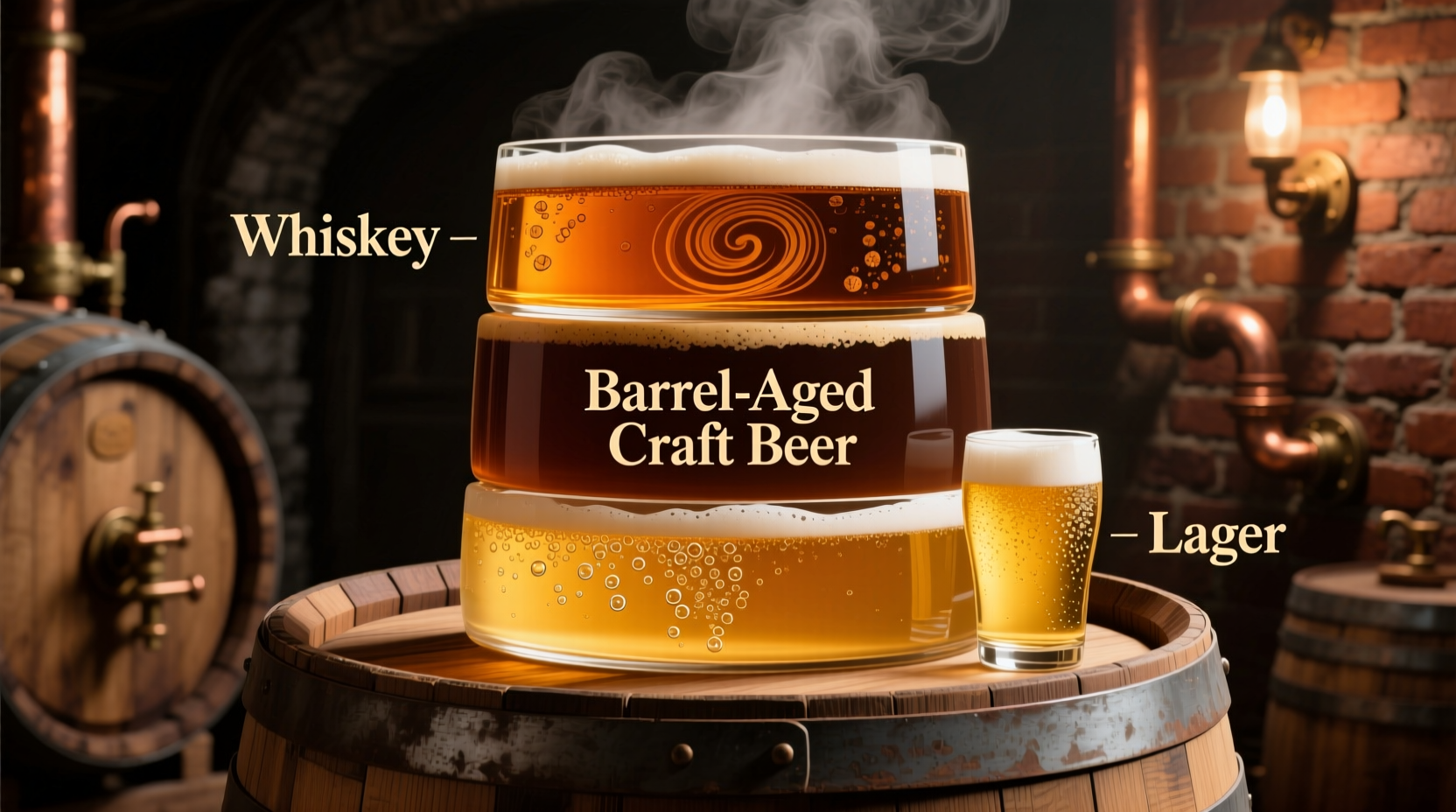
Whiskey and lager both begin with grain—and that’s where their shared lineage ends. Whiskey is a *distilled* spirit: fermented wort (called “wash” in distilling) is heated in a still, separating volatile compounds by boiling point. Ethanol (boiling at 78.4°C) vaporizes before water (100°C), concentrating alcohol and selectively capturing congeners—flavor-active molecules like esters, aldehydes, and fusel oils. The resulting distillate is typically 60–75% ABV before dilution and barrel aging. Lager, by contrast, is *fermented only*: yeast converts sugars into ethanol and CO₂ within a narrow temperature range (7–13°C), yielding beers usually between 4–6% ABV. No concentration occurs; no physical separation of compounds takes place.
Barrel-aged craft beer occupies a deliberate middle ground—but one anchored firmly on the fermentation side. It begins as beer—fully fermented, carbonated (or not), and stable. Only then is it transferred to used spirit barrels (most commonly bourbon, but also rye, tequila, or cognac casks). The barrel imparts flavor via three mechanisms: extraction (vanillin, lignin derivatives, tannins), micro-oxygenation (softening harsh edges), and microbial influence (if wild yeast or bacteria are present). Crucially, no distillation occurs. Alcohol content may rise slightly due to evaporation of water (“angel’s share”) in warm warehouses, but ABV never exceeds the original beer’s ceiling—typically staying under 14%, far below even the lowest-proof whiskeys (which legally must be ≥40% ABV in the U.S. and EU).
Tip: When evaluating a barrel-aged beer, ask: Was alcohol concentrated? Was the liquid distilled? If the answer is no to both, you’re tasting an amplified beer—not a spirit cousin.Sensory Overlap ≠ Structural Kinship
The illusion of kinship arises from shared oak-derived compounds. Both bourbon and barrel-aged stouts pull vanillin, eugenol (clove), guaiacol (smoke), and lactones (coconut) from charred American white oak. That similarity is real—but superficial. Whiskey’s flavor profile is *built upon* distillation: the cut points (heads, hearts, tails) determine which congeners survive. A well-made bourbon emphasizes caramelized grain sweetness and solvent-like esters refined through copper contact in the still. Barrel-aged beer, however, retains its full suite of fermentation byproducts—including diacetyl (butter), dimethyl sulfide (cooked corn), and fruity esters like isoamyl acetate (banana)—that distillers actively remove. These compounds would be considered flaws in whiskey but add complexity in a carefully aged sour or barleywine.
Consider mouthfeel: whiskey delivers viscosity from ethanol, glycerol, and dissolved wood polymers—but lacks residual fermentables. Barrel-aged beer often contains unfermented dextrins, lactose (in milk stouts), or Brettanomyces-driven polysaccharides, creating a chewy, syrupy texture no whiskey replicates. Carbonation—whether subtle petillance or aggressive effervescence—is another defining beer trait absent in whiskey. Even in “still” barrel-aged releases, the expectation of effervescence shapes perception: our brains anticipate fizz, altering how we register acidity, bitterness, and warmth.
A Comparative Framework: Beer, Whiskey, and Barrel-Aged Beer
| Characteristic | Lager | Barrel-Aged Craft Beer | Bourbon Whiskey |
|---|---|---|---|
| Production Method | Fermentation only (low-temp lager yeast) | Fermentation + optional secondary microbes + oak extraction | Fermentation + distillation + oak aging |
| ABV Range | 4–6% | 6–14% (rarely higher) | 40–65% |
| Carbonation | Present (naturally or forced) | Often present (even in “still” variants, residual CO₂ remains) | None |
| Regulatory Classification | Beer (TTB Category: Lager) | Beer (TTB Category: Specialty Beer – “Barrel-Aged”) | Spirit (TTB Category: Whiskey) |
| Key Flavor Drivers | Malt crispness, hop bitterness, clean yeast profile | Base beer character + oak extractives + microbial nuance | Distillate character + barrel extractives + oxidation products |
This table reveals a critical truth: barrel-aged beer is legally, chemically, and functionally a *subcategory of beer*. Its TTB (Alcohol and Tobacco Tax and Trade Bureau) classification requires it to meet the federal definition of beer: “a fermented beverage containing malted barley and/or other malted grain, and hops, with alcohol derived solely from fermentation.” Distillation disqualifies any product from that definition—even if aged in the same warehouse, same barrel, and same climate as whiskey.
Real-World Context: The Case of Fremont Brewing’s Bourbon Barrel Aged Dark Star
In Seattle, Fremont Brewing’s Dark Star imperial stout began life as a 10.5% ABV, coffee-and-cacao-forward beer fermented with neutral ale yeast. After primary fermentation, it spent 12 months in 2nd- and 3rd-fill Heaven Hill bourbon barrels—barrels that had previously held whiskey for 6–8 years, then been refilled with beer. During aging, the beer absorbed vanillin and oak lactones, while slow oxygen ingress softened roast bitterness and polymerized tannins. Yet crucially, the base beer’s signature elements remained audible: a hint of blackstrap molasses from the Munich malt, low-level diacetyl rounding out the midpalate, and a faint lactic tang from ambient microbes in Fremont’s barrel room.
When compared side-by-side with Heaven Hill’s own 7-year bourbon, the differences were instructive. The whiskey delivered intense ethanol lift, sharp oak spice, and a dry, tannic finish. The barrel-aged Dark Star offered plush viscosity, integrated carbonation, and a lingering bittersweet chocolate note grounded by residual malt sugar. Tasters consistently described the beer as “whiskey-adjacent”—not “whiskey-like.” As brewmaster Matt Lincecum observed during a 2023 sensory panel:
“We’re not making whiskey. We’re making beer that’s had a very interesting conversation with wood. The yeast, the hops, the water chemistry—they’re still the authors. The barrel is just the editor.”
What Actually Makes a Beer “Whiskey-Close”? A Step-by-Step Reality Check
Not all barrel-aged beers lean equally toward whiskey’s sensory world. Here’s how to assess proximity—objectively and practically:
- Identify the base style: A clean, high-ABV barleywine or imperial stout provides the richest canvas for oak integration. A kettle-soured gose aged in tequila barrels will emphasize agave and salinity—not whiskey’s grain-and-char profile.
- Check the barrel provenance: First-fill bourbon barrels impart aggressive oak and spirit residue. Third-fill barrels contribute subtler wood notes and less ethanol transfer. If the label says “ex-bourbon,” assume significant vanilla/char influence. If it says “ex-rum” or “ex-port,” expect different congener profiles entirely.
- Assess alcohol integration: In whiskey, ethanol is a structural pillar—warming but rarely hot. In beer, >10% ABV can manifest as solvent heat unless balanced by residual sugar or body. A “whiskey-close” beer hides its alcohol behind malt richness and oak tannin.
- Listen for fermentation signatures: Does the beer retain estery fruit (banana, pear) or spicy phenolics (clove, pepper)? Those are yeast-driven—and distinctly non-whiskey. Whiskey’s esters are stripped or transformed during distillation.
- Taste the finish: Whiskey finishes dry, with tannin and ethanol as dominant impressions. Beer finishes with residual sweetness, carbonation prickle, or microbial acidity—even in barrel-aged versions. If the last impression is a lingering, syrupy chocolate-coffee note, it’s beer. If it’s drying oak and heat, it’s leaning spiritward—but still not there.
Expert Insight: The Brewer’s Perspective
Dr. Janae Yelderman, a brewing scientist and adjunct professor at UC Davis’ Department of Viticulture & Enology, has studied oak extractives in fermented beverages for over a decade. Her lab’s 2022 analysis of 42 barrel-aged stouts found consistent biomarkers confirming their beer identity—even after 24 months in oak:
“The presence of intact alpha-acids from hops, measurable levels of iso-alpha-acids, and detectable concentrations of yeast-derived phenylethanol prove these are fermented—not distilled—products. You cannot distill away the hop signature and still call it beer, but you *can* age it until the hop character recedes beneath oak. That’s maturation, not transformation.” — Dr. Janae Yelderman, Brewing Science Researcher
Her work underscores a biochemical reality: distillation removes water and concentrates volatiles, but it also strips non-volatile compounds essential to beer’s structure—like hop acids, proteins, and complex carbohydrates. Barrel-aging preserves them. That preservation is why barrel-aged beer pairs with food like beer (cutting fat with carbonation and bitterness) rather than like whiskey (cleansing the palate with ethanol and tannin).
FAQ
Can barrel-aged beer ever become whiskey if aged long enough?
No. Aging time does not convert fermentation into distillation. Without heat-driven phase change and physical separation of compounds, no amount of time in oak transforms beer into whiskey. Legally and scientifically, the distinction is absolute.
Why do some barrel-aged beers taste hotter or more alcoholic than others at the same ABV?
Perceived alcohol heat depends on balance. High residual sugar (e.g., in a maple-aged barleywine) masks ethanol burn. Low carbonation and high tannin (e.g., in a wine-barrel-aged sour) can amplify warmth. Conversely, crisp carbonation and clean fermentation (as in a barrel-aged pilsner) diffuse alcohol sensation—even at 7% ABV.
Is “bourbon barrel-aged” the same as “bourbon-aged”?
No—and this is a critical labeling distinction. “Bourbon barrel-aged” means the beer aged in barrels that previously held bourbon. “Bourbon-aged” would imply the beer was aged *with* bourbon—which is illegal for beer in most jurisdictions (and would make it a cocktail, not a beer). Reputable producers use precise terminology.
Conclusion: Embrace the Nuance, Not the Hype
Barrel-aged craft beer isn’t “closer to whiskey than lager”—it’s a sophisticated evolution of lager’s foundational principles, expanded through time, wood, and intention. It inherits lager’s reverence for clean fermentation, precise temperature control, and grain-forward expression—then layers on the patience and artistry of cooperage. To call it whiskey-adjacent is to honor its ambition; to call it whiskey is to misunderstand its soul. The magic lies precisely in that duality: it satisfies whiskey drinkers with depth and warmth, yet rewards beer lovers with carbonation, hop nuance, and the unmistakable fingerprint of living yeast. Rather than forcing comparisons, taste it on its own terms—as a bridge between traditions, not a replacement for either.
Next time you pour a glass of barrel-aged imperial stout, don’t ask whether it’s “like whiskey.” Ask what the base malt tells you about the terroir of the barley. Notice how the oak tannins interact with the beer’s natural acidity. Feel how carbonation lifts the vanilla note instead of suppressing it. That’s where true appreciation begins—not in categories, but in conscious, curious sipping.
💬 Your turn: Have you tasted a barrel-aged beer that reshaped how you think about beer’s boundaries? Share your experience—and the brewery—in the comments. Let’s deepen the conversation, one thoughtful pour at a time.