
Foldable phones have moved from futuristic concept to mainstream product in just a few years. Samsung, Google, Motorola, and even Apple (rumored) are investing heavily in flexible display technology. But despite sleek designs and jaw-dropping innovation, a critical question remains: is a foldable phone worth the price for everyday users—or is it still a gadget best left to tech enthusiasts and early adopters?
The answer isn't simple. While foldables offer unique benefits like larger screens in compact form factors, they also come with trade-offs in durability, price, software optimization, and long-term reliability. For the average user who checks email, browses social media, takes photos, and streams videos, spending $1,400–$1,800 on a foldable may not deliver proportional value compared to flagship non-foldable smartphones.
The Evolution of Foldable Phones: From Gimmick to Mainstream?
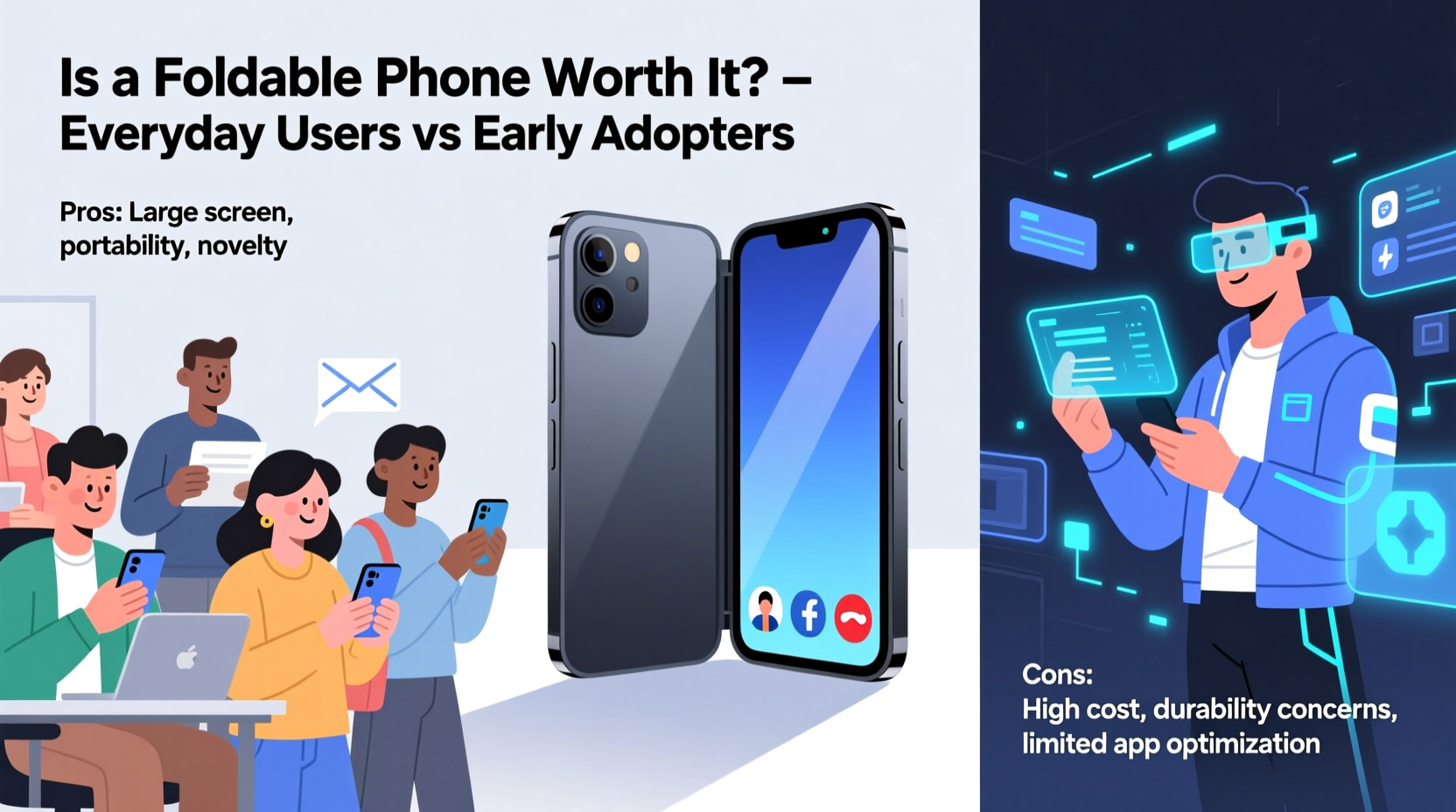
When Samsung launched the Galaxy Fold in 2019, it was met with skepticism—and broken screens. Early units failed under minimal stress, raising concerns about the viability of foldable displays. Critics dismissed them as overpriced novelties for tech influencers. But fast forward to 2024, and models like the Samsung Galaxy Z Fold 5, Google Pixel Fold, and Motorola Razr+ have made significant strides in durability, hinge design, and software integration.
Manufacturers now use advanced materials like ultra-thin glass (UTG), reinforced polymer layers, and dust-resistant hinges. Samsung’s “Armor Aluminum” frames and IPX8 water resistance on newer models suggest these devices are being built for real-world use—not just lab demonstrations.
“Foldables are no longer prototypes. They’re evolving into viable alternatives for power users who need multitasking and portability.” — David Lee, Senior Analyst at TechInsight Group
Yet evolution doesn’t equal mass adoption. Despite improvements, foldables still represent less than 2% of global smartphone sales. High prices, repair costs, and lingering concerns about screen creases and longevity keep many consumers hesitant.
Cost vs. Value: Breaking Down the Price Tag
A top-tier foldable phone starts around $1,399 and can exceed $1,800. Compare that to the iPhone 15 Pro ($999) or Samsung Galaxy S24 ($799), and the premium becomes clear. But is that extra $400–$800 justified by real utility?
Let’s examine what you're paying for:
- Larger internal display: Up to 7.6 inches when unfolded—closer to a small tablet.
- Improved multitasking: Split-screen apps, drag-and-drop functionality, and app pairing.
- Compact folding design: Fits in pockets better than tablets while offering expansive viewing.
- Innovative camera systems: Often borrowed from flagship models.
- Premium materials: Titanium frames, Gorilla Glass Victus, advanced polymers.
On paper, this sounds compelling. But for most users, the core smartphone experience—calls, messaging, social media, navigation—doesn’t require a 7.6-inch screen. Watching YouTube or reading articles on a larger display is pleasant, but not transformative enough to justify doubling the cost of a mid-range phone.
Tip: If your primary use case is media consumption or light productivity, consider a budget tablet or large-screen smartphone instead of a foldable.Durability Concerns: Are Foldables Built to Last?
One of the biggest barriers to mainstream adoption is durability. Folding a screen thousands of times inevitably introduces wear. While manufacturers claim their devices can withstand 200,000 folds (roughly five years of daily use), real-world conditions vary widely.
Exposure to dust, sand, moisture, and accidental drops can compromise the hinge or screen integrity. Even with IPX8 ratings, foldables aren’t fully dustproof—a known weakness in sandy or humid environments.
Repairs are another concern. Replacing a damaged inner display can cost $400–$600, and official repair programs remain limited. Third-party options risk damaging proprietary components or voiding warranties.
“I dropped my Fold 4 on tile from waist height. No external damage, but the crease deepened immediately, and touch response became spotty. I paid $520 to fix it—half the phone’s resale value.” — Mark T., Foldable Owner (via Reddit testimonial)
This leads to an important reality: foldables demand careful handling. Users must accept higher maintenance responsibility than with traditional smartphones. For parents, outdoor workers, or anyone prone to accidents, this added fragility may outweigh the benefits.
Who Actually Benefits from a Foldable Phone?
Not all users are the same. The value of a foldable depends heavily on lifestyle, work demands, and digital habits. Let’s identify who gains the most—and who doesn’t.
Best For:
- Mobile professionals: Lawyers, consultants, or remote workers who edit documents, manage emails, and join video calls on the go benefit from multitasking across two apps simultaneously.
- Content creators: Vloggers and photographers appreciate the larger viewfinder and split-screen editing tools.
- Frequent travelers: Those needing a single device that replaces both phone and tablet save space and weight.
- Tech-savvy multitaskers: Power users who run multiple messaging apps, browsers, and productivity tools at once see tangible efficiency gains.
Less Useful For:
- Casual users: If you mostly scroll Instagram, text friends, and stream Netflix, a standard flagship offers similar performance at lower cost.
- Budget-conscious buyers: With used iPhones and Androids offering excellent performance under $500, the ROI on a foldable is low.
- Heavy outdoor users: Construction workers, hikers, or anyone in rugged environments face higher risk of damage.
Real-World Example: A Day in the Life of a Foldable User
Sophia is a freelance graphic designer based in Austin. She works remotely, travels frequently, and relies on her phone for client communication, file sharing, and creative ideation. Last year, she upgraded from an iPhone 14 Pro to a Galaxy Z Fold 5.
Her typical day starts with opening three apps at once: Slack for team updates, Gmail for client messages, and Adobe Express for quick edits. On her Fold, she runs all three side-by-side without switching tabs. During lunch, she watches a tutorial video on the inner screen while taking notes in Samsung Notes on half the display. Later, she joins a Zoom call using the outer screen for convenience and privacy in public spaces.
For Sophia, the foldable has increased productivity by an estimated 20%. She values the ability to sketch ideas directly on the large screen and share mockups instantly. However, she admits she treats the device like fragile equipment—using a protective case, avoiding pocket carry, and never placing it face-down on rough surfaces.
“It’s powerful, but it’s not indestructible,” she says. “I wouldn’t recommend it to someone who drops their phone regularly. But if you work digitally and want more screen without carrying a tablet, it’s a game-changer.”
Comparison Table: Foldable vs. Traditional Flagship (2024)
| Feature | Foldable (e.g., Galaxy Z Fold 5) | Traditional Flagship (e.g., iPhone 15 Pro) |
|---|---|---|
| Starting Price | $1,399 | $999 |
| Main Screen Size | 7.6\" foldable AMOLED | 6.1\" OLED |
| Battery Life | ~12 hours mixed use | ~14 hours mixed use |
| Durability | Moderate (hinge/screen sensitivity) | High (proven build quality) |
| Repair Cost (Screen) | $400–$600 | $299–$499 (Apple), varies by brand |
| Multitasking Capability | Excellent (split-screen, pop-up windows) | Limited (picture-in-picture, slide-over) |
| Portability | Compact when folded, thicker when open | Consistent slim profile |
| Software Optimization | Improving, but some apps still stretch poorly | Full ecosystem support |
The table shows that while foldables excel in screen size and multitasking, they lag in battery life, repair affordability, and consistent software experience. For many, the trade-offs aren’t worth the novelty.
Practical Checklist: Should You Buy a Foldable Phone?
Before making a decision, ask yourself the following questions:
- Do I frequently need to run two or more apps at once for work or creativity?
- Am I willing to pay a 40–80% premium over standard flagships?
- Can I commit to careful handling, including using a case and avoiding drops?
- Do I travel often and want one device instead of a phone + tablet?
- Am I comfortable with potential repair costs exceeding $500?
- Do I value cutting-edge tech and don’t mind occasional software glitches?
If you answered “yes” to most of these, a foldable could be a smart investment. If not, a conventional high-end phone likely serves you better.
Future Outlook: When Will Foldables Go Mainstream?
Foldable phones are improving rapidly, but mass adoption hinges on three key developments:
- Price reduction: Until foldables drop below $1,000, they’ll remain niche. Analysts predict this could happen by 2026 as manufacturing scales.
- Better durability: Eliminating the visible crease and achieving full IP68 ratings would ease consumer fears.
- Broader software support: Developers must optimize apps specifically for foldable layouts, not just stretch existing ones.
Companies like Xiaomi and Oppo are already testing rollable prototypes—devices that extend the screen without a hard fold. This could solve many current limitations. Additionally, rumors suggest Apple is exploring a foldable iPhone, which would instantly boost credibility and market penetration.
Until then, foldables remain in transition: past the “gimmick” phase but not yet ready for universal appeal.
FAQ: Common Questions About Foldable Phones
Are foldable phones waterproof?
Most current models, like the Galaxy Z Fold 5, have IPX8 water resistance, meaning they can survive submersion in fresh water up to 1.5 meters for 30 minutes. However, they are not dustproof, and repeated exposure to particles can damage the hinge mechanism.
Does the screen crease affect usability?
The crease is visible and slightly tactile, especially under bright light. Most users report getting used to it within a few days. It doesn’t interfere with touch responsiveness on modern models, but writing or drawing directly over the crease may feel uneven.
How long do foldable phones last?
Manufacturers rate hinges for around 200,000 folds—equivalent to five years of average use. Battery lifespan is similar to other flagships (2–3 years before noticeable degradation). However, long-term reliability beyond three years is still unproven due to the technology’s youth.
Final Verdict: Early Adopter Toy or Everyday Tool?
Foldable phones are no longer science fiction. They’ve evolved into functional, capable devices with real advantages for specific users. But for the majority of people, they remain overpriced solutions to problems that don’t exist.
Everyday users who prioritize reliability, value, and simplicity will find better options in traditional smartphones. The extra cost, care requirements, and uncertain long-term durability make foldables a hard sell outside professional or highly specialized use cases.
That said, if you’re a mobile-first worker, digital creator, or someone who genuinely needs a hybrid phone-tablet experience, today’s foldables offer meaningful benefits. Just go in with eyes open: treat it carefully, budget for repairs, and don’t expect perfection.
💬 Have you tried a foldable phone? Was it worth the price for your lifestyle? Share your experience in the comments and help others decide whether to embrace the future—or wait a little longer.