When it comes to dive watches, two names often dominate conversations: the Invicta Pro Diver and the Rolex Submariner. One retails for under $200, the other starts above $10,000. The gap isn’t just in price—it spans heritage, materials, engineering, and brand perception. But does that mean the Rolex Submariner is ten times better? Or is much of its appeal rooted in prestige rather than practical superiority? This article dissects both timepieces across key criteria to answer a crucial question: Is the Rolex worth the hype, or are you simply paying for the name?
Design and Build Quality: Substance Behind the Shine
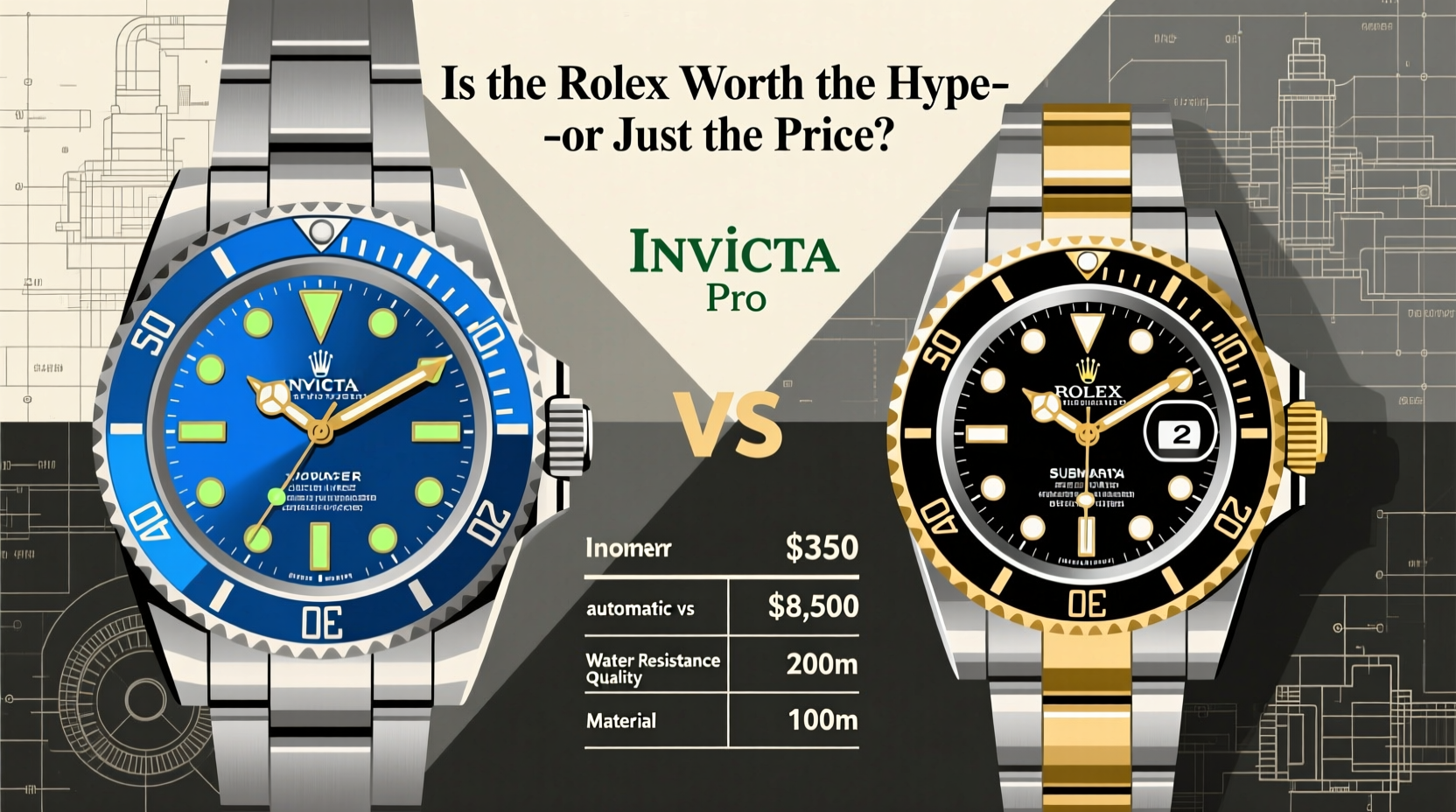
The visual similarities between the Invicta Pro Diver and the Rolex Submariner are undeniable. Both feature a rotating bezel, luminous markers, and a three-link stainless steel bracelet. At a glance, especially from a distance, they could be mistaken for siblings. However, closer inspection reveals stark differences in execution.
The Invicta Pro Diver uses mineral crystal, which is more prone to scratching than sapphire. Its case, while robust for the price, is made from standard stainless steel without the proprietary Oystersteel used by Rolex. The crown on the Invicta is not screw-down, reducing water resistance reliability over time. In contrast, the Submariner features a Triplock crown system, sapphire crystal with a Cyclops lens over the date, and a monobloc middle case machined for durability.
Tip: Always check whether a watch has a screw-down crown if you plan to use it for actual diving—this detail significantly impacts water integrity.Rolex’s attention to finish is evident in every angle: brushed links, polished center bars, and perfectly aligned lugs. Invicta, while offering decent finishing for its price, can show inconsistencies in polishing and fit. Over time, these micro-differences compound into a noticeable gap in perceived quality.
Performance and Movement: What Powers the Watch
At the heart of any watch is its movement. The Invicta Pro Diver typically runs on a Japanese-made Miyota 8215, a reliable automatic movement with a 40-hour power reserve. It's accurate within -10 to +30 seconds per day—an acceptable range for an entry-level automatic.
The Rolex Submariner, on the other hand, is powered by the Caliber 3235 (or 3230 for no-date models), a fully in-house developed movement featuring Chronergy escapement, Parachrom hairspring, and a 70-hour power reserve. Certified as a Superlative Chronometer, it guarantees accuracy within -2/+2 seconds per day—ten times tighter than the Invicta’s potential variance.
“Precision in horology isn’t just about telling time—it’s about mastering it. Rolex’s movements are engineered to perform under pressure, literally and figuratively.” — Daniel Hart, Independent Watchmaker & Horology Journalist
This isn’t merely technical one-upmanship. For someone who values long-term reliability, minimal servicing, and consistent timekeeping, the Submariner’s movement delivers tangible benefits. The Invicta performs admirably for casual wear but lacks the longevity and resilience expected of professional-grade instruments.
Value Comparison: Price Versus Long-Term Investment
Let’s address the elephant in the room: cost. The Invicta Pro Diver retails between $150 and $250. The Rolex Submariner starts at around $10,500 and can exceed $15,000 depending on model and market availability. That’s a 50x difference. So where does that money go?
| Feature | Invicta Pro Diver | Rolex Submariner |
|---|---|---|
| Price | $150–$250 | $10,500+ |
| Movement | Miyota 8215 (automatic) | Caliber 3235 (in-house) |
| Crystal | Mineral | Sapphire with Cyclops |
| Water Resistance | 200m (theoretical) | 300m (tested) |
| Power Reserve | ~40 hours | 70 hours |
| Accuracy | -10 to +30 sec/day | -2 to +2 sec/day |
| Bracelet Quality | Stainless steel, basic clasp | Oyster bracelet with Glidelock extension |
| Resale Value | Depreciates quickly | Often appreciates or holds value |
The table illustrates that while both watches claim “200m+” water resistance, Rolex subjects its watches to rigorous testing beyond ISO standards. Their depth rating is conservative; many Submariners have survived far deeper dives. Invicta’s rating is based on design, not real-world stress testing.
Moreover, resale value tells a compelling story. An Invicta purchased today will likely be worth less than $100 in five years. A Rolex Submariner, particularly steel sports models, frequently sells above retail due to scarcity and demand. In this sense, the Submariner isn’t just a purchase—it’s a financial asset.
Real-World Use Case: Two Divers, Two Watches
Consider two recreational divers: Mark and Alex. Mark bought an Invicta Pro Diver for $200 as a backup watch. He uses it monthly during dives, occasionally knocks it against boat rails, and stores it in a drawer when not in use. After 18 months, the crystal shows multiple scratches, the lume has dimmed, and the movement gains 25 seconds daily. He replaces it with another Invicta.
Alex invested in a Rolex Submariner five years ago. He dives weekly, wears it daily, and never babyed it. Last year, he sent it in for a service at a cost of $800—still cheaper than buying a new luxury watch. Post-service, it performs like new. Recently, a collector offered him $14,000 for it. He declined, not because he couldn’t use the cash, but because he trusts the tool on his wrist.
This scenario doesn’t imply the Invicta failed. It fulfilled its role as an affordable, stylish dive-inspired watch. But it wasn’t built to endure decades of hard use. The Submariner was—and did.
Is the Hype Justified? Separating Image From Integrity
Yes, Rolex benefits from immense brand marketing, celebrity endorsements, and cultural mythology. There’s no denying that part of its price reflects intangible equity. But reducing the Submariner to “just a logo” overlooks decades of vertical integration, R&D investment, and obsessive quality control.
Rolex manufactures nearly every component in-house—from springs to screws to gold alloys. They operate their own foundry, test every movement for days before assembly, and simulate real-world conditions rigorously. This level of control ensures consistency that few brands, luxury or otherwise, can match.
Invicta, meanwhile, sources movements, cases, and crystals from third parties. While efficient for keeping prices low, it limits customization, precision tuning, and long-term supply chain stability. You’re not just paying for parts—you’re paying for process.
Tip: If you're buying a watch primarily as a tool or heirloom, prioritize in-house movements and proven durability over aesthetics alone.Frequently Asked Questions
Can the Invicta Pro Diver be used for actual diving?
Technically, yes—it meets the 200m water resistance standard on paper. However, lack of a certified screw-down crown, lower-grade gaskets, and inconsistent manufacturing mean it shouldn't be relied upon for deep or frequent dives. It’s better suited for swimming and shallow snorkeling.
Does the Rolex Submariner hold its value?
Historically, yes. Steel Rolex sports watches like the Submariner, GMT-Master II, and Daytona often retain or increase in value, especially in good condition and with full papers. This makes them rare examples of luxury items that can double as alternative investments.
Is the Invicta Pro Diver a “fake Rolex”?
No, but it borrows heavily from Rolex’s design language. Invicta doesn’t infringe on trademarks, but the resemblance is intentional. Whether this is homage or imitation depends on perspective. Legally, it’s permissible; ethically, opinions vary.
Conclusion: Worth the Hype? Yes—but With Nuance
The Rolex Submariner is expensive, but not merely because of branding. It earns its premium through superior materials, engineering excellence, long-term reliability, and residual value. For those who demand a tool watch capable of performing under pressure for decades, the Submariner justifies its cost.
The Invicta Pro Diver serves a different purpose: accessible style with dive-watch flair. It’s an excellent entry point for beginners, fashion-focused wearers, or those testing the waters of mechanical timepieces. But it’s not a substitute for a professional instrument.
The hype around the Submariner isn’t manufactured—it’s accumulated. Built on generations of real-world performance, innovation, and trust. You’re not just paying for what the watch is today, but what it represents: precision, endurance, and legacy.
💬 What do you value more in a watch: performance and longevity, or affordability and style? Share your thoughts and experiences—we’d love to hear how your timepiece fits into your life.