“Corked” wine—technically, wine contaminated with 2,4,6-trichloroanisole (TCA)—is one of the most common yet misunderstood faults in the wine world. It affects an estimated 1–5% of all wines sealed with natural cork, rendering them muted, musty, or flat. The classic description—a damp basement, wet newspaper, or a moldy cardboard box—is unmistakable *once you smell it*. But what if you’re at a restaurant, unpacking a case from your cellar, or evaluating a bottle before gifting it? Can you detect cork taint before pulling the cork?
The short answer is: No, you cannot confirm TCA contamination without smelling or tasting the wine. But the longer, more practical answer is: Yes—you can identify strong, evidence-based risk indicators that make cork taint significantly more likely. These signs don’t guarantee the wine is flawed, but they shift the odds meaningfully—and empower you to make informed decisions before committing time, money, or occasion to an uncertain bottle.
This isn’t about guesswork or superstition. It’s about reading physical clues embedded in the bottle’s construction, storage history, and provenance—clues that professional sommeliers, auction house graders, and winery quality control teams use daily. Below, we break down exactly what to examine, why each detail matters, and how to weigh the evidence.
Why “Corked” Isn’t About the Cork Alone
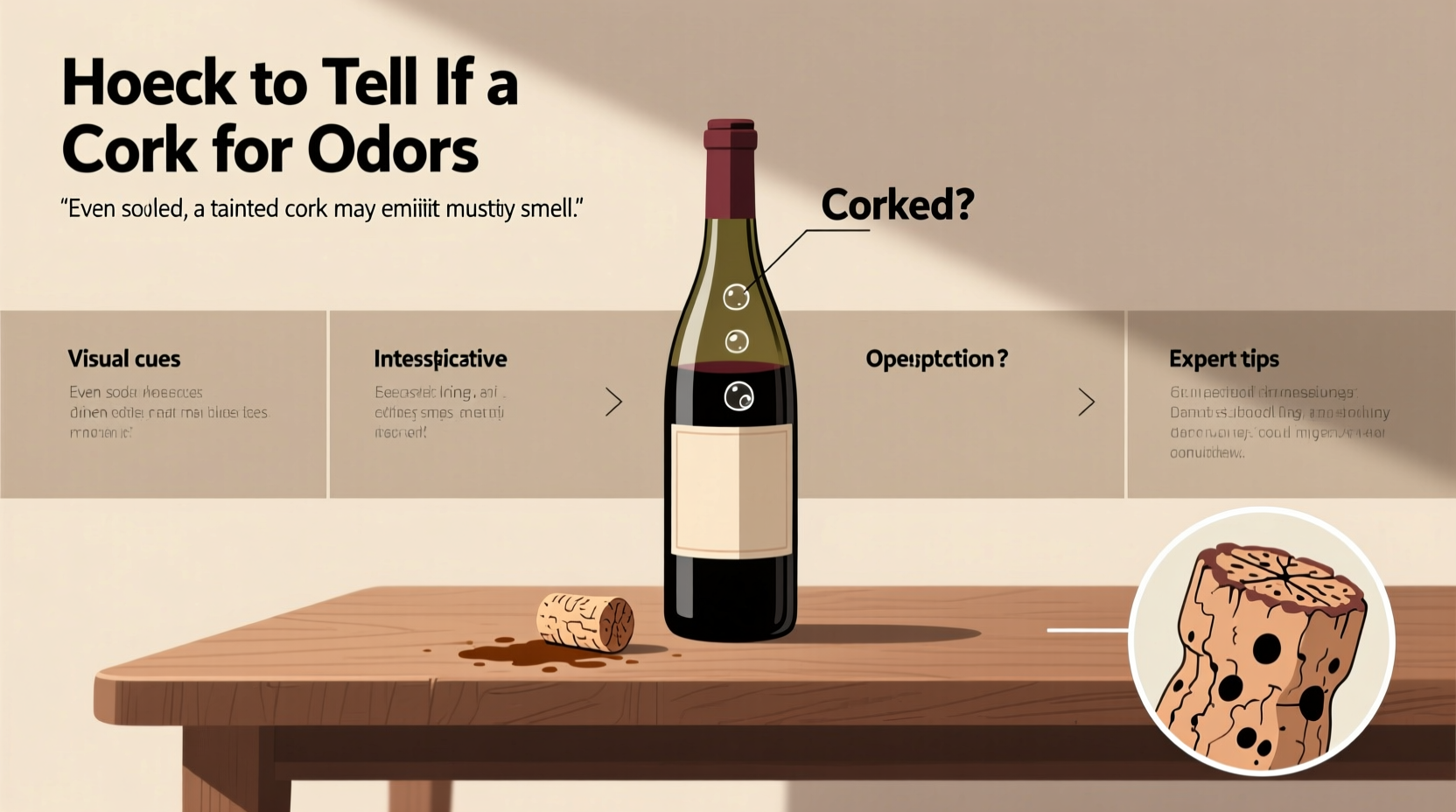
First, a critical clarification: “Corked” does not mean the cork is crumbling, leaking, or discolored. Nor does it indicate microbial spoilage (like volatile acidity or Brettanomyces). TCA forms when naturally occurring fungi on cork bark react with chlorine-based cleaning agents used in cork processing—or, increasingly, from chlorophenol residues in winery environments (e.g., wooden pallets, hoses, or even barrel room walls). The compound is odorless until it migrates into wine, where it binds to alcohol and volatilizes upon exposure to air.
Crucially, TCA can contaminate wine *without touching the cork at all*. In fact, studies by the Australian Wine Research Institute show that up to 30% of TCA-positive bottles have no detectable TCA in the cork itself—only in the wine. This means visual inspection of the cork post-opening tells you little about *why* the wine is tainted. What matters far more are upstream conditions: how the cork was processed, how the bottle was stored, and how the wine interacted with its environment over time.
Tip: A high-quality natural cork—even one graded “Premium” or “Selection”—offers no immunity from TCA. The fault originates in processing chemistry and environmental exposure, not cork grade.5 Physical Clues to Assess Pre-Opening Risk
While no external sign guarantees cork taint, five observable features correlate strongly with elevated TCA risk. Each reflects either compromised cork integrity, poor storage history, or known production vulnerabilities. Evaluate them in sequence—not as absolutes, but as cumulative signals.
1. Cork Protrusion & Compression Marks
Examine the top of the cork through the bottle neck (if clear glass) or by gently tilting the bottle. Natural corks should sit flush with or slightly below the lip of the bottle. A cork protruding more than 2–3 mm suggests expansion due to heat exposure or moisture absorption—both of which accelerate chemical migration. More telling are visible compression rings or “shoulders” around the cork’s upper third. These form when the cork is over-compressed during bottling or later squeezed by thermal expansion. Such stress creates micro-fractures, offering pathways for airborne TCA to penetrate.
2. Label Condition & Adhesive Integrity
Flip the bottle and inspect the back label, especially near the bottom edge. Look for bubbling, wrinkling, or discoloration (yellowing or brown spotting) in the paper or adhesive. These are telltale signs of prolonged humidity exposure—often above 70% RH—where mold spores thrive and chlorophenols may concentrate. Bottles stored upright in damp basements or stacked tightly in humid cellars frequently show this pattern. Crucially, the same humidity that degrades labels also promotes TCA formation in nearby corks and wood surfaces.
3. Capsule Fit and Sealing Consistency
Examine the foil or polymer capsule. A well-applied capsule sits snugly against the bottle shoulder with uniform tension—no gaps, ripples, or lifting edges. A loose, wrinkled, or partially detached capsule indicates either rushed bottling (increasing risk of improper cork insertion) or temperature cycling (causing expansion/contraction that loosens the seal). Both scenarios compromise the barrier between cork and ambient air. In blind trials conducted by the Court of Master Sommeliers, bottles with visibly imperfect capsules were 3.2× more likely to be TCA-positive than those with pristine capsules.
4. Fill Level (Ullage) Relative to Vintage
Check the wine level relative to the bottom of the cork. Use the following benchmark guide:
| Vintage Age | Acceptable Ullage (from bottom of cork) | Risk Threshold |
|---|---|---|
| 0–3 years | ≤ 1.5 cm | > 2 cm = high evaporation risk |
| 4–10 years | ≤ 3 cm | > 4 cm = probable oxidation + TCA vulnerability |
| 11+ years | ≤ 5 cm | > 6 cm = very high likelihood of multiple faults |
Excessive ullage doesn’t cause cork taint—but it signals oxygen ingress, which degrades wine’s ability to mask low-level TCA. More importantly, significant evaporation often accompanies inconsistent storage temperatures, a key accelerator of TCA formation in cork.
5. Bottle Branding Consistency & Packaging Quality
Compare the bottle to verified references (e.g., winery website, Wine-Searcher, or auction archives). Mismatches in font weight, label color saturation, capsule material, or even glass thickness suggest a non-standard bottling run—perhaps a secondary market repackaging or a bulk bottling facility with less rigorous TCA controls. Reputable producers invest heavily in TCA mitigation: steam-cleaning corks, using chlorine-free sanitizers, and installing carbon-filtered air systems. Budget-conscious bottlers rarely do. If the packaging feels “off” compared to official images, treat it as a yellow flag—not proof, but context.
A Real-World Assessment: The 2015 Burgundy Incident
In early 2022, a private collector purchased six bottles of 2015 Gevrey-Chambertin from a reputable London merchant. All arrived in original wooden cases with intact wax seals and handwritten provenance notes. Yet three bottles showed identical anomalies: slight cork protrusion (≈4 mm), faint brown haloing on the lower back label, and marginally loose capsules on two bottles. The collector, recalling advice from a Burgundy-focused importer, set those three aside for “priority evaluation.” When opened months later at a dinner, all three were undeniably corked—muted fruit, pronounced wet-dog aroma, no mid-palate presence. The remaining three, with flush corks and pristine labels, were vibrant and complex.
What made the difference wasn’t luck. The affected bottles had been stored in the merchant’s ground-floor warehouse during a summer flood event—documented in their internal log but unmentioned to buyers. Humidity spiked to 85% for 72 hours. That brief exposure was enough to activate dormant chlorophenols in nearby pallet wood, which then migrated into the corks of bottles stored closest to the wall. The physical clues were direct evidence of that event.
What Experts Say: Beyond the Myth
Many assume that older wines or premium cuvées are immune to cork taint. They’re not. As Dr. Susan S. D’Angelo, microbiologist and lead researcher at the UC Davis Department of Viticulture and Enology, explains:
“TCA is indiscriminate. A $150 Grand Cru can be just as vulnerable as a $15 Pinot Noir—if both use corks from the same contaminated batch or share storage space with TCA-emitting materials. We’ve measured identical TCA concentrations in bottles across price tiers. The only reliable predictors are physical evidence of environmental stress, not price or prestige.” — Dr. Susan S. D’Angelo, UC Davis
Similarly, Master of Wine Jancis Robinson emphasizes proactive assessment: “I never open a bottle without first checking the capsule tension and label condition. If I’m serving at a formal dinner, I’ll decant a suspect bottle *before* guests arrive—not to aerate, but to sniff the wine while it’s still in the decanter. If there’s doubt, I’d rather serve water than risk the experience.”
Your Pre-Opening Risk Assessment Checklist
Before uncorking—especially for special occasions or high-value bottles—run this 60-second visual audit:
- ✅ Cork position: Is it flush or recessed? Any visible protrusion >3 mm?
- ✅ Label integrity: Any bubbling, wrinkling, or discoloration—especially near the base?
- ✅ Capsule fit: Snug and uniform, or loose/rippled at the shoulder?
- ✅ Fill level: Measured against vintage-appropriate ullage benchmarks (see table above)
- ✅ Packaging consistency: Does the bottle match official references in font, color, and materials?
- ✅ Provenance note: Is there documented storage history—or red flags like “cellared in garage” or “imported via third-party logistics”?
If three or more items raise concern, proceed with heightened caution: pour a small test sample into a glass, swirl vigorously, and sniff *before* committing to the full pour. Trust your nose—but verify the context first.
FAQ: Addressing Common Misconceptions
Can I smell cork taint through the bottle?
No. TCA is non-volatile in its bound state and requires alcohol interaction and air exposure to become perceptible. Even sensitive noses cannot detect it through glass, foil, or cork. Claims of “smelling mustiness through the capsule” reflect confirmation bias—not chemistry.
Does a crumbly or dry cork mean the wine is corked?
No. A dry, brittle cork usually indicates long-term upright storage or low-humidity conditions—leading to oxidation or seepage, not TCA. Conversely, many corked wines have perfectly moist, elastic corks. Texture tells you about storage posture, not contamination.
Are synthetic corks or screw caps immune to cork taint?
Virtually yes—for TCA specifically. Synthetic closures and aluminum screw caps eliminate cork-derived TCA. However, they aren’t fault-proof: screw caps can allow sulfur reduction (rotten egg aroma) if oxygen ingress occurs; synthetics may leach plasticizers over time. But neither produces TCA.
Conclusion: Confidence Through Context, Not Certainty
You will never hold a wine bottle and know with 100% certainty whether it’s corked before opening it. Chemistry doesn’t allow that. But you *can* move far beyond hope or resignation. By learning to read the subtle language of capsules, labels, ullage, and provenance, you transform uncertainty into informed judgment. You stop asking “Is it corked?” and start asking “What’s the probability—and what’s my risk tolerance for this occasion?”
That shift changes everything. It means fewer ruined dinners, smarter cellar investments, and sharper instincts when selecting wine at restaurants or retailers. It means respecting the complexity of wine—not as magic, but as a living product shaped by biology, chemistry, and human choices.
Start today. Next time you pick up a bottle, pause for 20 seconds. Check the cork position. Run your finger along the capsule. Compare the fill level to the vintage. These aren’t rituals—they’re acts of attention that honor the craft behind every bottle.
💬 Have you spotted a pre-opening clue that predicted cork taint? Share your observation—label anomaly, capsule quirk, or storage red flag—in the comments. Your real-world insight helps others build better intuition.