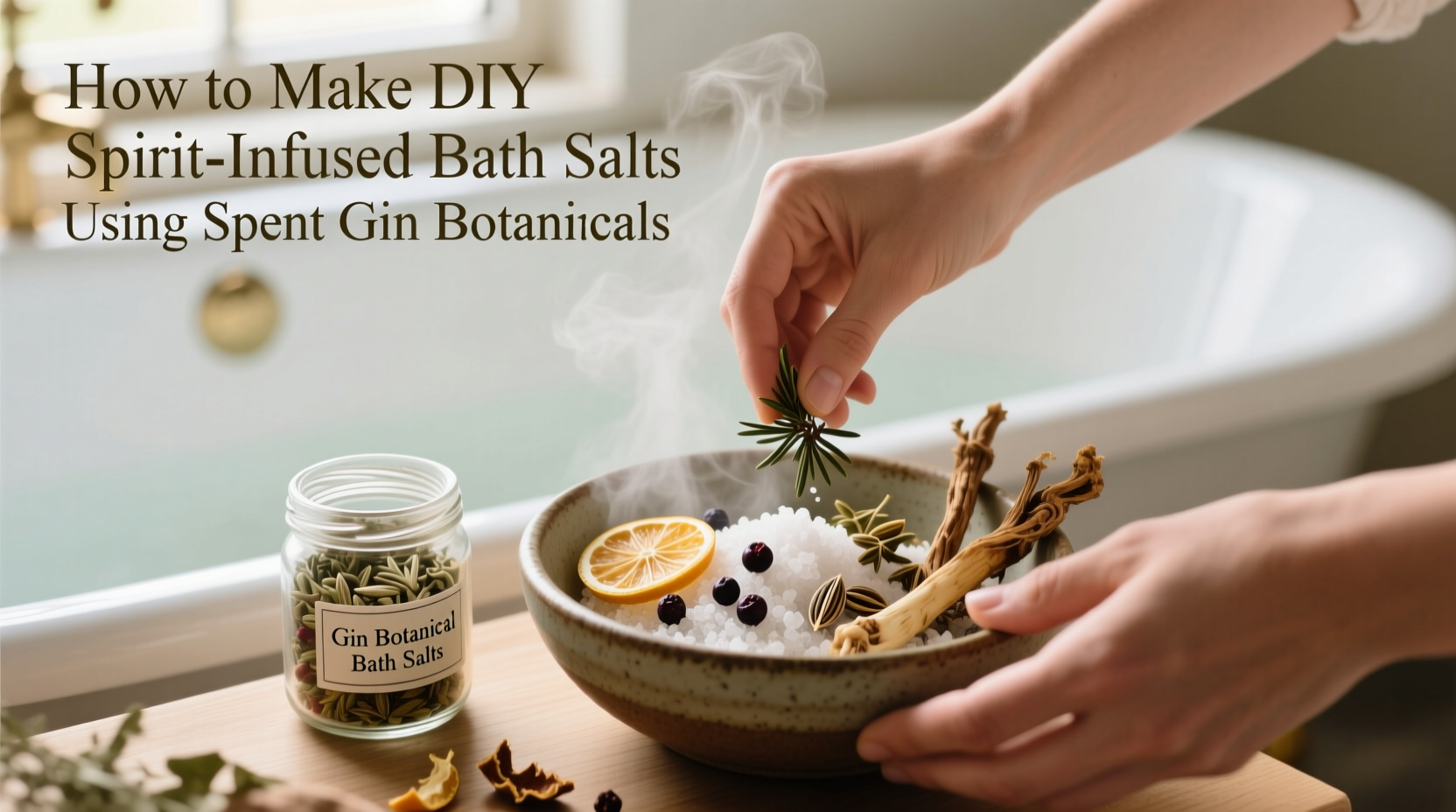
Spent botanicals—the aromatic remnants left after gin distillation—are often discarded as waste. Yet these damp, fragrant residues retain significant volatile oils, tannins, and water-soluble compounds that, when properly stabilized and combined with mineral-rich salts, yield uniquely therapeutic, sensorially rich bath salts. This isn’t just upcycling; it’s a deliberate extension of the distiller’s craft into self-care ritual. Unlike conventional infused salts that rely on fresh or dried herbs, spent botanicals offer deeper complexity: juniper berries softened by ethanol exposure, coriander seeds enzymatically unlocked, and citrus peels whose essential oils have partially migrated into the distillate—but whose pectin, flavonoids, and residual terpenes remain intact in the marc. Done correctly, this process yields salts that dissolve cleanly, scent the steam without overwhelming the senses, and support skin barrier integrity—not just fragrance.
Why Spent Botanicals Deserve a Second Life
Gin distillation typically uses a 1:3–1:5 ratio of botanicals to neutral spirit. After vapor extraction, the spent material (or “marc”) retains 60–75% of its original mass—moist, warm, and still highly aromatic. Commercial distilleries often compost or landfill this material, but small-batch and craft distillers increasingly recognize its value beyond waste streams. Research published in the Journal of Cleaner Production (2022) found that spent juniper-citrus botanicals retained up to 42% of their original polyphenolic content post-distillation—compounds linked to anti-inflammatory activity in topical applications. Crucially, the ethanol exposure during distillation partially hydrolyzes plant cell walls, increasing bioavailability of certain actives when rehydrated in warm water—a distinct advantage over raw, unprocessed herbs.
This isn’t about replicating gin’s alcohol-forward profile. It’s about honoring the botanical’s full lifecycle: first as flavor architect in spirit, then as soothing agent in hydrotherapy. The resulting bath salts carry subtle, grounded notes—earthy juniper resin, softened citrus zest, faint coriander warmth—not sharp or medicinal, but deeply calming.
Tip: Never use spent botanicals directly from the still head without cooling and pH testing. Residual ethanol can volatilize dangerously in hot baths, and acidic leachates (pH < 4.5) may irritate sensitive skin. Always air-dry for 24–48 hours and verify pH between 5.2–6.8 before formulation.Preparing & Stabilizing Your Spent Botanicals
Immediate post-distillation handling determines success. Fresh marc is warm (often 50–65°C), moist (65–80% water content), and microbiologically active. Leaving it in sealed containers invites mold, especially with citrus peel. Instead:
- Cool rapidly: Spread evenly on food-grade stainless steel trays no more than 2 cm deep. Use ambient airflow—not forced heat—to bring temperature below 30°C within 2 hours.
- Air-dry selectively: Dry only until surface moisture disappears (typically 24–36 hours at 20–22°C and 45–55% RH). Over-drying degrades delicate monoterpenes like limonene and pinene. A slight pliability in juniper berries and softness in citrus pith indicates ideal moisture retention (~25–30%).
- Test pH: Blend 1 g dried marc with 10 mL distilled water, stir for 1 minute, let sit 5 minutes, then measure with calibrated pH meter. Target range: 5.2–6.8. If below 5.2, mix with 0.5% food-grade sodium bicarbonate (by dry weight) and retest.
- Sift and sort: Remove any charred fragments, metal shavings, or fibrous stems using a 2 mm stainless sieve. Juniper berries should be whole or lightly fractured; citrus peel in 3–5 mm pieces; coriander seeds intact.
Store prepared botanicals in amber glass jars with desiccant packs (silica gel, not clay) at 12–15°C. Shelf life: 4 weeks refrigerated, 8 weeks frozen. Do not vacuum-seal while moisture remains—it encourages anaerobic spoilage.
Formulating Your Spirit-Infused Bath Salts: Science Meets Sensibility
The base salt blend must balance solubility, skin compatibility, and aromatic synergy. Epsom salt (magnesium sulfate) alone creates excessive osmotic draw and lacks buffering capacity. Table salt (sodium chloride) is too harsh and strips lipids. Optimal blends leverage complementary mineral profiles and dissolution kinetics.
| Salt Type | Recommended % | Key Function | Notes |
|---|---|---|---|
| Magnesium sulfate (Epsom) | 45–55% | Muscle relaxation, transdermal Mg²⁺ delivery | Dissolves fastest; avoid >60%—increases skin tightness |
| Sodium chloride (unrefined sea salt) | 25–35% | Mineral diversity, gentle exfoliation, osmotic balance | Choose Celtic or Himalayan—contains trace potassium, calcium, zinc |
| Sodium bicarbonate | 10–15% | pH buffering, softens water, enhances aroma lift | Neutralizes acidity from botanicals; prevents skin stinging |
| Dead Sea salt (crude, unrefined) | 0–10% | Potassium/magnesium synergy, anti-inflammatory support | Add only if sourcing certified low-heavy-metal batches |
For every 500 g of total salt blend, add 30–45 g of prepared spent botanicals. Higher ratios risk sedimentation and uneven dispersion in bathwater. Citrus-heavy marcs benefit from 10% less total botanicals (25–35 g/500 g) due to higher pectin content, which can create slight cloudiness.
“Spent botanicals behave differently than dried herbs—they’re pre-extracted, hydrated, and chemically altered. Their infusion isn’t about steeping; it’s about controlled rehydration and ion exchange with the salt matrix. That’s why precise moisture management and pH control aren’t optional—they’re foundational.” — Dr. Lena Voss, Phytochemical Formulator & Former Distillery R&D Lead, Cotswold Distillery
Step-by-Step: Crafting Your Batch (Yield: ~600 g)
Follow this sequence precisely. Deviations compromise stability, safety, and sensory performance.
- Prep workspace: Clean all tools (glass bowls, stainless spoons, digital scale accurate to 0.1 g) with 70% isopropyl alcohol. Air-dry completely. No residual moisture.
- Weigh salts: Measure magnesium sulfate (275 g), unrefined sea salt (175 g), sodium bicarbonate (50 g). Combine in large glass bowl. Whisk 90 seconds until uniform.
- Add botanicals: Weigh 40 g prepared spent botanicals. Sprinkle evenly over salt blend. Do not grind or crush—intact structure preserves slow-release aroma.
- Infuse with controlled hydration: Mist mixture with 8 mL distilled water using a fine-atomizer spray bottle (not dropper). Water activates residual enzymes and begins gentle reconstitution of plant matrices. Toss gently with silicone spatula for 60 seconds.
- Rest and equilibrate: Cover bowl with breathable linen cloth (not plastic). Rest at 20–22°C for exactly 4 hours. This allows water absorption without clumping.
- Final blend & package: Gently break up any soft agglomerates with fingers. Transfer to amber glass jars with tight-sealing lids. Label with date, botanical origin (e.g., “Juniper-Citrus-Coriander, Cotswold Batch #7”), and “Use within 8 weeks.”
Do not add essential oils, alcohol, or preservatives. The spent botanicals provide sufficient aroma; added ethanol destabilizes magnesium sulfate; preservatives are unnecessary when moisture and pH are controlled.
Mini Case Study: The Bristol Distiller’s Wellness Pivot
In early 2023, Sarah Chen co-founded *Haven Distilling* in Bristol, producing small-batch London Dry gin. Within six months, she faced mounting disposal costs for 12 kg/week of spent botanicals—and growing customer interest in “gin-inspired wellness.” Rather than partner with a third-party upcycler, Sarah developed an in-house protocol validated by a local cosmetic chemist.
Her first batch used marc from a citrus-forward gin (grapefruit peel, Seville orange, lemon verbena, and Macedonian juniper). Following the stabilization steps above, she formulated salts at 42 g botanicals per 500 g blend. Initial user testing revealed two key insights: First, users reported deeper muscle relaxation than with standard Epsom-only salts—attributed to synergistic magnesium + citrus flavonoids enhancing cellular uptake. Second, steam carried a softer, more nuanced aroma: not “gin cocktail,” but “sun-warmed citrus grove at dusk.” Within four months, her “Still Steam” bath salts became 35% of retail revenue—and diverted 1,800 kg of botanical waste from landfill.
Crucially, Sarah avoided common pitfalls: She rejected vinegar-based “acid infusions” (caused pH crash and skin stinging) and skipped glycerin additives (which attracted humidity and caused caking). Her success hinged on respecting the botanical’s post-distillation physiology—not forcing it into a conventional herbal paradigm.
FAQ
Can I use spent botanicals from flavored or barrel-aged gins?
No. Flavored gins often contain added sugars, artificial colorants, or non-botanical extracts that degrade unpredictably in saline environments and may cause skin sensitization. Barrel-aged gins introduce tannins and lignin derivatives that can oxidize and discolor salts within days. Stick exclusively to London Dry or distilled-only gins with transparent botanical lists.
Why not just use fresh juniper berries instead?
Fresh juniper berries contain high levels of safrole—a compound restricted in cosmetics by the IFRA and EU Cosmetics Regulation due to potential hepatotoxicity at elevated doses. Distillation significantly reduces safrole content (studies show 70–85% reduction), making spent botanicals safer for topical use. Fresh berries also lack the enzymatic and structural changes induced by ethanol exposure that enhance solubility and skin compatibility.
My salts formed hard clumps after two weeks. What went wrong?
Clumping almost always results from excess moisture during blending or storage in high humidity (>60% RH). Re-sift the batch through a 3 mm sieve, then spread thinly on parchment paper in a room with a dehumidifier (target 45–50% RH) for 12 hours. For future batches, reduce misting water by 2 mL and confirm botanical moisture is ≤30% before blending. Never store in plastic bags—use amber glass with silica gel packs.
Conclusion: From Still to Soak, With Intention
Making spirit-infused bath salts from spent botanicals is more than a clever hack—it’s a commitment to material respect, process transparency, and sensory intelligence. It asks you to observe what others discard, to understand the chemistry behind the aroma, and to trust that transformation doesn’t require addition, but careful attention to what remains. These salts won’t replicate a cocktail’s boldness—but they offer something rarer: quiet potency. The way juniper’s grounding note lingers in steam long after the water cools. How magnesium and citrus flavonoids together ease tension that caffeine and cortisol built over weeks. The quiet pride of knowing your self-care ritual began not in a lab or factory, but in the warm, fragrant aftermath of distillation.
This work rewards patience, precision, and curiosity—not perfection. Your first batch may vary slightly in hue or dissolution rate. That’s not failure; it’s data. Adjust drying time. Retest pH. Note how your local water hardness affects fizz. Refine. Repeat. In doing so, you join a growing cohort of makers who see waste not as endpoint, but as invitation—to listen closer, extract deeper, and bathe not just in water, but in continuity.
💬 Have you worked with spent botanicals—or adapted this method for other spirits? Share your observations, challenges, or favorite botanical combinations in the comments. Let’s build collective knowledge, one still, one soak, one thoughtful gram at a time.