Counterfeit liquor is not a niche concern—it’s a global public health crisis. According to Interpol’s 2023 Operation Lionfish report, over 1.2 million liters of adulterated or fake spirits were seized across 42 countries in a single year. These products often contain dangerously high levels of methanol, industrial solvents, or unregulated denatured alcohol—substances that can cause blindness, organ failure, or death after just one serving. Unlike luxury fakes—where the risk is financial—the stakes with counterfeit liquor are physiological and irreversible.
Most consumers assume counterfeits appear only in unlicensed markets or online gray zones. In reality, they infiltrate mainstream channels: corner stores with inconsistent inventory, discount warehouse outlets, and even reputable retailers during supply chain disruptions. The good news? You don’t need lab equipment or forensic training to detect red flags. With focused observation and methodical comparison, you can assess authenticity using nothing more than your eyes, hands, and common sense—all from your kitchen counter or home bar.
1. Examine the Bottle Shape, Glass, and Weight
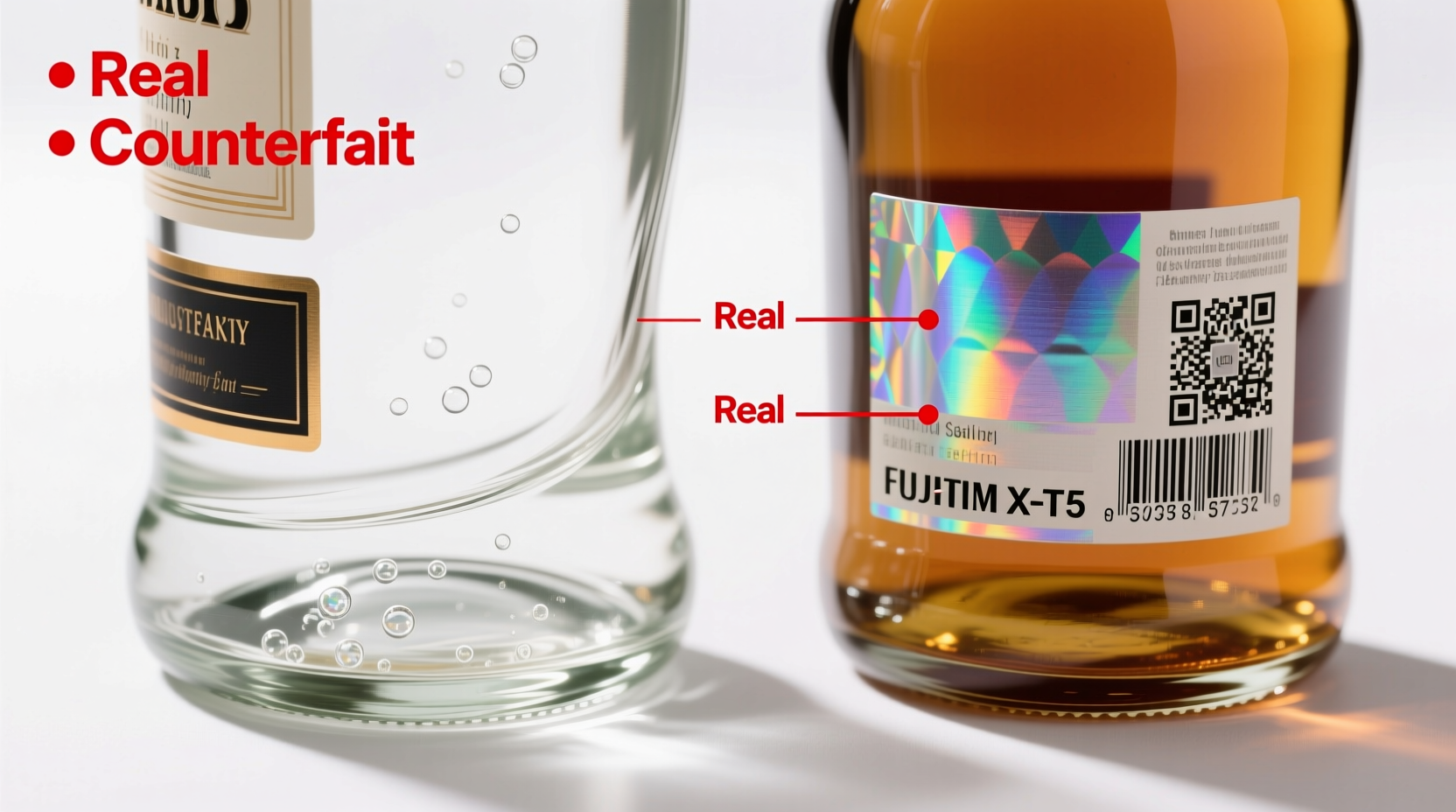
Authentic premium spirits invest heavily in proprietary bottle design—not just for branding, but as an anti-counterfeiting layer. Knockoffs rarely replicate subtle dimensional details because molds are expensive and tightly controlled. Start by holding the bottle upright on a flat surface. Does it wobble? Genuine glass bottles—especially those used for aged whiskey, cognac, or tequila—are made with consistent wall thickness and precise base geometry. Counterfeits often use thinner, uneven glass that feels lightweight or “hollow” compared to the heft of authentic stock.
Look closely at seams. Machine-blown glass bottles have a single, clean seam running vertically from base to shoulder. Counterfeiters using cheaper blow-molding techniques may produce double seams, misaligned mold lines, or visible ripples near the neck. Also inspect the base: legitimate producers etch batch codes, manufacturer marks (e.g., “O-I” for Owens-Illinois), or recycling symbols into the glass—not printed on labels. If the base is smooth and blank, or if markings look shallow and smudged under magnification, treat it with suspicion.
Tip: Keep a known-authentic bottle of the same brand on hand for side-by-side weight and shape comparison. A 750ml bottle of Macallan 12 should weigh approximately 1,380g when full; a counterfeit may weigh 10–15% less due to thinner glass and lower-proof adulterated liquid.2. Decode the Label: Typography, Registration, and Layering
Labels are among the most scrutinized elements—and most frequently botched. Counterfeiters rely on digital scans and screen captures, which lose micro-detail. Begin with typography: compare font weight, kerning (letter spacing), and character height. For example, Johnnie Walker Red Label uses a custom serif typeface where the “J” has a distinct tapered serif and the “W” features symmetrical, evenly spaced arches. Fakes often substitute generic fonts like Times New Roman or Arial, with inconsistent baseline alignment or mismatched capitalization (e.g., “RED LABEL” instead of “Red Label”).
Registration—the precision with which multiple printed colors align—is another giveaway. Authentic labels use offset lithography with tight registration tolerances (±0.1mm). Hold the label under bright light and examine fine text or borders. Blurry edges, color halos, or overlapping hues indicate low-resolution digital printing. Also check for layered elements: many premium brands apply holographic foils, embossed logos, or spot UV varnish over matte backgrounds. Run a fingernail gently across a raised logo—if it’s flat and smooth, it’s likely printed ink, not true embossing.
3. Inspect the Closure System: Caps, Corks, and Seals
The closure is both functional and forensic. Screw caps on spirits like vodka or gin should feature precise threading, uniform torque tension, and branded engravings (e.g., “Absolut” laser-etched on the underside of the cap). Counterfeit caps often have rough threading, inconsistent paint coverage, or lack internal liners—leading to evaporation or oxidation signs (a faint vinegar-like odor or dull, flat taste).
For cork-finished bottles (common in aged rum, brandy, or single malt), examine the cork itself. Authentic corks are graded Grade A or B—dense, uniform, and free of cracks or discoloration. They’re branded with the distillery’s logo, usually heat-stamped or inked. Fake corks may show faded, misaligned, or pixelated branding—or no branding at all. Pull the cork carefully: genuine ones compress evenly and reseal tightly; fakes crumble, shed particles, or fail to create an audible “pop.”
Shrink-wrap seals (the plastic band around the neck) are equally telling. Legitimate seals are heat-shrunk tautly with no wrinkles or gaps, often bearing micro-perforations or batch-specific QR codes. Counterfeits use loose, wrinkled film, glue residue, or generic shrink bands without traceability features.
4. Analyze Liquid Clarity, Viscosity, and Aroma
Once opened, sensory evaluation becomes essential—but only after verifying external integrity. Never taste suspected counterfeit liquor unless you’ve confirmed all prior checks and are prepared to discard it immediately.
First, pour a small amount into a clear, odorless glass. Observe clarity against natural light. Authentic spirits—especially filtered vodkas, gins, or white rums—should be brilliantly clear with no cloudiness, sediment, or floating particles. Cloudiness suggests poor filtration or water contamination; suspended fibers may indicate improper bottling hygiene.
Next, swirl gently and observe “legs” or “tears”—the rivulets that run down the glass. While legs indicate alcohol content and glycerol presence, their behavior matters: authentic high-proof spirits (e.g., 50% ABV+ rums or whiskies) produce slow, viscous, evenly spaced legs. Counterfeits often show rapid, thin, or erratic runoff due to inconsistent ethanol/water ratios or added sugars masking low quality.
Aroma is the most revealing test. Swirl, then sniff at two distances: first from 2 inches away (to detect volatile top notes), then with your nose just above the rim (for mid-palate complexity). Authentic bourbon will express caramel, oak, and vanilla—not sharp acetone, nail polish remover, or chemical sweetness. Methanol-laced fakes emit a pungent, burning nasal sensation; ethyl acetate adulterants smell like overripe bananas or glue. If the aroma triggers immediate eye-watering, throat tightening, or headache—even before tasting—stop immediately and ventilate the area.
| Sensory Cue | Authentic Indicator | Counterfeit Red Flag |
|---|---|---|
| Clarity | Crystal-clear, no haze or particles | Cloudiness, sediment, or oily film |
| Viscosity (Legs) | Slow, thick, evenly spaced rivulets | Rapid, thin, fragmented, or absent legs |
| Aroma Profile | Layered, balanced, no harsh volatility | Acetone, solvent, rubber, or artificial fruit notes |
| Taste (if safe to proceed) | Smooth entry, integrated warmth, clean finish | Burning heat, bitter aftertaste, metallic tang, or numbing mouthfeel |
5. Verify Batch Codes, QR Links, and Regulatory Markings
Batch or lot codes are not decorative—they’re traceability anchors. Locate the code (usually etched on the bottle base, printed on the label’s back, or stamped on the capsule). Enter it into the brand’s official verification portal (e.g., Diageo’s Brand Verification Hub or Pernod Ricard’s Anti-Counterfeiting Portal). Legitimate codes return production date, distillery location, and bottling facility. Fake codes either return “not found,” generic placeholder text, or redirect to unofficial domains.
QR codes on modern labels should link *only* to the brand’s verified domain (e.g., “johnniewalker.com/verify”)—never to shortened URLs, third-party sites, or pages requesting personal data. Scan with your phone’s native camera app (not a browser), and watch the redirect path. If the URL changes mid-load or contains strings like “bit.ly,” “tinyurl,” or random alphanumeric subdomains, abort.
Regulatory markings also matter. In the U.S., TTB (Alcohol and Tobacco Tax and Trade Bureau) requires specific formatting: a two-letter state abbreviation (e.g., “CA”), distiller/bottler license number (e.g., “DSP-XX-XXXX”), and net contents in metric units. In the EU, look for the “e-mark” (℮) indicating volume accuracy compliance, plus the importer’s EU address. Absence of these—or inconsistent placement, font size, or spelling—signals noncompliance and heightened risk.
“Counterfeiters don’t replicate regulatory compliance—they replicate aesthetics. The moment you see a missing TTB number or a misaligned e-mark, you’re looking at a product that bypassed every safety checkpoint designed to protect consumers.” — Dr. Lena Torres, Forensic Toxicologist & Lead Investigator, Alcohol Adulteration Task Force, WHO Collaborating Centre
Real-World Case Study: The $29 “Macallan” Incident
In early 2023, a Massachusetts couple purchased a bottle of “The Macallan 18 Year Old Sherry Oak” for $29 at a local discount retailer—a price point nearly 80% below wholesale. Suspicious of the discount, they conducted a home inspection before opening.
They noted three immediate discrepancies: First, the bottle base lacked the engraved “Macallan Distillers Ltd, Speyside, Scotland” mark and showed no manufacturer code. Second, the label’s gold foil logo peeled easily with a fingernail—authentic Macallan foil is laminated and resistant to abrasion. Third, the QR code redirected to a domain registered in Vietnam with no SSL certificate.
They contacted Macallan’s consumer affairs team with photos. Within 48 hours, the brand confirmed the bottle was counterfeit and shared its batch code with U.S. Customs and Border Protection. Lab analysis later revealed the liquid contained 42% methanol—more than 20 times the WHO-recommended safe limit for incidental exposure. The couple avoided ingestion; two other identical bottles sold in the same store were recalled and destroyed.
Step-by-Step Home Authentication Checklist
- Weight & Balance: Compare bottle weight to official specs (check brand website or importer datasheet); feel for consistent glass thickness and stable base.
- Label Integrity: Check typography consistency, color registration, embossing/foil depth, and absence of smudging or pixelation.
- Closure Audit: Inspect screw cap threading or cork branding; verify shrink-wrap is taut, perforated, and aligned.
- Liquid Observation: Assess clarity, viscosity (“legs”), and aroma—discard immediately if irritation occurs.
- Digital Verification: Scan QR codes, enter batch numbers in official portals, and confirm regulatory markings match jurisdictional requirements.
FAQ
Can I trust liquor bought from duty-free shops or online marketplaces?
Duty-free shops are generally reliable—provided they operate within airport terminals or seaports under government licensing. However, “duty-free” websites not affiliated with official airport operators (e.g., .travel domains, social media storefronts) carry high fraud risk. Always verify the seller’s physical address, contact information, and whether they list a licensed importer on the label. When in doubt, call the brand’s U.S. or regional headquarters to confirm authorized distributors.
Does price alone indicate a counterfeit?
Not definitively—but extreme discounts warrant scrutiny. A $45 bottle of premium tequila sold for $12 is a strong signal, especially if accompanied by vague sourcing claims (“imported from Mexico”) without NOM (Norma Oficial Mexicana) number. Conversely, some authentic bottles sell at discount due to overstock, seasonal promotions, or regional pricing differences. Price is a trigger for investigation—not proof of fraud.
What should I do if I suspect a counterfeit?
Do not consume it. Seal the bottle securely and retain all packaging. Contact the brand’s consumer relations team with photo evidence. Report to the TTB’s Office of Consumer Affairs (U.S.) or your national alcohol regulator. If you’ve already consumed it and experience symptoms—blurred vision, nausea, dizziness, or difficulty breathing—seek emergency medical attention immediately and request blood methanol testing.
Conclusion
Identifying counterfeit liquor isn’t about cultivating skepticism—it’s about practicing informed stewardship of your own well-being. Every bottle you open carries responsibility: to yourself, your guests, and the integrity of craft distilling traditions built over centuries. The techniques outlined here require no special tools, only intention and attention. Start tonight. Pick up one bottle from your shelf and walk through the five-point inspection—weight, label, closure, liquid, verification. Notice what you’ve overlooked before. That awareness is your first line of defense.
Share this knowledge—not as a warning, but as an act of care. Tell your friends at the next gathering why you pause before pouring. Post a photo of a suspicious label in a community forum. Encourage your local retailer to display batch verification QR codes prominently. Authenticity isn’t a luxury; it’s the baseline expectation for every substance we invite into our bodies. Your vigilance today protects more than your health—it sustains the standards that make exceptional spirits possible.
💬 Have you spotted a counterfeit—or caught one in time? Share your experience in the comments. Real stories help others recognize patterns faster and build collective resilience against dangerous fakes.