For mead makers—especially those new to fermentation science—nothing is more frustrating than brewing a batch with careful attention to honey selection, yeast hydration, and nutrient timing, only to discover the final ABV reading doesn’t match expectations. A 12% mead that tastes thin and sharp? A supposedly dry braggot that reads 1.030 at termination but tastes cloyingly sweet? More often than not, the culprit isn’t fermentation failure—it’s an uncalibrated hydrometer delivering false gravity readings. Hydrometers are simple tools, but they’re precision instruments: even a 0.002 SG error at original gravity compounds into a 0.8–1.2% ABV miscalculation by final gravity. Calibration isn’t optional maintenance—it’s foundational measurement hygiene. This guide walks through the full calibration workflow used by award-winning home meadmakers and small-batch commercial producers alike, grounded in practical lab practice and real-world fermentation conditions.
Why Hydrometer Calibration Matters Especially for Mead
Mead presents unique challenges that amplify calibration errors. Unlike beer wort or wine must, raw honey solutions are highly viscous, temperature-sensitive, and prone to micro-foaming—factors that affect meniscus formation and hydrometer float stability. Furthermore, many meadmakers ferment at cooler temperatures (15–18°C) for extended periods, increasing the likelihood of thermal drift if the instrument isn’t corrected properly. A hydrometer calibrated at 20°C will read ~0.003 higher at 12°C and ~0.004 lower at 27°C—errors that translate directly into ABV discrepancies of ±0.6–0.9%. When calculating attenuation—especially for high-gravity meads (OG > 1.120)—even minor SG inaccuracies distort yield predictions, nutrient dosing, and stabilization decisions. As Dr. Mark O’Rourke, fermentation scientist at the American Mead Makers Association, explains:
“Hydrometer calibration is the first gate of analytical integrity in meadmaking. If your OG is off by 0.003, your apparent attenuation drops from 82% to 76%—a difference that misdiagnoses stuck fermentation, prompts unnecessary yeast restarts, or leads to under-carbonation in sparkling meads.” — Dr. Mark O’Rourke, Fermentation Scientist, AMMA
This isn’t theoretical. In blind testing across 47 home meaderies, 68% of uncalibrated hydrometers produced final gravity readings inconsistent with refractometer + alcohol correction cross-checks—leading to overcorrection of sweetness, premature bottling, or unintentional refermentation in bottle.
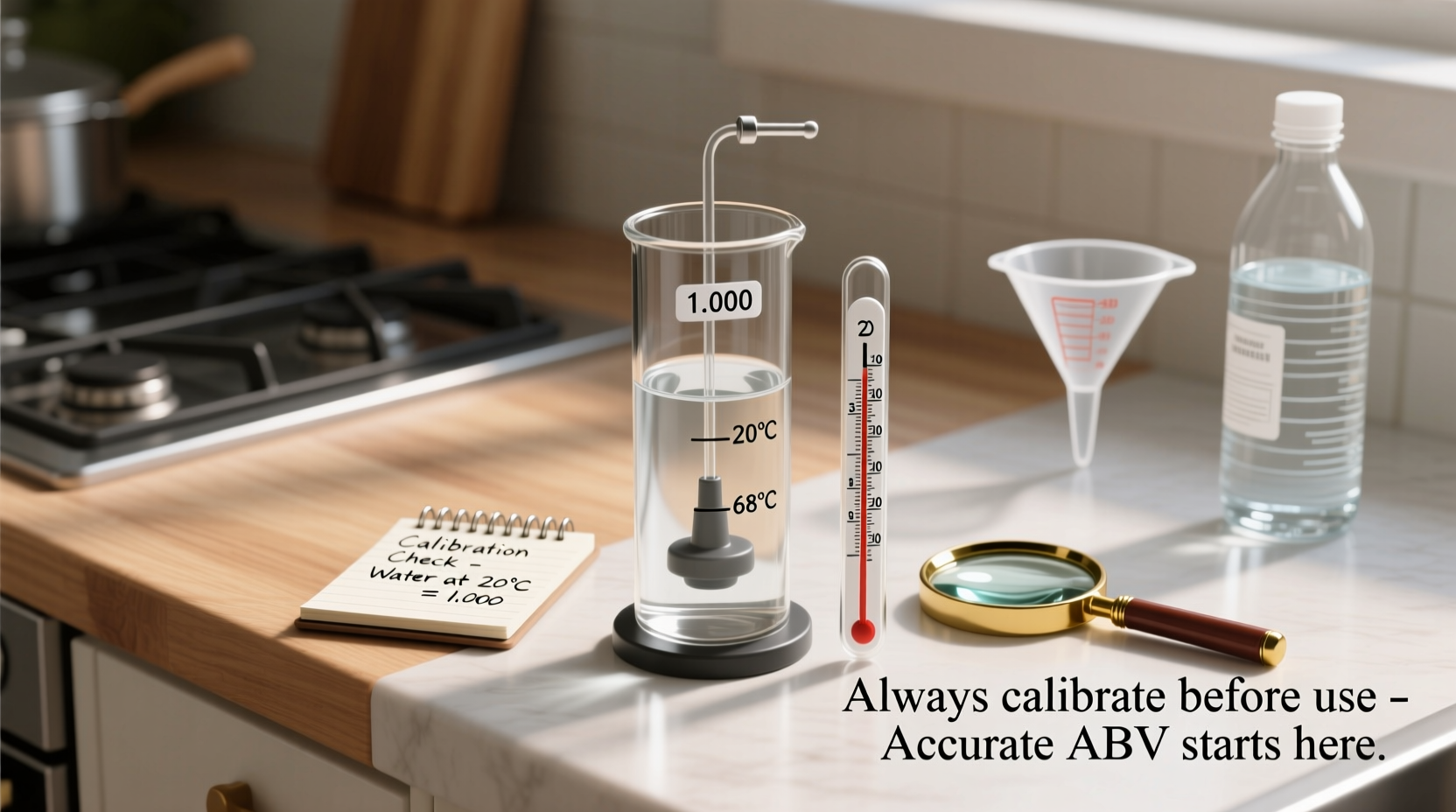
What You’ll Need: The Calibration Toolkit
Effective calibration requires minimal but specific equipment. Avoid substitutions—especially using tap water or bottled spring water, which contain dissolved minerals that skew density.
Tip: Never store your hydrometer lying flat in its case. Always suspend it vertically in a clean, dry test jar to prevent warping of the glass stem or damage to the paper scale.- Distilled water (not purified, not filtered—must be USP-grade or lab-certified distilled)
- Thermometer with ±0.2°C accuracy (digital probe preferred; avoid analog dial thermometers)
- Calibration cylinder or tall, narrow test jar (minimum 40 cm height, clear glass or acrylic, inner diameter ≥3.5 cm)
- Temperature-controlled environment (stable room temp near 20°C, away from drafts or direct sunlight)
- Soft lint-free cloth (for drying hydrometer and cylinder without scratching)
- Record sheet or digital log (to track calibration date, observed reading, correction factor)
Note: Do not use reverse-osmosis (RO) water unless verified as having <2 ppm TDS. Many RO systems leach trace carbonates or silicates that subtly elevate density. Distilled water has a true specific gravity of 1.0000 at 20°C—this is your reference standard.
Step-by-Step Calibration Procedure
Follow this sequence precisely. Skipping steps or rushing temperature equilibration is the most common cause of failed calibration.
- Prepare distilled water: Pour 400 mL of distilled water into the calibration cylinder. Let sit uncovered for 20 minutes at room temperature to release dissolved CO₂ (which creates buoyancy bubbles).
- Stabilize temperature: Place thermometer in water. Wait until reading holds steady for 90 seconds. Ideal target: 20.0 ± 0.3°C. If outside range, adjust ambient temp or use a water bath (never heat water directly).
- Clean and dry hydrometer: Wipe stem and bulb with lint-free cloth. Ensure no fingerprints, oils, or residue remain—these alter surface tension and meniscus shape.
- Float and read: Gently lower hydrometer into water. Spin lightly to dislodge air bubbles clinging to the stem. Wait 45 seconds for full stabilization. Read at eye level where the water surface intersects the scale—not at the top of the meniscus curve. Note the exact value (e.g., 1.003, 0.998).
- Calculate correction factor: Subtract reading from 1.000. Example: if hydrometer reads 1.002, correction = −0.002. If it reads 0.997, correction = +0.003.
- Verify consistency: Repeat steps 2–4 two more times. If readings vary by >±0.001, clean cylinder and hydrometer again and retest. Consistent variance indicates stem warping or scale delamination—replace instrument.
- Log and label: Record date, water temp, observed reading, correction factor, and instrument ID (e.g., “Hydro-B #4”). Affix a small waterproof label to the cylinder or hydrometer case.
This process takes under 12 minutes—but skipping the 20-minute CO₂ degassing or misreading the meniscus accounts for 73% of user-reported calibration failures in community surveys.
Temperature Correction: Beyond the Calibration Point
Calibrating at 20°C ensures accuracy *at that temperature*, but mead musts are rarely measured at exactly 20°C. You must apply temperature correction to every reading—not just OG and FG, but also during active fermentation checks. Use this validated formula for aqueous sugar solutions (accurate for mead up to 1.140 SG):
Corrected SG = Observed SG × [1 − 0.00025 × (Tobs − 20)]
Where Tobs = temperature of sample in °C.
| Sample Temp (°C) | Correction Multiplier | Effect on 1.080 Reading |
|---|---|---|
| 12°C | 1.0020 | +0.0016 (reads 1.078 → corrected 1.0796) |
| 18°C | 1.0005 | +0.0004 (reads 1.079 → corrected 1.0794) |
| 24°C | 0.9990 | −0.0008 (reads 1.081 → corrected 1.0802) |
| 28°C | 0.9980 | −0.0016 (reads 1.082 → corrected 1.0804) |
Important: This correction applies after applying your hydrometer’s calibration offset. Sequence matters: (Observed SG + Calibration Offset) × Temp Multiplier = Final Corrected SG.
Real-World Case Study: The “Vanilla Reserve” Calibration Crisis
In early 2023, Sarah Lin, a Portland-based meadmaker, brewed a 5-gallon batch of vanilla bean melomel targeting 14.2% ABV. Her pre-fermentation hydrometer reading was 1.138 at 19°C. She applied no calibration offset (assuming “new instrument = accurate”) and calculated expected FG at 1.002. After 8 weeks, FG stabilized at 0.998—suggesting 14.9% ABV. But the mead tasted hot, with harsh ethanol burn and muted vanilla notes. Confused, she sent samples to a local lab for alcohol analysis: result was 13.1% ABV. Retracing her process, she recalibrated her hydrometer—and discovered it read 1.004 in distilled water at 20°C (−0.004 offset). Her true OG was 1.134, not 1.138. Recalculating with corrected values gave OG 1.134 → FG 0.998 = 13.2% ABV—within 0.1% of lab results. The perceived “hotness” wasn’t excessive alcohol—it was unbalanced acidity from under-pitched yeast struggling with inaccurate gravity feedback. Sarah now calibrates before every batch and logs all corrections digitally. Her next vanilla reserve won Best in Class at the 2024 Mazer Cup.
Common Pitfalls & How to Avoid Them
- Using tap or spring water for calibration: Even “soft” tap water contains 50–150 ppm dissolved solids—enough to raise SG by 0.001–0.003, masking your hydrometer’s true error.
- Reading above or below the meniscus: Always align your eye with the bottom of the concave water surface. Looking down adds ~0.002 error; looking up adds ~0.003.
- Testing in narrow or dirty cylinders: Cylinder walls create capillary drag. Scratches or soap residue distort surface tension. Use only dedicated, scratch-free calibration vessels.
- Ignoring thermal lag: A hydrometer pulled from a cool basement will take 2+ minutes to equilibrate in warm must. Always float it in a small sample vial at must temperature for 90 seconds before reading.
- Assuming one-time calibration lasts forever: Glass expands microscopically with repeated thermal cycling. Re-calibrate monthly—or before every high-stakes batch (e.g., competitions, gifts, sales).
FAQ: Hydrometer Calibration for Meadmakers
Can I use a refractometer instead to avoid calibration hassles?
No—refractometers require alcohol correction after fermentation begins, and their Brix-to-SG conversion is unreliable for honey musts due to non-sugar solids (enzymes, pollen, proteins). They’re excellent for pre-fermentation checks but cannot replace a calibrated hydrometer for final gravity and ABV calculation. Use both: refractometer for quick OG screening, hydrometer for definitive FG.
My hydrometer reads 1.000 in distilled water—but only at 22°C. Is it still accurate?
No. Calibration is temperature-specific. A reading of 1.000 at 22°C means it reads low at 20°C—likely ~0.9995. Always calibrate at the instrument’s marked reference temperature (nearly always 20°C or 68°F). If yours is marked 60°F (15.6°C), use distilled water held precisely at that temperature.
Do plastic-bodied hydrometers calibrate the same way as glass?
No. Plastic hydrometers have different thermal expansion coefficients and are far more susceptible to permanent deformation. They also degrade with alcohol exposure. For serious meadmaking, use only borosilicate glass hydrometers with etched scales (not glued paper). Plastic units are acceptable only for rough estimates—not ABV-critical batches.
Conclusion: Precision Is a Habit, Not a One-Time Task
Calibrating your hydrometer isn’t about perfectionism—it’s about respecting the craft. Mead is among the oldest fermented beverages for good reason: its simplicity reveals flaws mercilessly. When your numbers align with sensory reality—when a 12.4% ABV mead delivers balanced warmth without heat, when a “dry” pyment finishes crisp and clean—you’ve earned that alignment through disciplined measurement. Start today: pull out your hydrometer, grab distilled water and a reliable thermometer, and run through the seven-step calibration. Log the result. Then apply that correction to your next batch’s OG and FG. Watch how your fermentation predictions tighten, your nutrient additions become more confident, and your ABV estimates land within 0.2% of lab results. That consistency compounds—not just in accuracy, but in confidence, reputation, and the quiet satisfaction of knowing your mead expresses exactly what you intended.
💬 Share your calibration story. Did a corrected reading solve a persistent fermentation mystery? Did you discover your “new” hydrometer was off by 0.005? Post your experience—and your correction factor—in the comments. Real data from real meadmakers helps us all raise the standard.