
Distilling alcohol at home evokes images of craft innovation—small-batch gin infused with foraged botanicals, a smooth corn whiskey aged in oak barrels, or a crisp apple brandy made from orchard fruit. Online marketplaces advertise sleek copper stills, compact reflux columns, and “beginner-friendly” distillation kits with promises of “restaurant-quality results.” But behind the allure lies a complex web of federal law, state regulation, chemical hazard, and public health precedent. This isn’t like brewing beer or fermenting kombucha. Distillation concentrates ethanol—and with it, volatile compounds that can be toxic, flammable, or both. Understanding the legal boundaries and safety imperatives isn’t optional; it’s foundational to responsible experimentation.
The Legal Reality: Federal Prohibition Still Stands
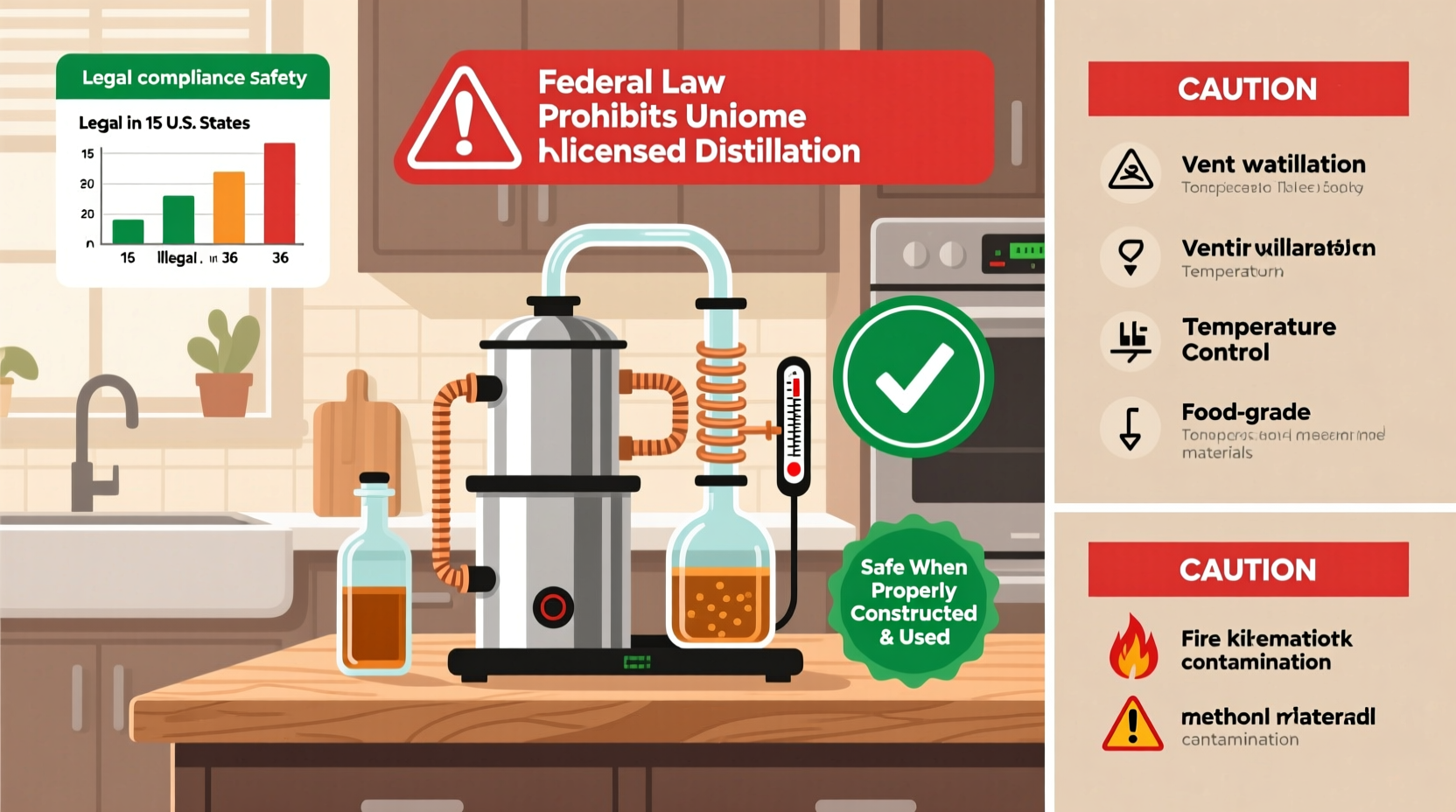
In the United States, distilling alcohol for beverage purposes without a federal permit is illegal—full stop. The authority rests with the Alcohol and Tobacco Tax and Trade Bureau (TTB), which enforces the Internal Revenue Code. Section 5601(a)(1) explicitly prohibits the “distillation of spirits at any place other than a distilled spirits plant duly qualified under this chapter.” That means even a 1-liter tabletop still used to make a single bottle of flavored vodka violates federal law unless operated under a TTB-issued permit.
Permits exist—but they’re not designed for hobbyists. A distilled spirits plant (DSP) license requires facility inspections, bonded warehouse designation, detailed recordkeeping, formula approvals, labeling compliance, and payment of federal excise tax ($13.50 per proof gallon). Applicants must demonstrate financial responsibility, submit blueprints, undergo background checks, and maintain continuous oversight by TTB agents. There is no “hobbyist,” “educational,” or “non-commercial” exemption. As former TTB Chief Counsel John H. Lash III stated:
“Distillation for human consumption is regulated as a manufacturing activity—not a culinary or agricultural one. The law draws a bright line: if ethanol is produced by distillation and intended for drinking, it falls under federal jurisdiction, regardless of volume, intent, or equipment size.” — John H. Lash III, Former TTB Chief Counsel
The UK presents a similar stance. Under the Alcoholic Liquor Duties Act 1979, distilling spirits for consumption without a distiller’s license from HM Revenue & Customs (HMRC) is a criminal offense. Licenses require premises approval, security bonds, and ongoing duty reporting. In Canada, Health Canada and the Canada Revenue Agency jointly enforce strict prohibitions, while Australia’s state-based liquor acts universally ban unlicensed distillation—even for personal use.
Tip: If you're exploring distillation for non-beverage purposes—such as purifying water, extracting essential oils, or creating perfume bases—verify your still’s design and usage comply with local fire and chemical safety codes. Never repurpose equipment across applications.Safety Risks: Beyond the Law, Into the Laboratory
Legality aside, home distillation carries inherent physical and chemical hazards that demand rigorous attention. Unlike fermentation—which occurs at ambient temperatures and produces relatively low-alcohol liquids—distillation involves heating flammable vapors to boiling points between 78°C (ethanol) and 100°C (water), often using open flames or high-wattage electric elements.
The most immediate danger is fire or explosion. Ethanol vapor has an ignition temperature of just 363°C, but its flash point is -14°C—meaning it can ignite at sub-zero ambient temperatures if exposed to a spark or pilot light. A single leak in a condenser joint, a cracked glass adapter, or a poorly sealed gasket can release enough vapor to create an explosive mixture in a small room.
More insidious is the risk of methanol poisoning. All fermented mashes produce trace methanol, especially from fruit pectin. During distillation, methanol concentrates in the early portion of the run—the “foreshots.” A properly conducted distillation discards the first 5% of the distillate (by volume) for every 5 gallons of wash. Skipping this step—or misjudging cuts due to lack of thermometer placement, inadequate reflux, or rushed operation—can deliver dangerous doses. As little as 10 mL of pure methanol can cause permanent blindness; 30–100 mL may be fatal.
| Risk Factor | Why It Matters | How to Mitigate |
|---|---|---|
| Methanol accumulation | Concentrates in foreshots; odorless and tasteless, but neurotoxic | Discard first 5% of distillate; use calibrated thermometer; monitor head temperature (should stay below 78.3°C during foreshots) |
| Flammable vapor buildup | Ethanol vapor is heavier than air and pools near floors and corners | Operate only in well-ventilated, spark-free areas; use explosion-proof fans; install vapor detectors |
| Copper toxicity | Acidic washes (e.g., fruit brandies) leach copper from stills over time | Use food-grade copper; inspect for corrosion; clean thoroughly after each run; avoid prolonged contact with low-pH mashes |
| Pressure buildup | Blocked condensers or closed valves turn stills into pressure bombs | Never seal a still airtight; install pressure-relief valves; use sight glasses to monitor flow |
A Real-World Example: When “Just One Batch” Went Wrong
In late 2022, a home brewer in Oregon purchased a $299 stainless-steel reflux still marketed as “ideal for gin and vodka beginners.” He followed a YouTube tutorial that omitted methanol-cut guidance and used a digital thermometer placed incorrectly—in the collection vessel rather than the vapor path. His apple wine wash had fermented for 14 days at warm ambient temperatures, increasing pectin-derived methanol. He collected the entire 1.2-liter run without discarding foreshots. Within 36 hours, he experienced blurred vision, nausea, and headache. Emergency room testing revealed serum methanol levels at 28 mg/dL—well above the toxic threshold of 20 mg/dL. He received intravenous fomepizole and survived, but required six weeks of visual rehabilitation. No charges were filed—because his still was technically legal for essential oil extraction—but the hospital bill exceeded $42,000. His story is not rare. Poison control centers report 12–18 methanol-related distillation incidents annually in the U.S., with rising frequency since 2020.
What *Is* Legally Permitted—and How to Explore Responsibly
While beverage distillation remains off-limits without licensing, several legitimate pathways allow hands-on learning and creative expression—without violating statutes or compromising safety.
- Fermentation-only projects: Make wine, cider, mead, or high-ABV beers (up to 20% with specialized yeast). These fall under federal “homemade wine” allowances (26 U.S.C. § 5053(e)), permitting up to 200 gallons per year for households with two or more adults.
- Non-alcoholic distillation: Use a still to purify rainwater, create herbal hydrosols, or extract citrus oils. Ensure the equipment is rated for food-grade steam distillation and never introduce fermented material.
- TTB-approved education: Enroll in accredited distilling programs (e.g., Moonshine University, Siebel Institute) that operate licensed lab facilities. Students gain hands-on experience under supervision and learn cut-point science, sensory analysis, and regulatory compliance.
- Collaborative micro-distilling: Join or invest in a community distillery where members share licensed space, equipment, and mentorship—similar to brewery co-ops. Several states (e.g., Tennessee, Colorado) now offer “micro-distillery” licenses with reduced fees and simplified reporting for operations under 10,000 proof gallons/year.
For those committed to understanding distillation science, consider building a transparent, non-pressurized water-distillation rig using borosilicate glass and digital temperature controls. Document vapor-phase temperatures, condensation rates, and fraction collection times. This teaches thermodynamics, phase change, and separation principles—without crossing legal or toxicological lines.
FAQ: Clarifying Common Misconceptions
Can I legally distill if I don’t sell it and only drink it myself?
No. U.S. federal law makes no distinction between commercial and personal use when it comes to distilled spirits. The prohibition applies to “production, sale, barter, exchange, or gift” of distilled spirits—regardless of quantity or intent. State laws cannot override this federal standard.
Are “alcohol-free” distillation kits exempt from regulation?
Only if they are genuinely incapable of producing ethanol concentrations above 0.5% ABV—and are marketed and tested solely for water purification or essential oil extraction. Kits sold with “spirit recipes,” “cut charts,” or “vodka mash guides” signal beverage intent and may trigger TTB scrutiny, especially if advertised alongside fermentable ingredients.
What about historical or cultural exemptions—like Native American tribal sovereignty or moonshining heritage?
No statutory or judicial exemption exists. While some tribes operate licensed distilleries under self-governance agreements, these require full TTB compliance—including facility bonding and tax remittance. Cultural practice does not supersede federal excise law. Heritage distilling demonstrations at museums or festivals use de-fueled, non-operational equipment or ethanol-free simulations.
Conclusion: Curiosity Deserves Caution—and Better Alternatives
Distillation is a powerful, ancient technology—one that shaped economies, fueled revolutions, and refined medicines. But its power demands proportionate respect. Purchasing a home distillation kit doesn’t grant permission to bypass centuries of regulatory evolution built on hard-won lessons about public safety, tax integrity, and consumer protection. The legal barriers exist not to stifle curiosity, but to prevent preventable harm: poisoned consumers, devastating fires, and untraceable products entering informal markets. Fortunately, the world of flavor, fermentation, and craft spirits offers abundant legal, safe, and deeply rewarding alternatives. Master wild-fermented fruit wines. Experiment with barrel-aging in food-grade oak inserts. Learn sensory evaluation through certified tasting courses. Collaborate with licensed distillers through apprenticeship programs. Or build your knowledge through university extension workshops on food science and fermentation microbiology. True craftsmanship isn’t defined by circumventing rules—it’s forged through disciplined learning, ethical practice, and deep respect for both tradition and consequence.
💬 Have you navigated the distillation landscape responsibly? Share your experience with legal alternatives, educational resources, or safety-first practices in the comments—your insight could help others explore boldly, wisely, and within the law.