Ask any seasoned bartender or spirits enthusiast what defines a truly expressive spirit—and the answer often pivots on aroma. Not just strength or finish, but the layered, evocative scent that tells a story before the first sip. Gin and infused vodka occupy adjacent spaces in the bar cart, both prized for fragrance, yet governed by fundamentally different philosophies: one is distillatively bound, the other extractively open. Gin’s character emerges from botanicals vapor-infused during distillation—a tightly choreographed chemical ballet where volatility, solubility, and thermal sensitivity dictate what survives the still. Vodka infusions, by contrast, operate at room temperature, in glass, with time as the primary catalyst. The question isn’t which is “better,” but which offers more aromatic versatility: the capacity to express a wider range of scents, textures, intensities, and combinations—reliably, reproducibly, and with creative latitude.
The Structural Divide: Distillation vs. Maceration
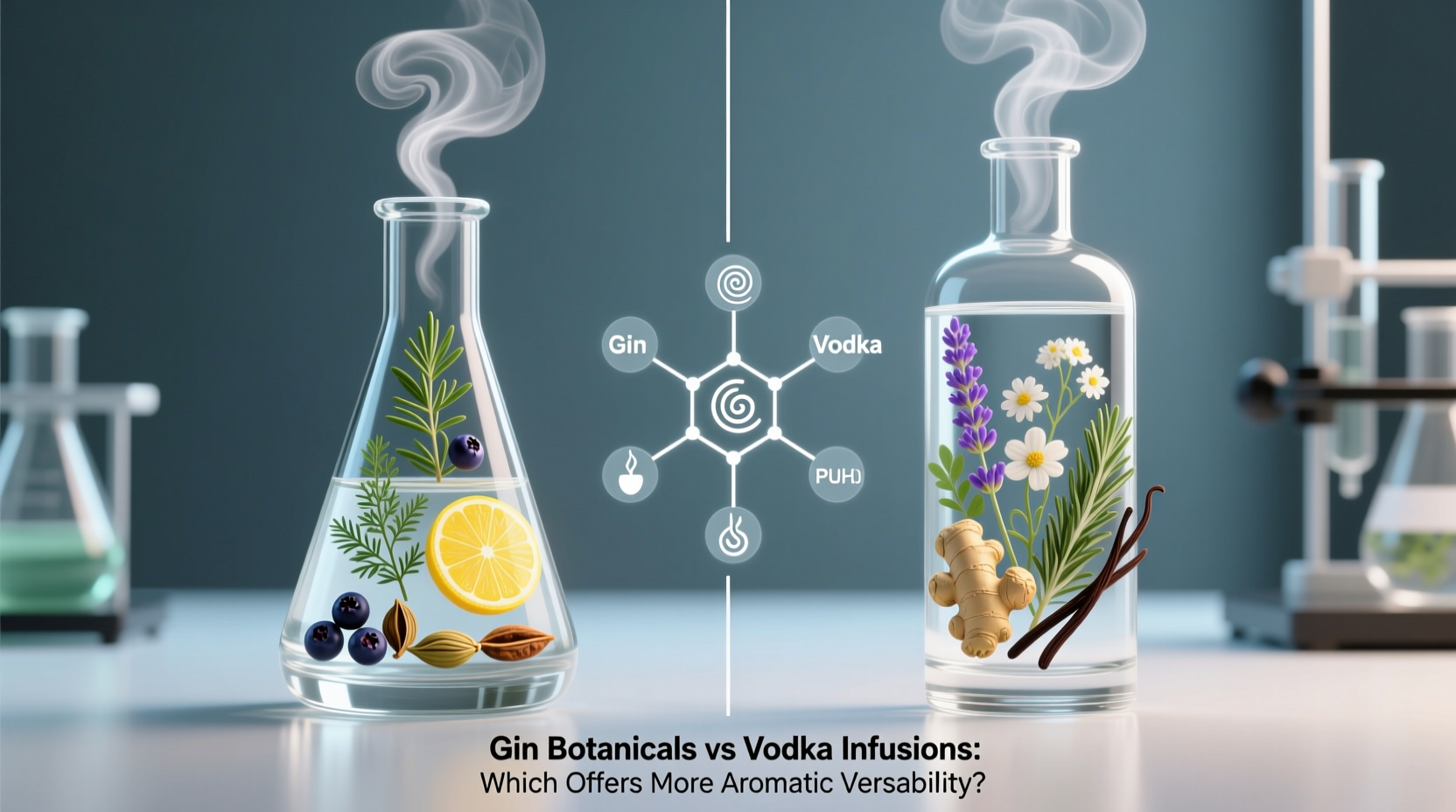
Gin’s aromatic architecture is defined by legal and technical constraints. EU Regulation 110/2008 and U.S. TTB standards require gin to be “flavoured predominantly by juniper berries” and mandate that botanicals be added prior to or during distillation. This means volatile compounds must survive steam distillation—typically between 78°C and 100°C—without degrading, oxidizing, or hydrolyzing. Citrus peels contribute bright limonene and linalool; coriander seed yields spicy, floral linalool and pinene; orris root acts as a fixative, binding lighter volatiles. But heat-sensitive molecules—like fresh basil’s ocimene, green bell pepper’s methoxypyrazines, or raw ginger’s zingiberene—largely vanish or transform. What remains is a refined, integrated, and harmonized aromatic profile—not a literal snapshot of the source material, but its distilled essence.
Vodka infusions bypass distillation entirely. Neutral grain spirit (typically 40–50% ABV) serves as a solvent, extracting compounds through diffusion and solvation over hours or days. Because no heat is applied, thermolabile aromatics remain intact. A cucumber infusion retains crisp, watery aldehydes; a black tea infusion preserves delicate theaflavins and volatile bergamot notes from Earl Grey; even delicate floral waters like rose or chamomile integrate without distortion. The trade-off? Less integration. Infused vodka can taste “added-on,” with sharper edges and less mouthfeel cohesion than gin—unless carefully balanced with filtration, dilution, or supporting botanicals.
Tip: For cleaner vodka infusions, use high-proof (50–60% ABV) neutral spirit instead of standard 40% vodka—it extracts more efficiently and reduces vegetal bitterness from plant cell walls.Aromatic Range Comparison: What Each Can (and Cannot) Express
To assess versatility, we must map not just *what* each method delivers, but *how many dimensions* it accesses: freshness, depth, nuance, intensity control, textural dimension, and combinatorial flexibility. A comparative framework reveals clear asymmetries.
| Aromatic Dimension | Gin Botanicals | Vodka Infusions |
|---|---|---|
| Freshness (green, juicy, herbaceous) | Limited: Steam distillation degrades chlorophyll, lipoxygenase-derived aldehydes (e.g., hexanal), and leafy top-notes. Coriander and lemon peel offer approximation—not replication. | Exceptional: Cucumber, mint, shiso, pea shoots, watercress, and green tomato retain vivid, photorealistic freshness when cold-infused 4–12 hours. |
| Floral Complexity | Moderate: Orris root, rose petals, lavender, and orange blossom are common—but heat alters terpenes. Rose oxide (the “dewy rose” note) degrades above 60°C; most gins evoke rose *jam*, not rose *garden*. | High: Fresh edible flowers (jasmine, elderflower, violets) infuse cleanly at low temperatures. Floral waters or glycerite tinctures can be blended post-infusion for precise modulation. |
| Umami & Savoury Depth | Rare: Fermented or roasted elements (miso, dried mushrooms, smoked salt) cannot survive distillation. Traditional gin avoids them entirely. | Emerging: Dried shiitake, toasted nori, roasted garlic, or fermented black beans yield deep, brothy, glutamate-rich infusions—ideal for savoury cocktails like a Bloody Mary variant or umami martini. |
| Intensity Control & Precision | Fixed per batch: Once distilled, the aromatic ratio is immutable. Adjusting citrus brightness requires re-distilling—not tweaking. | Fine-tuned: Infusion time, temperature, surface area (shredded vs. whole), and ABV allow millimetre-level control. A 3-hour basil infusion tastes radically different from a 9-hour one. |
| Combinatorial Flexibility | Constrained: Botanicals must co-distil without clashing or suppressing each other. Citrus + clove + cinnamon risks overwhelming phenolics; balancing is iterative and costly. | Modular: Infuse components separately (e.g., ginger + lemongrass + kaffir lime), then blend ratios post-infusion. Enables layered, non-linear aromatic construction—like building a scent pyramid in real time. |
The Craftsperson’s Toolkit: When to Choose Which
Choosing between gin and infused vodka isn’t about superiority—it’s about intentionality. Consider these real-world decision trees:
- You need a consistent, shelf-stable, complex backbone for a signature serve? — Choose a well-crafted gin. Its integrated structure supports modifiers (vermouth, bitters, citrus) without fragmenting. A classic Martinez or Southside relies on gin’s cohesive matrix.
- You’re designing a seasonal, hyper-local cocktail highlighting foraged herbs or heirloom produce? — Infused vodka wins. A wild strawberry-and-woodruff infusion for a summer spritz, or roasted beet-and-caraway for an earthy negroni riff, leverages immediacy and authenticity.
- You want to highlight a single, fragile aromatic without competition? — Infused vodka excels. Try yuzu zest (cold-peeled, 2-hour infusion) or fresh pandan leaf (blanched, infused 6 hours). Gin would flatten or distort both.
- You require repeatability across months or venues? — Gin is more reliable. Infusions vary with harvest, temperature, and operator technique. Batch documentation (time, temp, ABV, botanical weight-to-spirit ratio) is non-negotiable for consistency.
- You’re bridging culinary and cocktail thinking—using techniques like fat-washing, sous-vide, or vacuum infusion? — Vodka is the only viable canvas. Sous-vide ginger at 55°C for 2 hours in 50% ABV yields enzymatically active, uncooked spice notes impossible in gin.
Mini Case Study: The “Forest Floor” Martini at Bar Lichen, Portland
When Bar Lichen launched its foraging-driven menu in 2022, lead bartender Maya Ruiz faced a challenge: translate the damp, fungal, mossy aroma of Pacific Northwest forest floors into a stirred, spirit-forward cocktail. Early gin attempts—using pine needle, dried chanterelle, and Douglas fir—produced a medicinal, tannic, and disjointed result. Distillation stripped the humid geosmin note and amplified bitter resins. Switching to vodka, Ruiz developed a three-phase infusion: first, dried porcini mushrooms cold-infused 36 hours in 55% ABV; second, fresh salal leaf (a native evergreen) infused 8 hours; third, a tincture of dried cedar tips macerated in glycerin for viscosity. She blended all three at precise ratios, then clarified with agar filtration. The resulting “Forest Floor” Martini—served with a single juniper berry garnish—delivered unmistakable petrichor, loam, and green woodsmoke, with zero bitterness. Crucially, the base spirit remained neutral enough to let the terroir shine, while the gin’s role was reduced to a whisper of tradition—not the foundation. As Ruiz notes: “Gin gave us the idea. Vodka gave us the truth.”
Expert Insight: The Distiller’s Perspective
“The still is a filter—not just of alcohol, but of aromatic possibility. It selects for volatility and thermal stability. That’s why gin will never smell like a freshly cracked cardamom pod or a sun-warmed tomato vine. Those notes live in the fragile, polar, water-soluble realm. Vodka infusions access that world freely—but they don’t have the structural memory of distillation. One gives you poetry; the other, documentary realism. Versatility isn’t about volume—it’s about vocabulary.”
— Dr. Lena Cho, Master Distiller, Juniper Ridge Distillers & Adjunct Professor of Sensory Science, UC Davis
Practical Mastery: A 5-Step Infusion Protocol for Maximum Versatility
Infused vodka’s versatility is unlocked only through disciplined technique. Here’s how professionals achieve repeatable, nuanced results:
- Select & Prep Botanicals: Use organic, pesticide-free produce. Wash thoroughly. For herbs: remove thick stems. For roots (ginger, turmeric): peel and slice thinly (<2mm) to maximize surface area. For citrus: use only zest (no pith)—cold-peel with a microplane.
- Choose ABV & Vessel: Use 50–60% ABV neutral spirit (not 40% vodka) for efficient extraction. Glass mason jars are ideal—avoid plastic or reactive metals. Fill jar ¾ full with botanicals, then top with spirit.
- Control Time & Temperature: Refrigerate infusions for delicate items (basil, cucumber, flowers); room temperature works for robust spices (cinnamon, star anise, black pepper). Monitor hourly for first 4 hours—aroma development accelerates early. Set timers: 2h (citrus zest), 6h (herbs), 24h (roots/spices), 72h (dried mushrooms).
- Strain & Refine: Strain through a chinois lined with cheesecloth, then a coffee filter. If bitterness emerges (common with citrus pith or over-extracted herbs), add 1 tsp sugar syrup per 100ml and stir—sugar binds tannins. For clarity, use agar clarification: dissolve 0.2% agar in hot water, mix with infusion, chill, then strain through a fine mesh.
- Blend & Bottle: Never assume one infusion tells the full story. Create a “library”: 3–5 core infusions (e.g., ginger, lemongrass, yuzu, shiso, toasted sesame). Blend small test batches (10ml each) before scaling. Bottle in amber glass, refrigerate, and label with date and botanical ratio.
FAQ
Can I combine gin and infused vodka in one cocktail?
Absolutely—and it’s increasingly common. A base of London Dry gin provides structure and juniper backbone, while a 0.25 oz float of house-made black tea–lavender vodka adds aromatic lift without diluting the spirit’s integrity. Just ensure the infusion complements, rather than competes with, the gin’s profile.
Does filtering infused vodka remove aroma?
Standard paper filters (coffee filters, cheesecloth) remove particulates but preserve >95% of volatile aromatics. Over-filtering with activated charcoal *will* strip top-notes—reserve charcoal for correcting off-flavours, not routine use. Cold filtration (chilling to 4°C before straining) improves clarity without aroma loss.
Why do some infused vodkas turn cloudy?
Cloudiness usually indicates the presence of essential oils (e.g., from citrus or herbs) precipitating out of solution—especially when chilled or diluted. This is harmless and often desirable (it signals fresh, unadulterated extraction). To prevent it, increase ABV to 55%+ or add a tiny amount (0.1%) of polysorbate 80 as an emulsifier—but purists avoid this to preserve authenticity.
Conclusion
“More aromatic versatility” isn’t measured in sheer number of possible scents—but in the breadth of sensory experiences a base spirit can authentically deliver: the dew on morning grass, the warmth of toasted cumin, the mineral tang of coastal air, the sweet decay of fallen apples. Gin offers elegance, integration, and centuries of refinement—its versatility lies in its ability to harmonize complexity within strict boundaries. Vodka infusions offer immediacy, fidelity, and fearless experimentation—their versatility is expansive, democratic, and deeply tactile. Neither supplants the other. The most compelling modern bars don’t choose sides; they deploy both as complementary instruments in the same aromatic orchestra. Gin sets the key. Infused vodka paints the accents, shadows, and unexpected modulations. Your next great cocktail won’t emerge from dogma—but from knowing precisely when to reach for the still, and when to reach for the jar.
💬 Try one infusion this week—document your process, taste notes, and timing. Share your findings (and surprises!) in the comments. Let’s build a living library of aromatic possibility, one jar at a time.