Vermouth isn’t just a supporting player in classic cocktails—it’s a defining ingredient that shapes balance, texture, and character. Yet many home mixologists reach for the same bottle every time, unaware that choosing the wrong vermouth can mute complexity, unbalance acidity, or even sabotage structure entirely. Dry and sweet vermouths differ far more than their names suggest: they originate from distinct production traditions, employ different base wines and botanical profiles, and serve fundamentally opposing roles in drink architecture. Understanding those differences isn’t about memorizing labels—it’s about recognizing how each style interacts with spirit, citrus, bitters, and dilution. This guide cuts through marketing ambiguity and regional naming confusion (yes, “rosso” doesn’t always mean “sweet,” and “extra dry” isn’t always drier than “dry”) to give you actionable criteria—not rules—for confident, consistent vermouth selection.
What Actually Defines “Dry” and “Sweet” — Beyond Sugar Content
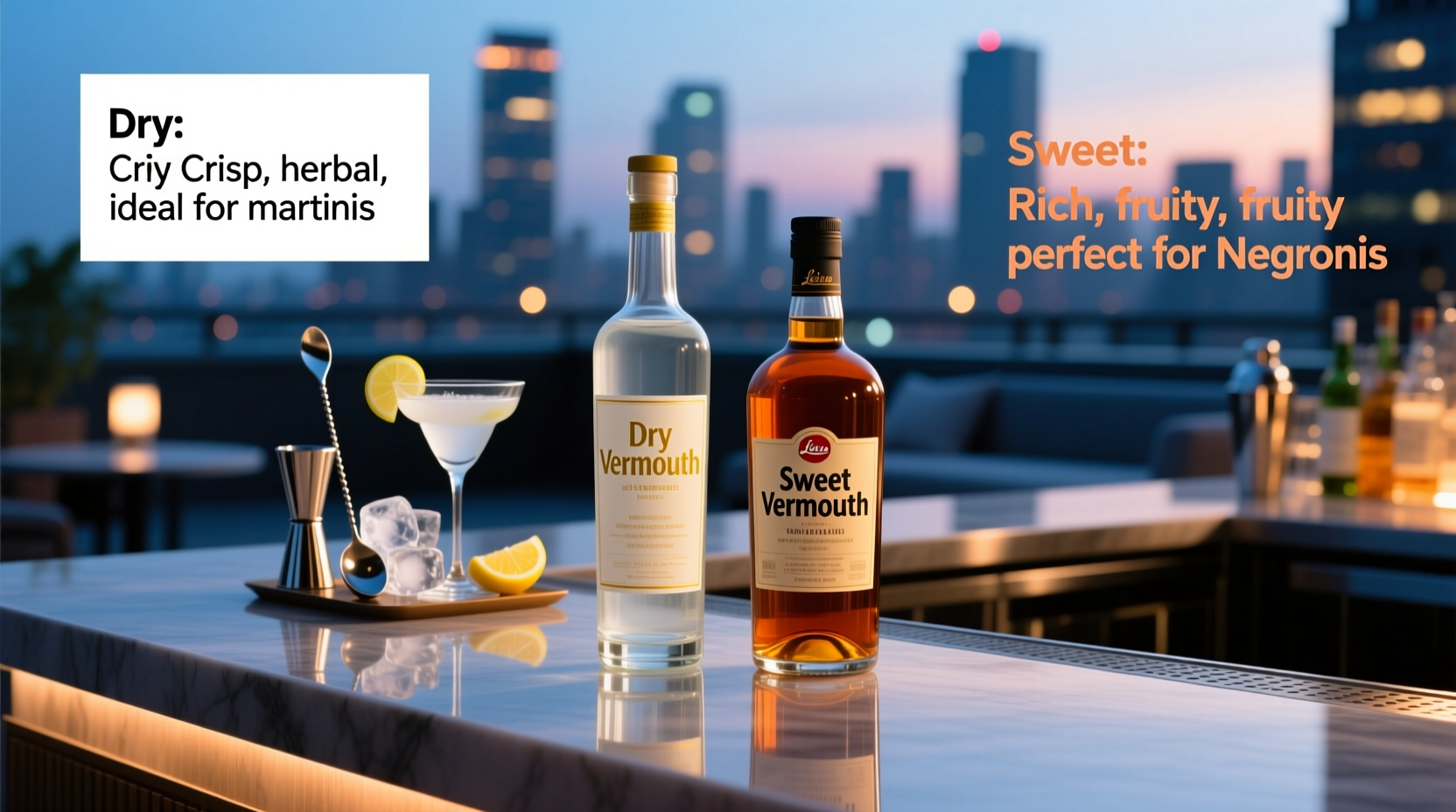
The distinction begins with residual sugar—but stops there. While dry vermouth typically contains 0–4 grams of sugar per liter and sweet vermouth ranges from 100–160 g/L, sugar alone doesn’t dictate function. More critical are the base wine’s weight, the intensity and composition of botanicals (especially wormwood, gentian, citrus peel, and herbs), and the aging method. Dry vermouth is almost always made from light, high-acid white wines—often Italian Trebbiano or French Ugni Blanc—fermented to full dryness before fortification and infusion. It’s rarely aged in wood; instead, it’s bottled young to preserve brightness and crisp herbal lift. Sweet vermouth, by contrast, commonly uses richer, fuller-bodied red or white grapes (like Muscat or Clairette), often with added caramelized sugar or mistelle (grape must fortified before fermentation) to build viscosity and roundness. Many premium sweet styles—especially Italian rosso—are aged in large oak casks for months or years, softening tannins and adding notes of vanilla, dried fig, and toasted spice.
This structural divergence explains why substituting one for the other rarely works—even when sugar is adjusted. A dry vermouth lacks the glycerol-rich mouthfeel needed to cushion rye whiskey’s spice in a Manhattan. Conversely, a sweet vermouth’s density overwhelms gin’s delicate florals in a Martini, muting the spirit rather than framing it.
Tip: Taste vermouth neat at room temperature before mixing. Swirl, smell deeply, then sip slowly—notice where bitterness lands (front/mid/back), how long sweetness lingers, and whether acidity feels sharp or integrated. This reveals its true role in a cocktail.Flavor Profile Comparison: A Practical Reference Table
| Characteristic | Dry Vermouth | Sweet Vermouth |
|---|---|---|
| Typical Sugar Range | 0–4 g/L (nearly bone-dry) | 100–160 g/L (noticeably sweet) |
| Base Wine Profile | Light, high-acid white (e.g., Trebbiano, Ugni Blanc) | Medium-bodied white or red-blend (e.g., Muscat, Clairette, Sangiovese) |
| Dominant Botanical Notes | Lemon zest, chamomile, sage, white pepper, subtle wormwood bitterness | Cinnamon, clove, orange peel, caramelized fig, licorice root, roasted nuts |
| Aging & Texture | Unaged or short steel-tank storage; lean, linear, bracing | Often aged 6–24 months in large oak; viscous, rounded, layered |
| Best Paired With | London dry gin, vodka, blanc vermouth, citrus-forward spirits | Rye whiskey, bourbon, aged rum, Campari, Fernet-Branca |
How Cocktail Structure Dictates Your Choice
Cocktail architecture relies on tension—between spirit strength and dilution, bitterness and sweetness, acidity and richness. Vermouth modulates that tension. In spirit-forward drinks (those with minimal or no citrus or modifiers), vermouth’s role shifts from diluent to structural counterweight.
Martinis demand dry vermouth—not because “martinis are dry,” but because gin or vodka needs a precise, high-acid foil. The vermouth’s lemony lift and clean bitterness cut through alcohol heat without adding weight. Using sweet vermouth here creates cloying imbalance: the sugar amplifies perceived alcohol burn while dulling botanical clarity. Even a 1:1 ratio with sweet vermouth yields something closer to a boozy, spiced syrup than a Martini.
Manhattans require sweet vermouth’s viscosity and resonance. Rye’s aggressive rye spice and tannic bite need rounding—something that clings to the palate and echoes the whiskey’s baking-spice notes. Dry vermouth’s austerity leaves the drink hollow and disjointed; its lack of body fails to bridge spirit and bitters. As bartender and vermouth authority Adam Fournier observes:
“A Manhattan built with dry vermouth isn’t ‘lighter’—it’s structurally unsound. You’re not reducing sweetness; you’re removing the mortar holding the brickwork together.”
Negronis use equal parts gin, Campari, and sweet vermouth—a triumvirate where each element must carry equal aromatic and textural weight. Dry vermouth collapses the drink: its low sugar can’t temper Campari’s aggressive bitterness, and its thin body lets gin dominate unchecked. The result tastes medicinal and fragmented, not harmonious.
Rob Roys, Boulevardiers, and Brooklyn cocktails follow the same logic: any drink built around whiskey, amaro, or bitter liqueurs gains cohesion from sweet vermouth’s depth. Conversely, Champagne Cocktails, White Negronis, and Adonis cocktails rely on dry vermouth’s vibrancy to complement lighter bases like sparkling wine or sherry.
Real-World Selection: A Mini Case Study
Sarah, a home bartender in Portland, spent months frustrated with her Martinis. She used a widely recommended “premium dry” vermouth, stirred her drinks meticulously, and still found them flat and harsh—lacking the crisp elegance she tasted at her favorite bar. She assumed her technique was flawed. Then she visited the bar’s head bartender, who asked two questions: “What gin are you using?” and “What vermouth do you have open?” Sarah listed her London dry gin and a French dry vermouth aged in oak for three months. The bartender smiled: “That’s your problem. That vermouth isn’t dry—it’s *rich*. Oak aging adds tannin and vanilla, muddying the gin’s juniper. Try an unaged Italian dry—something zesty and angular, like Dolin Dry or Noilly Prat Original.”
Sarah switched to Dolin Dry. Her next Martini had immediate lift—bright citrus, clean bitterness, and a finish that refreshed rather than fatigued. The difference wasn’t sugar level; it was botanical fidelity and structural intent. Her original vermouth was technically dry but stylistically mismatched: it behaved like a light sweet vermouth, not a true dry. This illustrates a crucial point: “dry” and “sweet” are categories, not guarantees. Always evaluate the producer’s style—not just the label.
Your Step-by-Step Vermouth Selection Framework
- Identify the cocktail’s structural anchor: Is it spirit-dominant (Martini, Gibson), bitter-dominant (Negroni, Boulevardier), or effervescent (Champagne Cocktail)?
- Map the spirit’s profile: Does it lean floral/crisp (gin, vodka), spicy/tannic (rye, bourbon), or rich/roasted (aged rum, mezcal)?
- Assess required mouthfeel: Does the drink need cutting acidity (dry) or rounding viscosity (sweet)?
- Check botanical synergy: Match dominant notes—e.g., lemon-forward dry vermouth with citrus gin; cinnamon-forward sweet vermouth with rye’s clove notes.
- Taste your vermouth side-by-side with the base spirit: Stir 1 oz spirit with ¼ oz vermouth over ice, strain into a chilled glass. Does the vermouth enhance or obscure? Does it linger pleasantly or fade awkwardly?
Common Misconceptions & What to Avoid
- “All French vermouths are dry.” False. While France excels at dry styles (Noilly Prat, Dubonnet Blanc), it also produces sweet vermouths like Byrrh and St. Raphael—both historically used in pre-Prohibition cocktails.
- “Older vermouth is better.” Not for dry styles. Oxidation degrades freshness rapidly. Dry vermouth peaks within 3–4 weeks of opening and should be refrigerated. Sweet vermouth lasts longer (up to 3 months refrigerated) due to higher sugar and alcohol acting as preservatives—but still declines in aromatic precision.
- “Extra dry means drier than dry.” Marketing noise. “Extra dry” vermouths (like some Spanish brands) are often identical in sugar to standard dry—just more aggressively filtered or blended for neutrality. They sacrifice character for predictability.
- “Vermouth is just ‘fortified wine.’” Oversimplification. Fortification is only step one. The botanical infusion—type, quantity, and maceration method—is what defines category, region, and style. A single wormwood variety, harvested at different times, changes bitterness quality profoundly.
FAQ: Quick Answers to Persistent Questions
Can I substitute dry vermouth for sweet in a Manhattan if I reduce sugar elsewhere?
No—substitution fails structurally. Adding simple syrup compensates for missing sweetness but not missing viscosity, oxidative depth, or complementary spice notes. You’ll get a thinner, less resonant drink that lacks the Manhattan’s signature velvety finish. Use a true sweet vermouth, even an affordable one like Cocchi Vermouth di Torino.
Why does my dry vermouth taste bitter and unpleasant on its own?
It’s working as intended. Dry vermouth is designed to balance—not please solo. Its bitterness (primarily from wormwood and gentian) is meant to cut alcohol and refresh the palate mid-sip. If it tastes harshly medicinal, it may be oxidized (check for sherry-like nuttiness or flatness) or overly aggressive for your palate—try a gentler style like Dolin Dry over Noilly Prat Extra Dry.
Is there such a thing as “medium” vermouth—and is it useful?
Yes—styles like Carpano Antica Formula (technically sweet but less sugary than Punt e Mes) or Lustau Vermut Rojo (a sherry-based Spanish style) occupy the middle ground. They shine in drinks requiring nuance: try Lustau in a Bamboo cocktail or Carpano in a Brooklyn. But avoid using them as default swaps—they’re specialists, not generalists.
Conclusion: Confidence Starts With Clarity
Picking the right vermouth isn’t about memorizing categories—it’s about listening to what the drink needs. Dry vermouth is architecture: precise, angular, and clarifying. Sweet vermouth is foundation: resonant, grounding, and unifying. When you understand that distinction—not as trivia, but as functional truth—you stop following recipes and start composing. You’ll know why a Martinez demands sweet vermouth despite its gin base (its herbal richness bridges gin and maraschino), or why a Vesper benefits from a split base of dry and bianco (adding texture without sweetness). You’ll taste the difference between a vermouth that merely “works” and one that elevates. Start small: buy one trusted dry (Dolin Dry) and one trusted sweet (Cocchi di Torino). Taste them neat. Mix two Martinis and two Manhattans—one with each vermouth. Compare. Adjust. Repeat. Mastery isn’t in perfection—it’s in intentionality. Your next cocktail won’t just be balanced. It will be unmistakably yours.
💬 Which vermouth pairing surprised you most? Share your breakthrough moment—or your biggest mix-up—in the comments. Let’s learn from each other’s pours.