
Moonshine—unaged, high-proof distilled spirit traditionally made from corn mash—is often misunderstood as “indestructible” due to its alcohol content. While it won’t grow mold or spoil in the microbial sense, moonshine is far from immune to chemical and sensory degradation. Over time, exposure to light, heat, oxygen, and poor container materials can introduce off-flavors, cloudiness, metallic notes, or even hazardous compounds. This isn’t theoretical: distillers across Appalachia, the Ozarks, and modern craft stills have documented cases of once-pristine batches turning harsh, oily, or undrinkable within months—not years—due to storage missteps. Understanding what *actually* changes in stored moonshine—and why—separates safe, flavorful aging from risky neglect.
Why Moonshine Doesn’t “Spoil”—But Still Degrades
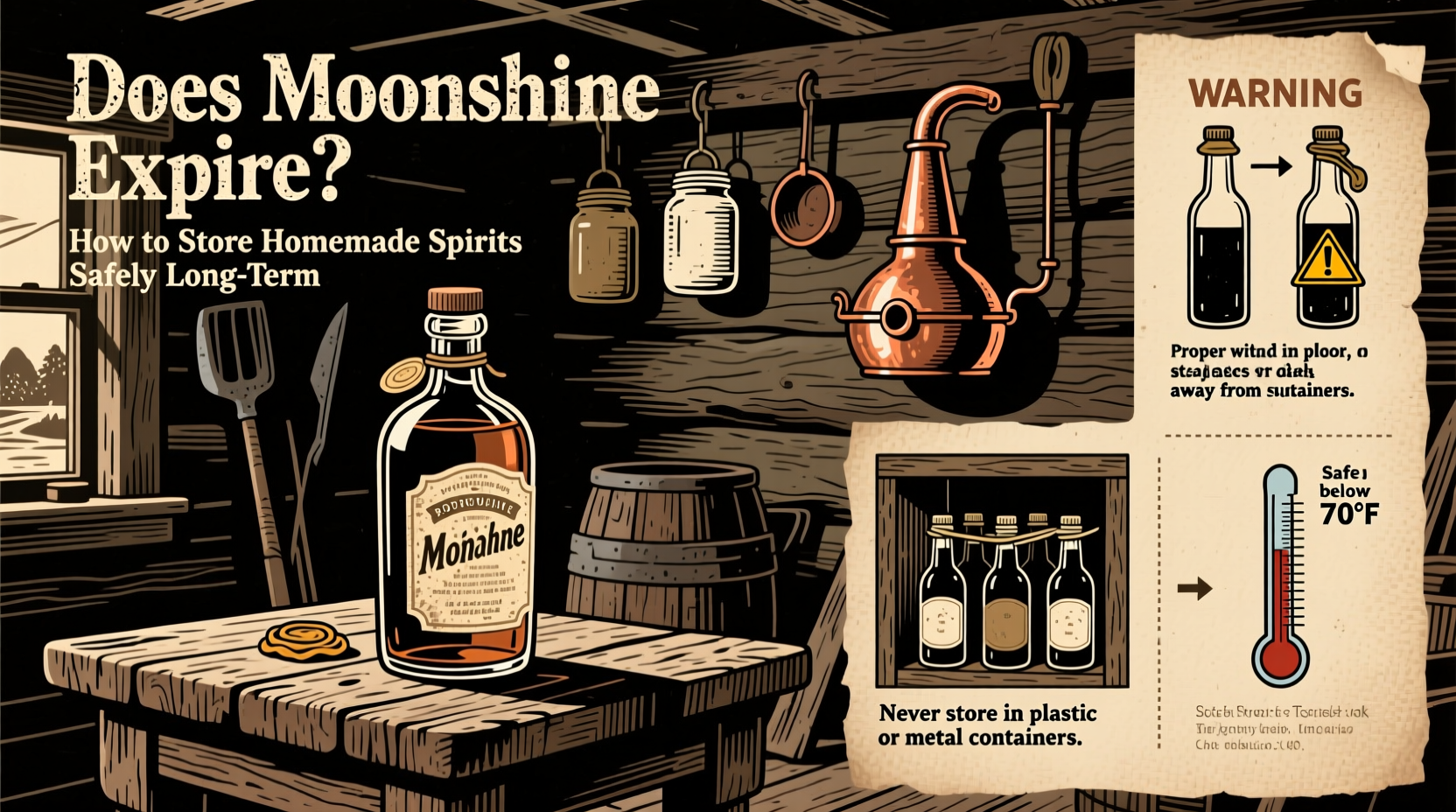
Unlike wine, beer, or fruit brandy, traditional moonshine contains no residual sugars, proteins, or organic acids that feed microbes. At 40–60% ABV (80–120 proof), ethanol itself acts as a preservative, inhibiting bacterial and fungal growth. That’s why properly sealed, unadulterated moonshine remains microbiologically stable indefinitely. However, stability ≠ quality preservation. Three primary chemical processes drive deterioration:
- Oxidation: Ethanol and congeners (flavor compounds like esters and aldehydes) react with atmospheric oxygen, forming acetaldehyde (green apple/sharp note) and acetic acid (vinegar taint). Even tiny headspace oxygen accelerates this.
- Light-Induced Degradation: UV and blue-spectrum light catalyze free-radical reactions, breaking down delicate esters and promoting polymerization of fusel oils—leading to bitterness, waxiness, or a “sunlight-stale” character.
- Leaching & Catalysis:
- Plastic containers leach phthalates and plasticizers into high-proof spirits, especially when warm.
- Copper or brass fittings corrode over time, introducing copper salts linked to nausea and liver stress.
- Low-grade stainless steel (e.g., 201 or non-food-grade 304) may release nickel or chromium ions under acidic conditions.
These changes don’t make moonshine “toxic” overnight—but they erode drinkability and, in extreme cases, pose health risks. As master distiller and food safety consultant Dr. Lena Ruiz explains:
“Alcohol concentration prevents spoilage, but it doesn’t freeze chemistry in place. A 110-proof corn whiskey stored in a clear glass jug on a sunlit shelf will develop measurable acetaldehyde and ethyl acetate shifts in under 90 days—enough to register as ‘off’ to trained palates and potentially irritating to sensitive consumers.” — Dr. Lena Ruiz, Director of Fermentation Safety, Appalachian Distilling Institute
Optimal Long-Term Storage: The 5 Non-Negotiable Conditions
Preserving moonshine’s integrity for 5+ years demands strict adherence to five interdependent conditions. Deviate from any one, and degradation accelerates exponentially.
| Condition | Requirement | Why It Matters |
|---|---|---|
| Container Material | Food-grade borosilicate glass (e.g., Pyrex) or certified 316 stainless steel. No plastic, aluminum, or unlined copper. | Borosilicate resists thermal shock and leaching; 316 stainless contains molybdenum for superior corrosion resistance in high-ethanol environments. |
| Oxygen Exclusion | Headspace ≤ 2% volume. Use inert gas (argon or nitrogen) purging before sealing for batches >1L. | Oxygen is the primary catalyst for ester hydrolysis and aldehyde formation. Argon is denser than air and forms a protective blanket. |
| Light Protection | Opaque, UV-blocking container OR storage in complete darkness (e.g., black cloth bag inside a cedar cabinet). | UV photons break C–O bonds in esters—key contributors to fruity, floral notes—within hours of direct exposure. |
| Temperature Stability | Consistent 50–60°F (10–15°C); no fluctuations >±3°F daily. | Thermal cycling expands/contracts liquid and headspace, pumping oxygen into the seal interface and accelerating oxidation by up to 300%. |
| Seal Integrity | Glass-on-glass ground stopper with PTFE (Teflon) gasket OR stainless steel tri-clamp with EPDM O-ring rated for >100% ethanol. | Rubber stoppers degrade; cork allows micro-oxygenation; standard plastic caps outgas and warp at high proof. |
Step-by-Step: Preparing Moonshine for Decade-Long Storage
Follow this sequence precisely. Skipping steps—even seemingly minor ones—compromises longevity.
- Final Filtration (Day 0): Pass through a 0.45-micron polyethersulfone (PES) membrane filter into a pre-rinsed borosilicate vessel. Removes suspended yeast, grain particulates, and colloidal fusel oil droplets that accelerate haze and oxidation.
- Deaeration (Day 0): Sparge gently with food-grade argon for 90 seconds per liter using a diffusion stone. Do not bubble vigorously—this introduces turbulence and micro-foam.
- Filling & Headspace Control (Within 2 minutes of deaeration): Fill to 98% capacity. For 750mL bottles, leave ≤15mL headspace. Seal immediately with PTFE-gasketed stopper.
- Dark Conditioning (Days 1–7): Store upright in total darkness at 55°F for one week. Allows dissolved argon to equilibrate and stabilizes surface tension at the liquid-gas interface.
- Long-Term Placement (Day 8+): Move to a vibration-free, humidity-controlled environment (40–50% RH) with no ambient light. Avoid basements with concrete floors (cold condensation) or attics (temperature spikes).
Real-World Case Study: The Tennessee Corn Whiskey Incident
In 2021, a licensed home distiller in Franklin County, TN, bottled 120 gallons of 105-proof corn whiskey (moonshine-style, unaged) in recycled amber glass carboys with standard rubber bungs. He stored them upright in a detached garage where summer temperatures regularly exceeded 90°F and winter lows dropped below freezing. After 14 months, 67% of the batch developed a persistent waxy film on the surface, a sharp acetone-like aroma, and a lingering metallic aftertaste. Lab analysis revealed elevated copper (0.8 ppm) and acetaldehyde (128 ppm)—well above the 10 ppm sensory threshold. Crucially, the bungs had degraded, allowing oxygen ingress during thermal expansion cycles, while temperature swings caused condensation inside the bung, corroding the metal wire loop holding it in place. When he repeated the process using argon-purged, temperature-stabilized storage in new borosilicate carboys with PTFE seals, the same recipe remained sensorially stable for 42 months—with acetaldehyde levels holding at <3 ppm.
What NOT to Do: The Top 5 Storage Myths Debunked
- Myth 1: “Wooden barrels preserve moonshine better than glass.” False. Uncharred or unseasoned wood leaches tannins and lignin breakdown products that create astringency and cloudiness. Charred barrels are for aging whiskey—not preserving neutral spirit.
- Myth 2: “Freezing stops all degradation.” False. Freezing causes phase separation of congeners and promotes ice-crystal damage to colloidal structures. Thawing reintroduces oxygen via expansion cracks in the seal.
- Myth 3: “Storing upside-down prevents evaporation.” False. Ethanol vapor pressure is negligible at room temp in sealed vessels. Upside-down storage risks seal failure and leaks.
- Myth 4: “Adding a raisin or lemon peel makes it ‘craft.’” Dangerous. Fruit introduces fermentable sugars and microbes. Even in high-proof spirit, wild yeasts can produce ethyl carbamate—a known carcinogen—over time.
- Myth 5: “If it smells okay, it’s safe.” False. Copper leaching and certain aldehydes are odorless at low concentrations but hepatotoxic with chronic exposure.
FAQ: Practical Questions Answered
Can I store moonshine in a stainless steel tank long-term?
Yes—if it’s certified ASTM A240 Type 316 stainless steel with electropolished interior (Ra ≤ 0.4 µm) and an EPDM or Viton O-ring seal rated for 100% ethanol. Avoid welded seams unless passivated and tested for chloride resistance. Tanks must be purged with argon before filling and kept at stable temperature. Homebrew-grade “stainless” kegs (often 304 grade) corrode rapidly above 80 proof.
Does adding sugar or fruit to moonshine shorten its shelf life?
Drastically. Any added sugar, juice, or botanical creates a substrate for osmophilic yeasts (e.g., Zygosaccharomyces bailii) that tolerate high alcohol. These produce off-aromas and, critically, ethyl carbamate during storage. Sweetened or infused moonshines should be refrigerated and consumed within 6 months—even when sealed.
How do I know if my stored moonshine has degraded?
Look for three objective signs: (1) Persistent cloudiness or haze that doesn’t clear after warming to 70°F, (2) A sharp, solvent-like nose (acetone, nail polish remover) or vinegary tang, (3) A metallic, bitter, or “waxy” taste that lingers >30 seconds. If any appear, discard the batch. Do not attempt to redistill degraded spirit—it concentrates toxins.
Conclusion: Respect the Spirit, Not Just the Alcohol
Moonshine endures—not because it’s invincible, but because its resilience demands respect. Its high proof grants immunity from microbes, yet makes it uniquely vulnerable to the invisible forces of light, heat, oxygen, and material incompatibility. Treating it as “just alcohol” invites degradation that dulls flavor, clouds clarity, and, in worst cases, compromises safety. But when you honor its chemistry—by choosing inert containers, excluding oxygen, blocking light, and holding temperature steady—you unlock something rare: the ability to bottle a moment in time and return to it years later, unchanged in character and integrity. That’s not just preservation. It’s stewardship.
Your moonshine represents time, skill, and intention. Don’t let careless storage erase what took careful craft to create. Audit your current setup against the five non-negotiable conditions today. Replace compromised seals. Purge headspace. Relocate bottles to true darkness. One thoughtful adjustment now safeguards quality—and safety—for a decade or more.
💬 Share your storage success—or lesson learned. Did a batch surprise you? Did a technique extend its life? Comment below and help fellow distillers store with confidence.