Sangria occupies a curious space in the world of mixed drinks: beloved for its festive informality, yet frequently undermined by inconsistency. A pitcher served at a summer gathering might shimmer with vibrant fruit and layered complexity—or taste flat, cloying, or oddly metallic. One ingredient often whispered about in sangria circles—yet rarely examined—is salt. A pinch stirred in at the end. A rimmed glass. A subtle garnish of flaky sea salt on a citrus wedge. But what does salt actually do in this context? Does it elevate the drink’s structural harmony—or is it a culinary bandage for deeper flaws? This isn’t about dogma or tradition alone. It’s about understanding how salt interacts with acidity, sugar, tannin, and volatile aromatics—and whether reaching for the shaker reflects intention or improvisation.
The Science of Salt in Fruit-Forward Drinks
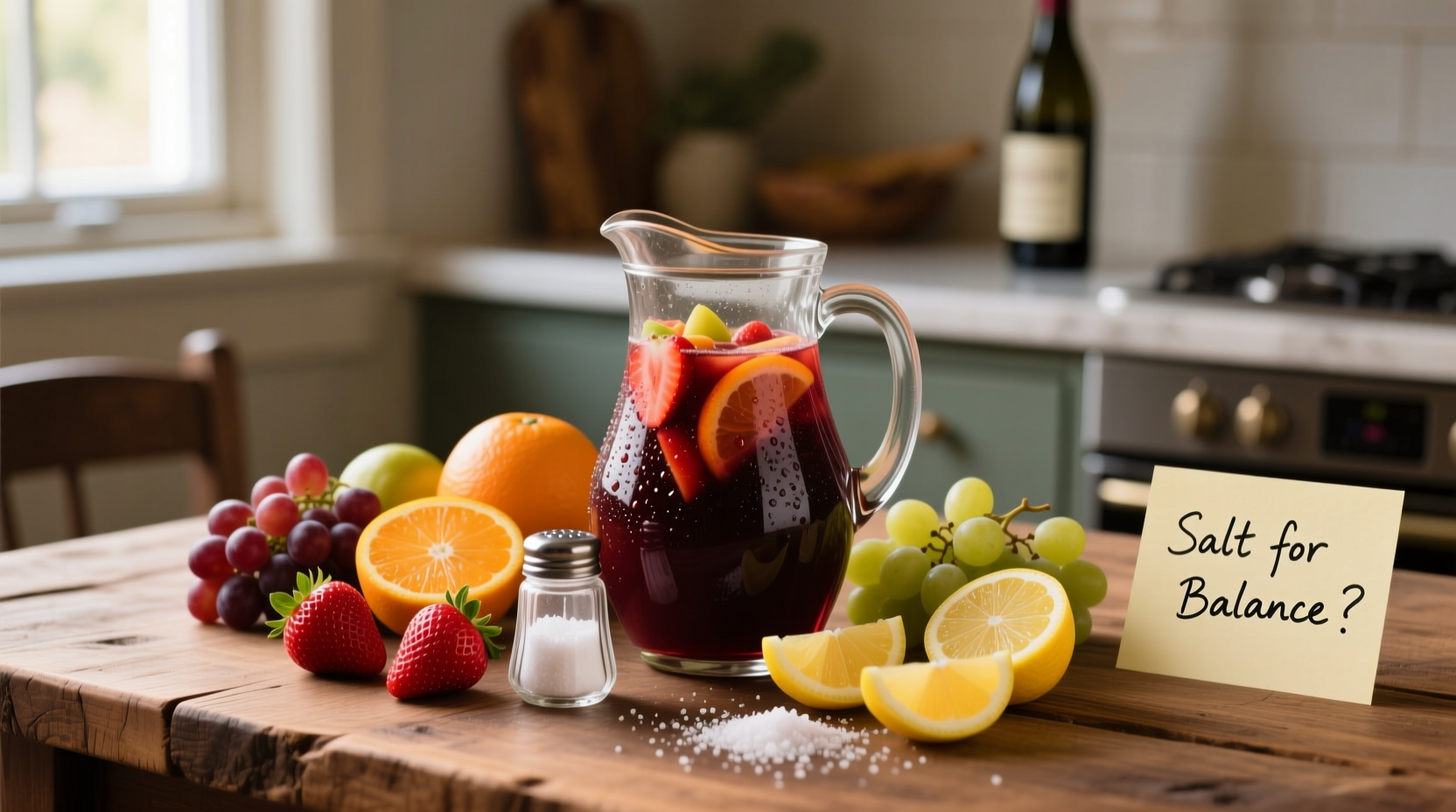
Salt doesn’t “sweeten” sangria—but it *enhances* perceived sweetness and suppresses bitterness, all while sharpening aromatic clarity. This isn’t magic; it’s neurogastronomy. Sodium ions interfere with bitter-tasting compounds (like certain polyphenols in oversteeped red wine or unripe citrus pith), reducing their signal to taste receptors. Simultaneously, salt amplifies the perception of sweetness without adding sugar—a phenomenon confirmed in peer-reviewed studies on sucrose solutions where low-concentration sodium chloride increased sweetness intensity by up to 20%. In sangria, where residual sugar from fruit maceration and added sweeteners must coexist with tannic grip and tart acidity, salt acts as a quiet conductor: lifting fruit notes, softening harsh edges, and allowing volatile esters (those bright, floral, berry-like aromas) to project more fully.
Crucially, salt’s effect is highly dose-dependent. Too little has no perceptible impact. Too much triggers salinity that clashes with wine’s natural minerality and overwhelms delicate fruit. The optimal window lies between 0.05% and 0.12% by weight of the total liquid volume—roughly ⅛ to ¼ teaspoon per liter. Beyond that threshold, salt stops balancing and starts dominating.
Tip: Dissolve salt in a small amount of warm sangria base (wine + sweetener) before adding fruit and chilling—this ensures even distribution and prevents undissolved crystals from settling at the bottom.When Salt Reveals Flaws—Not Fixes Them
Adding salt won’t rescue sangria made with underripe, mealy strawberries that release no juice and contribute only starch. It won’t neutralize the green, vegetal off-notes of poorly chosen, overly tannic young Tempranillo. And it absolutely cannot compensate for fruit left to oxidize for 48 hours before serving, turning apples brown and lemons bitter. Salt enhances what’s already present—it doesn’t create missing qualities. If your sangria tastes thin, sour, or disjointed *before* salt, salt won’t confer body or roundness. It may even accentuate imbalance: amplifying sourness if acidity is unchecked, or making astringency more abrasive by suppressing the very bitterness that sometimes provides counterpoint.
Consider the role of fruit ripeness. Ripe stone fruit (peaches, plums) and berries deliver fructose, glucose, and aromatic terpenes that integrate seamlessly with wine’s structure. Underripe fruit contributes malic acid and unfermentable pectins—creating a chalky mouthfeel and sharp, unbalanced tartness. Salt may mute the worst of that tartness, but it can’t generate the succulence or depth that ripe fruit imparts. Likewise, using canned fruit in heavy syrup introduces excessive, one-dimensional sweetness that salt can’t harmonize—it simply makes the syrup taste *saltier*, not more integrated.
A Real-World Case Study: The Barcelona Tapas Bar Test
In spring 2023, sommelier and beverage consultant Lucia Mendez conducted an informal but rigorous tasting across three Barcelona tapas bars known for house sangria. Each bar used local Garnacha, seasonal fruit, and identical preparation time (2 hours chilled). Bar A used no salt. Bar B added ⅛ tsp fine sea salt per liter post-chilling. Bar C used underripe local peaches and overoxidized lemon slices—then added ½ tsp salt per liter, believing “more salt means more balance.”
Blind tasters (12 local food writers and bartenders) rated each on fruit clarity, acidity integration, finish length, and overall harmony. Bar A scored highest on freshness but lowest on depth. Bar B received the strongest consensus: “bright but grounded,” “fruit tasted juicier,” “acidity felt purposeful, not aggressive.” Bar C ranked last—described as “confusing,” “salty-sour,” and “like licking a lemon rind after swimming in the sea.” Crucially, when tasters were told Bar C’s ingredients were subpar, they unanimously agreed salt hadn’t masked the flaw—it had *exaggerated* the dissonance between stale citrus and saline bite. The takeaway: salt refines good foundations. It doesn’t rehabilitate compromised ones.
Do’s and Don’ts of Salt in Sangria: A Practical Guide
| Action | Why It Works | Risk If Done Poorly |
|---|---|---|
| Use flaky sea salt (e.g., Maldon) dissolved in warm base | Even dissolution; clean mineral note without brininess | Coarse, undissolved crystals create salty shocks and grit |
| Add salt after fruit has macerated 1–2 hours, but before final chill | Allows salt to interact with released fruit sugars and acids during cold stabilization | Adding salt to fully chilled, dense sangria leads to uneven dispersion |
| Pair salt with high-acid fruit (green apple, rhubarb, Seville orange) | Counteracts raw tartness while preserving brightness | Using salt with low-acid fruit (overripe banana, canned pears) creates flat, salty-sweet monotony |
| Omit salt entirely if using naturally balanced wine (e.g., mature Rioja Reserva) + ripe, local fruit | Respects the wine’s own structure and fruit’s inherent harmony | Unnecessary salt flattens nuance and adds distracting minerality |
| Never add salt to sangria containing dairy-based additions (e.g., coconut milk sangria) | Prevents curdling and off-flavors from salt-induced protein denaturation | Causes separation, graininess, and metallic aftertaste |
Expert Insight: What Professional Sangria Crafters Say
“Salt in sangria is like a well-placed comma—not a period. It pauses, clarifies, and directs attention. But if your sentence is poorly constructed—weak verbs, vague nouns, bad syntax—no punctuation will make it elegant. I taste hundreds of sangrias yearly. The ones that sing all share two things: impeccable fruit timing and zero need for salt. The ones that rely on salt? They’re usually hiding something.” — Javier Ruiz, Head Beverage Director, La Vinya del Senyor (Barcelona) & author of *The Sangria Principle*
“In laboratory trials, we found salt improved hedonic response *only* when sangria contained ≥7% total acidity (TA) and ≤12 g/L residual sugar. Below those thresholds, salt reduced perceived quality. So yes—it’s functional. But it’s also diagnostic. If your sangria needs salt to be palatable, audit your fruit sourcing and wine selection first.” — Dr. Elena Torres, Food Science Researcher, Universidad Politécnica de Valencia
Step-by-Step: Building Balanced Sangria—With or Without Salt
- Select wine intentionally: Choose medium-bodied, low-to-moderate tannin reds (Garnacha, young Tempranillo, Dolcetto) or crisp dry whites (Albariño, Verdejo) for white sangria. Avoid heavily oaked or aggressively tannic bottles.
- Assess fruit ripeness rigorously: Smell first—ripe fruit should have pronounced, sweet aroma. Press gently—yielding slightly, not hard or mushy. Taste a piece raw: it should be juicy and sweet-tart, not sour or bland.
- Prep fruit thoughtfully: Remove pith and seeds (sources of bitterness). Cut into uniform pieces for even infusion. For citrus, use only zest and juice—discard white pith and membranes.
- Macerate mindfully: Combine wine, fruit, and sweetener (simple syrup, not granulated sugar). Stir. Refrigerate 1–2 hours—no longer. Extended maceration extracts unwanted tannins and dulls aroma.
- Taste, then decide on salt: Before final chilling, taste the sangria. If acidity feels sharp but not unpleasant, fruit is vivid, and finish is clean, skip salt. If acidity bites, fruit tastes muted, or there’s a slight green/bitter edge, add ⅛ tsp fine sea salt per liter. Stir 30 seconds, taste again. Stop when fruit aroma lifts and acidity feels rounded—not suppressed.
FAQ: Your Salt-and-Sangria Questions, Answered
Can I use kosher salt instead of sea salt?
Yes—but adjust quantity. Kosher salt is less dense than fine sea salt. Use ⅓ tsp Diamond Crystal or ¼ tsp Morton’s per liter instead of ⅛ tsp fine sea salt. Always dissolve completely.
Does salt affect alcohol perception?
No direct pharmacological effect—but by enhancing fruit and softening harshness, salt can make the drink feel smoother and less “hot,” especially with higher-alcohol wines (14%+ ABV). This is perceptual, not chemical.
What if my sangria tastes salty even without adding any?
Check your wine. Some regions (e.g., coastal Priorat, certain Sicilian Nero d’Avola) naturally express saline minerality due to terroir. Also verify your sweetener—some agave nectars and brown rice syrups contain trace sodium. Finally, ensure your water isn’t high in sodium if you’re diluting with sparkling water or club soda.
Conclusion: Salt as Signal, Not Solution
Salt in sangria is neither a universal upgrade nor a red flag—it’s a diagnostic tool and a precision instrument. When used with awareness, it reveals how deeply the components work together: the ripeness of the peach, the restraint of the winemaker, the care in the chop. When relied upon reflexively, it signals gaps in sourcing, timing, or technique. The most memorable sangrias—the ones that linger in memory long after the last sip—are never defined by salt. They’re defined by fruit so vivid it tastes sun-warmed, wine so expressive it tells a story of soil and season, and balance so innate it needs no intervention. Start there. Master the fundamentals. Then, if you reach for the salt, do it with purpose—not habit. Let it clarify, not conceal. Let it honor the ingredients, not override them.
💬 Your turn: Next time you make sangria, try two batches—one with intentional salt, one without. Taste side-by-side. Notice what changes—and what stays the same. Share your observations in the comments. What did the salt reveal about your ingredients?