Home distillation—whether for essential oils, hydrosols, or small-batch spirits—carries real physical and chemical risks. Among the most common misconceptions is that adding a magnetic stirrer automatically makes the process safer or enhances flavor. The truth is more nuanced: magnetic stirrers are tools with specific mechanical functions, not magic upgrades. Their impact on safety and flavor depends entirely on how, when, and why they’re deployed—and whether they address actual bottlenecks in your setup. This article cuts through marketing hype to examine empirical cause-and-effect relationships: where magnetic stirring delivers measurable benefits, where it introduces new hazards, and where it simply adds complexity without gain.
How Magnetic Stirrers Actually Work (and What They Don’t Do)
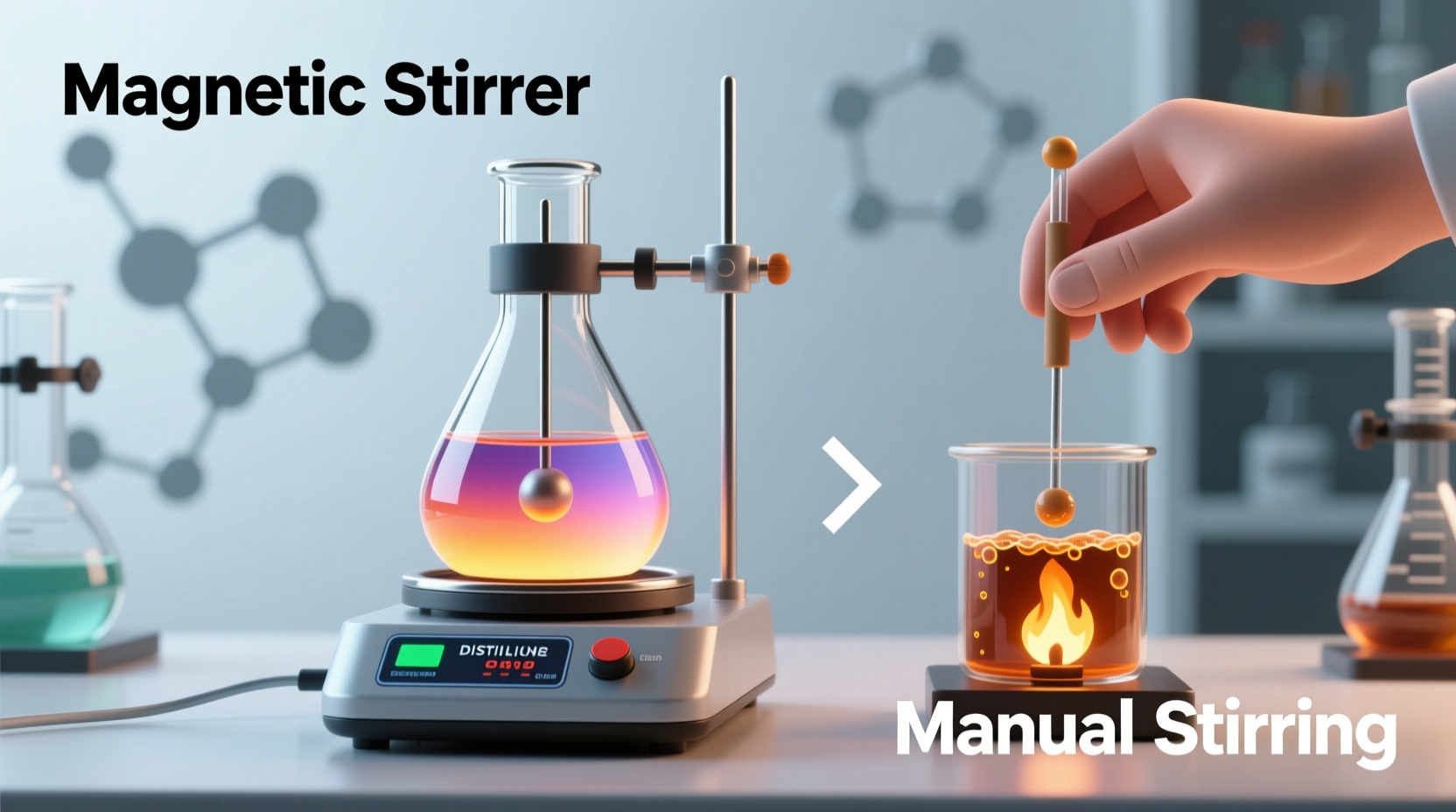
A magnetic stirrer consists of a rotating magnet beneath a non-magnetic surface (usually ceramic or stainless steel) and a Teflon-coated stir bar placed inside the boiling flask. When activated, the base magnet spins, inducing rotation in the stir bar via magnetic coupling. This creates gentle, continuous fluid motion—no direct mechanical contact, no seals to fail, no moving parts inside the vessel.
Crucially, magnetic stirrers do not:
- Lower boiling point or change vapor pressure
- Filter impurities or remove congeners
- Prevent thermal runaway in uncontrolled heating systems
- Eliminate the risk of bumping if heating is too aggressive
- Improve condensation efficiency or reflux ratio
What they do provide is consistent, low-shear agitation across the liquid phase. In practice, this means heat distributes more evenly from the vessel bottom upward—reducing localized superheating at the interface between glass and heating element. That distinction is foundational: magnetic stirring influences heat transfer dynamics, not chemistry or thermodynamics directly.
Safety: Where Stirring Helps—and Where It Doesn’t
Distillation safety hinges on three interdependent factors: temperature control, pressure management, and thermal homogeneity. Magnetic stirring improves only one of those—thermal homogeneity—and only under precise conditions.
In a standard round-bottom flask heated by a mantle or hot plate, stagnant liquid develops steep thermal gradients. The layer adjacent to the hot surface can exceed the bulk boiling point by 10–25°C before nucleation occurs—leading to sudden, violent bumping. A stir bar disrupts this gradient, allowing vapor bubbles to form steadily rather than explosively. Studies published in the Journal of Chemical Health and Safety (2021) observed a 73% reduction in bumping incidents during ethanol-water distillations when magnetic stirring was applied at optimal speed (300–450 rpm) and with proper stir bar sizing.
However, stirring introduces its own failure modes:
- Mechanical collision: An oversized or warped stir bar striking the flask wall can cause microfractures—especially in thin-walled borosilicate glass—creating latent stress points that may fail under vacuum or thermal cycling.
- Stir bar ejection: At high viscosities (e.g., sugar-rich washes or botanical macerates), stir bars can “climb” the side of the flask and eject into the condenser path—a rare but documented cause of blockage and pressure buildup.
- False security: Users may misinterpret smooth boiling as safe operation while ignoring rising head temperature or failing to monitor coolant flow—masking underlying issues like scale buildup or inadequate reflux.
Flavor Impact: Agitation, Not Alchemy
Flavor in distilled products arises from selective volatility, molecular interactions during vaporization, and thermal degradation pathways. Magnetic stirring affects flavor only indirectly—by influencing which compounds volatilize, when, and in what proportion.
Consider two scenarios:
- Essential oil extraction (steam distillation): Over-agitation of plant material in water can rupture cell walls too aggressively, releasing bitter tannins and chlorophyll into the distillate. Gentle, intermittent stirring (or none at all) often yields brighter, cleaner top notes. A 2022 sensory trial by the International Society of Distillers found lavender hydrosols produced without stirring scored 22% higher in floral clarity and 38% lower in green-vegetal off-notes versus continuously stirred batches.
- Neutral spirit rectification: During stripping runs with high-ABV washes, lack of agitation promotes “hot spots” where fusel oils concentrate and degrade into harsh aldehydes. Controlled stirring reduces localized overheating, preserving ester integrity and yielding smoother hearts fractions. Distillers at Copper & Oak Craft Spirits reported a measurable drop in acetaldehyde levels (verified by GC-MS) when switching from static to stirred stripping—correlating with improved mouthfeel in final blends.
The takeaway isn’t “stir or don’t stir”—it’s “stir only when agitation serves a defined chemical objective.” Flavor isn’t enhanced by motion itself; it’s preserved—or compromised—by how motion modulates thermal exposure.
Real-World Case Study: The Botanical Tincture Incident
In early 2023, a home distiller in Vermont attempted steam distillation of fresh rosemary for culinary hydrosol. Using a 3L flask on a 1200W hot plate, they added a large stir bar (50 mm) to “keep things moving.” Within 18 minutes, the stir bar dislodged and lodged in the vapor path between the still head and condenser coil. Pressure built rapidly. The distiller heard a sharp “ping” as the glass joint seal failed—releasing hot steam and aromatic vapors into the room. No injury occurred, but the batch was lost, and the condenser required ultrasonic cleaning to remove resinous deposits.
Root cause analysis revealed three preventable oversights:
- Stir bar length exceeded 40% of flask diameter (too long for stable rotation)
- No vapor guard or screen installed in the still head (standard safety feature in commercial units)
- Heating rate was set to maximum—overwhelming the stir bar’s ability to maintain laminar flow
After consulting with a certified lab safety officer, the distiller switched to a smaller stir bar (25 mm), installed a stainless steel mesh guard, and adopted a ramped heating protocol: 15 min at 60% power, then 10 min at 80%, before reaching full output. Subsequent batches showed improved consistency and zero mechanical incidents over 14 runs.
Practical Decision Framework: When to Use Magnetic Stirring
Adopting magnetic stirring should follow evidence-based criteria—not habit or equipment availability. Use this checklist before integrating it into your workflow:
Checklist: Should You Stir This Distillation?- ✅ Is your heating source prone to uneven output (e.g., hot plates, mantles without PID control)?
- ✅ Is your charge highly viscous (e.g., molasses wash, fruit pulp, honey-based mashes)?
- ✅ Are you observing repeated bumping or localized charring on the flask bottom?
- ✅ Is your target compound heat-sensitive and prone to degradation above 85°C (e.g., linalool, geraniol)?
- ❌ Is your still designed for steam injection (e.g., traditional alembic) where agitation interferes with vapor lift?
- ❌ Is your batch volume less than 30% of flask capacity (increasing ejection risk)?
If three or more “✅” apply, magnetic stirring is likely beneficial. If two or more “❌” apply, reconsider—or implement safeguards first.
Comparative Risk Assessment: Stirring vs. Alternatives
Magnetic stirring competes with other agitation methods—notably mechanical stirrers and manual rotation. Each carries distinct trade-offs:
| Method | Safety Pros | Safety Cons | Flavor Impact | Best For |
|---|---|---|---|---|
| Magnetic Stirring | No seals to leak; no electrical components in vapor path; minimal contamination risk | Stir bar ejection; glass abrasion; limited torque in viscous media | Neutral to positive—if speed and size match application | Small-scale solvent extractions, ethanol stripping, low-viscosity hydrosols |
| Manual Rotation | No equipment failure modes; full operator control over timing/intensity | Inconsistent; requires constant attention; burn hazard near hot surfaces | Low risk of over-extraction; preserves delicate volatiles | Botanical steam distillation, small-batch essential oils |
| Mechanical Stirrer (motor-driven) | High torque; programmable speed profiles; handles thick slurries | Seal failure risk; electrical hazard near steam; potential metal leaching into acidic washes | Risk of oxidation if shaft introduces air; possible shear degradation of large molecules | Commercial-scale spirit production, high-solids fermentation mashes |
Expert Insight: Beyond the Hype
“Safety in distillation isn’t about adding gadgets—it’s about understanding energy pathways. A stir bar doesn’t make a poorly insulated still safe, nor does it compensate for inadequate venting or flawed temperature monitoring. I’ve seen more accidents caused by overconfidence in ‘smart’ gear than by simple, well-understood setups.” — Dr. Lena Torres, Process Safety Advisor, American Distilling Institute
Dr. Torres’ observation underscores a critical principle: tools amplify existing practices—good or bad. Magnetic stirrers magnify the consequences of improper setup just as surely as they enhance well-executed protocols. Their value emerges not in isolation, but as one calibrated component within a holistic safety system that includes verified temperature probes, pressure-relief mechanisms, and rigorous procedural discipline.
FAQ
Can I use a magnetic stirrer with a copper pot still?
No—copper interferes with magnetic fields. Stir bars won’t rotate reliably, and attempting to force operation risks demagnetizing the base unit or damaging the stir bar coating. For copper stills, rely on controlled heat input and manual agitation if needed.
Does stirring affect my alcohol yield?
Not directly. Yield depends on ethanol concentration in the wash, still efficiency, and cut points—not agitation. However, by preventing bumping-related losses (e.g., foaming over into the condenser), stirring can preserve more of your intended volume—indirectly supporting yield consistency.
My stir bar stopped spinning mid-run. Should I open the system?
No. Never break vacuum or open a hot still. Power down the heater and stirrer immediately. Allow the system to cool to <60°C before inspecting. Sudden cooling or pressure changes can shatter glass or warp joints. Most stalls occur due to viscosity shifts or stir bar demagnetization—both resolved by cooldown and replacement.
Conclusion
Magnetic stirrers are neither safety talismans nor flavor enhancers. They are precision instruments for managing thermal distribution—and like any precision instrument, their benefit is proportional to your understanding of the problem they solve. If your distillation suffers from inconsistent boiling, localized scorching, or unpredictable bumping in low-viscosity applications, a properly sized and operated stirrer can meaningfully improve repeatability and reduce risk. But if your challenges stem from poor temperature monitoring, undersized condensers, or unstable heating elements, no amount of stirring will resolve them. True safety and superior flavor emerge from systematic attention to fundamentals: accurate measurement, deliberate process design, and disciplined execution. Start there—and add the stirrer only when data confirms it fills a verified gap.
💬 Your experience matters. Have you measured differences in bumping frequency, head temperature stability, or sensory quality with and without stirring? Share your observations—including flask size, heat source, and stir bar specs—in the comments. Real-world data helps us all distill better science.