Barrel aging transforms raw spirit into something richer, smoother, and more complex—adding vanilla, caramel, oak tannin, and subtle spice through controlled wood interaction. For decades, this process belonged exclusively to distilleries with climate-controlled rickhouses and decades of empirical knowledge. Today, a growing number of home enthusiasts purchase compact “DIY barrel aging kits” promising similar results in weeks, not years. But do these kits deliver authentic flavor development? More critically: Are they safe to use with high-proof alcohol? And is the investment—both financial and time-based—justified for someone without formal distilling training?
The answer isn’t yes or no. It’s layered—dependent on wood sourcing, barrel construction, alcohol proof, storage conditions, and user vigilance. This article cuts through marketing hype to examine what actually happens inside those small charred oak barrels, how contamination or off-flavor risks emerge, and whether the sensory payoff justifies the effort. Drawing from distillery safety protocols, FDA guidance on wood contact with food-grade ethanol, and firsthand accounts from experienced home crafters, we present a grounded, actionable assessment—not speculation.
How DIY barrel aging kits actually work (and where they differ from commercial aging)
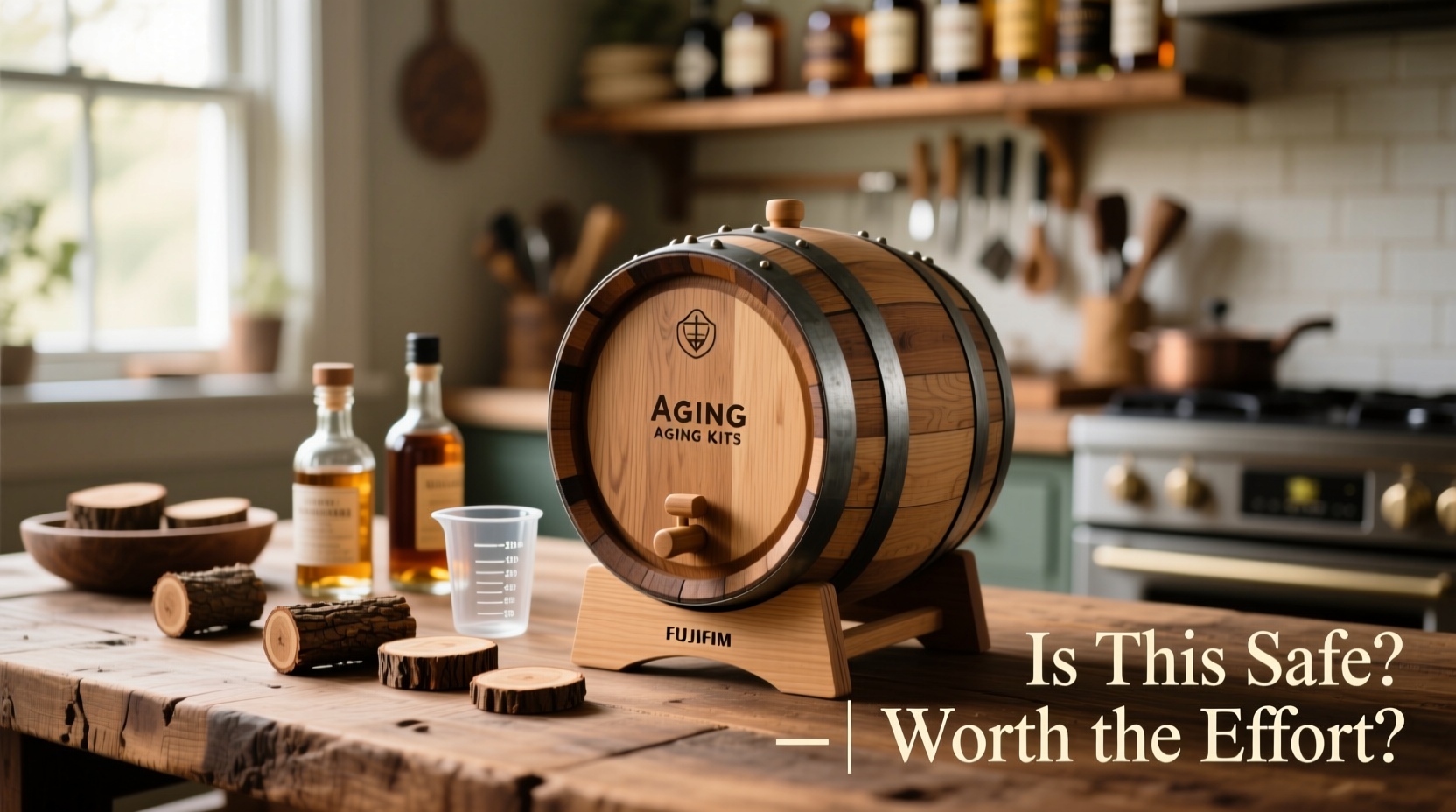
Most consumer kits include a 1–5 liter charred American white oak barrel, a stand, a bung, and sometimes a hydrometer or tasting journal. Unlike full-scale aging—which relies on seasonal temperature swings to drive spirit in and out of wood pores over months or years—mini-barrels operate under accelerated, static conditions. The smaller volume-to-surface-area ratio means faster extraction, but also heightened risk of over-extraction: bitter tannins, excessive woody astringency, or solvent-like “green oak” notes can dominate in as little as 7–14 days if unmonitored.
Crucially, these barrels are rarely toasted or charred to industry standards. Commercial cooperage uses precise heat gradients (e.g., Level 3 or 4 char) that create distinct lignin and cellulose breakdown products. Many kits use shallow, uneven charring—or even laser-etched “char”—that lacks the porous carbon layer essential for filtering harsh congeners. Without that active carbon interface, fusel oils and acetaldehyde aren’t effectively mellowed, potentially resulting in a spirit that tastes *more* aggressive, not less.
“Small barrels accelerate extraction—but they don’t replicate maturation. What you get is rapid wood infusion, not the chemical evolution that defines true aging. That distinction matters for both flavor and safety.” — Dr. Laura Chen, Food Chemist & Former Master Distiller, Anchor Distilling Co.
Safety first: Real risks you must understand before pouring your first shot
Home aging introduces three primary safety concerns: microbial contamination, wood leaching, and ethanol degradation. Each is preventable—but only with disciplined protocol.
Microbial contamination occurs when bacteria (like Acetobacter) or wild yeast colonize residual sugars or organic matter in the barrel. In low-proof spirits (<40% ABV), this risk spikes dramatically. Even at 50% ABV, improper sanitation creates biofilm habitats that resist cleaning. Left unchecked, acetobacter converts ethanol into acetic acid—producing vinegar taint, not complexity.
Wood leaching is often overlooked. Not all oak is equal. Some budget kits source wood from non-food-grade suppliers, where fungicides, mold inhibitors, or industrial sealants may have been applied pre-charring. When exposed to ethanol, these compounds can solubilize into the spirit. The FDA prohibits direct contact between spirits and untreated or non-FDA-compliant wood; yet many kits lack third-party certification verifying wood origin or treatment history.
Ethanol degradation becomes relevant during extended aging. Ethanol oxidizes over time, especially when exposed to air pockets in partially filled barrels. This forms acetaldehyde—a known irritant linked to headaches and nausea—and eventually acetic acid. While small amounts occur naturally in aged spirits, uncontrolled oxidation in mini-barrels can push concentrations beyond sensory or physiological comfort thresholds.
Tip: Never age spirits below 45% ABV in a DIY barrel. Below this threshold, antimicrobial protection drops sharply—and spoilage risk rises exponentially.A realistic comparison: DIY kit vs. professional aging vs. alternatives
| Factor | DIY Barrel Kit (1–2 L) | Commercial Aging (53-gal barrel) | Alternative: Oak Infusion (chips/staves) |
|---|---|---|---|
| Aging Time for Noticeable Flavor | 3–14 days | 6–24 months | 1–7 days |
| Risk of Over-Extraction | Very High | Low (with monitoring) | Moderate (easily controlled) |
| Microbial Contamination Risk | High (if sanitation lapses) | Very Low (ethanol + environment) | Negligible (no porous vessel) |
| Wood Safety Certification | Rarely provided | Required (FDA/TTB compliant) | Widely available (food-grade certified) |
| Cost per 750mL Finished Spirit | $18–$35 (barrel + spirit + loss) | $4–$12 (bulk economics) | $3–$8 (reusable chips) |
Note: “Loss” refers to evaporation (“angel’s share”) and absorption into wood—typically 15–25% in mini-barrels versus 2–4% annually in full-size barrels. That loss isn’t just volume: it disproportionately removes lighter, volatile congeners, concentrating heavier, potentially harsher compounds.
Step-by-step: A verified safe process for using DIY barrel aging kits
Follow this sequence rigorously—deviations increase risk without meaningful flavor benefit.
- Verify wood origin and certification. Contact the seller. Ask for documentation confirming the oak is Quercus alba, sourced from USDA-inspected forests, and charred without chemical accelerants. Reject kits that refuse to disclose this.
- Sanitize the barrel before first use. Rinse thoroughly with boiling water (not steam—can crack staves). Then fill with 50% ABV neutral spirit for 48 hours. Discard this “seasoning spirit.” Do not skip this—it leaches surface tannins and opens wood pores safely.
- Fill only to 90% capacity. Leave headspace for expansion and micro-oxygenation—but never exceed 10% air gap. Too much air invites oxidation; too little impedes extraction.
- Store horizontally in stable, cool (12–18°C), dark conditions. Avoid garages or attics where daily temperature swings exceed ±5°C. Fluctuations stress wood and accelerate off-flavor formation.
- Taste every 48 hours after Day 3. Use a clean pipette. Record observations: color depth, oak sweetness, bitterness, mouthfeel. Stop aging the moment tannic astringency or “sawdust” notes appear—they won’t mellow with time.
- Empty and rinse immediately after desired profile is reached. Refill only after re-sanitizing with boiling water and a 50% ABV rinse. Never reuse a barrel for >3 cycles without professional re-charring.
Mini case study: When enthusiasm outpaced caution
In early 2023, Portland-based home distiller Marcus R. purchased a popular $129 “Whiskey Wizard” 2L kit. He filled it with 40% ABV corn whiskey, stored it upright near a south-facing window (peak temps hit 28°C), and checked only on Day 7. The spirit had turned cloudy, developed a sharp vinegar tang, and left a faint film on the bung. Lab testing (via a local university extension service) revealed Acetobacter pasteurianus at 4.2 × 10⁴ CFU/mL—well above safe thresholds for consumption. The barrel had never been sanitized pre-use, and the low ABV + heat created ideal spoilage conditions. Marcus discarded 1.8L of spirit and the barrel. His follow-up? Switching to food-grade oak cubes in glass with strict ABV control—and achieving superior, safer results in half the time.
What experts say about viability—and when to walk away
Industry consensus isn’t dismissive—but it is cautious. Master coopers emphasize that barrel integrity hinges on proper hydration: new small barrels must be swelled correctly, or ethanol seeps through seams. “A leaky 2-liter barrel isn’t just inefficient—it’s a fire hazard,” warns James O’Leary, Certified Cooper and instructor at Moonshine University. “I’ve seen DIY users tape cracks with duct tape. That’s not aging—it’s gambling with flammability.”
Flavor chemists add nuance. “You *can* get pleasant oak notes quickly,” says Dr. Elena Torres, Senior Researcher at the Beverage Testing Institute. “But true congener transformation—the reduction of fusels, the esterification that creates fruity notes—that requires time, oxygen exchange, and thermal cycling. Mini-barrels give you wood tea, not whiskey.” Her recommendation? Use kits for short-term infusion experiments (≤10 days), then transition to fractional blending: age 10% of your spirit in oak, then marry it with 90% unaged spirit to balance intensity and safety.
FAQ: Your most pressing questions—answered plainly
Can I reuse a DIY barrel for different spirits?
Yes—but only if you fully sanitize between uses and accept carryover flavor. A rum-aged barrel will impart molasses notes to subsequent whiskey. More critically, residual esters from fruit brandies can react unpredictably with grain spirits. Never switch between high-sugar (e.g., liqueurs) and dry spirits without professional cleaning.
Do “pre-charred” kits eliminate the need for seasoning?
No. Pre-charring addresses surface carbonization only. Seasoning hydrates the wood, swells staves to seal micro-gaps, and leaches harsh, soluble tannins. Skipping it risks leakage, excessive bitterness, and inconsistent extraction—even with “ready-to-use” branding.
Is there a safer, lower-cost alternative to DIY barrels?
Absolutely. Food-grade, TTB-certified oak cubes or spirals (medium toast, 1–2 mm particle size) in glass carboys offer precise control, zero leakage risk, and full traceability. At ~$12 for 100g (enough for 5L), they’re 60% cheaper than entry-level kits—and produce more repeatable, cleaner results. Just stir daily and taste hourly after Day 2.
Conclusion: Worth trying—if you respect the science, not the sales copy
DIY barrel aging kits aren’t inherently unsafe—but they’re inherently high-risk without rigorous attention to wood provenance, alcohol strength, sanitation, and sensory discipline. They’re not shortcuts to craft distilling mastery. They’re tools that amplify both reward and consequence. If you approach them as controlled experiments—with lab-grade vigilance, not bar-cart novelty—you’ll gain genuine insight into wood chemistry and spirit behavior. You’ll also likely discover that patience, precision, and humility yield better results than haste ever could.
Start small: Buy one certified kit. Follow the step-by-step protocol exactly. Document everything. Compare side-by-side with an oak-infused control sample. Then decide—not based on Instagram aesthetics, but on measurable flavor, safety compliance, and your own honest palate.
💬 Your experience matters. Did a DIY kit surprise you—or disappoint you? Share your unfiltered results, timelines, and lessons learned in the comments. Real data from real users helps everyone age smarter, safer, and more intentionally.