It’s not nostalgia. It’s not a fad. And it’s certainly not just about higher alcohol content or Instagrammable can designs. Over the past five years, U.S. craft beer volume has grown 7.2% annually—even as overall beer consumption declined by 1.4%. In the UK, independent breweries now account for 28% of total beer sales, up from 12% in 2015. These aren’t marginal shifts. They reflect a fundamental recalibration in consumer values: away from uniformity and toward intentionality, from passive consumption to active participation. What’s driving this resurgence isn’t just better flavor—it’s deeper alignment between what people drink and who they aspire to be.
The Flavor Chasm: Chemistry, Not Just Craft
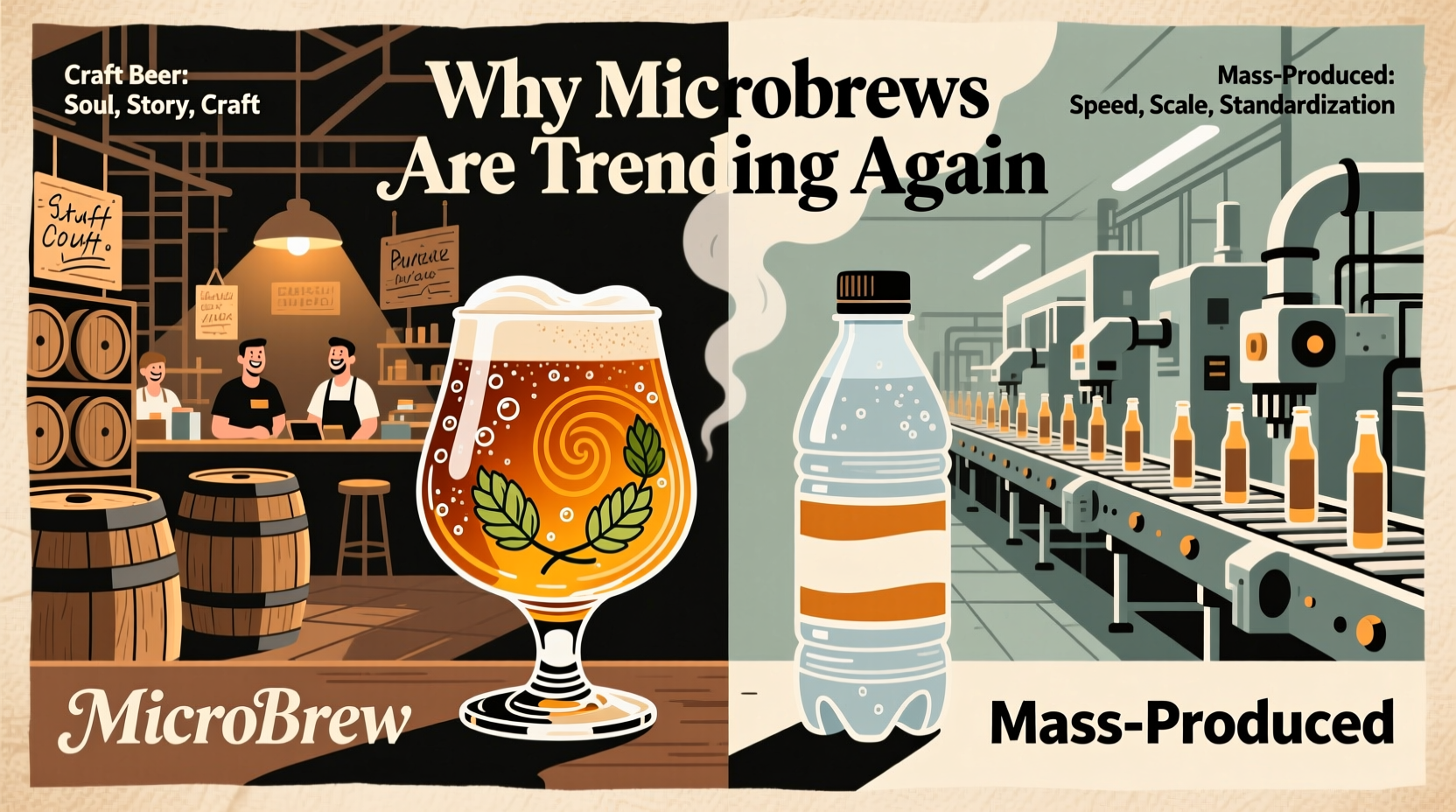
Mass-produced lagers rely on consistency above all else. That means adjunct grains (corn, rice), extended cold lagering, high-temperature pasteurization, and filtration that strips volatile esters and phenols. The result? A clean, light, neutral profile engineered for broad appeal—and shelf stability over character. Craft brewing, by contrast, treats yeast as a co-creator. Fermentation temperatures are precisely modulated to encourage specific flavor compounds: clove and banana from German hefeweizens, tropical thiols from New England IPAs, barnyard funk from mixed-culture sours. A 2023 sensory analysis by the Siebel Institute found that top-tier craft beers contain up to 47 distinct aromatic compounds detectable by trained tasters—nearly triple the average for macro lagers.
This difference isn’t academic. It’s visceral. When you taste a barrel-aged imperial stout aged in ex-bourbon casks, you’re tasting vanillin from wood lignin, lactones from oak hydrolysis, and Maillard-derived pyrazines from roasted barley—all layered with notes of dark chocolate, dried fig, and toasted coconut. A macro lager offers none of that complexity because its production process deliberately suppresses it.
Tip: Next time you order a craft beer, ask the bartender *how* it was fermented—not just what it’s called. Temperature, yeast strain, and fermentation duration tell you more about flavor than the style name ever could.Transparency as Trust: From Faceless Brands to Named Brewers
Walk into a supermarket and scan the beer aisle: “Premium Lager,” “Classic Amber,” “Original Draft”—generic descriptors designed to evoke familiarity without revealing origin. Now walk into a taproom. You’ll see names like “Hops & History IPA” brewed by Maya Chen, head brewer since 2019; or “Tidal Rye Sourdough Porter,” collaboration with the neighborhood bakery using spent grain from their rye loaves. This isn’t marketing theater. It’s structural transparency: batch numbers traceable to grain lot, water mineral profiles published online, lab results for IBUs and ABV posted beside the tap handle.
A 2024 YouGov survey revealed that 68% of craft beer drinkers say knowing the brewer’s name and story increases their willingness to pay 22% more per pint. Why? Because authenticity functions as social proof. When a brewery publishes its wastewater treatment metrics or shares photos of its spent-grain compost going to local farms, it signals accountability—not just to regulators, but to neighbors.
“People don’t buy beer. They buy belonging. A taproom isn’t a retail space—it’s civic infrastructure. We host school fundraisers, repair cafes, and climate action meetings. The beer funds the mission.” — Derek Ruiz, co-founder of Harborlight Brewing (Portland, OR), 2023 Brewbound Leadership Summit
The Local Anchor Effect: How Microbreweries Stabilize Communities
Consider the data: For every $1 million in annual craft brewery revenue, an average of 14 full-time jobs are created—not just in brewing, but in graphic design, logistics, equipment maintenance, and hospitality. More significantly, craft breweries generate disproportionate local economic multipliers. A University of Vermont study tracked spending patterns in 12 rural towns and found that patrons of independent breweries spent 3.2x more at adjacent small businesses (bookstores, coffee roasters, vintage shops) within a 0.5-mile radius than macro-beer bar customers did.
This isn’t accidental. Microbreweries operate on a different spatial logic. They locate near residential neighborhoods—not industrial parks—because foot traffic matters. They host trivia nights on Tuesdays, live jazz on Fridays, and sour beer blending workshops on Sundays. Their taprooms become third places: spaces distinct from home and work where relationships form organically. In post-industrial cities like Detroit and Cleveland, breweries have been central to neighborhood revitalization—not as gentrifying forces, but as anchor tenants that attracted artists, educators, and small manufacturers seeking collaborative ecosystems.
Craft Beer’s Quiet Rebellion Against Industrial Logic
Industrial brewing follows a linear model: extract resources → standardize output → maximize throughput → minimize cost per unit. Craft brewing operates on a circular, adaptive model: source locally → respond to seasonal ingredients → iterate based on feedback → prioritize longevity over speed. This philosophical divergence shows up in tangible ways:
- Grain sourcing: While macros purchase commodity barley futures months in advance, 73% of U.S. craft brewers use at least one locally grown grain variety—often working directly with farmers to trial heirloom strains like ‘Honey Malt’ or ‘Midnight Rye’.
- Water stewardship: Macro breweries use ~7 gallons of water per gallon of beer; leading craft breweries average 3.8:1, with pioneers like New Belgium achieving 2.8:1 through closed-loop cooling and rainwater capture.
- Package innovation: Cans now dominate craft packaging—not for convenience alone, but because aluminum is infinitely recyclable with 95% less energy than virgin production. Meanwhile, macros still ship 40% of volume in non-recyclable plastic six-pack rings.
| Dimension | Mass-Produced Beer | Craft Beer (Top Quartile) |
|---|---|---|
| Mean Time-to-Consumer | 112 days (brewery → warehouse → distributor → retailer) | 17 days (brewery → taproom or local retailer) |
| Yeast Strain Diversity | 3–5 proprietary strains across entire portfolio | 12–40+ strains, often house-cultivated or wild-isolated |
| Ingredient Traceability | Country-of-origin only | Farm name, harvest date, soil pH, maltster batch # |
| Community Investment | Corporate CSR budget (0.7% of net profit) | Direct local grants + in-kind support = 4.3% of gross revenue |
Real-World Resurgence: The Case of Asheville’s Hop Revival
In 2010, Asheville, North Carolina had three breweries. Today it hosts 34—and isn’t just “the Beer City USA” by tourism board decree. Its resurgence began quietly in 2014, when French Broad River Brewery launched its “Grain-to-Glass” initiative. Instead of importing German pilsner malt, they partnered with Appalachian farmers growing heritage barley varieties. Initial yields were low; kilning required custom-built equipment. But the resulting “Highlands Pilsner” had a cracker-like snap and subtle honey note no imported malt replicated. Within two years, seven other Asheville breweries joined the coalition. By 2022, the region grew 82% of its base malt locally—a figure unheard of outside Germany or the Czech Republic.
What made this sustainable wasn’t just terroir. It was interdependence: the maltster invested in on-farm drying facilities; brewers adjusted recipes seasonally; restaurants featured “Malt Week” dinners pairing local cheeses with barley-forward beers. When Hurricane Helene flooded Asheville in 2024, the coalition diverted 12,000 lbs of unprocessed grain to feed displaced livestock—proving that local supply chains aren’t just flavorful, they’re resilient.
Your Next Pour: A Practical Action Plan
You don’t need to renounce macro lagers to engage meaningfully with craft beer’s resurgence. Start with intention—not ideology. Here’s how to align your choices with the values driving the trend:
- Visit a taproom—not for novelty, but for context. Ask about water source, malt origin, and yeast history. Note how staff describe flavors: Do they reference place (e.g., “this saison tastes like our orchard’s wild chamomile”) or process (e.g., “dry-hopped twice with Citra”)?
- Try one “process-forward” beer monthly. Choose styles defined by method, not just ingredients: a kettle sour, a mixed-culture Brettanomyces ale, or a spontaneous fermentation lambic. Taste how time and microbes transform simplicity into complexity.
- Support breweries with public sustainability reports. Look beyond “eco-friendly cans.” Seek water-use ratios, spent-grain diversion rates, and renewable energy percentages—published, not press-released.
- Host a “local-only” tasting. Select three beers from breweries within 50 miles. Compare mouthfeel, bitterness perception, and finish length. Notice how regional water chemistry and grain varieties create shared signatures.
- Ask your retailer: “Which local brewery needs help right now?” Then buy their flagship beer—not the limited release. Consistent demand sustains jobs more reliably than hype cycles.
FAQ: Cutting Through the Hype
Is craft beer actually healthier than mass-produced beer?
No—but it’s often *less processed*. Most craft beers skip pasteurization and filtration, retaining more B vitamins and polyphenols from hops and barley. However, ABV and calorie content vary widely by style. A 9% imperial stout delivers more alcohol and calories than a 4.2% macro lager. Health impact depends on quantity and frequency, not category.
Why do some craft beers cost twice as much as macro lagers?
Three primary drivers: labor intensity (small-batch fermentation requires manual monitoring), ingredient cost (single-origin hops cost 3–5x more than pelletized blends), and scale inefficiency (a 15-barrel system can’t amortize equipment costs like a 5,000-barrel brewhouse). That premium pays for human attention—not marketing budgets.
Does “craft” always mean independent and small?
Not legally. The Brewers Association defines “craft” as small (<6M barrels/year), independent (≤25% owned by non-craft entities), and traditional (fermented with malted barley and/or other fermentables). But ownership matters: Lagunitas was acquired by Heineken in 2017; Ballast Point by Constellation Brands in 2015. Both retain craft designation by volume—but their capital structure and distribution priorities shifted. Always check ownership before assuming values alignment.
Conclusion: Raise a Glass to Intentional Drinking
The craft beer resurgence isn’t about rejecting mass production—it’s about reclaiming agency. Every time you choose a beer whose label names the farmer who grew its barley, or whose tap handle lists the exact fermentation temperature, you’re voting for systems where quality isn’t outsourced to algorithms, where relationships matter more than reach, and where flavor serves as a conduit for connection rather than a commodity to be optimized. This trend endures because it answers a quiet human need: to know where things come from, who made them, and why they matter. It’s not happening *despite* modern life—it’s flourishing *within* it, as a deliberate counterweight to fragmentation and abstraction. So next time you raise a glass, don’t just taste the beer. Taste the choice behind it.
💬 Your turn: Which local brewery changed how you think about beer? Share their name, a standout beer, and what made it meaningful—your insight might help someone discover their next favorite pour.