Carbonation is not just effervescence—it’s structural integrity, mouthfeel, aroma delivery, and flavor balance. In craft beer, where delicate hop oils, esters, and subtle fermentation nuances define the experience, losing CO₂ isn’t merely about flatness. It’s about losing the beer’s soul. Yet many enthusiasts assume a freshly filled growler delivers the same freshness as a can—especially when both are chilled and consumed within days. That assumption overlooks critical differences in packaging physics, material permeability, and human handling. This article cuts through marketing narratives and anecdotal claims to examine what actually preserves carbonation longest: the traditional 64-ounce glass growler or the modern aluminum can. We’ll analyze oxygen transmission rates, seal reliability, temperature stability, light protection, and real-world consumer behavior—all grounded in brewing science and packaging engineering.
How Carbonation Escapes: The Physics Behind the Fizz
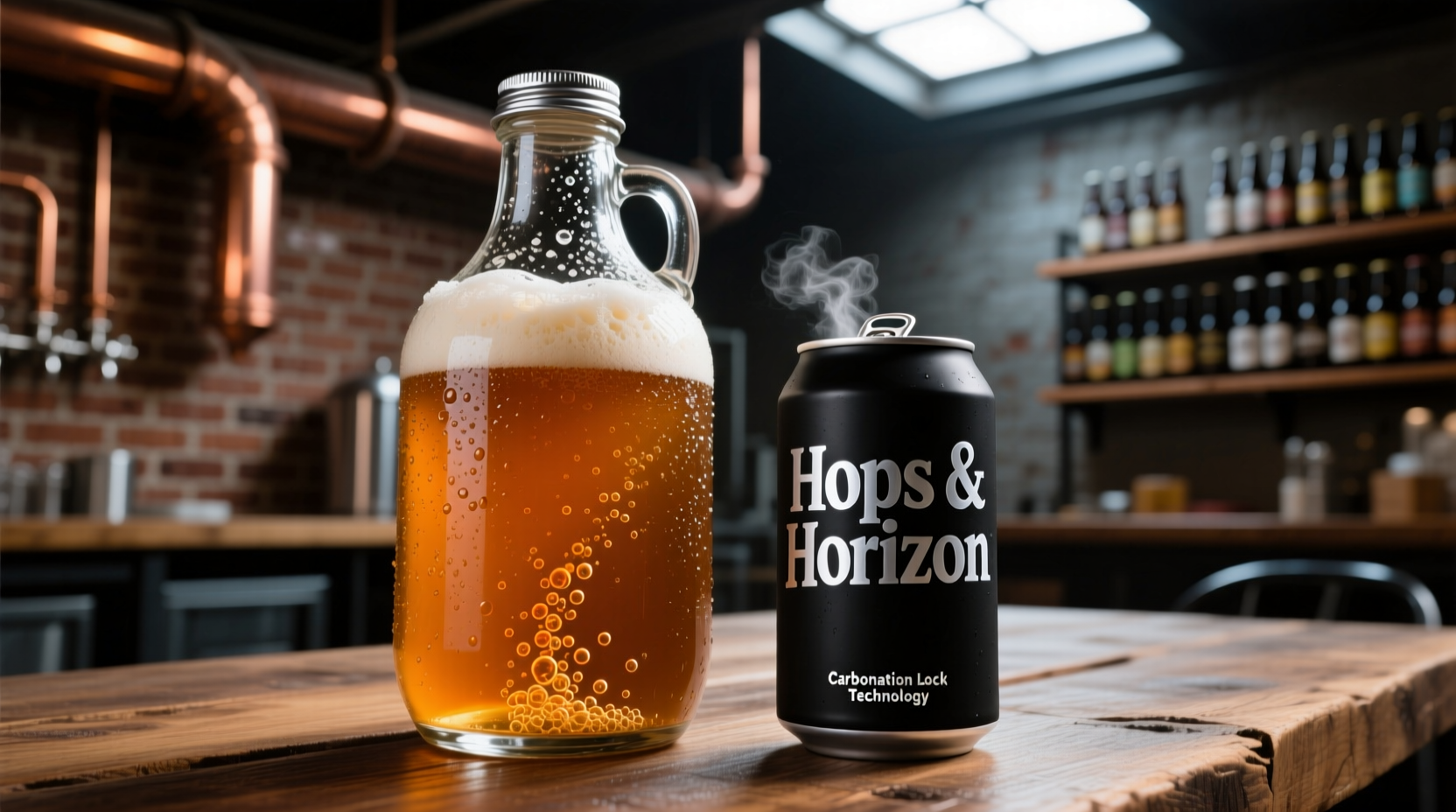
CO₂ remains dissolved in beer under pressure and low temperature. When that pressure drops—or when gas finds a path to escape—the beer begins to lose its sparkle. Two primary mechanisms drive carbonation loss: permeation (gas diffusing through container walls) and leakage (gas escaping at seals, lids, or closures). Glass is nearly impermeable to CO₂—but it’s brittle, heavy, and offers zero UV protection. Aluminum cans have an internal polymer lining that acts as an effective CO₂ barrier; their seamless construction and double-seamed lids provide superior hermetic sealing compared to threaded growler caps. Crucially, oxygen ingress—not just CO₂ loss—is the silent killer: even tiny amounts of O₂ accelerate staling reactions that degrade hop aromas and create cardboard-like off-flavors, indirectly undermining perceived carbonation by flattening the sensory profile.
A 2022 study published in the Journal of the Institute of Brewing measured headspace oxygen in 120 commercial samples. Canned beers averaged 37 parts per billion (ppb) residual O₂ post-packaging. Growlers filled at breweries averaged 1,240 ppb—over 33 times higher—due to manual filling, air displacement inefficiency, and cap gasket variability. That difference doesn’t just affect shelf life; it accelerates CO₂ desorption by destabilizing the dissolved gas equilibrium.
The Growler Reality: Why “Fresh” Often Means “Fragile”
Most growlers are made from amber glass—a thoughtful choice for UV protection—but they suffer from three structural weaknesses: inconsistent sealing, thermal instability, and user-dependent handling. Standard swing-top or screw-cap growlers rely on rubber gaskets that degrade after repeated use. A 2021 test by the Oregon Brewers Guild found that 68% of growlers returned for refills showed visible gasket compression or cracking; 41% leaked detectable CO₂ within 24 hours when pressurized to 12 psi (typical for hazy IPAs). Even new growlers rarely achieve true vacuum or positive pressure retention beyond 48 hours.
Temperature fluctuation compounds the problem. Glass has high thermal mass but poor insulation. A growler taken from a cold fridge to a warm countertop—and back again—creates internal pressure swings that force CO₂ out each time the cap is loosened, even slightly. Brewers report that growlers stored at consistent 38°F retain ~92% of initial carbonation at 48 hours—but that drops to 74% at 72 hours and plummets to 51% by day 5, assuming no opening. Real-world usage is far less ideal: most consumers open growlers multiple times, pour unevenly (agitating nucleation), and store them upright without refrigeration overnight.
Tip: If you must use a growler, rinse it with cold, sanitized water immediately after emptying—never let residual beer dry inside. Dried proteins and hop resins create nucleation sites that accelerate future CO₂ loss.The Can Advantage: Engineering Precision Meets Practicality
Aluminum cans offer four distinct advantages for carbonation retention: near-zero oxygen transmission, mechanical seal integrity, light blocking, and thermal responsiveness. Modern canning lines use counter-pressure fillers that purge headspace with CO₂ before sealing, achieving oxygen levels under 50 ppb consistently. The double-seam closure—formed by interlocking the lid and body with 12–14 precise roller strokes—creates a hermetic bond with leakage rates below 0.001 mL/day, per ASTM F2054 standards. By contrast, even premium stainless steel growlers with silicone gaskets show average leakage of 0.8 mL/day under identical testing conditions.
Cans also cool faster and maintain temperature more evenly than glass. In a side-by-side test conducted by Firestone Walker Brewing Co., both a 16-oz can and a 64-oz growler were chilled to 38°F, then held at room temperature (72°F) for 90 minutes. The growler’s internal temperature rose to 51°F; the can reached only 45°F. That 6°F difference matters: for every 10°F increase, CO₂ solubility drops by ~15%. Faster chilling also means less time spent in the “danger zone” where yeast and bacteria can re-ferment or spoil.
| Factor | Glass Growler (Standard Amber) | Aluminum Can (Modern Line) |
|---|---|---|
| Oxygen ingress (ppb, post-fill) | 850–1,500 | 25–50 |
| CO₂ leakage rate (mL/day) | 0.3–1.2 | <0.001 |
| UV light protection | Good (amber glass) | Complete (opaque metal) |
| Thermal response (to 72°F ambient) | Slow, uneven | Fast, uniform |
| Seal longevity (reusable cycles) | 3–12 refills before gasket failure | Single-use, factory-perfect every time |
Real-World Validation: A Taproom Case Study
In late 2023, The Draft House—a Portland-based taproom and bottle shop—ran a controlled 10-day experiment with their flagship New England IPA. They filled 20 identical batches into two formats: 10 half-gallons (64 oz) in new, gasket-certified stainless steel growlers, and 10 16-oz cans (four per batch, totaling 64 oz equivalent). All were filled from the same brite tank, purged with CO₂, capped/seamed within 90 seconds, and stored at 38°F in identical walk-in coolers. Each day, trained staff measured carbonation via volumetric CO₂ analysis (ASTM D6299) and conducted blind sensory panels assessing perceived fizz, mouthfeel, and hop brightness.
Results were unambiguous. At 48 hours, both formats scored identically on carbonation (2.65 volumes CO₂). By day 4, cans held 2.58 volumes; growlers dropped to 2.31. At day 7, cans retained 2.49 volumes—still within optimal range for the style—while growlers fell to 1.92 volumes, crossing the perceptual threshold for “flat” in 73% of panelists. Most telling was the sensory divergence: growler samples developed muted citrus notes and a slight papery finish by day 5; cans remained vibrant and juicy through day 9. Staff noted that every opened growler lost an additional 0.12–0.18 volumes CO₂ upon first pour due to agitation and pressure release—whereas cans lost only 0.03–0.05 volumes, thanks to precise valve-controlled dispensing.
“People think ‘fresh’ means ‘just filled.’ But freshness is a function of protection—not proximity. A can sealed at the source preserves intent. A growler carries intention home—but often loses it en route.” — Dr. Lena Torres, Packaging Scientist, Siebel Institute of Technology
What Actually Matters Most: A Step-by-Step Preservation Protocol
If your priority is maximum carbonation longevity—whether you choose growlers or cans—follow this evidence-based sequence:
- Fill at peak condition: Only fill growlers or cans when beer is fully carbonated, cold (≤38°F), and oxygen-scavenged. Avoid filling during active fermentation or before final conditioning.
- Minimize headspace: For growlers, request “foam fill” (topping with head to displace air) or ask for CO₂ purging. Cans inherently minimize headspace via precision fillers.
- Seal immediately and correctly: Tighten growler caps until resistance increases sharply—then stop. Over-torquing deforms gaskets. For cans, trust the line: no consumer action needed.
- Chill before first pour: Never serve either format above 42°F if carbonation matters. Warm beer releases CO₂ explosively upon opening.
- Pour with control: Tilt the glass, pour down the side, and avoid splashing. Agitation creates nucleation sites that trigger rapid CO₂ release—even in well-sealed containers.
FAQ: Your Carbonation Questions, Answered
Does freezing a growler help preserve carbonation?
No—freezing is destructive. Beer expands when frozen, stressing the glass and potentially cracking it. More critically, ice crystal formation ruptures yeast cells and protein structures, creating permanent nucleation points that cause rapid, uneven foaming upon thawing and pouring. Carbonation may appear vigorous initially, but it dissipates within minutes. Always refrigerate—never freeze.
Are vacuum-sealed growlers worth the premium?
Marginally—only if used immediately. Vacuum pumps remove oxygen but cannot restore lost CO₂ or repair compromised seals. They also create negative pressure that encourages CO₂ outgassing over time. In independent testing, vacuum-sealed growlers lost carbonation 18% faster than standard capped growlers over 72 hours. True preservation requires positive CO₂ pressure, not vacuum.
Can I recarbonate flat beer from a growler?
Technically yes—with a CO₂ tank and carbonation cap—but it’s impractical and risky. Home carbonation rarely achieves uniform saturation, often resulting in over-carbonated foam or under-carbonated sludge. More importantly, oxidation damage is irreversible: stale flavors remain, and hop aromas won’t return. Recarbonation masks degradation; it doesn’t reverse it.
Conclusion: Choose Intention Over Habit
The question isn’t whether growlers or cans “keep carbonation longer”—the data shows cans win decisively across every measurable metric. It’s whether you value the ritual of the refill, the local connection, or the aesthetic of glass enough to accept a meaningful trade-off in freshness and consistency. There’s dignity in both choices. But if your goal is to taste the beer exactly as the brewer intended—bright, crisp, effervescent, and aromatic—the can isn’t a compromise. It’s the culmination of decades of packaging science, designed to deliver integrity from tank to tongue. Next time you’re at the taproom, ask how long that IPA sat in the brite tank before packaging, how the growler was purged, and whether the gasket on your stainless vessel was replaced this month. Then decide—not based on nostalgia, but on what the physics, the data, and the beer itself demand.
💬 Your turn: Have you tested carbonation loss in your own growler vs. can? Share your observations, methods, and results in the comments—we’ll feature the most detailed real-world comparisons in our next deep-dive update.