Whiskey lovers increasingly encounter a new label on boutique shelves: “cold brew infused,” “wood-aged in 72 hours,” or “accelerated oak finish.” These products tout the complexity of barrel-aged spirits—without the years of waiting, warehouse space, or evaporation loss. At first glance, it’s an elegant solution to scarcity, cost, and consumer impatience. But behind the convenience lies a fundamental question about what defines whiskey—not just legally, but sensorially and philosophically. This isn’t merely about speed versus time; it’s about how chemistry, craftsmanship, and context shape the soul of a spirit. We examine cold brew infusion not as a novelty, but as a deliberate alternative—one that rewrites extraction kinetics while challenging centuries-old definitions of maturation.
What Actually Happens in Traditional Barrel Aging?
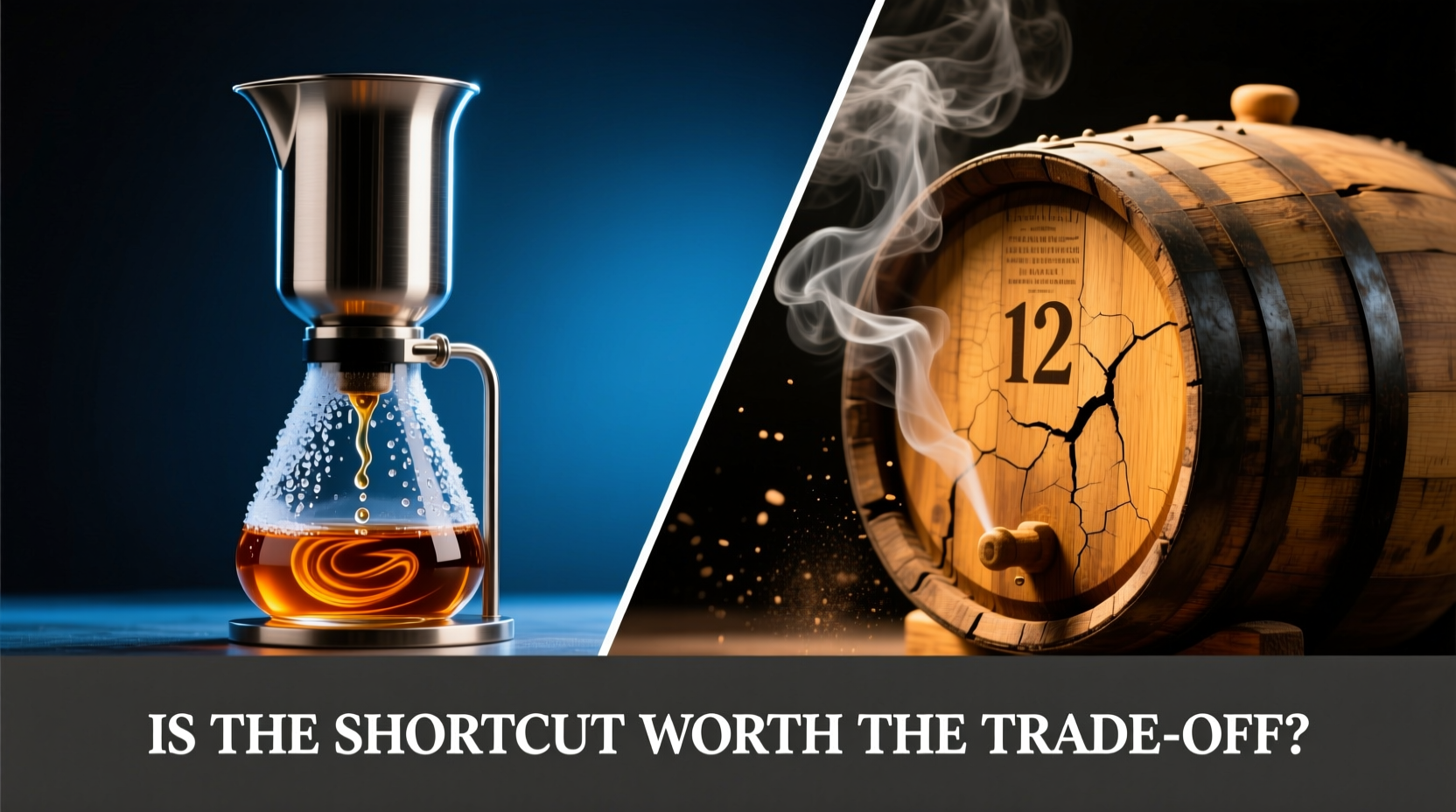
Traditional barrel aging is neither passive storage nor simple flavor addition. It’s a dynamic, multi-phase biochemical process governed by temperature fluctuations, wood porosity, ethanol concentration, and time. When new-make spirit enters a charred oak cask—typically American white oak—the interaction begins immediately:
- Extraction: Ethanol and water leach vanillin, lactones (coconut/woody notes), tannins, and lignin derivatives from the wood’s hemicellulose and lignin matrix.
- Chemical Transformation: Aldehydes oxidize into acids; esters form and hydrolyze; Maillard reactions deepen caramel and spice notes; ethanol reacts with wood-derived compounds to create stable, aromatic complexes.
- Micro-Oxidation: Oxygen slowly diffuses through oak pores, softening harsh alcohols, polymerizing tannins, and encouraging integration—reducing volatility and enhancing mouthfeel.
- Evaporation & Concentration: The “angel’s share” (2–4% annual loss) concentrates congeners, increases ABV slightly in humid climates, and gradually shifts the spirit’s density and aromatic balance.
Crucially, this process unfolds over months and years—not because distillers are nostalgic for delay, but because many key reactions require thermal energy cycles and molecular diffusion rates that cannot be meaningfully accelerated without collateral damage. As Dr. Rachel Kim, Senior Flavor Chemist at the Scotch Whisky Research Institute, explains:
“Barrel aging isn’t just ‘oak + time.’ It’s a cascade of interdependent reactions—some catalyzed by heat, others by oxygen, many requiring weeks to reach equilibrium. Rushing extraction doesn’t accelerate integration; it often bypasses it entirely.” — Dr. Rachel Kim, Flavor Chemist & Whisky Process Researcher
How Cold Brew Infusion Works—and Where It Diverges
Cold brew whiskey infusion borrows methodology from coffee and tea extraction: finely toasted or charred oak chips, staves, or spirals are immersed directly into matured (or sometimes new-make) spirit at ambient or refrigerated temperatures. Agitation—via tumbling, nitrogen sparging, or ultrasonic vibration—is often employed to increase surface contact and mass transfer. Extraction typically completes in 24–96 hours.
The chemistry is real: vanillin, eugenol, and β-methyl-γ-octalactone appear rapidly in measurable quantities. But the profile differs structurally:
- No thermal cycling means minimal Maillard development—fewer roasted, nutty, or baked notes.
- No micro-oxygenation prevents tannin polymerization, resulting in sharper, more astringent oak character.
- Higher surface-area-to-volume ratios extract wood sugars and bitter compounds disproportionately—often requiring post-infusion filtration or blending to mitigate harshness.
- Without evaporation-driven concentration, the spirit retains its original alcohol strength and volatile top notes, which can clash with aggressive oak extracts.
Side-by-Side Comparison: Sensory, Economic, and Regulatory Realities
| Factor | Traditional Barrel Aging | Cold Brew Infusion |
|---|---|---|
| Timeframe | Minimum 2 years (legally required for “straight” whiskey); typically 4–12+ years for premium expressions | 1–4 days active infusion; +1–3 weeks optional resting/filtration |
| Oak Source | Whole, air-dried, fire-charred barrels (toasted layers: 1–4) | Chips, staves, or spirals—often kiln-dried and aggressively toasted/charred |
| Key Flavor Drivers | Integrated vanillin, caramelized sugars, oxidative esters (ethyl hexanoate), soft tannins, subtle smoke | Pronounced vanilla, clove, coconut, sharp oak spice—less layered, more linear |
| Production Cost (per liter) | High: barrel purchase ($180–$350), warehousing, insurance, labor, evaporation loss (~35% over 6 years) | Low: oak adjuncts ($8–$25/kg), minimal labor, no long-term capital tied up |
| Regulatory Status | Fully compliant with U.S. TTB and EU whisky definitions (“aged in oak containers”) | Cannot be labeled “aged” in most jurisdictions; must use terms like “finished with oak,” “infused,” or “oak rested” |
This table reveals more than logistics—it underscores a philosophical divide. Traditional aging treats the barrel as a living bioreactor. Cold infusion treats oak as a flavor concentrate. One seeks harmony; the other prioritizes immediacy.
A Real-World Case Study: The Glenhaven Experiment (2022–2023)
In early 2022, the independent Scottish bottler Glenhaven Spirits launched two limited releases drawn from the same single cask of 6-year-old Highland malt: one finished traditionally in a first-fill bourbon barrel for 18 months; the other subjected to a 36-hour cold infusion using medium-toast French oak spirals, followed by 3 weeks of inert-gas-rested settling.
Blind tastings with 42 industry professionals (distillers, blenders, sommeliers) revealed stark divergence:
- 94% identified the traditionally finished expression as “integrated,” with “silky tannins” and “caramel-apple depth.”
- 78% described the cold-infused version as “vivid but disjointed”—praising its upfront vanilla and baking spice but noting “green wood bite on the finish” and “lack of resonance.”
- Only 11% preferred the infused version overall—though 63% said they’d choose it for high-volume cocktails where nuance is secondary to aromatic impact.
Crucially, Glenhaven didn’t position the infusion as a replacement. Instead, they marketed it as a “barrel-inspired expression”—transparent about method, pricing it 38% lower than the finished counterpart. Sales data showed 71% of buyers were under 35 and cited curiosity and value as primary motivators. The takeaway wasn’t that infusion failed—it succeeded on its own terms—but that its success lived in a different category: accessibility, experimentation, and mixability—not contemplative sipping.
When Does the Shortcut Make Strategic Sense? A Practical Decision Framework
Not all whiskey exists to be savored neat in a crystal tulip. Context determines whether speed is a compromise—or an advantage. Use this step-by-step framework to evaluate if cold infusion aligns with your goals:
- Define the intended use: Is this for sipping, mixing, gifting, or education? If >60% of volume will go into cocktails (e.g., Old Fashioneds, Whiskey Sours), infusion’s bold, immediate oak character often performs better than delicate, nuanced aged whiskey.
- Analyze your audience: Are you serving connoisseurs seeking terroir and time, or newcomers exploring flavor categories? Infused whiskeys lower the barrier to entry—vanilla and spice are universally approachable; subtle sherry-cask dried fruit or rancio is not.
- Evaluate scale and capital: Can you afford $200,000 in barrel inventory tied up for 4+ years? If launching a small-batch brand with <$50k startup capital, infusion enables rapid iteration, seasonal releases, and responsive flavor testing.
- Assess regulatory alignment: Verify labeling compliance in target markets. In the U.S., TTB requires “infused” or “flavored with oak” language—and prohibits “aged” or “barrel-finished” unless actual cask contact occurred. Mislabeling risks rejection or recall.
- Commit to transparency: Disclose method, oak source, and infusion duration. Consumers increasingly reward honesty—even when the process diverges from tradition. A clear story builds trust faster than obscured terminology ever could.
FAQ: Addressing Common Concerns
Does cold infusion produce harmful compounds that barrel aging avoids?
No evidence suggests cold infusion generates uniquely hazardous compounds. However, aggressive extraction from poorly sourced oak (e.g., non-food-grade wood, excessive charring) can elevate levels of guaiacol or syringol beyond sensory comfort—leading to medicinal or smoky bitterness. Reputable producers use food-grade, cooperage-sourced oak and validate extraction parameters via GC-MS analysis.
Can cold-infused whiskey ever match the mouthfeel of barrel-aged spirit?
Rarely—due to the absence of micro-oxygenation and esterification. Barrel-aged whiskey develops longer-chain esters and polymerized tannins that coat the palate. Cold infusion yields shorter-chain, more volatile compounds that evaporate quickly, often resulting in a leaner, drier, or more alcoholic perception. Some producers compensate with glycerol addition or light caramel coloring—but these alter authenticity, not just texture.
Is there a hybrid approach gaining traction?
Yes. “Dual-phase finishing” is emerging: a spirit aged traditionally for 2–3 years, then given a short (7–14 day) cold infusion with specialty woods (Japanese mizunara, acacia, chestnut) to layer distinct aromatic signatures without overwhelming the base. This leverages time for structure and speed for nuance—respecting both disciplines.
Conclusion: Not Either/Or—But Intentional Choice
The question isn’t whether cold brew whiskey infusion is “worse” than traditional barrel aging. It’s whether it serves the right purpose, with integrity and clarity. Barrel aging remains irreplaceable for creating depth, balance, and the quiet authority that only time confers. But infusion answers real needs: democratizing oak influence, accelerating innovation, and meeting demand for expressive, affordable, and transparent spirits. The trade-off isn’t between quality and convenience—it’s between patience and precision, between legacy and agility.
What matters most is intention. If you’re choosing infusion to cut corners, skip steps, or mislead—then yes, it’s a compromise with lasting consequences. But if you’re choosing it to explore, educate, experiment, or extend access—then it’s not a shortcut. It’s a different path, walked with purpose.
💬 Your thoughts matter. Have you tasted a cold-infused whiskey that surprised you? Did a traditionally aged bottle change your perspective? Share your experience—and what “worth it” means to you—in the comments below.