For decades, Kahlúa has anchored coffee-forward desserts and after-dinner drinks — its syrupy body, caramelized sweetness, and 20% ABV offering predictable richness and gentle warmth. But a quiet revolution has taken hold in craft bars and home kitchens: cold brew coffee liqueurs, often distilled or infused with single-origin beans, clocking in at 30–35% ABV. This isn’t just a stronger sip — it’s a structural shift in how coffee liqueur interacts with sugar, fat, acidity, and texture. Alcohol content doesn’t merely adjust potency; it recalibrates extraction efficiency, volatility of aromatic compounds, mouthfeel perception, and, most critically, how the spirit harmonizes — or clashes — with desserts. Understanding this shift separates intuitive pairing from accidental dissonance.
Alcohol Content: More Than Just a Number on the Label
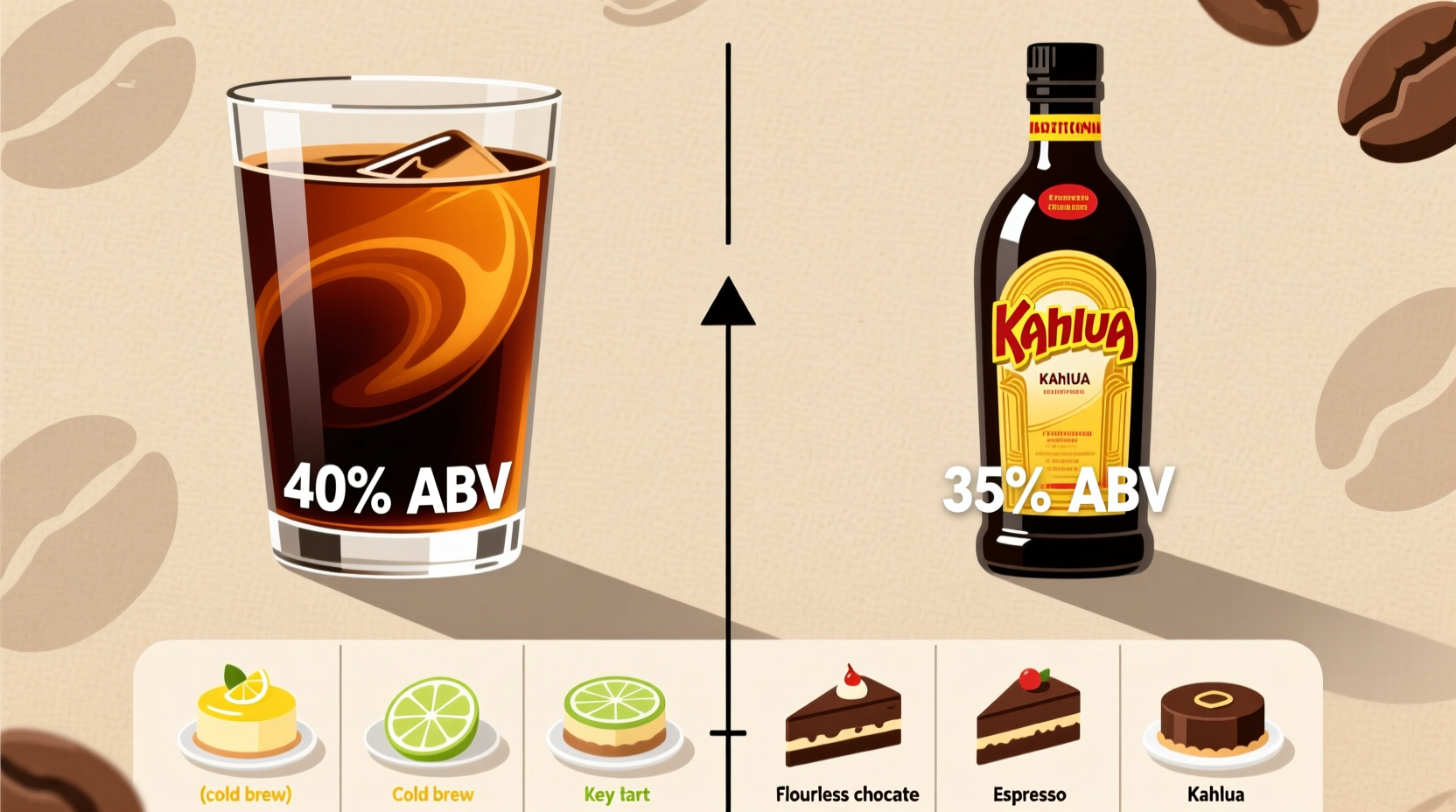
Traditional Kahlúa sits at 20% ABV (40 proof), a figure unchanged since its 1936 Mexican inception. Its formulation relies on rum as a base, blended with arabica coffee extract, sugar, vanilla, and caramel. That 20% serves a precise functional role: high enough to preserve and carry flavor, low enough to remain viscous, sweet-forward, and non-intimidating when poured neat or stirred into milk-based desserts like tiramisu or affogato.
Cold brew coffee liqueurs — brands like Cuvee Coffee Liqueur (32% ABV), Maud’s Cold Brew Liqueur (35% ABV), or house-made versions from specialty roasters — operate in a different chemical regime. Their higher alcohol percentage stems from two deliberate choices: first, using neutral grain spirits or aged rums as a more efficient solvent for cold brew’s delicate acids and volatile oils; second, reducing added sugar to avoid cloying heaviness at elevated strength. The result? A leaner, drier, more aromatic profile where bitterness is clarified rather than masked, and roast notes (think dark chocolate, walnut skin, cedar) emerge with startling precision.
This isn’t incremental change. A jump from 20% to 35% ABV represents a 75% increase in pure ethanol by volume — enough to significantly alter solubility dynamics. Ethanol dissolves hydrophobic compounds (like coffee’s chlorogenic acid derivatives and certain Maillard reaction products) far more effectively than water or low-proof spirits. That means cold brew liqueurs extract and retain more of the bean’s intrinsic structure — including tannic grip and bright acidity — which directly impacts how they behave on the palate alongside desserts.
How Alcohol Strength Reshapes Dessert Pairing Logic
Pairing coffee liqueur with dessert isn’t about matching flavors; it’s about managing contrast and complement across five sensory axes: sweetness, acidity, bitterness, fat, and texture. Alcohol content modulates all five.
Tip: When substituting cold brew liqueur for Kahlúa in a dessert recipe, reduce added sugar by 15–20% and add a pinch of flaky sea salt to rebalance perceived bitterness and enhance complexity.Consider sweetness first. Kahlúa’s 20% ABV allows for ~38g of sugar per 100ml — nearly half its volume. That sugar isn’t just sweet; it coats the tongue, muting acidity and softening bitterness. A 35% cold brew liqueur typically contains 18–22g sugar per 100ml. Less sugar means less masking power. Paired with a rich chocolate torte, Kahlúa adds a velvety, caramel-kissed finish. The same torte with cold brew liqueur delivers a sharper, more angular interaction: the liqueur’s clean bitterness cuts through fat, while its higher alcohol lifts volatile cocoa aromas — but only if the dessert isn’t already oversweetened. An overly sugary crème brûlée will taste thin and disjointed with cold brew liqueur, whereas Kahlúa would melt seamlessly into its custard.
Acidity follows closely. Cold brew’s lower pH (typically 4.8–5.1 vs. Kahlúa’s ~5.4–5.6) combined with higher ethanol creates a brighter, more wine-like presence. In a lemon tart, Kahlúa would dull the citrus and add uninvited heaviness. Cold brew liqueur, however, mirrors the tart’s acidity, creating a layered resonance — think espresso-toned lemon curd with a clean, lifted finish. Fat interaction differs too: ethanol is a natural emulsifier. At 35% ABV, cold brew liqueur integrates more readily into whipped cream or ganache without “breaking” the emulsion, whereas Kahlúa’s lower alcohol and higher sugar can cause slight weeping or textural separation over time.
Practical Pairing Framework: Matching Liqueur Strength to Dessert Structure
Forget rigid rules. Instead, use this evidence-based framework grounded in sensory science and professional pastry practice:
- Assess dessert sweetness level: Low-sugar (e.g., olive oil cake, panna cotta with grapefruit gelée) → favors cold brew liqueur. High-sugar (e.g., sticky toffee pudding, bourbon pecan pie) → favors Kahlúa.
- Evaluate dominant fat source: Dairy-heavy (custards, cheesecakes) → Kahlúa’s viscosity stabilizes texture. Cocoa butter–dominant (dark chocolate mousse, flourless cake) → cold brew’s alcohol enhances cocoa’s aromatic lift.
- Identify acidity profile: Bright fruit (raspberry, yuzu, passionfruit) → cold brew liqueur’s acidity harmonizes. Caramelized or roasted notes (toasted almond, dulce de leche, maple) → Kahlúa’s depth complements.
- Consider serving temperature: Warm desserts (bread pudding, baked apples) magnify alcohol heat. Kahlúa’s lower ABV integrates smoothly. Chilled desserts (ice cream, semifreddo) suppress alcohol perception, making cold brew liqueur’s complexity shine without burn.
- Factor in preparation method: If liqueur is reduced into a glaze or sauce, Kahlúa’s sugar caramelizes predictably. Cold brew liqueur’s lower sugar requires careful reduction to avoid bitter concentration — better used in uncooked applications like infusions or finishing drizzles.
Real-World Application: A Pastry Chef’s Menu Shift
At Juniper & Grain in Portland, pastry chef Lena Torres redesigned her winter dessert menu after switching from Kahlúa to a house-made 33% ABV cold brew liqueur infused with Guatemalan Huehuetenango beans. Her signature “Mocha Affogato” — traditionally espresso poured over vanilla gelato with a 15ml Kahlúa float — began tasting unbalanced: the liqueur’s sweetness overwhelmed the gelato’s subtle dairy notes, and its low alcohol failed to lift the espresso’s roasted weight.
Torres recalibrated: she reduced the liqueur portion to 10ml, swapped in a less sweet Madagascar vanilla gelato, and added a microplane of dark chocolate (72%) directly onto the affogato. The result was transformative. The cold brew liqueur’s higher ABV volatilized the chocolate’s esters, releasing fruity top notes. Its lower sugar allowed the gelato’s lactic tang to register clearly. And the clean bitterness cut the fat without competing with the espresso — instead, it extended its finish. Customer feedback noted “more dimension,” “less cloying,” and “a finish that lingers like good wine.” Crucially, she didn’t change the core ingredients — only the liqueur’s strength and how she deployed it.
Comparative Analysis: Key Differences at a Glance
| Attribute | Traditional Kahlúa (20% ABV) | Cold Brew Coffee Liqueur (30–35% ABV) |
|---|---|---|
| Sugar Content | ~38g per 100ml | 18–22g per 100ml |
| Primary Solvent | Rum (lower proof) | Neutral grain spirit or aged rum (higher proof) |
| Perceived Bitterness | Soft, rounded, caramel-moderated | Clear, structured, bean-driven (chocolate, walnut, citrus pith) |
| Best Dessert Matches | High-sugar, dairy-rich, caramelized desserts (tiramisu, bread pudding, crème brûlée) | Low-sugar, cocoa-dominant, acidic, or texturally light desserts (dark chocolate mousse, olive oil cake, lemon tart, affogato) |
| Cocktail Role | Base sweetener & body builder (e.g., White Russian) | Aromatic accent & structural modifier (e.g., stirred Manhattan variation, spritz) |
Expert Insight: The Chemistry Behind the Shift
“The leap from 20% to 35% ABV changes coffee liqueur from a ‘flavor delivery vehicle’ to an ‘aromatic catalyst.’ Higher ethanol extracts and preserves volatile phenols — like guaiacol and furfural — that define origin character. But it also increases the perception of astringency when paired with residual sugar. That’s why cold brew liqueurs demand intentional dessert design, not substitution. You’re not swapping one coffee spirit for another — you’re changing the entire flavor architecture.” — Dr. Aris Thorne, Food Scientist & Fermentation Specialist, Cornell University Department of Food Science
Essential Checklist for Confident Pairing
- ✅ Test sweetness balance first: Mix 1 tsp liqueur into 1 tbsp of your dessert’s base (e.g., custard, ganache, cake crumb) before scaling up.
- ✅ Chill cold brew liqueur before use: Serving at 8–10°C suppresses alcohol heat and sharpens aromatic clarity.
- ✅ Reduce Kahlúa slowly over low heat if concentrating flavor; cold brew liqueur should never be boiled — volatile aromatics evaporate above 65°C.
- ✅ When layering in cocktails with dessert, match ABV tiers: Cold brew liqueur pairs best with 40%+ base spirits (rye, reposado tequila); Kahlúa shines with lower-ABV modifiers (vermouth, amaro).
- ✅ Always taste the liqueur neat at room temperature first: Note its bitterness threshold and acidity level — this predicts dessert compatibility more reliably than label claims.
Frequently Asked Questions
Can I use cold brew coffee liqueur in tiramisu?
Yes — but with critical adjustments. Traditional tiramisu relies on Kahlúa’s sugar and viscosity to stabilize the mascarpone and moisten the ladyfingers. Replace Kahlúa with cold brew liqueur at a 2:3 ratio (e.g., 30ml cold brew for every 45ml Kahlúa), add 1 tsp extra powdered sugar to the mascarpone, and dip ladyfingers for only 1 second in espresso — the higher alcohol will penetrate faster and risk sogginess. The result is a lighter, more caffeinated, and distinctly origin-expressive tiramisu.
Does higher alcohol mean more caffeine?
No. Caffeine solubility in ethanol is low. Cold brew liqueurs derive caffeine from the coffee infusion stage, not the spirit. Most contain 25–40mg caffeine per 30ml serving — comparable to Kahlúa (30–35mg). The perceived “energy” comes from heightened aromatic stimulation and reduced sugar-induced drowsiness, not increased caffeine.
Will cold brew liqueur curdle dairy in sauces?
Unlikely — and less likely than Kahlúa. Curdling is triggered by acidity + heat + protein denaturation. Cold brew liqueur’s pH is only marginally lower than Kahlúa’s, and its lower sugar content reduces the risk of caramelization-induced instability. For maximum safety, warm dairy components gently (below 70°C) and stir liqueur in off-heat.
Conclusion: Elevating Your Palate Through Precision
The choice between cold brew coffee liqueur and traditional Kahlúa isn’t about superiority — it’s about intentionality. One offers comfort, consistency, and culinary familiarity; the other offers revelation, nuance, and a direct line to coffee’s terroir. Recognizing how alcohol content shifts the physics of flavor release, fat interaction, and sugar perception transforms dessert pairing from guesswork into gastronomy. Whether you’re plating a composed chocolate dessert for guests or stirring a weekend affogato, the right liqueur — matched to its structural role, not just its coffee label — deepens the experience, honors the ingredient, and rewards attention.
💬 Have you discovered an unexpected dessert pairing with cold brew liqueur? Share your breakthrough combination — and the ABV you used — in the comments. Let’s build a living reference guide for the next generation of coffee-conscious cooks.