Neat drinking—spirit served undiluted, unchilled, and without mixers—is often seen as the purest expression of a distiller’s craft. Yet not all spirits respond equally well to this approach. Cask strength whiskies, rums, and brandies (often 55–68% ABV) demand different engagement than standard bottlings (40–46% ABV). The choice isn’t about superiority—it’s about alignment: between alcohol strength, sensory capacity, setting, and intention. Understanding *why* and *when* to drink cask strength neat versus opting for dilution—or choosing a lower-strength expression altogether—separates casual tasting from considered appreciation.
What “Cask Strength” Really Means—and Why It’s Not Just About Heat
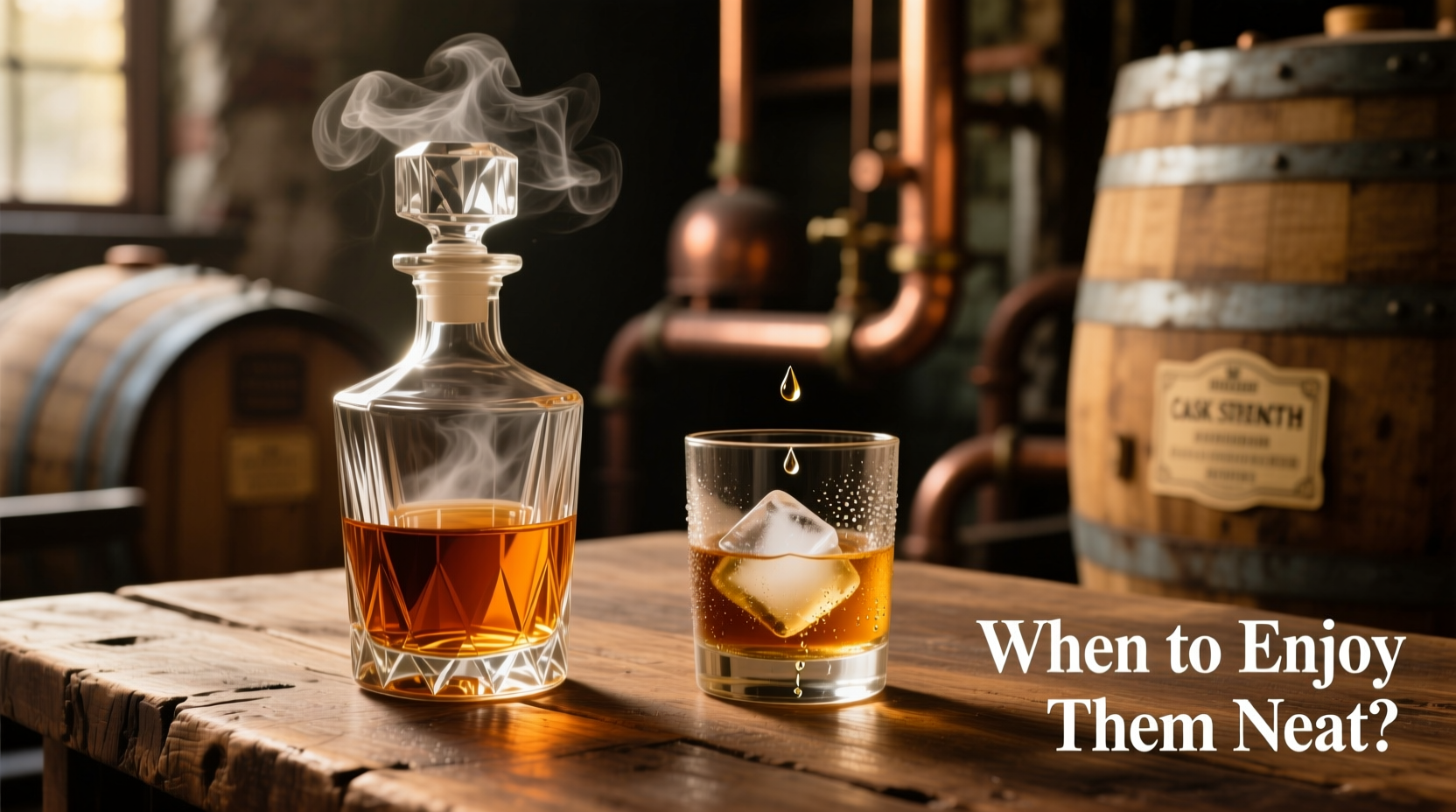
“Cask strength” (also called “barrel proof”) indicates a spirit bottled directly from the cask with no added water to reduce alcohol content. It reflects the exact ABV at which the liquid matured—subject to natural evaporation (“the angel’s share”) and warehouse conditions. A cask laid down at 63% ABV may yield a bottling at 57.2%, not because it was diluted, but because humidity, temperature, and wood interaction altered its concentration over time.
This matters because ethanol isn’t just a carrier—it’s an active participant in aroma release and mouthfeel. At higher concentrations, volatile esters and phenols are more readily volatilized, amplifying top notes like citrus zest, solvent, or medicinal lift. But simultaneously, excessive ABV can suppress mid-palate sweetness and mute oak-derived vanillin or spice. That’s why many cask strength releases benefit from a few drops of still spring water: not to “tame” the spirit, but to re-balance molecular volatility and allow layered complexity to emerge.
“Cask strength isn’t a challenge to endure—it’s an invitation to observe how water changes the conversation between spirit and palate. I’ve watched the same 62.4% Highland single malt reveal three distinct aromatic profiles across five minutes and six drops of water.” — Dr. Amina Rao, Master Blender & Sensory Scientist, Speyside Institute of Distillation Studies
The Palate Threshold: When Neat Cask Strength Works—and When It Doesn’t
There is no universal ABV threshold for “neat readiness.” A seasoned taster accustomed to high-proof rye or Jamaican pot still rum may find 60% ABV accessible and expressive. A newcomer—or even an experienced drinker after a heavy meal or late in the evening—may experience immediate nasal burn and suppressed flavor perception at just 52%.
Three physiological factors govern neat cask strength suitability:
- Salivary flow and mucosal sensitivity: Dry mouth or recent caffeine/alcohol intake heightens ethanol sting and reduces ability to detect subtle esters.
- Olfactory acuity: Fatigue, allergies, or ambient odors (perfume, cooking smoke) impair the nose’s ability to parse complex aromas masked by alcohol vapour.
- Thermal state: A chilled palate (from cold food or air conditioning) contracts taste receptors, making high-ABV spirits feel harsher and less integrated.
A Practical Comparison: Cask Strength vs. Diluted Bottlings
Below is a side-by-side assessment of key decision points when choosing whether to enjoy a spirit neat at cask strength—or reach for a standard or lightly reduced bottling instead. This table reflects real-world tasting conditions, not theoretical ideals.
| Factor | Cask Strength (58–65% ABV) | Diluted/Standard Bottling (40–46% ABV) |
|---|---|---|
| Best served | Room temperature, in a tulip-shaped nosing glass (e.g., Glencairn), with still spring water within reach | Room temperature or slightly cool (14–16°C), in a shorter tumbler or copita for relaxed sipping |
| Ideal context | Quiet, focused tasting; early evening; before dinner; post-work reflection | Social settings; after-dinner digestif; outdoor gatherings; casual weekday unwind |
| Palate fatigue risk | High after 2–3 servings; cumulative ethanol exposure dulls sensitivity rapidly | Low to moderate; allows for longer, more conversational engagement |
| Flavor accessibility | Demands attention—top notes jump forward; oak and grain structure may recede initially | More immediately balanced—sweetness, spice, and texture present from first sip |
| Water dependency | Not optional for most palates; 1–3 drops per 25 ml unlocks hidden layers | Rarely needed; water may flatten rather than elevate |
Real-World Scenario: How One Collector Adjusted His Approach
Mark D., a 42-year-old architecture professor and 15-year whisky enthusiast, built his collection around cask strength expressions—drawn to their intensity and perceived authenticity. For years, he drank everything neat, believing dilution betrayed the distiller’s intent. At a private tasting in Edinburgh, he sampled a 63.8% Islay single malt alongside a 46% sibling from the same distillery, same vintage, different cask type. He found the cask strength version overwhelming: medicinal smoke and brine dominated, while the 46% bottling revealed lemon curd, dried apricot, and maritime salinity he’d never noticed before.
He began experimenting—not with blind preference, but with intention. He kept tasting notes tracking ABV, water volume, and time elapsed before key flavors emerged. Within two months, he discovered his personal “sweet spot”: 57–59% ABV spirits required 2–4 drops of water and 90 seconds of air contact to express fruit and oak; anything above 61% needed at least 6 drops and 3 minutes to settle. He also realized he rarely enjoyed cask strength after 8 p.m.—his palate simply lacked resilience then. Today, Mark rotates based on context: cask strength for Sunday morning contemplation with black coffee; standard bottlings for weeknight wind-downs or hosting friends. His cellar now includes both formats—not as compromises, but as complementary tools.
When to Choose Neat Cask Strength: A Step-by-Step Decision Framework
Deciding whether to pour cask strength neat isn’t instinctive—it’s contextual reasoning. Follow this sequence before uncorking:
- Assess your current state: Are you rested? Hydrated? Free from congestion or strong residual tastes (garlic, mint toothpaste)? If not, defer.
- Check the ABV and age: Spirits under 4 years old at cask strength often lack structural maturity—heat may mask undeveloped character. Older casks (12+ years) tend to integrate higher ABV more gracefully.
- Evaluate the profile: Peated, smoky, or heavily sherried casks often benefit from slight dilution to temper phenolic or oxidative intensity. Lighter, floral, or bourbon-casked spirits may shine neat at 55–57%.
- Prepare your vessel and water: Use a clean, dry nosing glass. Have non-carbonated, low-mineral water ready—not tap water with chlorine or high sodium.
- Start minimal, then iterate: Pour 25 ml. Inhale gently. Sip. Hold. Wait 20 seconds. If alcohol dominates, add 1 drop of water. Swirl. Wait 45 seconds. Repeat only if needed—never exceed 5 drops for 25 ml unless the spirit is exceptionally robust (e.g., over 64%).
FAQ: Clarifying Common Misconceptions
Does adding water “ruin” a cask strength spirit?
No—water doesn’t degrade quality. Ethanol and water form hydrogen bonds that shift the equilibrium of volatile compounds. A few drops reduce surface tension, allowing esters and aldehydes previously bound in ethanol clusters to volatilize. This is chemistry, not compromise. As master distiller Jim McEwan observed, “Water doesn’t take away flavor—it gives flavor permission to speak.”
Is 40% ABV the legal minimum for Scotch? Does that make it “inferior”?
Yes, Scotch must be bottled at ≥40% ABV—but this is a regulatory floor, not a quality ceiling. Many exceptional drams are released at 43% or 46% to emphasize balance over power. A 40% bottling from a first-fill sherry cask may deliver richer dried-fruit depth than a 60% ex-bourbon release lacking oak integration. Strength ≠ sophistication.
Can I enjoy cask strength neat if I usually drink cocktails?
You absolutely can—but adjust expectations. Cocktail drinkers train their palates to perceive balance *within mixtures*, where sugar, acid, and dilution modulate spirit character. Neat cask strength requires shifting from “harmony through contrast” to “harmony within concentration.” Start with lower cask strengths (54–56%) and build gradually. Keep a small misting bottle of water handy—it’s your palate’s reset button.
Conclusion: Drink With Intention, Not Habit
Cask strength and diluted spirits aren’t rivals—they’re different languages of the same craft. One speaks in bold, declarative strokes; the other in measured, resonant phrases. Choosing to drink either neat isn’t about proving endurance or pursuing purity—it’s about honoring what the spirit offers *right now*, and meeting it with presence. Whether you’re savoring a 62% Jamaican rum that unfurls clove and overripe banana only after three precise drops of water, or letting a 43% Speyside glide across your tongue with quiet, honeyed grace, the act becomes ritual: deliberate, attentive, human.
So next time you reach for the decanter, pause—not to judge strength, but to ask: What do I need tonight? Clarity or comfort? Discovery or familiarity? Challenge or ease? Your answer will guide the pour far more reliably than any label’s ABV.
💬 Your turn: Share your most revealing cask strength moment—the time water transformed a spirit, or when a “standard” bottling surprised you with depth. Real stories help others taste with confidence. Leave a comment below.